

What to Wear for a Plus-Size Figure in 2027
 Curated byKory White · Fractional CRO · Maryland
Quality
Certified

Choose structured pieces that skim rather than cling: high-rise straight or wide-leg trousers, a shoulder-fitted blazer, and V-neck or wrap tops in cotton twill, linen blends, or matte jersey. Build a monochromatic base in deep neutrals, define the natural waist with a belt, and prioritize brands with true extended sizing.
The fitting-room scenario that exposes the real problem
Picture a standard Saturday. Someone wearing a size 20 walks into a department store with a specific goal: one blazer, one pair of trousers, one top that can carry a Monday meeting and a Friday dinner. Two hours later they leave with nothing. This is not a failure of taste or effort — it is a failure of grading, and understanding it changes how you shop.
Here is what actually happened in that fitting room. The blazer buttoned across the bust but the shoulder seam sat two inches down the upper arm, because the pattern was graded outward from a size 8 block without re-drafting the shoulder. The trousers fit the hip but gapped four inches at the back waist, because the grade added width uniformly instead of accounting for the waist-to-hip ratio change that happens across the size range. The top fit everywhere but the sleeve, which was cut to a straight-size bicep circumference. Three garments, three different grading failures, zero purchases.
Grading is the technical process of scaling a base pattern up or down. Most straight-size brands draft a fit sample at a size 6 or 8, then apply a fixed proportional grade — add a set number of inches per size across every measurement. That math holds for two or three sizes in either direction. Past that, it breaks. Bodies do not scale as uniform balloons. Bust-to-waist differential widens, back width increases faster than shoulder width, the front rise needs more length while the back rise needs comparatively less, and the bicep grows at a different rate than the forearm. A brand that grades a straight block up to a 3X produces a garment that fits nobody in particular.
Brands that draft on a dedicated plus block — a fit model in the middle of the extended range, usually around a 16 or 18, with the pattern re-drafted rather than scaled — solve this. That is the single most useful screening question you can carry into any shopping trip: does this brand draft for this body, or scale to it? The answer determines whether the shoulder seam lands correctly, whether the armhole is deep enough to raise your arm, and whether the waistband follows your actual waist curve.
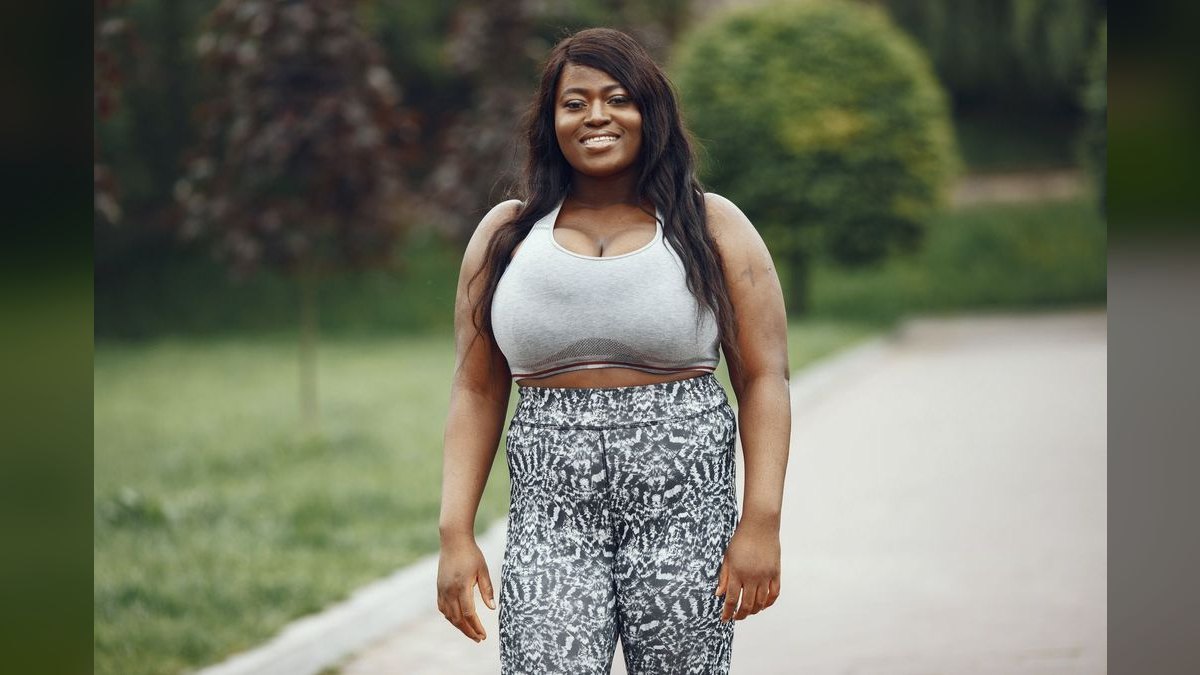
The practical upshot for the fitting room: stop evaluating garments on whether they close. Closure is table stakes. Evaluate on four fixed points that tailoring cannot easily fix — shoulder seam placement, armhole depth, rise length, and waistband curve. Everything else is adjustable. A blazer with a correct shoulder and a too-large waist is a $30 alteration. A blazer with a dropped shoulder is a donation. Reorganizing your judgment around what a tailor can and cannot change is the highest-leverage shift in the entire process, and it converts a two-hour failed trip into a twenty-minute triage.
Carry a soft tape measure. Know three numbers cold: your shoulder point to shoulder point across the back, your natural waist circumference, and your inseam. With those three, you can reject two-thirds of a rack from the hanger and spend your fitting-room time on the garments that have a real chance.
How fit, fabric, and line actually work together
The mechanics behind a good plus-size outfit are not mysterious. Three systems interact: the structure of the garment, the behavior of the fabric, and the visual line the combination creates. Get all three aligned and the outfit reads as intentional. Get one wrong and the other two cannot compensate.
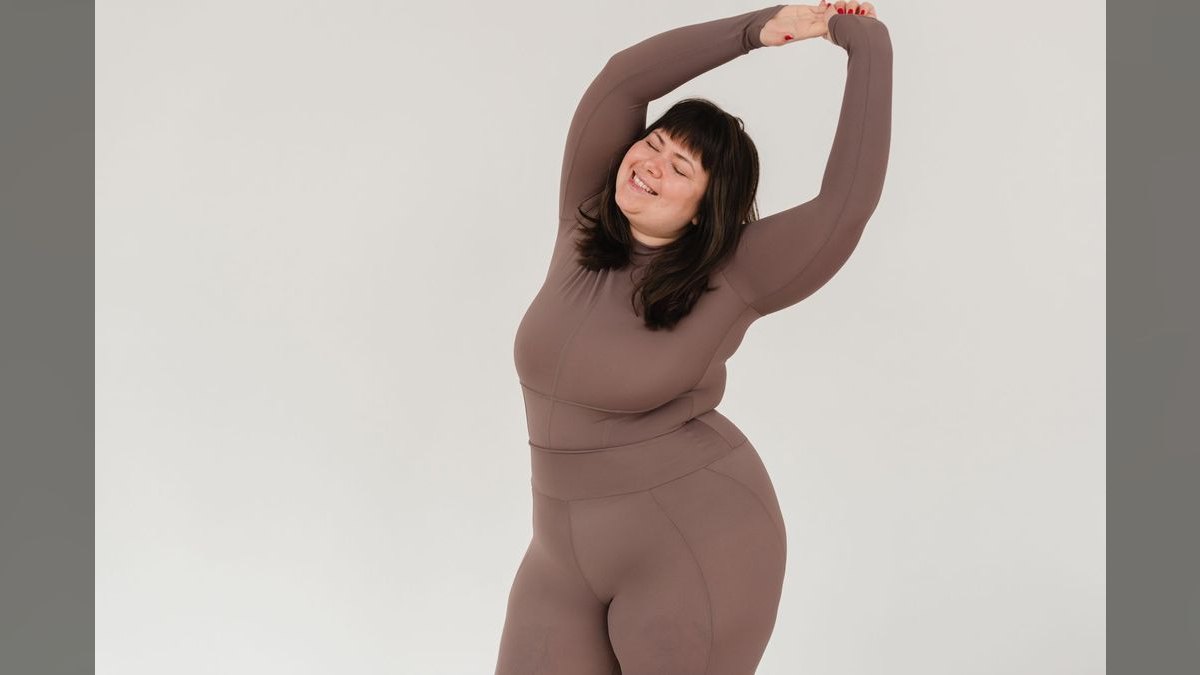
Structure comes from where the garment touches the body and where it releases. A well-made blazer touches at the shoulder and releases everywhere below — that single anchor point does the entire job. A wrap dress touches at the waist tie and releases above and below. A high-rise trouser touches at the natural waist and releases through the leg. The rule is one anchor point per garment, positioned at the narrowest available point, with clean release from there. Garments that touch in multiple places — a top that grips the bust and the waist and the hip — have no release, and they map every contour instead of describing a shape.
Fabric behavior determines whether that release actually happens. A fabric needs enough weight to fall away from the body and enough surface texture to avoid static cling. Cotton twill at roughly 7 to 10 ounces per square yard drapes with body. Linen and linen blends have stiffness that holds volume away from the frame. Matte jersey — the key word being matte — has weight and a light-absorbing surface that skims. Ponte knit, a double-knit with recovery, holds a shape through a full day without bagging at the knee or seat. Against these, thin polyester jersey and cheap rayon fail the same way: too light to hang, too slick not to cling, and often shiny enough to catch light exactly where you do not want a highlight.
Line is the third system and the one most people over-think. A continuous vertical column reads longer than a horizontally interrupted one. That is the entire principle. Matching your trouser to your top in tone creates an unbroken column from shoulder to hem; a contrasting belt or a bright top cuts that column at the waist and creates two shorter blocks. Neither is wrong — the monochrome column reads taller and more formal, and the interrupted line reads more casual and emphasizes waist definition. You are choosing between two effects, not between right and wrong.
The interaction between the three systems explains why certain combinations work reliably. A structured blazer over matte jersey works because the blazer supplies structure the jersey lacks while the jersey supplies drape the blazer lacks. A wide-leg trouser with a fitted knit top works because the volume of the leg is balanced by the definition above it. Two structured pieces together read stiff; two drapey pieces together read shapeless. The reliable formula is one structured piece plus one fluid piece, with the structure positioned wherever you want the eye to rest.
Real numbers: sizing, budgets, and what alterations cost
Concrete figures make the abstract advice actionable. Start with sizing conventions, which vary enough between brands to be genuinely confusing.
US plus sizing runs on two overlapping systems. The numeric system continues the straight-size run — 14, 16, 18, 20, 22, 24, 26, 28 — sometimes with a W suffix (18W, 20W) to signal a different block. The letter system runs 1X through 5X or 6X, where each letter typically covers two numeric sizes: 1X roughly maps to 14-16, 2X to 18-20, 3X to 22-24, 4X to 26-28. Brands are inconsistent about where their range starts and whether the W block differs from the plain numeric. A 20W and a 20 from the same brand are frequently different garments drafted on different blocks. Always read the size chart rather than trusting the number.
Menswear runs on measurement rather than abstract sizes, which is an advantage. Shirts are neck and sleeve (17 x 34/35), trousers are waist and inseam (40 x 30), and jackets are chest with a length letter — S for short, R for regular, L for long, XL for extra long. Big and tall lines split those two variables: "big" adds girth, "tall" adds length. Ordering a 2XLT when you need length and a 2XL when you need girth is the difference between a shirt that stays tucked and one that untucks every time you sit down. The tall variant typically adds around 1.5 to 2 inches of body length and roughly an inch of sleeve compared to the regular.
Budget ranges by tier, per piece, for the categories that matter most:
Trousers and jeans. Fast fashion and mass market run roughly $30 to $70. Mid-market specialists with dedicated plus blocks run $80 to $150. Contemporary and premium denim runs $150 to $250. The jump from the first tier to the second buys you drafted fit and fabric with recovery; the jump from second to third buys you fabric refinement and hardware, with diminishing returns on fit.
Blazers and outerwear. Mass market $70 to $130, mid-market $150 to $300, premium $350 and up. This is the category where spending more returns the most, because a blazer is almost entirely construction — canvas or fusing, shoulder shaping, armhole depth. A cheap blazer fails visibly in a way a cheap t-shirt does not.
Knits and tops. Mass market $20 to $50, mid-market $50 to $110, premium $120 and up. The relevant variable is fabric weight and fiber content. A midweight cotton or a merino at the mid-market tier will outlast three cheap polyester tops and hold its shape through repeated washing.
Footwear. Block-heel boots and pointed flats in the $90 to $200 mid-market range; note that wide-width availability matters more than brand prestige here, and many mainstream brands now carry W and WW widths in their core styles.
Alterations, which are the real multiplier on every dollar above:
Hemming trousers, $15 to $30. Hemming jeans with the original hem retained, $25 to $45. Taking in a waistband, $20 to $40. Shortening sleeves on a shirt, $15 to $25. Shortening sleeves on a lined jacket from the shoulder, $60 to $120. Taking in a jacket's side seams, $40 to $80. Adding a waist dart to a shirt or dress, $20 to $35. Prices vary by market — expect the upper end in major metros.
The arithmetic that matters: a $120 blazer with a correct shoulder plus $60 of side-seam and sleeve work lands at $180 and fits like something considerably more expensive. A $350 blazer with a dropped shoulder is unfixable at any price. Allocate roughly 15 to 25 percent of a garment's cost to alteration budget when buying structured pieces, and treat that as part of the purchase price rather than an afterthought.
A functional core wardrobe — two trousers, one pair of jeans, one blazer, four tops, one dress or one sport coat, two pairs of shoes — costs roughly $800 to $1,400 at mid-market with alterations included. That set covers work, casual, and most social occasions, and it is the base every other purchase should extend rather than duplicate.
Trade-offs: structure versus ease, and the alternatives worth weighing
Every choice in this space is a trade-off rather than an optimum, and knowing which axis you are trading along prevents second-guessing.
Structured versus relaxed. A tailored blazer and straight trousers create a defined, formal silhouette but constrain movement and require correct fit at multiple points. A relaxed knit and wide-leg pull-on trouser move freely and forgive fluctuation but read casual and risk shapelessness without a defined point somewhere. The reconciliation is the one-structured-one-fluid formula: pair the relaxed trouser with a fitted top, or the structured blazer with a soft knit underneath. You get definition and ease in the same outfit rather than choosing between them.
Monochrome versus color blocking. A tonal column reads taller and more polished, works in almost any setting, and simplifies getting dressed. It also risks reading severe and requires more attention to texture to stay interesting — a charcoal wool trouser with a charcoal cotton knit and a charcoal blazer works because three different surfaces catch light differently. Color blocking creates energy and waist definition but shortens the visual line and takes more effort to balance. A workable middle path: tonal from the waist down, color above, which preserves leg line while allowing personality where the eye naturally goes.
Off-the-rack plus lines versus made-to-measure. Off-the-rack with alterations is fast and cheap: buy today, wear next week, spend $150 to $250 all-in on a good blazer. Made-to-measure eliminates the shoulder problem entirely and typically runs $500 to $1,200 for a jacket with a four-to-eight-week turnaround. The break-even is not purely financial — it is about whether you have already tried and failed to find a shoulder that fits. If three or four off-the-rack attempts have failed at the shoulder, made-to-measure stops being an indulgence and becomes the cheaper path.
Natural fibers versus performance blends. Cotton, linen, and wool breathe, age well, and drape with weight, but they wrinkle, need more care, and cost more. Performance blends with elastane resist wrinkles, travel well, and cost less, but they can pill, hold odor, and often have the sheen that causes clinging. A pragmatic split: natural fibers for the pieces that carry the outfit's structure — blazer, trousers, coat — and blends where stretch genuinely helps, meaning jeans, knits, and anything worn under a jacket.
Investment versus rotation. Buying fewer, better pieces lowers cost per wear and simplifies decisions, but it is a poor fit if your size is actively changing. During a period of fluctuation, spend on pieces with built-in tolerance — pull-on ponte trousers, wrap dresses, knitwear, elastic-back waistbands — and defer the tailored investments until things settle. There is no virtue in owning a perfectly tailored blazer that stops fitting in four months.
Pitfalls that quietly ruin an otherwise good outfit
These are the errors that appear repeatedly, each with a specific correction.
Volume on volume. An oversized top with a wide-leg trouser removes every reference point and the whole outfit reads as fabric rather than a person in clothes. The fix is not to abandon volume — it is to keep exactly one volume piece per outfit. Wide leg with a fitted knit. Oversized sweater with a straight or slim trouser. If you want both, add a belt over the top layer to reintroduce a waist, which restores the reference point without sacrificing the drape.
Buying the number instead of the fit. Sizing is inconsistent enough between brands that the printed number carries almost no information. Someone can genuinely be a 16 in one brand and a 22 in another, and neither is wrong. Take the size that fits the largest measurement and alter down from there. Buying small to hit a target number produces pulling at the closure, horizontal stress lines, and a garment that draws attention to precisely the point of strain.
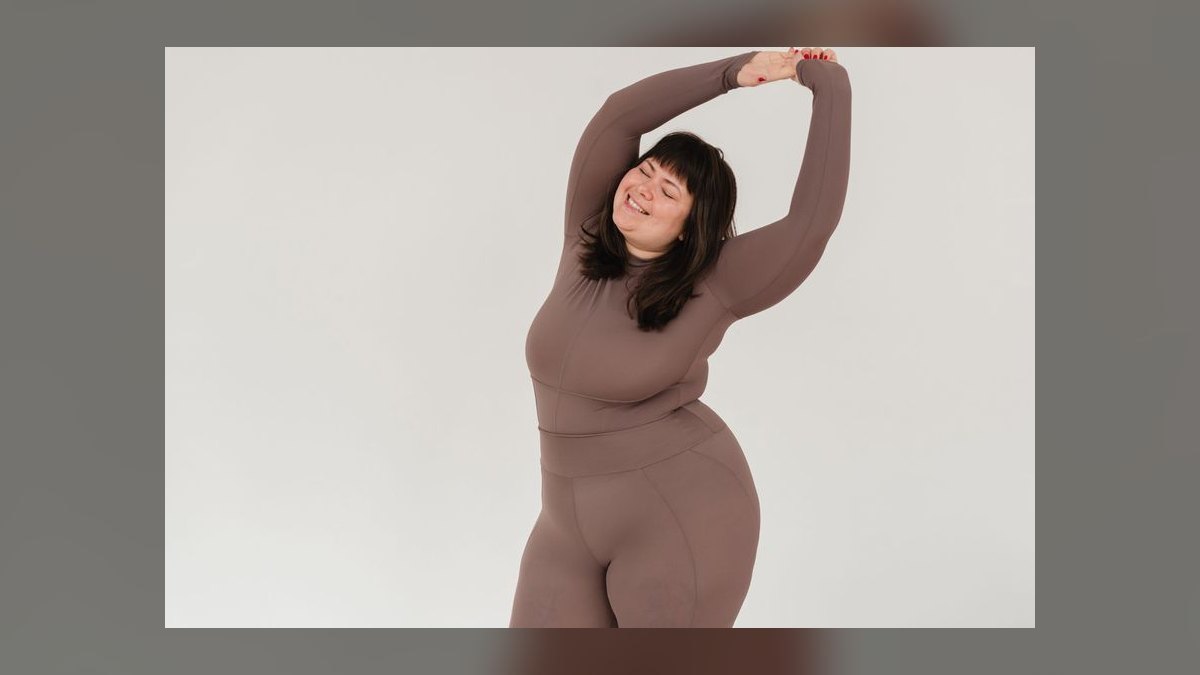
Ignoring shoulder fit on structured pieces. This is the pitfall with the worst cost-to-frequency ratio, because a dropped shoulder is expensive or impossible to correct and it visibly undermines everything else. Check it first, every time, on every jacket, blazer, and coat. The seam should sit at the bony point where your shoulder ends and your arm begins. Anything more than about half an inch off is a reject.
Underestimating length. Sleeves that end mid-forearm, hems that hit at an awkward mid-calf point, and shirts that untuck when you sit are all length failures masquerading as size failures. For men, the tall variants exist specifically to fix this and are underused. For everyone, hem length is the cheapest alteration on the menu — $15 to $30 — and it is the fastest way to make a mid-priced garment look considered.
Shiny and thin fabrics. Cheap polyester satin, thin rayon jersey, and anything with a high-sheen face catch light and map contour. If a fabric feels slick between your fingers or you can see your hand through a doubled layer, it will cling. Matte jersey, cotton twill, ponte, and linen blends are the reliable alternatives, and the difference in how the same silhouette reads is dramatic.
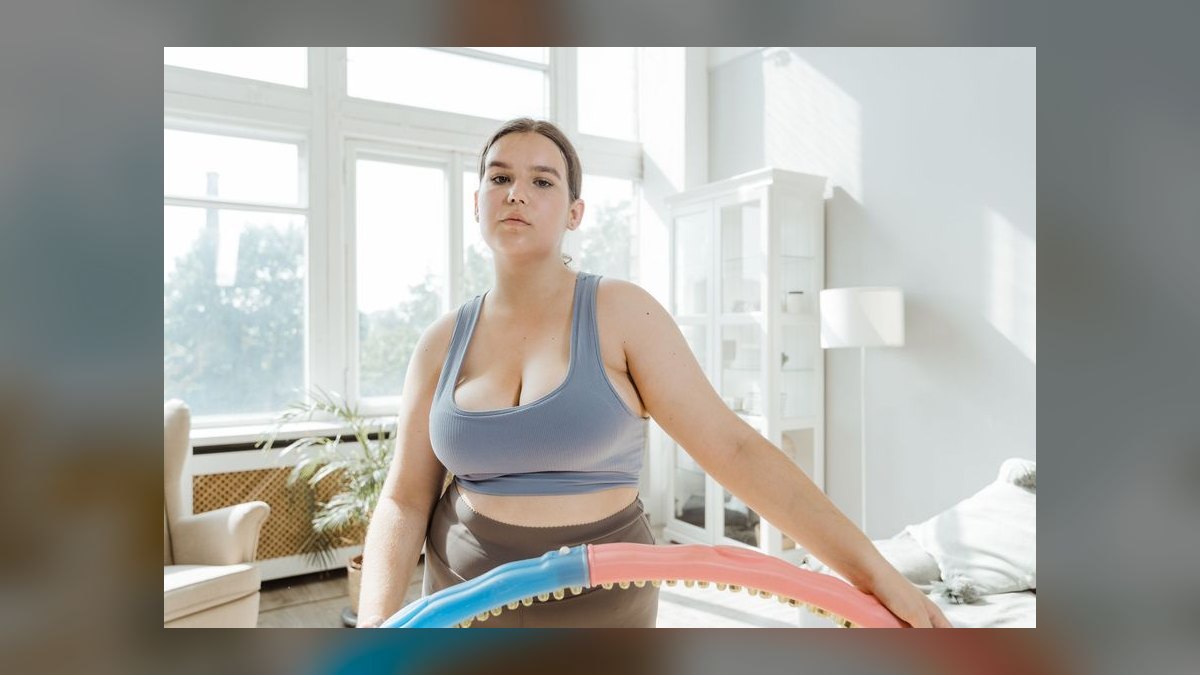
Neglecting foundation garments. A well-fitted bra changes bust position, which changes where the waist appears, which changes how every top hangs. Seamless or smooth underlayers prevent visible lines under knits. This is unglamorous and it does more for the finished look than most garment purchases.
Hiding rather than defining. The instinct to cover everything in loose fabric is understandable and it backfires. Loose fabric with no defined point makes the widest part of the drape read as the body's width. Defining a waist — with a belt, a wrap, a tailored seam, or a tucked hem — establishes where the body actually narrows and reads smaller than the tent version, not larger.
Treating accessories as afterthoughts. Bag size and strap placement matter more than at straight sizes. A crossbody strap worn at the widest point cuts a horizontal line exactly where you least want one; lengthening it so the bag sits at the hip or shortening it so it sits at the ribcage both read better. Scale matters too: a very small bag makes everything else read larger by comparison, and a mid-to-large structured bag reads proportionate.
Skipping the sit-and-move test. Every garment should be tested seated, with arms raised, and while walking. Trousers that fit standing can pull across the thigh seated; a jacket that looks fine still can bind across the back when you reach forward. Thirty seconds of movement in the fitting room prevents the majority of returns.
Related questions
How do I find a tailor who works confidently with extended sizes?
Ask two questions when you call: do they alter jackets from the shoulder, and can they add or move waist darts. Shoulder work is the marker of genuine skill. Bring one garment as a test before committing a whole wardrobe to a new alterations shop.
Are horizontal stripes actually off-limits?
No. A narrow horizontal stripe in a fitted knit reads as texture rather than a line. The problem is wide, high-contrast bands placed at the widest point. Placement and scale determine the effect far more than direction does.
What is the single highest-return purchase to make first?
Trousers that fit your waist and rise correctly, hemmed to your shoe. They anchor more outfits than any other item, and a correct rise fixes the fit of everything tucked into or layered over them.
Should I size up in everything by default?
No. Size up only where the largest measurement demands it, then alter the rest down. Blanket sizing-up produces dropped shoulders and dragging rises — two problems that no amount of extra room solves.
How do I keep a monochrome outfit from looking flat?
Vary surface texture across the three pieces: a matte knit, a woven twill, and a leather or suede accessory in the same tonal family. Light hits each differently, so the column stays unbroken while still having depth.
FAQ
What fabrics work best for a plus-size figure?
Fabrics with weight and a matte surface: cotton twill around 7 to 10 ounces, linen and linen blends, matte jersey, ponte knit, midweight merino, and crepe. They fall away from the body rather than gripping it. Avoid thin polyester jersey, high-sheen satin, and lightweight slick rayon, which cling and highlight contour.
How do I know if a brand's extended sizing is genuinely drafted rather than scaled?
Check whether the size chart shows the bust-to-waist and waist-to-hip differentials changing across the range. If every size adds the same increment everywhere, it is a scaled straight block. Brands that draft on a dedicated plus fit model usually say so, and their armhole and shoulder measurements shift non-uniformly.
Is monochrome dressing necessary, or just one option?
One option. A tonal column reads taller and simplifies dressing, but it is a technique rather than a requirement. Color blocking with a defined waist works equally well and reads more energetic. Choose based on the effect you want — height and formality, or definition and personality.
How should the Wear-and-move test work in a fitting room?
Sit fully, raise both arms overhead, cross your arms in front, and walk several steps. Watch for pulling across the thigh when seated, binding across the back when reaching, and a waistband that gaps or digs. Any of those means the fit is wrong regardless of how it looks standing still.
What is worth spending on versus saving on?
Spend on structured pieces where construction is the product — blazers, coats, trousers, and shoes. Save on knits, t-shirts, and trend items. A well-constructed blazer with correct shoulders returns more per dollar than any other category, and it carries the outfits around it.
Does dressing well for a Plus-Size Figure require a large wardrobe?
No. A tight core of two trousers, one pair of jeans, one blazer, four tops, one dress or sport coat, and two pairs of shoes covers most of life. Roughly $800 to $1,400 at mid-market including alterations. Depth in a small set beats breadth in a large one, and it removes decision fatigue — the same logic that makes any repeatable system, from a wardrobe to a revenue process, easier to run.
Sources
- https://www.vogue.com/fashion
- https://www.gq.com/style
- https://www.thecut.com/fashion
- https://www.si.edu/spotlight/fashion
- https://www.metmuseum.org/about-the-met/collection-areas/the-costume-institute
- https://www.bbc.com/culture/style
- https://www.nytimes.com/section/style
- https://www.harpersbazaar.com/fashion
- https://www.refinery29.com/en-us/fashion
- https://www.britannica.com/art/dress-clothing
Related on PULSE
- What to Wear to Brunch if You're Plus-Size in 2027
- What to Wear to a Gala if You're Plus-Size in 2027
- What to Wear to a Holiday Party if You're Plus-Size in 2027
- What to Wear to a Cocktail Party if You're Plus-Size in 2027
- What to Wear to a Graduation if You're Plus-Size in 2027
- What to Wear to a Funeral if You're Plus-Size in 2027
This page will be disappearing soon. Save it to your device for $1 — or read it free while it is here.
@Kory-White- · if Venmo asks, the last 4 of my number are 2012
This page is gone.
This one is off the shelf now. $1 keeps it on your phone for good — the whole page, pictures and diagrams included.
 pulse-styleHow to Wear Dusty Rose with a Bomber Jacket in 2027
 pulse-styleHow to Wear Olive Green in Summer in 2027
 pulse-styleHow to Wear Lavender in Summer in 2027
 pulse-styleWhat to Wear to an Award Ceremony at Work in 2027
 pulse-styleHow to Wear Terracotta with White Sneakers in 2027
 pulse-styleWhat to Wear to a Spring Lakeside Wedding in 2027
 pulse-styleWhat to Wear to a Video Government Job Interview in 2027
 pulse-styleWhat to Wear to a Bowling Night in 2027
 pulse-styleHow to Style Ankle Boots for a Job Interview in 2027
 pulse-styleWhat to Wear to a Cruise in 2027