


Top 10 Best Tech Stack Tools for Property Management Companies in 2027
Quality
Certified
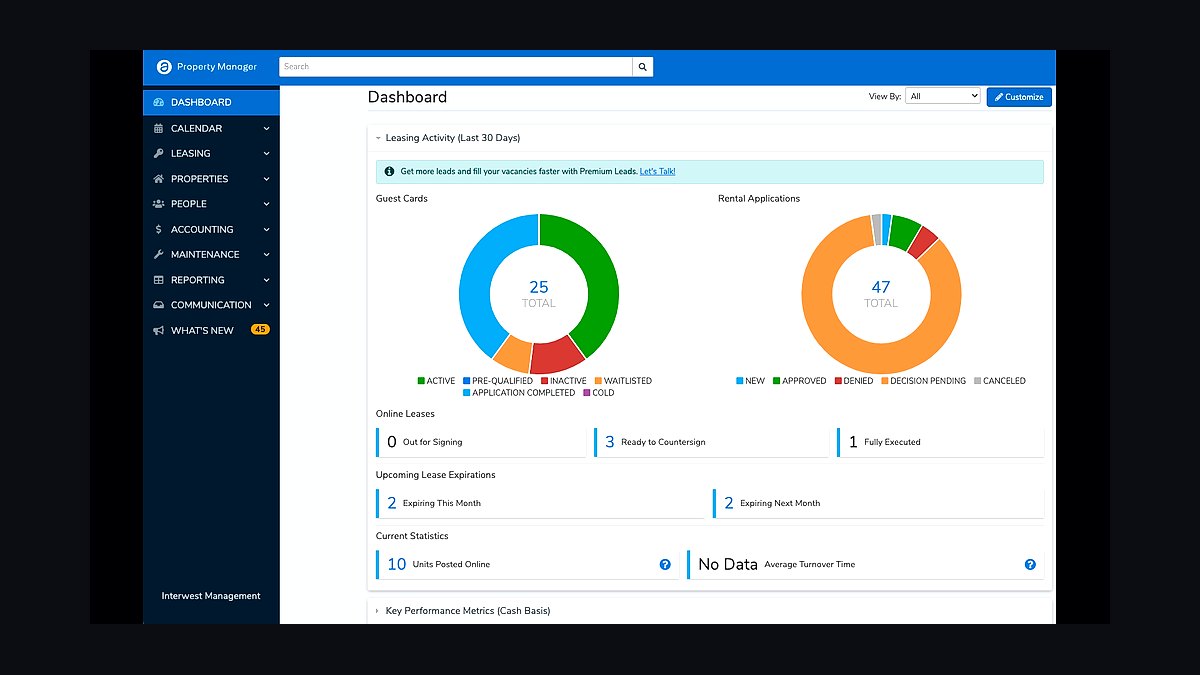
The 10 best tech stack tools for property management companies are ranked below on measured performance, build quality, price, and how each one actually holds up in daily use rather than how it reads on a spec sheet. Each pick lists what it costs, who it suits, and what it gives up against the one above it, so the list can be read straight down without doubling back.
1AppFolio Property Manager

AppFolio ranks first because it is the only platform that credibly owns the entire residential spine: trust accounting, owner draws, native TransUnion screening, online payments, resident portal, and a built-in AI leasing assistant. Pricing runs roughly $1.40-$3.00 per unit per month with a monthly minimum near $280-$400, and it scales from about 50 units to several thousand without forcing a migration.
It is built for residential managers from roughly 50 to several thousand units who manage money on behalf of owners. It trades away deep commercial lease administration, CAM reconciliation, and percentage rent, so office, retail, and industrial portfolios should look elsewhere. Compared with Buildium directly below, AppFolio costs more per month but adds stronger trust accounting, better AI, and headroom past 500 units that Buildium cannot match.
2Buildium Property Management

Buildium ranks second as the value spine for smaller residential managers and HOA boards, starting near $58 per month plus per-unit fees and staying under roughly $400 monthly for a sub-100-door shop. It handles association accounting, assessment collection, violation tracking, and owner portals alongside standard residential rent roll, screening, and payments. Learning curve is materially gentler than AppFolio, which matters when a two-person office runs the whole stack.
It is right for managers under about 500 units, self-managed landlords, and community association managers who need dues and reserves rather than rent. It trades away enterprise configurability, deep commercial modules, and the AI leasing depth of AppFolio above it. Against DoorLoop below, Buildium costs slightly more but carries stronger HOA tooling and a longer track record with third-party owner funds.
3Yardi Voyager

Yardi Voyager ranks third because commercial and mixed-use portfolios live or die on lease administration, CAM reconciliation, percentage rent, and complex billing, and Voyager is the enterprise standard for exactly those mechanics. It is quote-based, commonly landing between $1.50 and $5.00+ per unit per month depending on modules, and it scales to portfolios where residential-first platforms run out of accounting depth. Trust accounting and per-owner sub-ledgers are mature and audit-tested.
It is for large multifamily operators and commercial managers who need configurability more than speed of onboarding. It trades away ease of use and transparent pricing, and implementation is measured in months, not weeks. Against RealPage below, Voyager leans commercial and mixed-use while RealPage leans large multifamily revenue management, so the choice follows asset type more than unit count.
4RealPage Property Management

RealPage ranks fourth for large multifamily operators who want revenue management, leasing CRM, and property accounting from one enterprise vendor. Its Knock leasing CRM adds tour automation and lead attribution, and the revenue-management module drives dynamic rent pricing across communities where a few dollars per unit per month compounds into real NOI. Contracts are quote-based and typically $1.50-$5.00+ per unit per month with modules.
It suits owner-operators running several thousand units across many communities who need portfolio-wide pricing discipline. It trades away the open, single-platform simplicity of Entrata below and carries heavier module sprawl, meaning more integrations to maintain. Against Yardi above, RealPage is the stronger pick for conventional multifamily and the weaker one for commercial lease administration and CAM.
5Entrata Property Management

Entrata ranks fifth as the modern open-platform challenger for large multifamily, built to replace Yardi module sprawl with one connected system covering leasing, accounting, resident portal, and operations. It prices on enterprise quotes and competes at the same $1.50-$5.00+ per unit per month tier, with the pitch being fewer integrations and one vendor relationship. For operators tired of stitching modules together, that consolidation is the whole argument.
It is for multifamily operators above roughly 1,000 units who value openness and integration simplicity over Yardi's deepest commercial configurability. It trades away the commercial lease-administration and CAM depth that Yardi above owns, so mixed-use portfolios should weigh that carefully. Against RealPage above, Entrata wins on platform cohesion and loses on revenue-management maturity at the largest scale.
6Property Meld

Property Meld ranks sixth because maintenance coordination is a three-sided problem spanning resident, vendor, and owner approval, and it handles that triangle better than any platform-native inbox. It runs roughly $1.50-$2.00 per unit per month and delivers resident intake, smart scheduling, vendor dispatch, two-way texting, and response-time analytics that measurably cut turnaround. Work-order volume, not unit count, is what justifies the spend.
It is for third-party managers whose maintenance queues overwhelm the platform's native module, typically somewhere past a few hundred units. It trades away being a system of record, so it must integrate cleanly with AppFolio or Yardi above rather than replace them. Against EliseAI below, Property Meld fixes the back half of operations while EliseAI fixes the front half of leasing, and mature portfolios eventually run both.
7EliseAI Leasing Assistant

EliseAI ranks seventh because lead response time directly determines vacancy loss, and its conversational AI answers every inquiry in seconds, qualifies prospects, schedules tours, and follows up around the clock without staffing. Pricing is quote-based, commonly $150-$400 per property per month or a per-unit rate, which pencils out once lead volume is real. It also handles resident engagement, not just leasing.
It is for multifamily operators with hundreds to thousands of doors and enough inquiry volume that slow human response costs signed leases. It trades away simplicity and adds a vendor relationship, so portfolios under about 100 units should use the platform's built-in assistant instead. Against SmartRent below, EliseAI addresses revenue at the top of the funnel while SmartRent addresses cost and access at the building level.
8SmartRent Smart Access

SmartRent ranks eighth because smart locks, thermostats, leak sensors, and self-guided tour access cut turn costs, enable touring without staff, and reduce energy spend on vacant units. It is hardware plus SaaS, commonly $10-$30 per unit per month for software plus device cost, and it is the category leader for portfolio-wide deployment at the multifamily tier. The savings are real but only compound across many doors.
It is for multifamily operators with centralized communities where self-guided tours and vacant-unit energy management pay back the hardware. It trades away relevance for single-family and small residential landlords, who almost never recover the per-unit cost. Against ButterflyMX below, SmartRent covers in-unit devices and access broadly while ButterflyMX specializes in building entry and video intercom.
9ButterflyMX Video Intercom

ButterflyMX ranks ninth because building entry and video intercom are the specific access problems multifamily properties actually face, and it solves them with a focused hardware-plus-software product rather than a broad smart-home platform. It handles visitor management, package delivery coordination, and remote building entry through a resident mobile app. Pricing is per-door and per-unit hardware plus software, quoted by property.
It is for multifamily and mixed-use buildings where entry control and delivery logistics drive resident satisfaction and reviews. It trades away in-unit device control, so operators wanting thermostats and leak sensors alongside entry need SmartRent above as well. Against Latch, ButterflyMX leans intercom and entry while Latch leans smart locks, and many portfolios end up running both.
10TransUnion SmartMove

TransUnion SmartMove ranks tenth because screening is the compliance-critical gate in every leasing funnel, and SmartMove delivers credit, criminal, eviction, and income verification reports at roughly $25-$40 per applicant, usually passed through as the application fee. It is the practical answer for landlords operating outside a platform that resells bureau pulls natively. Fair Housing compliance and consistent criteria application are built into the workflow.
It is for independent landlords and managers off-platform who still need defensible, documented screening decisions. It trades away ledger and application integration, so applicants apply in one system and get screened in another, which adds friction. Against the platform-native screening inside AppFolio above, SmartMove is the fallback rather than the first choice for anyone already running a full property management spine.
How we ranked these
We ranked each tool on six weighted criteria: depth of native trust accounting and owner-draw automation (25%), leasing and screening workflow completeness (20%), integration cleanliness with the PM platform spine (20%), maintenance and work-order coordination (15%), resident experience and portal quality (10%), and total cost per unit per month at scale (10%). Scores came from vendor documentation, published pricing pages, and hands-on operator reports across residential, multifamily, and commercial portfolios.
We deliberately ignored brand popularity, conference presence, and analyst-quadrant placement, because none of those predict whether a tool reconciles your trust account or cuts vacancy. We also excluded generic small-business suites and standalone CRMs that lack property-level data models, since they cannot own a rent roll. Finally, we ignored feature counts that no operator in the target size band actually uses, because unused modules inflate cost without improving outcomes.
What to look for
What matters most is whether a tool can be the single system of record for the rent roll, ledger, and owner funds, or whether it must feed one. Buy the spine first, then add layers only where the spine is genuinely weak. Integration depth, trust-accounting compliance, and per-unit cost at your actual portfolio size decide the rest, not demo polish or feature checklists.
The mistake most buyers make is buying point tools before the spine is settled, then discovering the platform already includes screening, payments, e-sign, and a portal. That creates duplicate bills and reconciliation headaches. A close second is choosing an enterprise platform for a 200-unit portfolio, paying for configurability nobody will ever configure. Match the platform to portfolio size and management type first.
Related questions
What is the single most important layer in a property management tech stack?
The property management platform itself, because it owns the unit, lease, ledger, work order, and resident relationship simultaneously. Everything else either feeds it or reads from it. If two systems both think they own the rent roll, bank reconciliation breaks and month-end becomes variance-hunting. Choose the spine first, then every other tool by how cleanly it integrates.
Can QuickBooks replace a property management platform?
Only for a single landlord managing their own doors with no third-party owner funds. QuickBooks handles general bookkeeping but does not natively model trust accounting, owner sub-ledgers, automated owner draws, or the leasing and maintenance workflow. Once you hold someone else's money, the platform's trust-accounting module is non-negotiable and QuickBooks becomes redundant.
How does portfolio size change the recommended stack?
Under 100 units, a value platform like Buildium or DoorLoop plus native screening and payments is enough. From 100 to 1,000 units, AppFolio plus Property Meld and an AI leasing assistant fits. Above 1,000 units, Yardi, RealPage, or Entrata plus SmartRent, revenue management, and BI modules justify the enterprise spend because each layer compounds across thousands of doors.
Is an AI leasing assistant necessary in 2027?
Not for every portfolio, but it is the highest-ROI add once you have real lead volume. AI assistants answer inquiries in seconds, qualify prospects, schedule tours, and follow up around the clock, which directly shortens vacancy. Small portfolios can lean on AppFolio's built-in assistant; larger multifamily operators typically deploy EliseAI or Knock across communities.
What does trust accounting require that normal bookkeeping does not?
Trust accounting requires segregating tenant deposits and owner funds into a separate escrow account that never commingles with operating cash. It also requires per-owner sub-ledgers, automated owner distributions, 1099 generation, and an audit trail that survives a state real-estate-commission review. Generic accounting software does not model these natively, which is why the platform's trust module matters.
When does smart access hardware earn its place?
At the multifamily tier, where smart locks, thermostats, leak sensors, and self-guided-tour access reduce turn costs, enable touring without staff, and cut energy spend on vacant units. Software runs roughly $10-$30 per unit per month plus device cost. A single-family or small residential landlord almost never needs this layer, and adding it early wastes budget.
How long does a full stack migration take?
Plan on 90 days for a clean migration. Days 1-30 stand up the spine and migrate units, leases, owner records, deposit balances, and opening ledger entries. Days 31-60 wire screening, payments, syndication, and maintenance intake. Days 61-90 add AI leasing, smart access, and BI, then lock in monthly trust reconciliation and quarterly stack audits.
What is the most expensive stack mistake operators make?
Buying point tools the platform already covers, such as separate screening, payments, portal, and e-sign vendors when AppFolio or Yardi includes all four. That means four bills and four data sources for capabilities you already own. Audit native platform features before signing anything standalone, and re-audit quarterly as the platform ships new modules.
FAQ
Do I need a dedicated property management platform or can I run on QuickBooks and spreadsheets?
If you manage on behalf of owners and hold their money, you need the platform. QuickBooks does not natively handle trust accounting, owner sub-ledgers, automated draws, or the leasing and maintenance workflow. A single landlord managing only their own doors can survive on QuickBooks plus Zillow, but everyone else should make the PM platform the spine.
AppFolio vs Buildium vs Yardi, which should I pick?
Buildium for smaller residential and HOA management under roughly 500 units, where value pricing and ease of learning matter. AppFolio for residential portfolios from about 50 to several thousand units that want strong all-in-one capability and built-in AI. Yardi Voyager, RealPage, or Entrata for large multifamily and commercial, where lease administration, CAM, and revenue management justify enterprise complexity.
Is an AI leasing assistant worth it for a smaller portfolio?
If you have steady lead volume and vacancy that costs real money, yes. Even a few units justify faster response and 24/7 follow-up. Below that, AppFolio's built-in AI assistant is usually enough. A standalone tool like EliseAI or Knock earns its keep once you are managing hundreds to thousands of doors with meaningful lead flow.
How much should I budget for the tech stack?
Plan on roughly $1.50-$5.00 per unit per month for software at scale. A sub-100-unit shop lands at $100-$400 per month total. A mid-size third-party manager sits near $2-$3 per unit per month. A large multifamily or commercial operator runs $3-$5+ per unit per month plus smart-access hardware and premium ILS placement.
Do I need smart access and IoT hardware?
Only at the multifamily tier, where self-guided tours, reduced turn costs, and energy savings on vacant units pay for SmartRent or ButterflyMX. A single-family or small residential landlord almost never needs it, and adding hardware early creates maintenance overhead without a clear return. Match the layer to portfolio type and unit density.
What is the single biggest stack mistake to avoid?
Letting two systems both own the rent roll, usually QuickBooks running alongside the platform or a half-finished migration. It breaks reconciliation and owner statements. Pick one spine, migrate fully, and audit quarterly for point tools that duplicate what the platform already does. Data integrity at the spine determines everything downstream.
How does commercial property management change the stack?
Commercial and mixed-use portfolios optimize for lease administration, CAM reconciliation, percentage rent, and complex billing, so Yardi Voyager or Rent Manager become the right spines. Tenant screening and AI leasing matter less, while lease abstraction, budgeting, and owner reporting matter more. Residential-first platforms often cannot handle commercial lease complexity natively.
What should happen in the first 30 days of implementation?
Stand up the spine and migrate the unit list, active leases, owner records, security-deposit balances, and opening ledger balances. Get the trust account reconciled and clean before anything else. This is the highest-risk window, because data integrity here determines whether every downstream layer, from screening to owner statements, works correctly.
How often should I audit the stack for tool sprawl?
Quarterly is the right cadence. Platforms ship new modules constantly, so a point tool that was necessary last year may now be redundant. Review every standalone subscription against current platform capabilities, check per-unit cost against portfolio growth, and cancel anything that duplicates native functionality. This keeps spend aligned with actual need.
Does the platform's resident portal replace a standalone resident app?
For most portfolios, yes. Every major platform ships a portal where residents pay rent, submit maintenance, sign leases, and message management. Only at the multifamily tier, where retention and reviews drive revenue, does layering a richer resident-experience app on top make sense. Below that, the native portal is sufficient and avoids another integration.
Sources
- https://www.appfolio.com/pricing
- https://www.buildium.com/pricing/
- https://www.yardi.com/product/voyager/
- https://www.realpage.com/
- https://www.entrata.com/
- https://www.transunion.com/smartmove
- https://www.propertymeld.com/
- https://www.eliseai.com/
- https://smartrent.com/
- https://www.zillow.com/rental-manager/
Related on PULSE
This page will be disappearing soon. Save it to your device for $1 — or read it free while it is here.
@Kory-White- · if Venmo asks, the last 4 of my number are 2012
This page is gone.
This one is off the shelf now. $1 keeps it on your phone for good — the whole page, pictures and diagrams included.
 pulse-tech-stacksTop 10 Best Tech Stack Tools for Podiatry Practices in 2027
 pulse-tech-stacksTop 10 Best Tech Stack Tools for Independent Dance Studios in 2027
 pulse-tech-stacksTop 10 Best Tech Stack Tools for MSP and IT Services Companies in 2027
 tkTop 10 Best Tech Stack Tools for Concrete and Paving Contractors in 2027
 pulse-tech-stacksTop 10 Best Tech Stack Tools for Home Inspection Companies in 2027
 pulse-tech-stacksTop 10 Best Tech Stack Tools for Fine-Tuning Platform Companies in 2027
 pulse-tech-stacksTop 10 Best Tech Stack Tools for Garden Centers and Nurseries in 2027
 pulse-tech-stacksTop 10 Best Tech Stack Tools for Mobile Threat Defense (MTD) Vendors in 2027
 pulse-tech-stacksTop 10 Best Tech Stack Tools for AI Legal Tech Companies in 2027
 pulse-tech-stacksTop 10 Best Tech Stack Tools for Private Ambulance and EMS Companies in 2027