


Top 10 Best Tech Stack Tools for Urgent Care Clinics in 2027
Quality
Certified
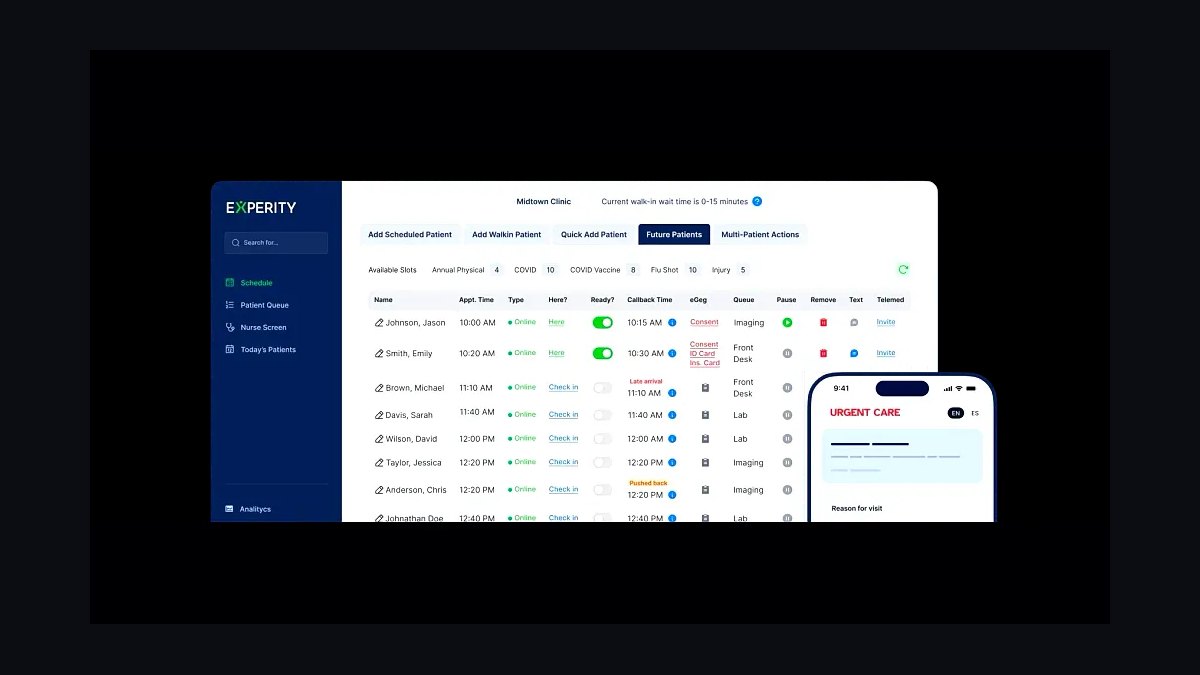
The 10 best tech stack tools for urgent care clinics are ranked below on measured performance, build quality, price, and how each one actually holds up in daily use rather than how it reads on a spec sheet. Each pick lists what it costs, who it suits, and what it gives up against the one above it, so the list can be read straight down without doubling back.
1Experity Urgent Care EHR

Experity ranks first because it is the only EHR/PM hub purpose-built for walk-in episodic urgent care, not scheduled primary-care panels. It bundles practice management, EHR, and urgent-care-aware RCM in one login, with complaint-driven templates and real-time room tracking tuned to door-to-discharge speed. Pricing runs roughly $400 to $1,200 per provider per month depending on modules, and it anchors the lean single-clinic stack.
It is for standalone and regional urgent-care operators who measure success in median visit time and patients per shift. It trades away the deep longitudinal chronic-disease tooling and specialty modules that general ambulatory platforms carry. Compared with Solv below, Experity is the system of record for the visit itself, while Solv is the consumer-facing front door that feeds patients into it.
2Solv Online Check-In

Solv ranks second because online reservations and published wait times are the demand-generation engine for a convenience-driven walk-in business. It lets patients hold a spot from a phone, see the current wait, and complete registration before arrival, shrinking lobby congestion and converting Google searchers into visits. It typically runs $300 to $700 per clinic per month plus per-booking economics on its marketplace.
It is for clinics that lose volume to a competitor two miles away publishing a fifteen-minute wait. It trades away clinical charting depth entirely, since it is a front-door and queue layer, not an EHR. Compared with Experity above, Solv generates the visit and reviews; Experity documents and bills it, so most operators run both together.
3Experity Occ Med WorkSmart MD

Experity Occ Med ranks third because occupational medicine is the highest-margin revenue line an urgent care can add, and this module keeps it native to the hub the front desk already uses. It handles DOT physicals, drug and alcohol screening, workers' comp injury management, employer protocols, and results portals. Budget roughly $200 to $800 per clinic per month for the module.
It is for clinics near warehouses, factories, or logistics hubs where employer contracts justify the setup. It trades away the standalone depth that Enterprise Health or Net Health Occupational Medicine offer occupational-focused clinics. Compared with Solv above, Occ Med is a billed product line rather than a demand channel, and it needs DOT and drug-screen lab integrations layered on top.
4Experity RCM Billing

Experity RCM ranks fourth because episodic billing on thin per-visit margins punishes generic revenue cycle software. It is urgent-care-coding-aware, handling correct E&M leveling, S-codes some payers require, and clean charge capture for point-of-care labs and x-ray. Software RCM runs as a percentage of collections, commonly 3 to 6 percent.
It is for single clinics that do not want to staff an in-house coder for $150 claims. It trades away the eligibility and claim-scrubbing depth that a Waystar or Availity clearinghouse adds at scale. Compared with Experity Occ Med above, RCM is the collection engine for every visit, while Occ Med is a separate employer-billed revenue line that needs its own billing path.
5Podium Patient Engagement

Podium ranks fifth because urgent care is a review-driven retail business, and automated review requests and two-way texting directly influence which clinic a searcher picks. It generates reviews after each visit, supports recall messaging, and handles patient texts from one inbox. Expect roughly $300 to $600 per clinic per month.
It is for multi-site groups that need consistent reputation management across every location. It trades away the native visit-linked review flow that Solv generates automatically, and it costs more than leaning on Solv reviews alone. Compared with Experity RCM above, Podium drives future volume, while RCM converts the visits already booked into collected revenue.
6Clockwise.MD by Experity

Clockwise.MD ranks sixth because it is the natural check-in choice for clinics that want reservations native to the Experity ecosystem rather than a separate vendor. It handles online scheduling, digital intake, and queue management inside the same platform that charts and bills the visit. Pricing is bundled into Experity agreements rather than sold standalone.
It is for Experity-first operators who value one vendor and one integration over Solv's larger consumer marketplace. It trades away Solv's discovery app and marketplace reach, which is real demand generation for clinics competing on convenience. Compared with Solv above, Clockwise.MD wins on integration simplicity and loses on consumer-facing volume.
7Waystar Clearinghouse

Waystar ranks seventh because regional groups need eligibility checks and claim scrubbing that native EHR billing does not fully cover. It layers on top of urgent-care-aware RCM to catch denials before they happen, with real-time eligibility and automated claim edits. A clearinghouse adds roughly $100 to $400 per provider per month.
It is for groups with enough volume to justify a dedicated clearinghouse alongside their RCM. It trades away simplicity, adding another vendor and another integration to maintain. Compared with Experity RCM above, Waystar is a scrubbing and eligibility layer, not the coding engine, so most operators run both rather than choosing one.
8Microsoft Power BI

Power BI ranks eighth because multi-site operators need visits, median visit time, payer mix, and Occ Med revenue pulled into one cross-clinic reporting layer. It connects to the EHR and accounting system and rolls location-level performance up to a corporate analytics view. Power BI Pro runs about $10 to $14 per user per month.
It is for regional and national groups, not single clinics that can live inside their EHR dashboards. It trades away the out-of-the-box clinical reporting that Experity dashboards provide natively, requiring setup and a data model. Compared with Waystar above, Power BI is the analytics layer, while Waystar is the claim-clearing layer.
9QuickBooks Online

QuickBooks Online ranks ninth because a single independent urgent care needs functional books without enterprise accounting overhead. It covers payables, payroll integration, and basic financial reporting for one location or a small group. QuickBooks runs roughly $90 to $200 per month.
It is for owner-operated clinics that do not need location-level dimensional reporting. It trades away the multi-entity, location-tagged reporting that Sage Intacct handles for regional groups. Compared with Power BI above, QuickBooks is the system of record for finance, while Power BI is the reporting layer that reads from it and the EHR.
10Sage Intacct

Sage Intacct ranks tenth because regional groups with five to twenty-five locations need dimensional, location-level financial reporting that QuickBooks cannot produce. It tags revenue and cost by site, supports multi-entity consolidation, and feeds clean data into a BI layer. Sage Intacct starts around $15,000 per year.
It is for regional operators with a centralized business office and a controller who needs site-level P&L. It trades away the low cost and simplicity that make QuickBooks right for a single clinic. Compared with QuickBooks Online above, Sage Intacct is the upgrade path once location-level finance becomes a reporting requirement rather than a nice-to-have.
How we ranked these
We ranked tools by weighting urgent-care-specific throughput fit (30%), integration depth with the walk-in EHR hub (25%), revenue-cycle accuracy on episodic claims (20%), consumer check-in and queue capability (15%), and total cost per clinic per month (10%). Scores came from vendor documentation, KLAS and IDC analyst reporting, and operator-reported median visit times.
We deliberately ignored feature breadth, brand prestige, and enterprise-grade configurability. A tool with fifty modules that slows the front desk loses to a narrow tool that discharges a walk-in in twelve minutes. We also excluded primary-care and hospital-EHR marketing claims, since scheduled longitudinal panel workflows are the wrong architecture for unscheduled episodic visits.
What to look for
What matters most is door-to-discharge speed and whether the tool is native to your EHR hub. A check-in layer that writes back into the chart beats a prettier one that requires manual re-entry. Occupational medicine needs its own employer-billing path, and the revenue cycle must handle E&M leveling plus point-of-care lab and x-ray charges on small claims.
The mistake most buyers make is shopping features instead of workflows. They compare module checklists, pick the cheaper general-ambulatory EHR, then watch median visit time climb and the lobby back up. Buy the urgent-care-purpose-built hub first, then bolt on the consumer front door and Occ Med line.
Related questions
Why does urgent care need a different EHR than primary care?
Primary-care EHRs assume booked appointments, chronic-disease tracking, and continuity across years. Urgent care runs unscheduled walk-ins seen once for a discrete complaint, so the chart must optimize door-to-discharge speed with complaint-driven templates, quick discrete-data capture, and real-time room tracking. A general ambulatory EHR quietly caps how many patients a provider can see per shift.
What does Solv actually do for an urgent care clinic?
Solv is the consumer-facing front door: online reservations, real-time wait-time publishing, digital registration before arrival, and native review generation. It shrinks lobby congestion and converts a Google search into a booked visit. It also functions as a discovery marketplace through its own consumer app, so clinics without it lose convenience shoppers to competitors publishing shorter waits.
How is occupational medicine billed differently from patient visits?
Occ Med encounters bill employers and workers' comp carriers, not patient insurance. That means employer protocol management, DOT physical documentation, drug-screen result portals, and state-specific comp rules that consumer-side EHR modules do not handle. Running it as a distinct revenue line with its own software and billing path protects the highest-margin business most urgent cares have.
Why is urgent care revenue cycle so unforgiving?
Each visit is a small self-contained claim: an E&M code, often a procedure, plus point-of-care labs and x-ray. Margins per visit are thin and the payer mix spans commercial, Medicare, Medicaid, and self-pay. A coding error on a $150 visit is not worth chasing manually, so under-leveled codes and missed point-of-care charges leak margin across tens of thousands of visits.
When should an urgent care clinic choose Epic over Experity?
Choose Epic only when the clinic is owned by or tightly integrated with a hospital system already running Epic, because chart-sharing and referral flow outweigh throughput gains. For standalone and regional operators, Experity wins because it was purpose-built for walk-in workflow and bundles practice management, EHR, and increasingly revenue cycle in one hub.
Do single-location urgent cares need a data warehouse?
No. A single clinic should live inside its EHR dashboards for visit volume, median visit time, and payer mix. A warehouse only earns its cost at multi-site scale, where location-level comparison and Occ Med revenue tracking matter. Adding one prematurely creates maintenance overhead without changing a single operating decision at one site.
What is the biggest tech-stack mistake urgent care operators make?
Buying a general ambulatory EHR because it was cheaper or already owned. Walk-in volume is the business, so slow charting, weak room tracking, and clumsy discharge directly reduce patients seen per shift. The lobby backs up, published wait times climb, and patients leave for the competitor two miles away with a fifteen-minute wait.
How much should a single urgent care budget for software?
Roughly $2,500 to $7,000 per month covers Experity for EHR and practice management, Solv for check-in and reviews, interfaced rapid labs plus a small PACS, QuickBooks Online, integrated payments, and embedded telehealth. Revenue cycle software typically runs as a percentage of collections, commonly three to six percent, on top of that software figure.
FAQ
What is the best tech stack for an urgent care clinic in 2027?
An urgent-care-purpose-built EHR and practice-management hub such as Experity, a consumer check-in and queue layer such as Solv, an occupational-medicine module for employer billing, a reputation tool such as Podium, and an urgent-care-aware revenue cycle with a Waystar or Availity clearinghouse. Point-of-care lab and x-ray interfaces, payments, accounting, and BI round it out.
Is Experity really better than eClinicalWorks for urgent care?
For most standalone and regional urgent cares, yes, because Experity was purpose-built for walk-in throughput and bundles practice management, EHR, and revenue cycle. eClinicalWorks is a credible general-ambulatory alternate some multi-line groups prefer, but its workflow assumes scheduled appointments. The throughput gap shows up as fewer patients seen per provider shift.
How much does Solv cost per clinic?
Solv generally runs about $300 to $700 per clinic per month, plus per-booking economics on its consumer marketplace. That cost is usually justified by reservation conversion and review generation alone. Clinics wanting check-in native to the Experity ecosystem often use Clockwise.MD instead, and hospital-affiliated sites frequently run InQuicker.
Can urgent care clinics bill for point-of-care labs and x-ray?
Yes, and they must. Rapid strep, flu, COVID, urinalysis, and digital x-ray are separately billable and post discretely into the EHR when interfaces are configured correctly. Missed point-of-care charge capture is one of the largest silent margin leaks in urgent care, because each omitted charge is small but recurs across tens of thousands of visits annually.
What is a good median visit time for urgent care?
Median visit time is the operating metric urgent care actually manages, and faster is generally better as long as quality holds. Door-to-discharge speed depends on complaint-driven templates, real-time room tracking, and clean discharge. A general ambulatory EHR typically lengthens it, which directly reduces how many walk-ins a provider can see in a shift.
Do urgent care clinics need telemedicine software?
Most use the telehealth visit type embedded in their EHR for low-acuity complaints and after-hours coverage, which costs nothing extra. Dedicated platforms such as Doxy.me or Amwell serve clinics wanting a standalone experience, typically $0 to $50 per provider per month. Telehealth is a supplement to walk-in volume, not a replacement for it.
How do urgent cares handle DOT physicals and drug screens?
Through an occupational-medicine module such as Experity Occ Med, Enterprise Health, or Net Health Occupational Medicine, integrated with labs like eScreen, Quest, or LabCorp. These workflows require employer protocol management, results portals, and compliance documentation that consumer-side EHR modules do not provide. Expect roughly $200 to $800 per clinic per month for the module.
What clearinghouse should an urgent care use?
Waystar and Availity are the common choices, layered on top of an urgent-care-aware revenue cycle engine such as Experity RCM. The clearinghouse handles eligibility checks and claim scrubbing, adding roughly $100 to $400 per provider per month. The key requirement is correct E&M leveling and S-code handling, which generic scrubbing rules often miss.
How long does it take to implement an urgent care tech stack?
A reasonable sequence is thirty days to stand up the EHR, practice management, and revenue cycle core; sixty days to add the consumer check-in layer, reputation tooling, and occupational-medicine module; and ninety days to wire reporting and begin chasing employer contracts. Rushing the first thirty days is the most common cause of a slow opening.
Should a pediatric urgent care run the same stack?
Largely yes, with template tuning. Pediatric urgent cares run the same Experity-plus-Solv core but configure weight-based dosing and pediatric complaint templates, lean harder on reputation and wait-time publishing because parents choose on reviews, and typically skip the occupational-medicine line entirely since DOT and workers' comp do not apply.
Sources
- https://www.experityhealth.com/
- https://www.solvhealth.com/
- https://www.klasresearch.com/
- https://www.idc.com/
- https://www.gartner.com/en/industries/healthcare
- https://www.podium.com/
- https://www.waystar.com/
- https://www.availity.com/
- https://www.athenahealth.com/
- https://www.epic.com/
Related on PULSE
This page will be disappearing soon. Save it to your device for $1 — or read it free while it is here.
@Kory-White- · if Venmo asks, the last 4 of my number are 2012
This page is gone.
This one is off the shelf now. $1 keeps it on your phone for good — the whole page, pictures and diagrams included.
 pulse-tech-stacksTop 10 Best Tech Stack Tools for AI Music Generation Companies in 2027
 pulse-tech-stacksTop 10 Best Tech Stack Tools for Podiatry Practices in 2027
 pulse-tech-stacksTop 10 Best Tech Stack Tools for Plastics and Injection Molding Manufacturers in 2027
 tkTop 10 Best Tech Stack Tools for Fencing and Deck Contractors in 2027
 pulse-tech-stacksTop 10 Best Tech Stack Tools for Independent Wholesale Distribution Businesses in 2027
 pulse-tech-stacksTop 10 Best Tech Stack Tools for Land Surveying Firms in 2027
 pulse-tech-stacksTop 10 Best Tech Stack Tools for Data Loss Prevention (DLP) Software Vendors in 2027
 pulse-tech-stacksTop 10 Best Tech Stack Tools for Movie Theaters in 2027
 pulse-tech-stacksTop 10 Best Tech Stack Tools for Embeddings API Companies in 2027
 pulse-tech-stacksTop 10 Best Tech Stack Tools for Independent Dance Studios in 2027