


Top 10 Best Tech Stack Tools for GRC Platform Vendors in 2027
Quality
Certified

The 10 best tech stack tools for grc platform vendors are ranked below on measured performance, build quality, price, and how each one actually holds up in daily use rather than how it reads on a spec sheet. Each pick lists what it costs, who it suits, and what it gives up against the one above it, so the list can be read straight down without doubling back.
1PostgreSQL with ClickHouse and Iceberg

PostgreSQL with ClickHouse and Iceberg ranks first because it is the evidence backbone every GRC vendor needs before any framework mapping matters. Postgres holds transactional control and user data, ClickHouse handles high-volume evidence telemetry, and Iceberg on S3 Object Lock provides WORM-compliant immutable storage for audit artifacts. Skipping this layer is the most common early-stage mistake.
This stack is for vendors at any ARR tier, from $5M to $500M, because evidence collection is the one layer that never changes across motions. It trades away simplicity, since running three storage systems demands real data engineering. Compared to the Neo4j graph pick below, it comes first because mappings are worthless without reliable evidence flowing underneath.
2Neo4j control-mapping graph

Neo4j ranks second because control-to-framework mapping is the second dependency in the build sequence, and Neo4j's Cypher query language and large install base make it the default choice for GRC graph workloads. It encodes relationships between evidence, controls, and frameworks, which is exactly the shape of SOC 2 and ISO 27001 mapping data. Hiring pools are deep.
It suits vendors past the evidence-infrastructure stage, typically $10M ARR and up, who need to model multi-framework overlaps. It trades away raw write throughput against Memgraph, which wins on real-time updates. Compared to the Postgres-plus-ClickHouse pick above, it is useless without evidence flowing first, but it is what turns stored evidence into sellable framework coverage.
3Workato integration platform

Workato ranks third because integration orchestration becomes the single most expensive engineering line item for GRC vendors, and Workato lets teams ship connectors without hand-rolling a bespoke pipeline per customer system. Each deep integration costs 3-12 engineer-months to build and maintain, so orchestration leverage compounds fast across 30 to 200 connectors.
It fits mid-market and enterprise vendors running 50-plus integrations, typically $25M ARR and above, where connector maintenance would otherwise consume the engineering roadmap. It trades away some low-level control versus fully custom pipelines. Compared to the Neo4j pick above, it sits downstream: the graph maps evidence, but Workato is what gets the evidence in.
4Salesforce Sales Cloud Enterprise

Salesforce Sales Cloud Enterprise ranks fourth because enterprise GRC deals of $100K-$2M ACV with six-stakeholder buying committees cannot be modeled in HubSpot, and custom objects track framework requirements, integration inventory, and audit-firm relationships per account. At roughly $165 per user per month, it is the CRM the enterprise motion requires from the first qualified opportunity.
It is for vendors selling sales-led into Fortune 1000 audit committees, typically $50M ARR and up. It trades away implementation speed, since Salesforce rollouts take months. Compared to Workato above, it is the commercial counterpart: Workato moves evidence, Salesforce moves deals. Vendors below $20M ARR should stay on HubSpot instead.
5Zuora billing platform
Zuora ranks fifth because multi-year, multi-framework enterprise contracts with mid-term amendments break Stripe Billing once ACV passes roughly $100K. Zuora's contract-amendment machinery handles usage-based pricing by employee count or connected-integration count, which is how enterprise GRC vendors actually charge. Annual spend runs $200K-$1M.
It is for vendors whose contract complexity has outgrown Stripe, typically past $50M ARR. It trades away implementation simplicity and adds real cost versus Stripe's flat percentage. Compared to Salesforce above, it is the second half of the enterprise commercial stack: Salesforce closes the deal, Zuora bills and amends it. Below $50M ARR, Stripe remains sufficient.
6HubSpot Enterprise CRM

HubSpot Enterprise ranks sixth because SMB GRC deals of $5K-$50K ACV do not justify Salesforce's implementation overhead, and HubSpot Enterprise at roughly $3,600 per month for five seats runs the self-serve funnel from trial to paid conversion without a sales-ops hire. It is the CRM early-stage Vanta and Drata-style vendors actually use.
It is for vendors at $5M-$25M ARR selling self-serve or lightly-assisted into 40-to-500-employee companies. It trades away the custom-object depth enterprise procurement demands. Compared to Salesforce above, it is the cheaper, faster counterpart, but it cannot model a six-stakeholder buying committee. Vendors crossing $20M ARR often run both CRMs in parallel.
7Stripe Billing

Stripe Billing ranks seventh because SMB and early mid-market GRC contracts are flat annual fees with low complexity, and Stripe handles them at a fraction of Zuora's cost and implementation time. It connects directly to HubSpot so the first paying customers get invoiced against framework-and-employee-count pricing without a billing engineer.
It is for vendors under roughly $50M ARR with simple contract structures and self-serve or light-touch sales. It trades away contract-amendment depth and multi-year deal modeling. Compared to Zuora above, it is the right answer until mid-term amendments become common. Most vendors migrate off Stripe only once enterprise ACV dominates the book.
8Gainsight customer success platform

Gainsight ranks eighth because renewal and expansion revenue matters more than net-new logos once GRC ACV clusters between $50K and $150K, and Gainsight's health scoring and playbook automation protect that revenue. Annual licensing runs $40K-$150K, and it enters earlier in the mid-market lane than at either extreme.
It is for mid-market vendors at $25M-$50M ARR with a dedicated CS motion and usage-based expansion potential. It trades away simplicity, since Gainsight needs a CS ops owner to configure and maintain. Compared to Stripe above, it is the retention counterpart to billing: Stripe collects revenue, Gainsight protects it. Below $25M ARR, Vitally Essentials is the lighter alternative.
9Datadog observability platform
Datadog ranks ninth because silent integration breakage is the failure mode that kills GRC vendor trust, and Datadog catches it before a customer's AWS Config pull dies unnoticed for three weeks. It monitors the evidence-ingestion pipelines, connector health, and API error rates across the whole stack in one platform.
It is for vendors running 30-plus live integrations where a broken connector means a failed audit for the customer. It trades away cost predictability, since usage-based pricing scales with log volume and can surprise. Compared to Gainsight above, it is the engineering-side counterpart: Gainsight watches customers, Datadog watches the pipelines feeding them. Smaller vendors often start with open-source alternatives.
10NetSuite ERP
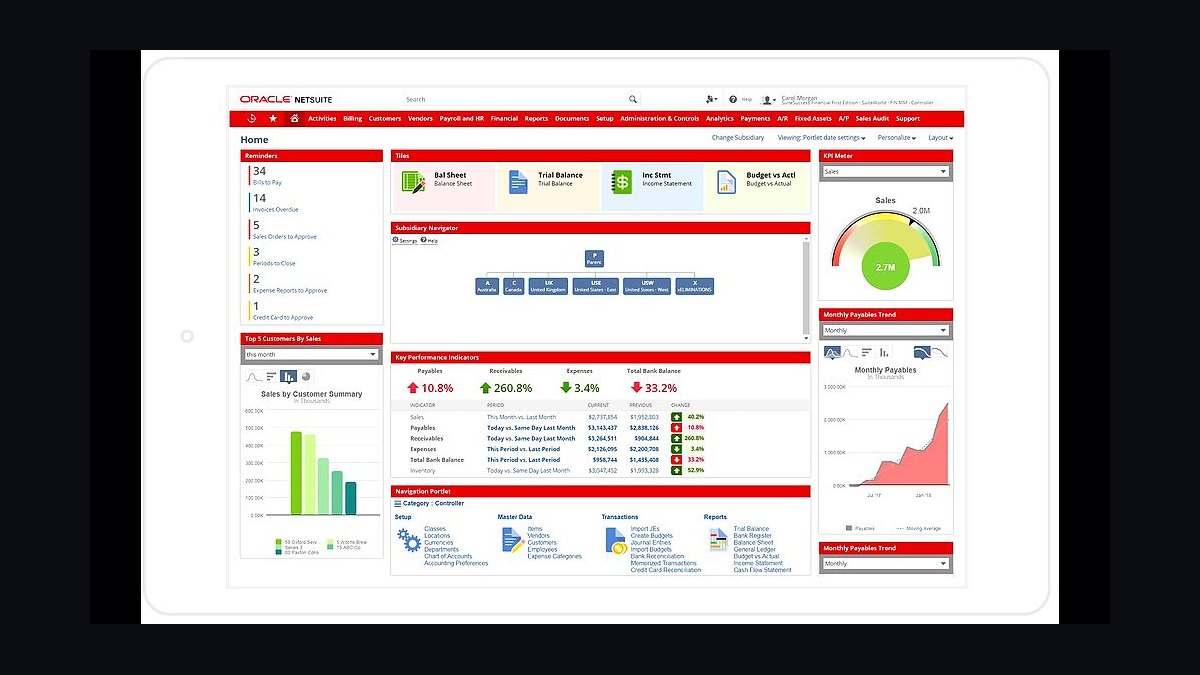
NetSuite ranks tenth because enterprise GRC vendors past $50M ARR need real revenue recognition, multi-entity consolidation, and ASC 606 handling that QuickBooks cannot provide. Annual licensing runs $50K-$500K, and it integrates with Salesforce and Zuora to close the quote-to-cash loop for complex multi-year contracts.
It is for vendors at $50M ARR and above with multi-framework enterprise books and international entities. It trades away implementation speed and cost, since NetSuite rollouts take months and require finance-ops staffing. Compared to Datadog above, it is the back-office counterpart: Datadog watches pipelines, NetSuite watches the money. Below $50M ARR, QuickBooks remains adequate.
How we ranked these
We ranked each stack layer by how directly it blocks revenue: evidence storage and control-mapping graph first, integration orchestration second, CRM and billing third, auditor-facing workflow fourth. Weighting favored total cost of ownership across a three-year horizon, integration maintenance burden measured in engineer-months, and how cleanly each component survives a motion change from SMB to mid-market to enterprise without a full rip-and-replace.
We deliberately ignored vendor brand prestige, analyst-quadrant placement, UI polish, and demo-day aesthetics, because none of those predict whether an AWS Config pull breaks silently at 2am. We also excluded pricing that only holds at list rate for sub-50-seat deployments, since GRC vendors rarely stay that small past their first enterprise logo. Feature checklists were discarded entirely — integration depth and auditor relationships decide evaluations, not checkbox counts.
What to look for
What actually matters is whether the stack can survive a motion change without a rebuild. A vendor that starts SMB on HubSpot and Stripe should be able to add a mid-market lane with lighter Salesforce customization and usage billing before committing to Zuora's full contract-amendment machinery. Integration maintenance cost, not license cost, dominates the three-year TCO.
The mistake most buyers make is sizing the commercial stack to the biggest deal in the pipeline rather than the median deal actually closing. That produces Salesforce and Zuora overhead on a $15K ACV self-serve funnel, starving the customer-success tooling that mid-market renewals actually need. Size to the motion you have revenue in, not the one you pitch in board decks.
Related questions
How many integrations does a new GRC vendor need before launch?
For SMB SOC 2 readiness, 30-50 native integrations covering the common cloud, identity, and ticketing stack is typically enough. Mid-market needs 50-100, and enterprise multi-framework coverage requires 100-200+, including legacy systems like SAP and ServiceNow that SMB vendors never touch.
Should framework mappings be built in-house or licensed?
Most vendors build mappings in-house because they function as durable, differentiating IP that compounds with each framework added. Licensing from vendors like Apptega trades away that differentiation for faster time-to-market, which only makes sense for a narrow launch window before the content team is hired.
Is FedRAMP authorization worth pursuing for a GRC vendor?
Yes if federal or federally-adjacent pipeline exists — FedRAMP Moderate runs $2M-$8M and 24-36 months, but it also signals credibility to enterprise commercial buyers who never touch a federal contract. The authorization functions as a trust proxy well beyond the federal market itself.
Neo4j or Memgraph for the control-mapping graph?
Neo4j has the larger install base and hiring pool; Memgraph wins on real-time update performance for high-frequency evidence ingestion. For most GRC workloads either is workable, and the deciding factor is usually team familiarity with Cypher rather than raw benchmark numbers.
When should a vendor add a mid-market motion between SMB and enterprise?
Once SMB deal sizes start clustering above $50K ACV with multi-stakeholder buying committees but customers still resist a six-month procurement cycle, a mid-market lane with lighter CRM customization and early CS tooling usually pays for itself within two quarters. Waiting longer risks losing those deals to enterprise-first competitors.
Does the evidence storage layer really need ClickHouse alongside Postgres?
Postgres handles transactional control and customer data well, but ClickHouse is what makes continuous-monitoring dashboards and evidence-trend queries fast at scale. Vendors that skip it usually hit query-latency walls somewhere between 500 and 2,000 active customers, forcing a painful mid-growth migration.
How much does the commercial stack cost at each motion tier?
SMB infrastructure plus commercial tooling lands around $80K-$300K/month. Mid-market runs $300K-$700K/month. Enterprise at $50-$200M ARR runs $1M-$4M/month, climbing to $3M-$12M/month at the $100-$500M ARR tier, driven mostly by integration-engineering headcount.
Can one operations stack credibly serve all three motions?
In practice, no. Vendors that scale past $100M ARR eventually run two or three stacks in parallel with a clear operational boundary — often ACV threshold or buyer employee count — determining which CRM and billing system a deal lands in. Trying to unify too early serves none of the motions well.
FAQ
Can a GRC vendor run SMB self-serve and enterprise-led motions from the same CRM?
It's possible below roughly $20M ARR, but most vendors split CRMs (HubSpot for self-serve, Salesforce for enterprise) once deal complexity diverges, because a single system rarely models both a self-serve trial and a six-stakeholder procurement process well. The split usually happens right after the first $100K+ ACV deal closes.
What's the single most expensive line item in the enterprise GRC stack?
Integration engineering. Maintaining 100-200+ live connectors against customer infrastructure, which changes constantly, costs more in ongoing engineer-months than any licensed software line, including Salesforce and Zuora combined. Each deep integration runs 3-12 engineer-months to build and keep current against API changes.
How often do framework mappings need to be updated?
Standards revise on their own timelines — NIST issues major revisions every few years, ISO reviews on a roughly five-year cycle, and newer regimes like the EU AI Act and DORA are still being interpreted through 2026-2027. A dedicated content team should review mappings quarterly at minimum.
Do GRC vendors need their own compliance certifications?
Yes — dogfooding SOC 2, ISO 27001, and sometimes FedRAMP on the vendor's own platform is close to mandatory, since prospective customers routinely ask whether the vendor selling compliance software is itself compliant. Running the product against itself is also the cheapest QA available.
What separates a winning GRC vendor from one that stalls out?
Integration breadth and auditor-firm relationships are the two most durable differentiators — both compound over years and are difficult for a fast-follower to replicate quickly, unlike UI polish or individual framework templates. Vendors that stall at 30-40 integrations tend to lose evaluations regardless of product quality.
Is Stripe Billing sufficient for an enterprise GRC vendor, or is Zuora required?
Stripe Billing works fine under roughly $50M ARR with simple contract structures. Once multi-year, multi-framework contracts with mid-term amendments become common, Zuora's contract-management depth becomes worth the added cost and implementation time. The crossover usually happens when usage-based pricing enters the mix.
What does the first 30 days of buildout actually look like?
Entirely the evidence layer: standing up Postgres, ClickHouse, and Iceberg with S3 Object Lock for immutability, plus shipping the handful of integrations (AWS, Azure, GCP, Okta, GitHub) covering the largest share of any customer's infrastructure. Skipping straight to framework mappings before evidence collection is reliable is the most common early-stage mistake.
When should a vendor start building the auditor-facing portal?
Days 61-90 in a typical sequencing, after evidence is flowing and mappings exist. Building a read-only auditor portal with OSCAL export and establishing named partnerships with Schellman, A-LIGN, or Coalfire turns the product from an internal dashboard into something an external auditor recommends to the next client.
How large does the framework content team need to be?
Under ten people for SOC 2 and ISO 27001 coverage at SMB scale. Enterprise multi-framework vendors realistically run 15-30 people to keep 15-30 frameworks current as standards revise, including NIST 800-53 Rev 5, ISO 27001:2022, and DORA's phased 2025-2026 rollout.
Does the mid-market lane need its own billing system?
Usually not at first — an upgraded Stripe plan handles employee-count or integration-count pricing adequately. Zuora's lighter usage-billing tier enters when contract amendments and multi-year structures become common, typically somewhere between $25M and $50M ARR as the enterprise pipeline starts closing.
Sources
- https://www.aicpa-cima.com/topic/audit-assurance/audit-and-assurance-content/soc-2-reporting
- https://www.iso.org/standard/27001
- https://csrc.nist.gov/pubs/sp/800/53/r5/upd1/final
- https://www.fedramp.gov/
- https://www.acq.osd.mil/cmmc/
- https://www.eba.europa.eu/regulation-and-policy/digital-operational-resilience-act-dora
- https://neo4j.com/docs/
- https://www.salesforce.com/sales/cloud/
- https://stripe.com/billing
- https://www.zuora.com/products/billing/
Related on PULSE
This page will be disappearing soon. Save it to your device for $1 — or read it free while it is here.
@Kory-White- · if Venmo asks, the last 4 of my number are 2012
This page is gone.
This one is off the shelf now. $1 keeps it on your phone for good — the whole page, pictures and diagrams included.
 pulse-tech-stacksTop 10 Best Tech Stack Tools for Home Builders and Residential Developers in 2027
 pulse-tech-stacksTop 10 Best Tech Stack Tools for Insulation Contractors in 2027
 pulse-tech-stacksTop 10 Best Tech Stack Tools for Email Security Vendors in 2027
 pulse-tech-stacksTop 10 Best Tech Stack Tools for MSP and IT Services Companies in 2027
 pulse-tech-stacksTop 10 Best Tech Stack Tools for Home Inspection Companies in 2027
 pulse-tech-stacksTop 10 Best Tech Stack Tools for Garden Centers and Nurseries in 2027
 pulse-tech-stacksTop 10 Best Tech Stack Tools for Plastics and Injection Molding Manufacturers in 2027
 tkTop 10 Best Tech Stack Tools for Concrete and Paving Contractors in 2027
 pulse-tech-stacksTop 10 Best Tech Stack Tools for Mobile Threat Defense (MTD) Vendors in 2027
 pulse-tech-stacksTop 10 Best Tech Stack Tools for AI Legal Tech Companies in 2027