
Should I Hire a Fractional CRO If A PE Firm Just Acquired Us?
 Curated byKory White · Fractional CRO · Maryland
 PULSEKNOWLEDGE LIBRARY
Quality
Certified

Yes, in most cases. A PE acquisition compresses your reporting cadence and raises the bar on forecast accuracy almost overnight, and few founder-led revenue teams have run that gauntlet before. A fractional CRO buys you that specific playbook for a fraction of a full-time package, with scope you can dial down once the integration settles.
What you're actually choosing between after the deal closes
The moment the wire hits, you have five realistic options for revenue leadership, and a fractional CRO is only one of them. Understanding the alternatives is what keeps the engagement from becoming an expensive experiment.
Promote your existing VP of Sales. The cheapest path and the one your board will ask about first. It works when your VP already runs a disciplined pipeline review, can defend a number in front of people who did not hire them, and has some exposure to unit economics beyond quota attainment. It fails when the VP is a great closer who has never built a system. The tell is simple: ask them to walk you through last quarter's forecast variance and explain what caused it. If the answer is "a couple of deals slipped," they are not ready for a PE board. If the answer breaks the variance into stage-conversion decay, a specific segment that underperformed, and a named account that pushed for a documented reason, promote them and skip the fractional hire.
Hire a full-time CRO immediately. The right answer when the sponsor's thesis depends on a genuine go-to-market rebuild rather than tightening — new segment, new motion, doubling headcount, entering a channel you have never sold through. The problem is timing. A full-time CRO search runs three to six months from kickoff to start date, plus a ramp. That is most of your first year gone in a hold period that may only be three to five years. You also make a permanent, equity-laden commitment before you have a clear read on what the business actually needs, and PE-backed executive turnover in the first eighteen months is common enough that sponsors budget for it.

Bring in the sponsor's operating partner. Many mid-market and larger firms staff a revenue or go-to-market operating partner who parachutes into portfolio companies. This is free to you in cash terms and carries real weight with the investment committee. The limit is bandwidth — an operating partner typically covers six to twelve companies and gives you a few days a quarter, not a few days a week. They are excellent at setting the standard and terrible at doing the work. If your firm has one, the fractional CRO's job becomes translating that standard into daily operating rhythm, which is a healthy division of labor rather than a conflict.
Retain a consulting firm. A named strategy or revenue-consulting shop will produce a rigorous diagnostic and a thick deck. What they usually will not do is sit in your Monday forecast call for nine months, tell an underperforming AE the truth to their face, or own the number. Consulting output is a recommendation; a fractional CRO is accountable. If your gap is analytical — segmentation, pricing study, TAM validation — buy the consulting engagement. If your gap is operating leadership, do not.
Hire a fractional VP of Sales or a RevOps contractor instead. This is the underrated alternative and it is right more often than the fractional CRO market admits. If your problem is that Salesforce is a swamp, your stages are undefined, and nobody can produce a clean pipeline-coverage number, that is a RevOps problem, not a CRO problem — and it is cheaper and faster to fix with a specialist. Likewise, if your motion is high-velocity inside sales with a small average contract value, a fractional VP of Sales who will actually coach call blocks delivers more than a strategist who thinks in board decks. Diagnose the gap before you buy the title.
The fractional CRO wins when the gap is specifically at the intersection of *operating leadership* and *sponsor fluency* — you need someone who can restructure territories on Tuesday and defend the resulting forecast to the investment committee on Thursday. That combination is rare internally and it is exactly what the fractional market prices.

How to choose between them without guessing
Run the decision in a fixed order rather than debating titles. The sequence below takes about two weeks of real work and will resolve the question more reliably than any amount of discussion.
Step one: read the thesis, not the LOI. Ask the sponsor's deal team for the investment memo's growth assumptions. You are looking for the specific mechanism — price increase, new segment, cross-sell into the installed base, add-on acquisitions, sales-capacity expansion. Each implies a different leader. A price-realization thesis needs someone strong in packaging and deal desk. An add-on roll-up thesis needs someone who can integrate acquired sales teams without torching customer relationships. A capacity thesis needs a hiring and enablement machine. If the memo says "improve sales efficiency" with no mechanism, that is your first finding and it is worth raising before you hire anyone.
Step two: score your current revenue function on four axes. Forecast accuracy over the last four quarters (variance to plan). Data hygiene (what percentage of open opportunities have a close date in the past, a blank amount, or no next step). Process definition (does a written qualification framework exist and do reps actually use its fields). Board fluency (can anyone besides the CEO present revenue to an outside audience). Score each red, yellow, green. Two or more reds usually justifies a fractional CRO. All greens means you need coaching, not leadership.

Step three: size the gap in days per month. Be honest about the workload. A full interim leader running the function is eight to fifteen days a month. A coach sitting alongside a competent VP is four to six. A defined project — build the forecast model, rebuild the comp plan, integrate an acquired team — is a fixed two to three months. Sponsors respect a scoped number far more than an open-ended retainer.
Step four: pressure-test conflicts and references before economics. Ask for two references from companies acquired by a PE firm in the last three years, and call them yourself rather than accepting a written blurb. Ask the reference one question that matters: "What did they tell you that you did not want to hear?" A fractional CRO who never delivered bad news was decorative. Separately, confirm no overlap with competing portfolio companies in your sponsor's book or in the books of firms they co-invest with.
The output of this sequence is not just a yes or no. It is a scoped mandate you can put in a statement of work, which is the single biggest predictor of whether the engagement produces anything.
Costs, timelines, and what impact actually looks like
Fractional CRO pricing is quoted as a monthly retainer tied to committed days, occasionally with a modest milestone bonus attached to something measurable like forecast variance or pipeline coverage. The market is wide and varies by geography, industry complexity, and how much operating work versus advisory work is in scope, so treat any single number you hear as an anchor rather than a benchmark. What is reliable is the shape of the comparison: a fractional engagement is a fraction of a full-time CRO's total package once you count base, variable, benefits, and equity — and the equity component is the one founders consistently underestimate, because at a successful exit it is frequently the largest line by a wide margin.

The more useful framing for a sponsor conversation is not "what does it cost" but "what does it cost relative to the error it prevents." Consider the arithmetic on forecast accuracy alone. A company running ±30% quarterly variance forces conservative decisions everywhere — you under-hire because you cannot trust the number, you delay a territory expansion, you hold cash against a miss that may not come. Tightening that to ±10% does not create revenue directly; it creates the confidence to deploy capital on schedule. Sponsors will pay for that because their entire model runs on deployment timing.
Timeline expectations, honestly stated. Weeks one through four produce a diagnostic and nothing else visible — resist the urge to demand results here, because a fractional CRO who starts changing things before understanding them is the worse hire. Weeks five through eight produce operational quick wins: a standardized forecast call, cleaned pipeline stages, a written qualification standard, and usually the first hard personnel conversation. Weeks nine through thirteen produce the twelve-month plan with quarterly targets, hiring sequence, and tooling requests. Real structural change — sales-cycle compression, retention improvement, a genuinely repeatable motion — lands in months six through twelve. Anyone promising a thirty-day turnaround is selling you something.
What good looks like at the six-month mark. Forecast variance materially tightened and, more importantly, *explainable* when it misses. Sales cycle shortened, typically in the fifteen to twenty-five percent range when the compression comes from removing genuine process waste rather than from discounting. Net revenue retention trending up if you sell recurring revenue. Customer acquisition cost improving because someone finally killed the two channels that were quietly burning budget. And the board package shifted from narrative optimism to leading indicators — cohort curves, coverage by stage, named-risk lists with owners.

What failure looks like, so you can call it early. Six months in, your pipeline is still unpredictable, no written methodology exists that reps can recite, and the board asks the same visibility questions it asked at close. If that is where you are, the engagement is not working and extending it will not fix it. The most common root cause is scope dilution — someone quietly added marketing, customer success, and partner strategy to a revenue-operations mandate and the CRO is now spread across four functions at four days a month.
The availability trade-off is real and worth naming in the contract. A fractional executive has other clients. They will not be on-site daily and they will not answer a 10 p.m. escalation. If your sponsor expects a full-time, always-on executive presence, either reset that expectation in writing before the engagement starts or accept that you need a full-time hire. This single misalignment kills more fractional engagements than competence ever does.
Adjacent cost you should budget for. A fractional CRO will almost always surface tooling and data gaps that cost money to fix — a CRM cleanup project, a forecasting layer, call-recording and coaching software, or a analyst-level RevOps hire to maintain what gets built. Budget ten to twenty percent of the engagement value for the remediation the diagnostic uncovers, or you will find yourself paying for a plan you cannot execute.
Running the engagement and planning the handoff from day one
The engagement should be designed backwards from its ending. A fractional CRO with no defined exit becomes a permanent part-time executive, which is the worst of both structures — you carry the cost without the commitment and your internal bench never develops.

Week one setup that prevents most failures. Put the mandate in writing: the three to five metrics owned, the days committed per month, the decisions the CRO can make unilaterally versus which require CEO or sponsor sign-off, and the explicit list of functions *out* of scope. Grant real system access on day one — CRM admin-level read, historical forecast files, comp plans, the last four board decks. Withholding access to protect feelings is a guaranteed way to waste the first month. Establish the reporting rhythm immediately: weekly pipeline call with the sales team, biweekly sync with the sponsor's operating partner, monthly written package that matches the format used across the rest of the portfolio. That last detail matters more than it sounds — sponsors compare portfolio companies side by side, and a package in a nonstandard format reads as a company that does not understand the game.
The personnel question, handled properly. Within the first thirty days the CRO should deliver a written assessment of every revenue-facing person. This is the most uncomfortable deliverable and the one most likely to get softened under pressure. Insist on written, not verbal, and insist it distinguishes between people who cannot perform and people who have never been given a system to perform inside — those require completely different responses, and firing the second group is how companies destroy institutional knowledge they later pay to rebuild.
Where this connects to adjacent workstreams. If the sponsor's thesis includes add-on acquisitions, the fractional CRO becomes useful well outside the four walls of your revenue team. They can assess a target's sales organization during diligence, flag integration risk before capital is committed, and design the merge sequence for two go-to-market motions — which reps to retain, which accounts to re-map, which CRM to make the survivor. That last decision is deceptively expensive to get wrong. Similarly, if pricing changes are part of the thesis, the CRO owns the field execution: how reps present the increase, what the concession ladder looks like, and which accounts get grandfathered. Pricing changes fail at the rep level far more often than at the strategy level.

The handoff itself. Two clean paths exist. The first is promoting an internal VP of Sales after twelve to eighteen months of deliberate coaching, with the fractional CRO tapering days rather than stopping abruptly. The second is hiring a full-time CRO into a function that already has working process, clean data, and a board rhythm — which materially improves your candidate pool, because strong CROs avoid situations where they will spend a year on cleanup. In both cases, the deliverable that makes the handoff work is documentation: the written methodology, the forecast model with its assumptions exposed, the comp plan rationale, and a standing operating calendar. If the knowledge lives only in the fractional CRO's head, you have rented a dependency rather than built a capability.
Signals that mean you should not hire anyone yet
There are situations where revenue leadership is the wrong first spend, and a good fractional CRO will tell you so in the first conversation — which is itself a useful screening test.
Negative unit economics. If you are losing money on every customer at current pricing and cost structure, adding sales leadership accelerates the loss. The sequence has to be pricing and cost work first, then growth. This is a hard conversation with a sponsor whose thesis assumed growth, but it is better had in month one than month nine.
Severe retention problems. High churn is usually a product or onboarding failure wearing a sales costume. Pouring new logos into a leaking bucket produces an expensive treadmill and a customer base that will speak badly about you in reference calls for years. Fix retention, then hire for acquisition.

No clear ICP. If you cannot describe, in one sentence, who buys from you and why they choose you over the alternative, no revenue leader can build a repeatable motion. The prerequisite work is segmentation analysis on your existing base — win rates, cycle length, and retention cut by segment. That is a four-to-six-week analytical project and it is cheaper than a year of a CRO discovering the same thing slowly.
Genuine distress. If the acquisition was a rescue and the company is burning cash with weeks of runway, you need a turnaround operator and a CFO, not a growth leader. The revenue question comes after solvency.
An operating partner already embedded full-time. If the firm has assigned a dedicated revenue resource who is genuinely in the business several days a week, a fractional CRO creates ownership ambiguity. Two people cannot own the number. Either the operating partner owns it or your hire does — write it down before anyone starts.

Common failure modes and how to design around them
The failures are predictable enough to be prevented contractually, which is why the statement of work matters more than the résumé.
Advice without execution. The single most common failure is hiring someone who produces analysis and recommendations but never touches the operating cadence. If the fractional CRO is not in the forecast call, not in deal reviews, and not having direct conversations with reps, you bought consulting at executive pricing. Write attendance at specific recurring meetings into the agreement.
No PE-native experience. Venture-backed and PE-backed environments differ in ways that matter operationally. Venture optimizes for growth rate and tolerates burn; PE optimizes for cash generation, margin discipline, and a defined exit window. A leader whose entire background is venture-stage hypergrowth will over-invest in headcount and under-invest in efficiency, and will be genuinely surprised when the board pushes back. Ask specifically about hold periods, quarterly lender reporting if there is debt in the structure, and add-on integration.
Scope creep across functions. Marketing, customer success, partnerships, and product feedback all touch revenue, and each will drift into a CRO's remit if unfenced. At four to eight days a month, every added function halves the attention on the core mandate. Name the out-of-scope list explicitly.

Sponsor and CEO misalignment. If the CEO wants a coach and the sponsor wants an enforcer, the fractional CRO is caught between two principals with different definitions of success. Align these before the first day, ideally in a single joint conversation with all three parties present. It is an awkward hour that prevents a wasted quarter.
Treating the assessment as optional. Companies frequently commission the team assessment and then decline to act on it, usually out of loyalty. The assessment then sits as a document everyone has read and nobody can unread, which poisons the working relationship. If you are not prepared to act on the findings, say so upfront and scope the engagement around process rather than people.
No measurement baseline. If you do not record current-state forecast variance, cycle length, coverage ratio, and CAC on day one, you cannot prove impact at month six — and the engagement gets judged on vibes, which favors whoever is more articulate rather than whoever is more effective.
Related questions
What if we were acquired by a strategic buyer instead of a PE firm?
The logic mostly holds, but the pressure differs. A strategic buyer typically wants integration into an existing go-to-market machine rather than a standalone growth engine. The fractional mandate shifts toward mapping your motion onto theirs, retention of key accounts through the transition, and rep re-badging — less board reporting, more change management.
Can a fractional CRO help before the deal closes?
Yes, and it is underused. During diligence, an experienced revenue operator can sanity-check the pipeline the seller is presenting, identify stage-inflation, and assess whether the sales team's performance is systemic or dependent on two individuals. Buy-side sponsors increasingly commission exactly this.
How does this differ if we sell through channel partners?
Substantially. Channel-led revenue has different leading indicators — partner-sourced pipeline, partner activation rate, deal registration hygiene — and many fractional CROs are direct-sales natives who underestimate the relationship timelines involved. Screen specifically for channel experience rather than assuming transferability.
Should the fractional CRO also own marketing?
Usually not at fractional day counts. Combining demand generation and sales under one part-time leader sounds efficient and produces two half-managed functions. The exception is a small team where marketing is one or two people executing a defined program, in which case coordination overhead is low enough to justify it.
What happens to our existing sales comp plan?
Expect it to be rebuilt within the first two quarters. PE-backed comp plans usually shift weight toward margin, retention, and multi-year commitments rather than pure new bookings. Communicate changes at a natural plan boundary and grandfather in-flight deals, or you will lose people mid-quarter.
FAQ
Does hiring a fractional CRO signal weakness to the PE firm?
The opposite, in practice. Sponsors see fractional executives constantly across their portfolios and generally read the decision as a management team that diagnosed a gap accurately and moved fast without over-committing capital. What does signal weakness is waiting three quarters, missing the plan twice, and then hiring under duress.
How long should the initial contract be?
Ninety days, with a defined renewal decision at the end. That is long enough for a real diagnostic and the first wave of execution, short enough that a bad fit costs one quarter rather than one year. Build the renewal criteria into the original agreement so the conversation is about evidence rather than feelings.
Who should the fractional CRO report to?
The CEO, with a dotted line to the sponsor's operating partner. Reporting directly into the PE firm undermines the CEO's authority with the sales team and creates a shadow chain of command. The dotted line gives the sponsor visibility without displacing the operating relationship.
Can one person do this across multiple portfolio companies?
Sponsors sometimes propose sharing a fractional CRO across two or three holdings to spread cost. It works only when the companies are genuinely non-competing and at similar stages, and even then the attention math is brutal. If you are one of three, verify how many days you actually get and whether your quarter-end collides with theirs.
What if our VP of Sales resents the hire?
Common and manageable if you get ahead of it. Frame the engagement as capability-building with a named development path rather than as oversight, and let the VP participate in scoping. If the resentment persists past sixty days despite that framing, it is usually a signal about the VP's self-assessment rather than about the fractional CRO.
Do we need to disclose the engagement to lenders or the board formally?
Any material management change typically belongs in the board reporting package, and debt covenants occasionally include key-person or management-change provisions. Check the credit agreement rather than assuming. In practice most sponsors want the engagement in the board materials anyway, because it demonstrates a specific response to a specific gap.
Sources
- Harvard Business Review — Private Equity
- McKinsey — Private Equity and Principal Investors
- Bain & Company — Global Private Equity Report
- SaaStr
- First Round Review
- Pavilion
- RevOps Co-op
- PitchBook — Private Equity Research
Related on PULSE
- [Does a PE-backed martech company need a fractional CRO in 2027?](/knowledge/tl13255)
- [Does a manufacturing company need a fractional CRO or a full-time CRO in 2027?](/knowledge/tl10475)
- [Does a bootstrapped edtech company need a fractional Chief Revenue Officer in 2027?](/knowledge/tl16296)
- [Does a founder-led government contracting company need a fractional Chief Revenue Officer in 2027?](/knowledge/tl16576)
- [Should I hire a fractional CRO in Bethany Beach in 2027?](/knowledge/tl20031)
- [Should I hire a fractional Chief Revenue Officer in Clinton in 2027?](/knowledge/tl20305)
This page will be disappearing soon. Save it to your device for $1 — or read it free while it is here.
@Kory-White- · if Venmo asks, the last 4 of my number are 2012
 pulse-toolsHow do I evaluate a fractional CRO in South Florida in 2027?
 pulse-toolsWhat does a fractional CRO cost in Delmar in 2027?
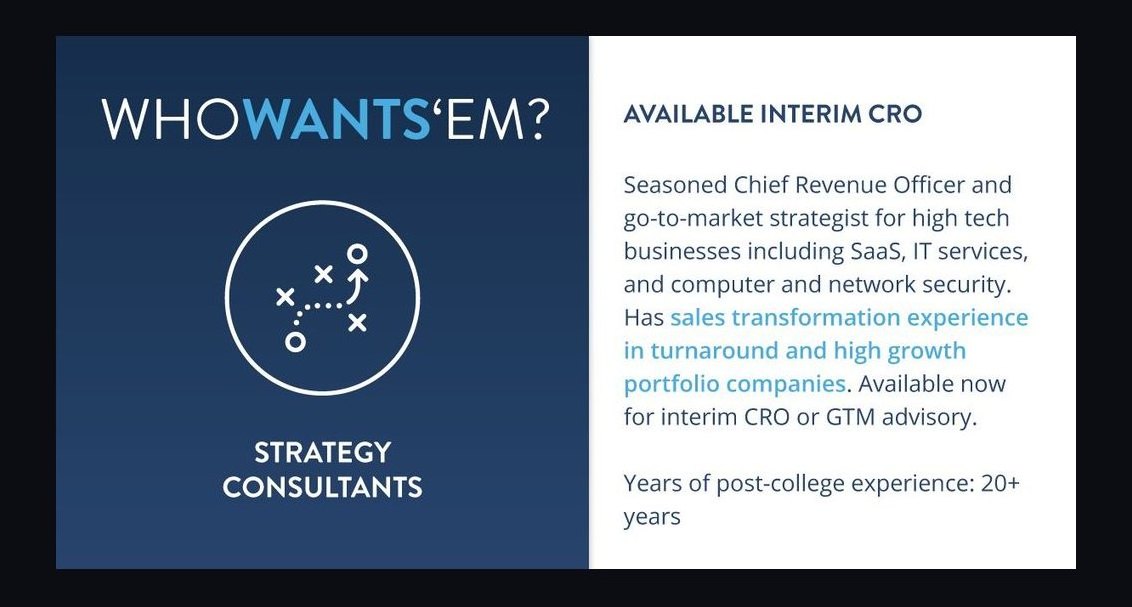 pulse-toolsWhere do I find an interim CRO in Fort Lauderdale in 2027?
 pulse-toolsWho is the best fractional CRO in Smyrna in 2027?
 pulse-toolsShould I Hire a Fractional CRO If My Reps Are Sandbagging the Forecast in 2027?
 pulse-toolsShould I Hire a Fractional CRO If I Need to Build My First Sales Playbook in 2027?
 pulse-toolsIs there a fractional CRO available near me in the Gulf Coast in 2027?
 pulse-toolsWhere do I find a fractional VP of Sales in Delaware?
 pulse-toolsShould I Hire a Fractional CRO If I Need Interim Coverage During a Medical Leave in 2027?
 pulse-toolsWhat should I look for in a fractional CRO in San Diego in 2027?