
Should I Hire a Fractional CRO If My Revenue Has Been Flat for Four Quarters?
 Curated byKory White · Fractional CRO · Maryland
 PULSEKNOWLEDGE LIBRARY
Quality
Certified

Hire a fractional CRO if four flat quarters trace to sales execution, pipeline generation, or leadership gaps — not to product or pricing. You get senior revenue leadership on a retainer for roughly 8–20 days a month, with a 90-day scope and an opt-out. If churn is high and demos stall, fix the product first.
How the engagement actually runs end to end
A fractional CRO engagement is not an advisory subscription. The good ones run a repeatable arc: diagnose, prescribe, implement, hand off. Understanding that arc before you sign is the single best protection against paying executive rates for a slide deck.
Days 1–15 — instrumentation and interviews. The operator pulls your CRM (Salesforce or HubSpot), exports 18–24 months of closed-won and closed-lost, and reconstructs the funnel by stage, by source, and by rep. In parallel they interview every customer-facing person: reps, SDRs, CS, marketing, and usually two or three lost prospects. The point of the interviews is not morale-taking. It is to find the gap between what your CRM says happens and what actually happens. In flat-revenue companies that gap is almost always large — stages that mean nothing, opportunities created after the verbal yes, forecast categories used as mood rings.
Days 16–30 — written diagnosis. You should receive a working document, not a deck: three to five named root causes, each with the evidence behind it, an owner, and a date. If the diagnosis reads like a generic sales-maturity assessment you could have downloaded, that is your early warning. A real diagnosis says things like "reps create the opportunity at proposal, so we have no real top-of-funnel data" or "62% of closed-lost in the enterprise segment cite a security review we cannot pass."
Days 31–60 — implementation. This is the phase most consultants never reach and the phase you are actually buying. Rewriting qualification criteria, redefining ICP, redrawing territories, running weekly pipeline inspection personally, coaching two reps and managing one out. Expect friction here. If nobody is uncomfortable by day 45, nothing is changing.

Days 61–90 — stabilize and instrument the handoff. New process gets documented, leading indicators get dashboarded, and the internal owner starts running the cadence with the CRO in the passenger seat. A fractional engagement that cannot survive its own ending was a rental, not a fix.
The arc scales down cleanly. A sub-$2M ARR founder-led company will compress days 1–15 into a week because there is less data to audit, and the implementation phase will look more like founder coaching than org design. It scales up too: at $15M+ the diagnosis phase often runs 30 days because there are three segments and two motions to untangle.
Where four flat quarters creates and leaks revenue
Flatness is not the absence of movement. It is usually two forces cancelling each other — new logos growing while churn eats the gain, or enterprise expanding while SMB collapses. The first job is to decompose the flat line into its components, because the fix for each is completely different.

The leak inventory a good operator builds in week two:
- Pipeline generation. Coverage ratio below 2x against the target means you have a top-of-funnel problem masquerading as a closing problem. Healthy B2B coverage is roughly 3x–4x depending on your win rate; a team winning 35% needs less coverage than one winning 15%. If a single source — one channel, one partner, one outbound sequence — produced more than half of last year's pipeline and has decayed, that is your flat line right there.
- Stage conversion. Plot conversion by stage across four quarters. Flat revenue with steady stage conversion means volume decay upstream. Flat revenue with collapsing late-stage conversion means a competitor, a pricing shift, or a procurement obstacle appeared and nobody escalated it.
- Net revenue retention. This is the leak founders most often miss because it lives outside the sales org. If NRR slid from 105% to 92%, your sales team can add the same new ARR every quarter and the top line still goes nowhere. No amount of sales leadership fixes that; it is a product, onboarding, or value-realization problem, and a CRO who takes the engagement anyway without flagging it is selling you something.
- Territory and coverage. In field-heavy or geographically distributed businesses — the same dynamic shows up in distribution, wireless retail, and multi-location services, not just SaaS — flat revenue frequently traces to unbalanced patches. Two reps sitting on 60% of the addressable accounts while four fight over the remainder produces exactly this signature: high performers capped, low performers starved, aggregate flat.
- Rep productivity distribution. Rank reps by trailing-twelve attainment. If the top two produce 70% of revenue and the bottom half produce under 40% of quota, you do not have a leadership problem in the abstract — you have a hiring profile, ramp, and enablement problem with a specific cost you can quantify.
Where the engagement *creates* revenue is mostly in unglamorous places: recovering deals that were stalling in a stage nobody inspected, raising average deal size by killing the reflexive discount, and shortening cycle time by removing an approval step. Upstream, a fractional CRO usually forces marketing to change what it optimizes for — from MQL count to qualified pipeline dollars — and that single reframe often does more for the flat line than anything happening inside the sales team. Downstream, tightening qualification improves retention six to nine months later, because you stop selling to accounts that were never going to succeed.
Concrete numbers, benchmarks, and what the retainer buys
Fractional CRO pricing has no single answer, but it has drivers you can reason about.

Days per month. Most engagements are scoped at 8–15 days monthly. Eight days is oversight plus weekly inspection — enough to diagnose and direct, not enough to run a team day to day. Fifteen to twenty days is effectively an embedded executive who is genuinely in the deals. Below eight days you are buying advice, and you should price and expect it accordingly.
Company stage. An operator targeting $1M–$5M ARR companies charges materially less than one who works with $10M–$20M businesses, because deal complexity, org size, and the buyer's willingness to pay all scale. Stage also changes what you should ask for: under $3M ARR the deliverable is usually a repeatable motion and a first sales hire profile; over $10M it is segmentation, comp design, and a management layer.
Structure. Cash retainer is the default. Some operators take a slice in equity (commonly quoted in the 0.5%–2% range for meaningful, multi-year involvement), but most prefer cash, and equity-heavy structures tend to misalign a 90-day engagement. Avoid pure commission structures for a turnaround — they incentivize discounting the pipeline you already have rather than rebuilding the engine.

Runway rule. Do not start an engagement you cannot fund for six months. Ninety days is the diagnosis-and-implementation window; revenue impact commonly lands in months three through six because pipeline built in month two closes in month five in a typical 60–120 day B2B cycle. Hiring a fractional CRO with four months of cash is how you end up cancelling in month three, right before the work pays.
Benchmarks to hold the engagement against, by day 90:
- Pipeline velocity improving 20–40% on comparable segments, measured first-contact to closed-won.
- Win rate on *qualified* opportunities up 10–15 points — with the caveat that tightening qualification shrinks the denominator, so track absolute won-deal count too or you will fool yourself.
- Coverage trending toward 3x on the next two quarters' target.
- Forecast accuracy within 10–15% at the start of the quarter, versus whatever chaos you had before.
- Rep ramp time reduced measurably, though this one takes two hiring cohorts to prove and rarely resolves inside 90 days.
The comparison that matters: a full-time CRO at this stage carries base plus variable plus equity plus benefits plus a search fee, and takes three to six months to hire and another quarter to ramp. Against four already-lost quarters, the fractional path's real advantage is not the discount — it is that the diagnosis starts in week one instead of month seven.

Pitfalls and how to avoid each one
Treating the hire as a band-aid. The most common failure. A founder under pressure wants a bump, so the engagement drifts toward discounting, a rushed upsell campaign, and a burst of outbound. You get a decent quarter and the same flat line the quarter after, because none of the structural causes changed. Guard against it by writing the diagnosis phase into the contract as a required deliverable with a date — you are paying for a diagnosis, not a sprint.
Hiring a growth-market operator for a plateau problem. Someone who took a company from $10M to $50M in a tailwind market has a genuinely different skill set from someone who has broken a flatline. Ask directly: "How many times have you fixed four-plus quarters of flat revenue, and what was the cause each time?" You want three or more instances, ideally at similar deal sizes and cycle lengths. Growth stories are not turnaround evidence.
Undefined authority. Fractional CROs routinely land in companies where the founder has been the de facto sales leader for years. If the CRO cannot set quota, approve a discount, restructure a territory, or exit a rep without a week of debate, they will spend the engagement producing suggestions. Write down explicitly which decisions they own outright, which need founder sign-off, and which need the board. Do this before day one; renegotiating authority in week six is a losing fight.

No internal owner. Assign a full-time liaison — VP Sales, head of RevOps, or the founder if the company is small enough. This person implements between the CRO's days, chases action items, and keeps the institutional knowledge when the engagement ends. Without them, the whole thing evaporates the month the retainer stops.
Dirty data. A fractional CRO cannot diagnose from spreadsheets. If your pipeline lives in a shared sheet, migrate to a real CRM at least two weeks before they start, define stages with exit criteria, and make sure historical revenue reconciles to your accounting. Every day the operator spends reconstructing data is a day at executive rates spent on work an analyst could have done.
Bad incentive design. Tie compensation purely to in-quarter revenue and you will get in-quarter revenue behavior: discounts, pulled-forward deals, and pipeline stripped bare for the next quarter. Weight a portion toward leading indicators — qualified pipeline created, win-rate movement, cycle compression — so the operator is paid to fix the engine rather than floor the accelerator.
Skipping the team conversation. Announce the hire yourself, early, in a company meeting. Say plainly that revenue has been flat four quarters, that this is a structural fix, and what the CRO's remit is. Left to rumor, your team will conclude layoffs are coming and the CRO will spend their first thirty days on politics instead of pipeline. Set the cadence in the same breath: weekly one-on-ones with sales leadership, bi-weekly pipeline review, monthly all-hands, and a named escalation path for urgent pricing decisions so nobody is blocked waiting on someone who works ten days a month.

Ignoring adoption signals. Run a short anonymous pulse at day 30 and day 60 asking reps whether their time is better spent and whether the guidance is practical. Low scores usually mean the operator is too theoretical, too abrasive, or culturally mismatched — all fixable at day 45, terminal at day 90.
A selection checklist you can actually run
Vetting is where most of the value is won or lost, and it is mostly about disqualifying fast.
Screen (30 minutes). Ask for the flatline pattern question first: "What is the most common cause of four consecutive flat quarters that you have personally fixed?" A strong operator answers with a specific mechanism — pipeline concentration in one decayed source, a comp plan that pays the same for renewals and new logos, a qualification standard that never existed. A weak one answers with a framework name.

Toolkit check. They should name the stack they work in without hesitation — Salesforce or HubSpot for CRM, Gong or similar for conversation data, Outreach or Salesloft for sequencing, a forecasting layer like Clari if you are large enough to need one. Someone who cannot discuss the systems layer will hand you strategy your RevOps function cannot implement.
Metric question. "What three to five leading indicators will you track in the first 30 days?" Acceptable answers: pipeline coverage ratio, average deal size by source, cycle length by segment, activity-to-meeting conversion, stage-to-stage conversion. If the only answer is revenue, keep looking.
References, chosen by you. Do not call the happiest logo. Ask specifically for a client whose revenue was stuck 12+ months, and a client where the engagement ended early. How someone describes an engagement that did not work tells you more than three success stories.
Written scope before signature. Named deliverables — revised playbook, territory plan, VP Sales hiring profile, comp recommendation — with dates, a defined day count, the authority map, a 90-day term, and a mutual opt-out with 30 days' notice.

Adjacent calls worth making at the same time
The fractional CRO question rarely arrives alone, and the neighboring decisions change the answer.
Fractional CRO versus fractional VP Sales. If your problem is that nobody is coaching reps, inspecting deals, or holding a forecast, you may need a sales leader rather than a revenue leader — and that is a cheaper, more hands-on hire. The CRO title earns its premium when the problem spans marketing, sales, and customer success: misaligned handoffs, a marketing team optimizing for volume while sales starves for quality, a CS function that renews without expanding. Buy the scope you actually have.
Fractional CRO versus a RevOps hire. Sometimes the flatline is a systems and measurement failure. If nobody can tell you win rate by source, or if your forecast is a spreadsheet nobody trusts, a strong RevOps person for six months may unlock more than executive strategy — because the strategy is unactionable without the data. Many engagements sequence this deliberately: RevOps first for two months to get instrumented, CRO after to act on what the instruments show.

Fractional CRO versus pricing work. Four flat quarters with rising deal counts and falling average deal size is a pricing and packaging problem, not a leadership one. That is a different specialist and usually a shorter, cheaper project.
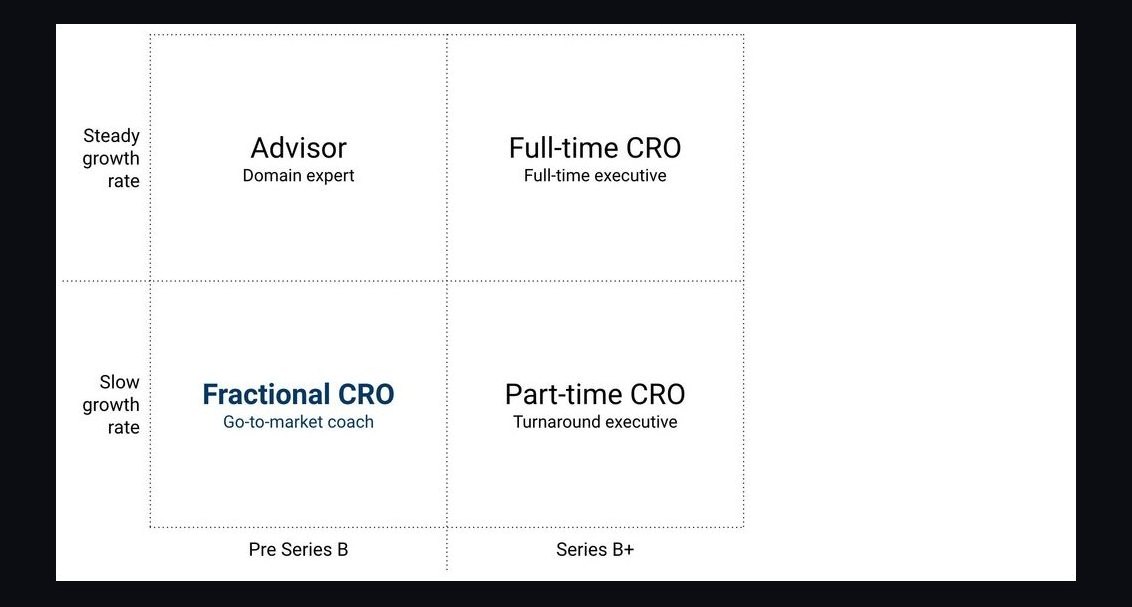
Interim versus fractional versus advisory. Interim is full-time and temporary, typically after a departure. Fractional is part-time and ongoing. Advisory is a few hours monthly with no execution accountability. For a four-quarter flatline, fractional or interim are the two live options; advisory almost never moves a plateau because nobody owns the outcome.
Sector translation. These patterns are not SaaS-specific. Multi-location services, distribution, manufacturing reps, and retail-heavy businesses hit the same four-quarter ceiling — the diagnostic vocabulary changes (route density, same-store growth, attach rate instead of NRR) but the structure of the problem is identical: a concentrated source decayed, coverage went unbalanced, or the motion never got documented past the founder's own instincts.
What to do if the answer turns out to be "not yet." If the diagnosis points at product-market fit, spend the same money on customer research, win-loss interviews, and a pricing review. Come back to the CRO question once you can show that customers who buy, stay. Hiring revenue leadership onto a retention hole is the most expensive way to confirm what a month of win-loss calls would have told you.
Related questions
How is a fractional CRO different from a sales consultant?
A consultant delivers analysis and leaves. A fractional CRO owns the revenue function within their scope — setting quota, running pipeline reviews, making hiring and firing calls, and being accountable for outcomes. You are buying decisions and execution, not a report.
Can this work under $2M ARR?
Yes, with a narrowed scope. At that stage the useful work is founder-led sales coaching, a documented repeatable motion, basic pipeline hygiene, and the profile for a first or second sales hire — not a full go-to-market overhaul. Scope it to five to eight days monthly.
What if revenue is still flat when the 90 days end?
Check leading indicators before deciding. If coverage, velocity, and win rate improved, revenue is likely lagging in a normal sales cycle and extension makes sense. If nothing moved, the diagnosis was wrong or the constraint sits outside sales execution entirely.
Should the fractional CRO hire my full-time CRO?
Often yes — they write the profile, run the search screen, and calibrate the bar better than a founder who has never managed a revenue executive. Just make sure their contract does not create an incentive to delay the permanent hire indefinitely.
Does a fractional CRO replace my VP of Sales?
Not usually. The better pattern is coaching: the CRO raises the VP's operating bar over 90 days. Replacement is only right when the VP was a top rep promoted past their capability and shows no growth after a real coaching attempt.
FAQ
What is the biggest risk of hiring a fractional CRO when revenue is flat?
Misdiagnosis. If the stagnation comes from product-market fit, pricing, or a market shift, no revenue leader — fractional or full-time — can fix it, and you will burn six months and a retainer confirming that. Insist that the first deliverable is a written diagnosis that explicitly rules the non-sales causes in or out, with evidence.
How quickly can a fractional CRO realistically move flat revenue?
Diagnosis and initial changes land inside 60 to 90 days. Actual revenue movement usually shows in months three to six, because pipeline built in month two closes on your normal cycle. Judge the first 90 days on leading indicators — coverage, velocity, win rate, forecast accuracy — not on closed dollars.
How many days a month should I buy?
Eight to ten days gets you diagnosis, direction, and weekly inspection. Fifteen to twenty gets an embedded operator who is in deals and managing people. If you have no sales leader at all, buy the larger package; if you have a VP who needs a coach and a plan, the smaller one is usually sufficient.
How do I keep the gains after the engagement ends?
Name an internal owner on day one, require every process change to be documented rather than carried in the CRO's head, and build the dashboards inside your own systems. A well-run handoff means the weekly cadence continues unchanged the first Monday after the retainer stops.
What should be in the contract?
A 90-day initial term, a defined day count per month, named deliverables with dates, a written authority map covering pricing, hiring and firing, a mutual opt-out with 30 days' notice, and confidentiality plus a light non-solicit. Avoid pure revenue-based compensation for a turnaround engagement.
Can I use a fractional CRO alongside an existing RevOps team?
Yes, and it is usually the strongest combination. RevOps supplies clean data and reporting; the CRO supplies the decisions that data implies. If you have no RevOps function, expect the CRO's first two weeks to be consumed by reconstructing basic funnel reporting.
Sources
- Harvard Business Review — Sales topic
- First Round Review
- SaaStr
- Pavilion
- RevOps Co-op
- McKinsey — Growth, Marketing & Sales insights
- Bain & Company — Customer Strategy & Marketing
- Salesforce Blog — Sales
- HubSpot Blog — Sales
Related on PULSE
- [Does a PE-backed martech company need a fractional CRO in 2027?](/knowledge/tl13255)
- [Should I hire a fractional CRO in Bethany Beach in 2027?](/knowledge/tl20031)
- [Does a bootstrapped edtech company need a fractional Chief Revenue Officer in 2027?](/knowledge/tl16296)
- [Does a founder-led government contracting company need a fractional Chief Revenue Officer in 2027?](/knowledge/tl16576)
- [Should I hire a fractional Chief Revenue Officer in Clinton in 2027?](/knowledge/tl20305)
- [Does a manufacturing company need a fractional CRO or a full-time CRO in 2027?](/knowledge/tl10475)
This page will be disappearing soon. Save it to your device for $1 — or read it free while it is here.
@Kory-White- · if Venmo asks, the last 4 of my number are 2012
 pulse-toolsHow do I hire a fractional VP of Sales in Tampa?
 pulse-toolsWho is the best fractional CRO in Smyrna in 2027?
 pulse-toolsHow much does a fractional Chief Revenue Officer cost for a $1M to $5M ARR company in 2027?
 pulse-toolsWhere do I find a fractional head of revenue in Tulsa in 2027?
 pulse-toolsHow do I find a fractional CRO for a life sciences company in Central Texas in 2027?
 pulse-toolsWho is the best fractional CRO in Temple Hills in 2027?
 pulse-toolsHow do I evaluate a fractional CRO in Tulsa in 2027?
 pulse-toolsHow do I find a fractional CRO in Oakton in 2027?
 pulse-toolsShould I Hire a Fractional CRO If I Need to Build My First Sales Playbook in 2027?
 pulse-toolsHow do I evaluate a fractional CRO in Dayton in 2027?