
Should I Hire a Fractional CRO If I Need to Build My First Sales Playbook?
 Curated byKory White · Fractional CRO · Maryland
 PULSEKNOWLEDGE LIBRARY
Quality
Certified

Yes, if you have zero revenue leadership in-house and need a playbook fast. A fractional CRO brings pattern recognition from dozens of sales motions, delivers a working draft in four to eight weeks, and costs far less than a full-time hire. Skip it if you're pre-product-market-fit, need someone carrying a quota, or lack budget to execute the plays.
The job a fractional CRO is actually hired to do
Founders often confuse three different hires. A sales consultant delivers a report and leaves. A VP of Sales owns a number, manages reps, and lives in your pipeline daily. A fractional CRO sits between them: embedded enough to take ownership of outcomes, part-time enough that you're not carrying an executive salary before you've proven the motion repeats.
When the specific job is "build my first sales playbook," the fractional CRO is being hired for one thing above all else — pattern library. You have one product, one market, and one set of assumptions. Someone who has built playbooks at 500K ARR, 2M ARR, and 5M ARR has watched the same mistakes recur across companies that thought they were unique. They know a $2K ACV self-serve motion and a $50K enterprise motion share almost nothing structurally: different qualification depth, different stakeholder counts, different follow-up cadence, different definitions of "sales-qualified." Learning that distinction yourself costs two or three quarters of misallocated effort.
The second job is forcing decisions you've been avoiding. Most first-playbook engagements stall not on writing but on unresolved strategy. Which segment do you prioritize when three look viable? What's your walk-away deal size? Do you disqualify a prospect who wants a pilot, or take the pilot and eat the cycle length? A founder can defer those questions indefinitely because deferring feels like keeping options open. An outside operator with a six-week deliverable can't. That forcing function is frequently worth more than the document itself.
The third job — and the one most people underweight — is knowledge transfer. A playbook that only its author understands is a liability. The engagement should end with you or your first rep able to update the thing: add a new objection response after a losing call, rewrite a sequence when open rates drop, retire an ICP segment that stopped converting. If the fractional CRO's model is "I'll keep maintaining this for you," you've bought a dependency, not a capability.

What the role is *not*: a bag carrier. If your unstated hope is that this person will personally close your next five deals while writing the document, you want a full-time sales leader or a commission-based closer. Fractional CROs architect and coach; they generally don't run full cycles. Being honest with yourself about that expectation before signing prevents the most common source of engagement resentment on both sides.
What a first playbook actually contains
A first playbook is not a fifty-page bible. Long playbooks don't get used — reps skim the first three pages and improvise the rest. A usable first version is a living document covering six core areas, and it should be short enough that a new rep can read it end to end in under an hour.
Ideal customer profile and personas. Who you sell to, who signs, who blocks. Specific: industry, employee count band, revenue band, the exact job titles of the economic buyer and the champion, and — critically — the disqualifiers. The disqualification list is the part first-time founders skip and the part that saves the most time.
Outbound sequence. Channels, timing, message templates, trigger events. This section should specify how many touches, over how many days, across which channels, and what happens at each no-response branch. Vague guidance like "follow up persistently" produces reps who follow up three times and quit.
Discovery framework. The questions you ask on call one to qualify or disqualify. Not a script to read — a question bank organized by what you're trying to learn: current-state pain, quantified cost of that pain, buying process, timeline, budget authority. The good version includes the follow-up probe for each answer.
Demo or presentation structure. What you show, in what order, what you deliberately do *not* show, and how you handle the four or five objections that come up most. Demo sprawl is the single most common early-stage conversion killer — showing everything signals you don't know what matters.
Proposal and pricing. How pricing is presented, what you'll discount and what you won't, approval thresholds, and how you respond to the standard negotiation gambits.
Post-sale handoff. How the customer moves to onboarding, what gets transferred, what the seller stays accountable for. Founders skip this because it feels like a customer success problem. It isn't — sloppy handoffs generate churn that gets misattributed to product.
Beyond those six, the best playbooks add three field manuals: deal doctors (how to revive a stalled opportunity), competitive battle cards (specific responses to each competitor's specific claims), and escalation paths (when to pull in the CEO or a technical SME, and how to do it without signaling desperation). A fractional CRO who has seen hundreds of deals knows which edge cases deserve documentation and which are rare enough to leave to judgment.
One honest caveat: if you have fewer than ten closed-won deals, your playbook is a hypothesis, not a proven system. A credible operator will label it as such and build in a ninety-day test-and-iterate cycle rather than presenting version one as finished.

How the engagement fits your RevOps stack
The playbook doesn't live in a document. It lives in your CRM stages, your sequencer, your call-recording tool, and your reporting. A playbook that isn't wired into the systems your reps actually touch becomes a PDF nobody opens after week three.
Practically, that means the engagement produces configuration, not just prose. Stage definitions in Salesforce or HubSpot get rewritten to match the qualification framework. Required fields get added at the stage gates that matter and removed everywhere else, because every non-essential required field is a tax reps pay by entering garbage. Sequences get built in whatever sending tool you use. Conversation intelligence, if you have it, gets tagged so objection patterns surface as data rather than anecdote.
That last loop is the highest-leverage piece and the most often skipped. If your call recordings are tagged by objection type, you can see within a few weeks which objections actually cost you deals versus which ones just feel painful. That converts playbook updates from quarterly guesswork into a weekly evidence-driven edit. It also means the playbook keeps improving after the fractional CRO leaves — which is the entire point.
Ask about tool fluency during vetting. If you run HubSpot and the candidate has only ever worked in Salesforce, that's survivable but adds ramp time. If they can't describe how they'd configure stage gates in *any* CRM, they've written playbooks in a vacuum.
Pricing, engagement models, and what drives the range
Fractional CRO pricing is typically structured one of three ways: a monthly retainer tied to a committed number of days per month, a fixed-scope project fee for the playbook build specifically, or a hybrid retainer plus equity. Day commitments for a playbook engagement commonly land in the range of eight to fifteen days per month over three to six months. Rates vary widely by market and seniority — get quotes from three candidates rather than anchoring on any published figure.
What actually moves the number:

Stage. Pre-revenue engagements are cheaper because the work is lighter and the data is thin — there's less to analyze and more to hypothesize. A company at 2M ARR with three years of messy CRM history is a bigger analytical lift than a company with forty rows in a spreadsheet.
Motion complexity. A single-decision-maker SMB sale is a fraction of the work of an enterprise motion with five to eight stakeholders, a security review, a procurement gate, and a legal redline cycle. Multi-stakeholder playbooks need a strategy per stakeholder type and a sequencing plan across them.
Scope of deliverable. Playbook document only is one price. Playbook plus CRM configuration plus sequence build plus live call shadowing plus team training is meaningfully more, and usually worth it — the document alone has the lowest adoption rate of any deliverable combination.
Equity substitution. Some fractional operators will take a reduced cash rate against a small equity grant, typically vesting over the engagement plus a cliff. This aligns incentives but complicates your cap table, and small grants to short-tenure advisors accumulate faster than founders expect. If you go this route, use a standard advisor agreement with a defined vesting schedule rather than improvising.
Geography. Operators in high-cost metros charge more. Remote engagements have flattened this considerably, and a strong operator in a lower-cost market working hybrid is often the best value available.

Now the cost most founders never price: your own time. If you build the playbook yourself at twenty hours a week for eight weeks, that's 160 hours of founder attention diverted from product, fundraising, and existing customers. Value that at whatever your realistic hourly opportunity cost is and the DIY option usually stops looking cheap. Add the deals you lose while the playbook is being written, tested, and rewritten — every week without a structured process is a week your reps, even if that's just you, are guessing.
Compare against the alternatives honestly. A full-time CRO is base plus variable plus equity plus benefits plus recruiting cost plus a three-to-six-month ramp, and if the motion turns out not to work you're unwinding an executive hire. A sales consultant is cheaper but delivers advice rather than owned outcomes. A playbook template you buy or inherit costs almost nothing and is worth roughly that — more on why below.
Why generic templates fail
The tempting shortcut is to grab a playbook from your last employer or buy a template pack. It rarely survives contact with your actual buyers, and the failure modes are specific enough to name.
They assume a linear buyer journey. Templates model awareness → interest → evaluation → decision. Real buyers now frequently start with a free trial or self-serve demo before ever talking to sales. A generic template has nothing useful to say about a prospect who has already used your product for two weeks and knows one of your limitations better than your new rep does. That conversation needs a completely different opening than a cold discovery call.
They assume clean data. Templates presume accurate lead sources, reliable attribution, and a CRM that reflects reality. Early-stage data is messy — duplicate contacts, half the closed-lost reasons blank, attribution that credits the last touch to a support email. A playbook that depends on data you don't have produces frustrated reps and silently dropped follow-ups.
They assume one decision-maker. Substantial B2B purchases routinely involve multiple stakeholders across departments — the user who feels the pain, the manager who owns the budget, security, procurement, sometimes legal. A generic template gives you one persona and one message. What you need is a map of who cares about what and a sequencing plan for reaching them in the right order. Going to procurement before your champion is ready is a common, avoidable way to lose a live deal.

They're static. A template is a snapshot. A playbook needs a defined update cadence and an owner. Without that, it decays — the objection responses stop matching what competitors are actually saying, the pricing section drifts from what you actually charge, and reps quietly stop trusting it.
The adjacent lesson applies well beyond sales playbooks: inherited process artifacts — onboarding checklists, QBR templates, renewal plays — fail the same way. The structure transfers; the specifics never do. Whoever builds yours needs to spend real hours in your data before writing a word.
How to evaluate and shortlist candidates
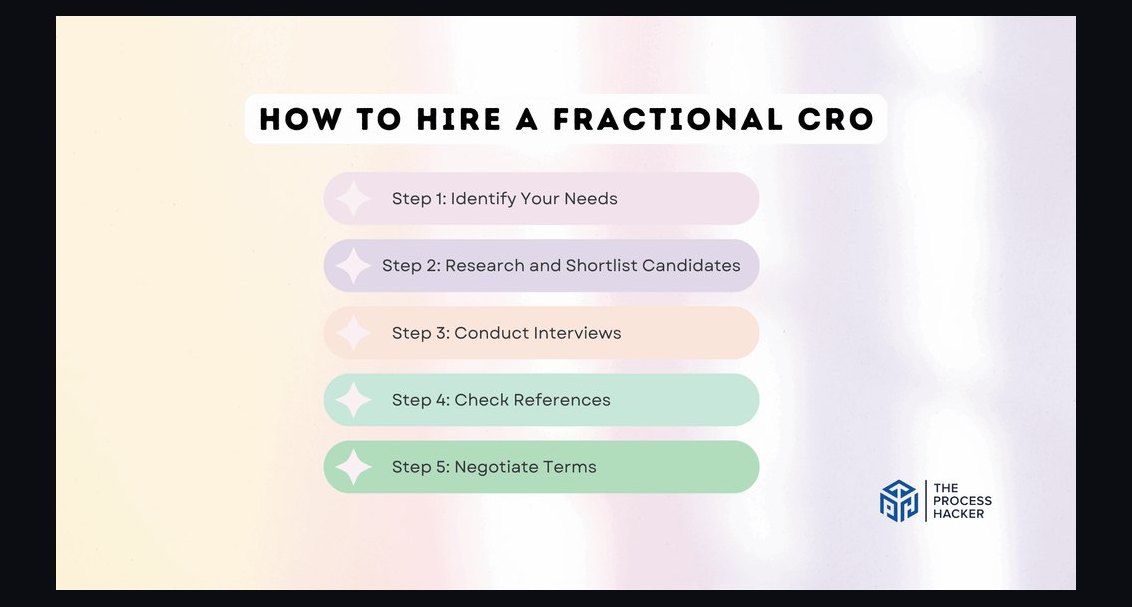
Not every fractional CRO is good at playbook building. Plenty excel at pipeline management, board reporting, or team coaching and have never written a structured playbook from a blank page. Vet for the specific job.
Ask for a table of contents. A credible candidate can send the structure of a playbook they've built within a day. If they can't produce one, they haven't done this.
Request a paid sample. Ask for one page of discovery questions specific to your industry, and pay for it. This is the highest-signal test available: it measures whether they can translate general pattern knowledge into your context, and paying for it means you get real effort rather than a sales artifact.

Interrogate the iteration story. Anyone can describe a first draft. Ask what changed between version one and version three. You want stories about sections they cut, sequences they rewrote, and ICP definitions that shifted after fifty deals. A candidate who only ever discusses the initial build is telling you they've never stayed long enough to see whether it worked.
Check references on behavior change, not satisfaction. Ask former clients three questions: Did reps actually use it? Did it change what they did day to day? Did any measurable number move? "It was a great document" is a failing answer.
Verify stage and motion match. Someone who has only built enterprise playbooks will overweight your qualification stages and overwhelm a self-serve motion. Someone who has only done SMB will underbuild your stakeholder strategy. Adjacent-vertical experience is usually fine; adjacent-*motion* experience often isn't.
Define measurement before you sign. Agree on what "working" means: qualified pipeline per rep, demo-to-proposal conversion, average deal size, cycle length. Establish the pre-engagement baseline in writing, even if the baseline is embarrassing. Without it, you'll argue about results in month four with no shared facts.
Two traps worth naming. First, the template reuse trap: some operators repackage a playbook built for a similar company with the product name swapped. Ask for a sample with real scripts and objection responses; if it reads generic, push back. Second, the no-data-review trap: insist the candidate spends meaningful time in your CRM history before writing scripts. If your data shows prospects who get a demo within twenty-four hours of requesting one convert materially better, the playbook should mandate that timing — and only a data review surfaces that.
A realistic week-by-week build
Founders often assume the fractional CRO disappears for a month and returns with a document. A real engagement is participatory, and your responsiveness is the main variable in the timeline.
Weeks one and two — discovery and data harvesting. They interview everyone who has sold your product, even if that's only you. They pull CRM data: call volumes, email response rates, closed-lost reasons, cycle lengths by segment. They review recorded calls if any exist, study competitor positioning, and map your current buyer journey as it actually is rather than as your deck describes it. Deliverable: a current-state audit and gap analysis. Expect it to be uncomfortable reading.
Weeks three and four — framework design. ICP refinement, personas, objection library skeleton, discovery question bank, demo flow, pricing guidelines, handoff criteria. This is also the right window for live call shadowing if you're buying it — the CRO sits in on three to five real discovery calls or demos, hears the objections firsthand, and adjusts in real time. If you have no sales experience at all, this single addition improves playbook quality more than any other line item. Not every fractional operator offers it; ask during vetting. Deliverable: playbook outline with example scripts.
Weeks five and six — scripting and sequencing. Actual scripts, email templates, call flows, branch logic, competitor-specific responses. You test the scripts against three to five live prospects and report back. Deliverable: working draft, roughly eighty percent complete.
Weeks seven and eight — training and handoff. A two-to-three-hour working session with whoever will run the plays, a one-page cheat sheet, and a documented process for quarterly updates including who owns it. Deliverable: final playbook, recorded training, update cadence.
That timeline assumes you grant CRM access promptly, schedule interviews without a week of back-and-forth, and test scripts within forty-eight hours. Every bottleneck on your side pushes delivery out one to two weeks. A good operator builds in buffer and flags slippage early rather than absorbing it silently.

When a fractional CRO is the wrong answer
Four situations where the honest answer is no.
You're pre-product-market-fit. If you're still changing your core value proposition every six weeks, a playbook is premature. You need demand validation first — founder-led selling with deliberate experimentation, not a documented process. A good fractional CRO will tell you this and decline the engagement rather than take money for a document you can't use.
You need someone to carry a bag. Covered above, but worth repeating because it's the most common mismatch. If the real need is closed revenue this quarter, hire a closer.
Your product is extremely technical or niche. Selling to nuclear engineers, clinical researchers, or semiconductor fabs requires domain fluency a generalist can't fake. Look for someone with adjacent-vertical experience, and if nobody credible exists, a domain-expert consultant paired with a structural template may beat a generalist CRO.
You have no execution budget. The CRO builds the engine; you need fuel. Without at least a part-time SDR, a junior rep, or your own committed selling hours, the playbook sits unused. This is the failure mode nobody predicts and everyone recognizes in hindsight.
There's a fifth, softer case: you already have a competent VP of Sales who just needs structural guidance. Then you don't need a fractional CRO — you need a playbook framework, a peer network, and maybe a few advisory hours. The fractional model earns its cost when you have no revenue leadership at all.
Measuring whether it worked
Define success before the engagement starts, then hold the line on those metrics rather than inventing flattering ones later.
Track four numbers monthly against the pre-engagement baseline: qualified pipeline generated per selling head, conversion rate from first meeting to proposal, average deal size, and sales cycle length. Ninety days after the playbook lands is the earliest fair read — anything sooner is noise, since deals in flight when the playbook shipped were sold under the old process.
Expect uneven movement. Cycle length often gets *worse* first, because a real qualification framework makes reps disqualify prospects they previously would have dragged through three meetings. Pipeline quantity may drop while pipeline quality rises. That's a healthy signal, not a failure, and it's why you track four metrics rather than one.
The leading indicator that matters most is adoption. If reps aren't opening the playbook, referencing the objection library, or following the sequence branches, no downstream metric will move regardless of document quality. Check adoption at week two, not month three. Low adoption usually means the playbook is too long, too generic, or not wired into the tools reps actually work in — all fixable, but only if you catch it early.
Finally, protect against the abandonment failure. Build the handoff into the contract: a named owner for the playbook, a quarterly review date on the calendar, and a documented update process. If the engagement ends without those, you own a document with no capability to evolve it, which decays to worthless within two or three quarters.
Related questions
What's the difference between a fractional CRO and a VP of Sales for a first sales hire?
A fractional CRO designs the system part-time and transfers knowledge. A VP of Sales owns a quota, hires and manages reps, and works full-time in your pipeline. Build the playbook first with the fractional operator, then hire the VP to execute and scale it.
How long should a first playbook engagement run before you re-evaluate?
Three to six months. Four to eight weeks produces the draft; the remaining time covers testing, iteration, and training. Anything under three months rarely survives contact with real deals, since you won't have enough closed cycles to validate assumptions.
Can a fractional CRO help hire and onboard my first full-time rep?
Usually yes, and it's a natural extension — scorecard design, interview loops, ramp plans, and first-90-day milestones. Ask whether it's in scope during negotiation; it often sits outside a playbook-only engagement and gets billed separately.
Do fractional CROs work with pre-revenue companies that have no CRM data?
Yes, but the output is explicitly a hypothesis built on industry patterns rather than your data. Expect every assumption flagged and a ninety-day validation cycle attached. Plan a substantial rewrite after twenty to thirty real sales conversations.
When should you transition from a fractional CRO to a full-time one?
When the motion demonstrably repeats across multiple reps and the constraint shifts from "what do we do" to "who executes it daily." That usually coincides with hiring your third or fourth seller, not your first.
FAQ
What exactly is a fractional CRO?
An experienced revenue leader who works with your company part-time or on contract, typically a committed number of days per month rather than full-time hours. They bring chief-revenue-officer-level strategic experience without the salary, equity, and permanence of a full-time executive hire — a fit for early-stage companies that need senior thinking but can't yet justify a senior headcount.
How is a fractional CRO different from a sales consultant?
Ownership. A consultant delivers analysis and recommendations, then leaves. A fractional CRO is embedded in the team, takes accountability for outcomes, builds the actual artifacts, and often coaches reps directly. The practical test: a consultant tells you what to do, a fractional CRO does it with you and is measured on whether it worked.
Can a fractional CRO build a playbook if my product is very niche?
Only if they have experience in your vertical or a closely adjacent one. Their value is pattern recognition, and patterns don't transfer across buyer behaviors that differ fundamentally. For genuinely specialized products, look for someone who has sold to buyers with comparable purchasing processes even if the product category differs — process similarity matters more than product similarity.
How long does it take to build a first sales playbook?
A solid first draft takes four to eight weeks, depending on how much usable data you have and how fast you align on ICP. Iteration over the following two to three months turns the draft into something proven. Treat the four-to-eight-week deliverable as a starting position, not a finished product.
Is a fractional CRO worth it if I only need a playbook and no ongoing management?
Yes, provided you select someone whose model centers on knowledge transfer. The engagement should leave you with both a living document and the internal capability to maintain it — training, a cheat sheet, and a defined update process. If the operator's approach implicitly requires them to stay for the playbook to stay current, you've bought a subscription rather than an asset.
What happens if the engagement ends before the playbook is fully tested?
This is why the contract should include a handoff plan and a quarterly review clause from the start. You want a named internal owner, a one-page reference, and a documented update process before the final invoice. Negotiate this during vetting and get it in writing — retrofitting a handoff after someone has moved on rarely works.
Sources
- Harvard Business Review — sales management and go-to-market research
- First Round Review — early-stage startup sales guidance
- SaaStr — SaaS sales, pricing, and growth benchmarks
- Pavilion — community and education for revenue leaders
- RevOps Co-op — revenue operations practitioner community
- OpenView Partners — SaaS benchmarks and go-to-market research
- MIT Sloan Management Review — sales strategy and organizational research
- Gartner — B2B buying behavior and sales research
Related on PULSE
- [Does a PE-backed martech company need a fractional CRO?](/knowledge/tl13255)
- [Does a bootstrapped edtech company need a fractional Chief Revenue Officer?](/knowledge/tl16296)
- [Does a founder-led government contracting company need a fractional Chief Revenue Officer?](/knowledge/tl16576)
- [Does a manufacturing company need a fractional CRO or a full-time CRO?](/knowledge/tl10475)
- [Should I hire a fractional Chief Revenue Officer for a first RevOps build?](/knowledge/tl20305)
This page will be disappearing soon. Save it to your device for $1 — or read it free while it is here.
@Kory-White- · if Venmo asks, the last 4 of my number are 2012
 pulse-toolsShould I Hire a Fractional CRO If I Need to Build a Partner Channel in 2027?
 pulse-toolsHow much does a fractional Chief Revenue Officer cost for a $1M to $5M ARR company in 2027?
 pulse-toolsWhere do I find a fractional head of revenue in Tulsa in 2027?
 pulse-toolsWhat does a fractional CRO cost in Fulton in 2027?
 pulse-toolsHow do I find a fractional CRO in Christiana in 2027?
 pulse-toolsHow do I find a fractional CRO in Oakton in 2027?
 pulse-toolsWhere do I find a fractional head of revenue in Reston in 2027?
 pulse-toolsWhat should an SMB company look for in a fractional CRO in 2027?
 pulse-toolsIs there a fractional CRO available near me in the Gulf Coast in 2027?
 pulse-toolsWhere do I find a fractional VP of Sales in Delaware?