
Should I Hire a Fractional CRO If I Need to Fix Broken Lead Routing and Handoffs?
 Curated byKory White · Fractional CRO · Maryland
 PULSEKNOWLEDGE LIBRARY
Quality
Certified

Yes—broken lead routing and handoffs are a systems problem, and a fractional CRO who has rebuilt this workflow elsewhere can usually fix it in weeks, not months. Budget a retainer for 2-5 days per week over a 3-month engagement. It works only if you give them real authority to change CRM rules, assignment logic, and SLAs.
The job this tool/role is hired to do
A fractional Chief Revenue Officer brought in to fix Broken lead Routing and Handoffs is not hired to run a strategy offsite or draft a five-year vision. The job is narrow and mechanical: trace every lead from the moment it hits a form, ad click, or inbound call, through the CRM, into an assignment queue, and out to a human who is supposed to respond. Somewhere in that chain, leads are getting lost, misassigned, or delayed long enough that the prospect has already moved on. The fractional CRO's job is to find exactly where that happens and rebuild the mechanism.
This is different from a generic "sales consultant" engagement. A consultant might give you a slide deck of recommendations and leave. A fractional CRO doing routing-and-handoff work should be hands-on inside your CRM, working with your admin (or acting as the admin), rewriting assignment rules, and setting up the alerting that catches failures in real time. The deliverable is not advice — it is a working system, plus proof that it works.

Concretely, the job usually breaks into four pieces. First, a data hygiene pass: pulling CRM records to find duplicate leads, missing required fields (company size, industry, role, phone number), and stale territory or industry tags that make automated Routing logic fail silently. It is common for 20-40% of leads at a mid-size B2B company to be misrouted because of exactly this kind of stale metadata, not because the routing logic itself is wrong. Second, a timing audit — measuring, using CRM timestamps, how long it actually takes from lead creation to first human touch. If that number is regularly north of 30 minutes for inbound leads, the handoff is Broken regardless of what the org chart says. Third, a rules rewrite: replacing naive round-robin assignment with qualification-aware routing, so a 500-employee enterprise inbound demo request does not land in the same queue as a content-download from a student. Fourth, an enforcement layer — SLA timers, escalation alerts, and manager dashboards that make the new rules stick instead of quietly decaying back to the old habits within a month.
The fractional CRO should treat this as a systems-and-behavior problem, not just a systems problem. Rewriting the routing logic is the easy half. The harder half is getting SDRs, AEs, and marketing to actually follow the new process — which is why the role also includes coaching, feedback loops, and accountability structures, not just CRM configuration.

How it fits the RevOps stack
A fractional CRO fixing Routing and Handoffs does not operate in isolation — the fix has to sit correctly inside your existing RevOps stack, touching marketing automation, the CRM, a routing layer (native CRM rules or a dedicated tool), and whatever notification and reporting tools your SDR team already uses. If the fractional CRO redesigns routing logic without accounting for how leads actually enter the stack (marketing automation platform, form fills, chat, inbound calls, partner referrals), the fix will look good on a whiteboard and fail in production.
The practical fit typically looks like this: marketing automation and lead capture tools feed the CRM, which is the system of record. Inside the CRM, either native rules or a bolt-on routing tool (commonly LeanData, Chili Piper, or a custom workflow built on the CRM's automation engine) makes the assignment decision. That decision triggers a notification to the assigned rep and starts an SLA timer. If the timer expires without a logged first-touch activity, an escalation fires to a manager or reassigns the lead. Every one of those steps needs to write back to the CRM so marketing can see what happened to the leads it generated — closing what is often the most damaged part of the stack: the feedback loop between marketing and sales.

Where the fractional CRO adds value is in owning the seams between these systems, not any single tool. Most internal teams own one piece each — marketing owns the automation platform, sales ops owns the CRM, SDR managers own the queue — and nobody owns the handoffs between them. A fractional CRO with cross-functional authority can sit above all three, which is precisely the authority a mid-level RevOps analyst or CRM admin usually lacks. If your company already has a strong, empowered RevOps function, some of this work may not require an outside hire at all; if RevOps is thin, siloed, or nonexistent, the fractional CRO effectively acts as interim RevOps leadership focused on this one workflow.
Pricing, engagement models, and typical ranges
Fractional CRO pricing for a routing-and-handoff fix is not a single number — it moves with days committed per week, scope, and company stage. As a general guide, day rates for an experienced U.S.-based fractional CRO commonly fall in the range of roughly $1,500-$3,000 per day, translating into a monthly retainer that scales with how many days per week you commit. A narrowly scoped engagement — audit, redesign routing rules, implement, and train — running 2 days per week for 3 months is the lower end of the spectrum. A broader engagement that also includes ongoing pipeline management, weekly forecast reviews, and SDR coaching at 4-5 days per week sits at the higher end.

Three variables drive the actual number you will be quoted. Days per week is the biggest lever: a 2-day/week engagement covers audit-and-design work but leaves implementation to your internal team, while 4-5 days/week means the fractional CRO is embedded enough to do (or directly supervise) the CRM changes themselves. Scope is the second lever — a pure routing-and-handoff fix is materially cheaper than a mandate that also covers comp plan redesign, hiring, or full pipeline ownership. Company stage is the third — early-stage companies under roughly $2M ARR sometimes negotiate a lower cash rate or a small equity component, while later-stage companies pay closer to full market rate because the fix touches more reps, more territories, and more historical CRM debt.
Most routing-and-handoff engagements run 3-6 months. The first 2-4 weeks are audit and diagnosis; the middle stretch is implementation, typically requiring direct or supervised CRM admin access; the final weeks are training and stabilization. At the end of that window, one of three things happens: the engagement ends because the fix is stable and documented, it converts into a lighter ongoing advisory retainer (often a handful of hours per month), or — if the underlying problem turns out to be bigger than routing — the fractional CRO recommends a CRM migration or a full-time VP of Sales hire and helps run that search. Treating the fractional engagement as open-ended rather than milestone-based is one of the most common ways companies overpay without getting a fix that sticks.

How to evaluate and shortlist
Because "fractional CRO" is not a licensed or standardized title, evaluating candidates for a routing-and-handoff mandate specifically requires asking questions that expose whether someone has actually rebuilt this workflow versus someone who can talk about revenue strategy in the abstract. Generic sales-leadership charisma does not translate into knowing how to write a routing rule inside your specific CRM.
Ask for a walkthrough of a specific past fix: "Walk me through how you diagnosed and fixed a Broken handoff at a company using [your CRM]." A strong candidate answers with specifics — which fields they audited, what the routing logic looked like before and after, how they measured improvement — not vague language about "alignment" or "culture." Ask what tools they use for routing; a candidate who only names one platform without being able to compare native CRM automation against a dedicated tool like LeanData or Chili Piper likely has shallow experience. Ask how they enforce SLAs once they are defined; the answer should involve concrete mechanisms — automated alerts, manager dashboards, escalation chains — not "we hold people accountable." Ask what data fields they require before routing logic can work reliably; someone who has done this before will immediately list company name, role, company size, industry, and some form of intent signal.

Beyond the interview, insist on a 30-day diagnostic milestone before committing to the full engagement. A capable fractional CRO should be able to deliver a written audit of your current routing and handoff process, specific proposed changes, and a realistic implementation timeline within the first 30 days. If a candidate cannot commit to that milestone, or the audit they deliver reads as generic best-practices rather than specific to your CRM and your data, that is a signal to keep shortlisting rather than sign a longer contract. Also check references specifically for routing and handoff work — a reference who can only speak to strategic advising, not hands-on CRM rebuilding, is not validating the skill you actually need.
Before you even get to interviews, be honest about a precondition: if your CRM has more than roughly 20-30% duplicate or incomplete records, no fractional CRO can route cleanly on top of that mess. Fixing data hygiene has to be sequenced first or in parallel, not treated as an afterthought.

Buyer decision framework
Not every company with slow lead response times needs a fractional CRO, and not every fractional CRO engagement will actually solve the problem. The decision comes down to three questions: is the root cause operational (routing, data, SLAs) or cultural (reps ignoring leads, no accountability); do you have someone internally with the bandwidth and authority to fix it; and is your growth trajectory stable enough that a 3-6 month fractional engagement makes more sense than jumping straight to a full-time hire.
If the problem is culture rather than mechanics — reps who ignore assigned leads regardless of how clean the routing is — a fractional CRO cannot fix that with better CRM rules alone; that requires management action from your CEO or VP of Sales first. If your company is growing 20%+ month over month, you risk outgrowing a fractional arrangement within 6-12 months and may be better served hiring a full-time leader now, using the fractional CRO only as a bridge to run that search. If the core issue really is Routing and Handoffs mechanics and you lack internal bandwidth or CRM expertise to fix it yourselves, a fractional CRO is typically the fastest, lowest-risk path.

One useful gut-check before committing budget: run a 2-week manual experiment where SDRs follow up on every new lead within 30 minutes using nothing more than a shared spreadsheet, no routing system involved. If conversion improves sharply, the problem is confirmed to be routing and process, which a fractional CRO can fix quickly. If it does not improve, the deeper issue is lead quality or team execution, and a routing fix — fractional or otherwise — will not move the number you actually care about.
Related questions
How do I know if my lead routing problem is operational or cultural?
Run a manual 2-week test: have reps follow up on every lead within 30 minutes using a spreadsheet, no routing tool involved. If conversion jumps, it's operational. If it doesn't change, the issue is team execution or lead quality, not routing.
What metrics should I track to measure routing improvement?
Track time-to-first-touch, percentage of leads contacted within your SLA window, misassignment rate (leads reassigned after initial routing), and lead-to-meeting conversion rate before and after the fix.
Can a fractional CRO fix routing regardless of which CRM I use?
Generally yes — the principles (qualification-based assignment, SLA enforcement, feedback loops) are CRM-agnostic, though implementation details differ between Salesforce, HubSpot, and Pipedrive, so ask candidates about experience in your specific platform.
How do I transition from a fractional CRO to a full-time VP of Sales?
Use the fractional engagement's final month to document the system, then have the fractional CRO help write the job description and interview candidates, handing off a stable, documented process rather than a half-finished fix.
What routing tools work best for B2B companies under 5M ARR?
Smaller companies often start with native CRM automation before investing in a dedicated tool like LeanData or Chili Piper, since a dedicated routing tool adds cost and complexity that may not be justified until lead volume grows significantly.
FAQ
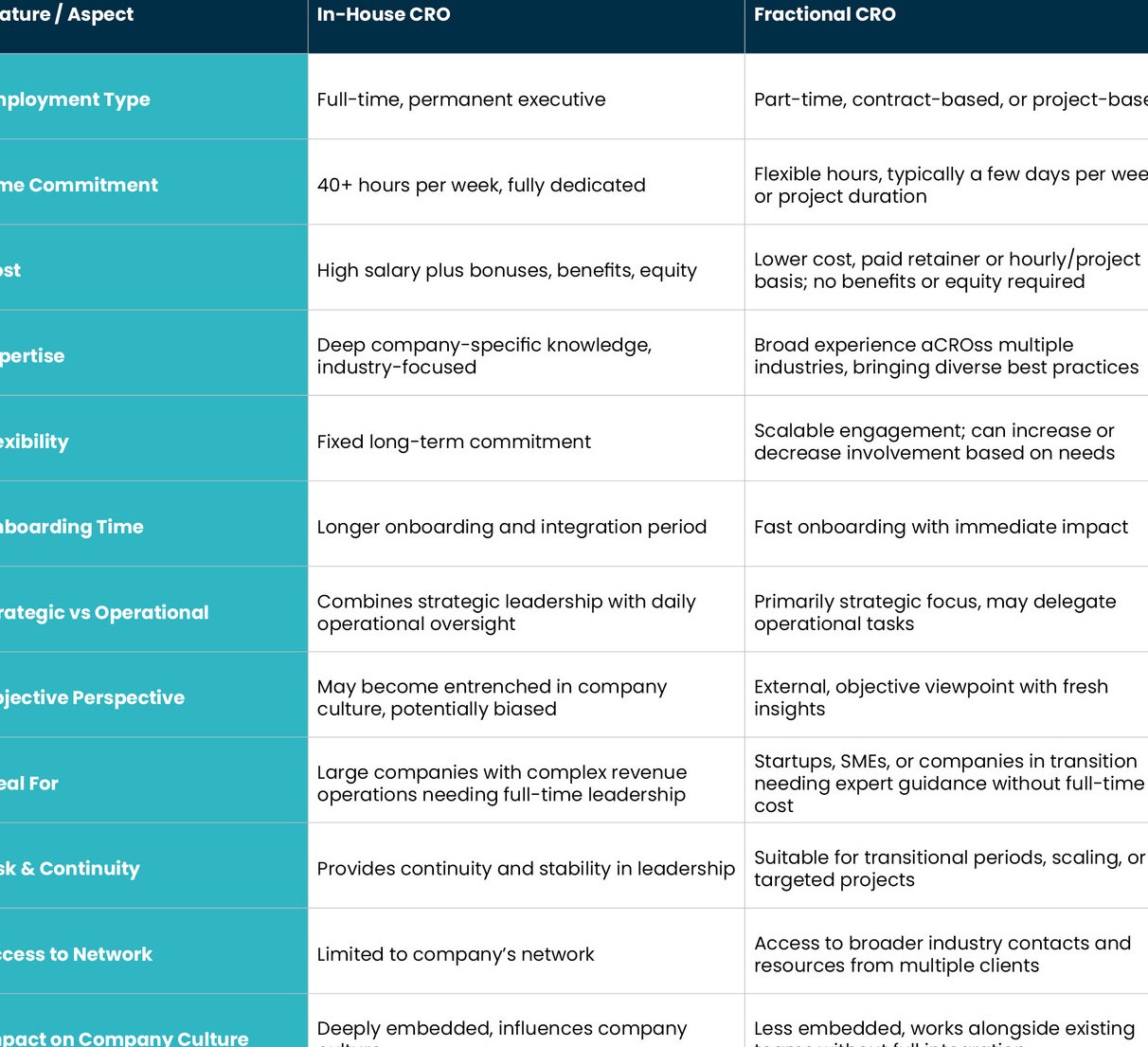
What exactly is a fractional CRO? A fractional CRO is an experienced revenue executive who works with a company on a part-time, contract basis — typically 2-5 days per week — taking on the strategic and operational responsibilities of a Chief Revenue Officer without the cost or commitment of a full-time hire.
How quickly can a fractional CRO fix Broken lead Routing? Because they have rebuilt similar workflows elsewhere, a fractional CRO can often complete diagnosis and implementation in a matter of weeks rather than months, bringing ready-made playbooks for CRM rules, assignment logic, and Handoffs SLAs.
Will a fractional CRO actually have the authority to change our CRM and process? Only if you grant it explicitly — CRM admin rights, authority to change SLAs without committee approval, and access to sales team calendars. Without that authority, the engagement becomes advisory rather than operational, and routing rarely gets fixed.
Is hiring a fractional CRO only sensible for small companies? No. It is especially cost-effective under roughly $5M ARR, but larger companies also use fractional CROs to solve a specific operational problem or to lead the search for a permanent revenue leader while keeping day-to-day routing issues from festering.
How do I know if my routing problem is severe enough to justify this hire? If leads are reaching the wrong reps, sitting unassigned for days, or disappearing entirely, and your internal team has not fixed it in a few weeks of trying, that is a strong signal an outside operator with a proven playbook is worth the cost.
What happens after the fractional CRO fixes the routing? Common outcomes are ending the engagement once the system is stable, converting to a lighter ongoing advisory retainer, or using the fractional CRO to help recruit and onboard a permanent full-time sales or revenue leader.
Sources
- SaaStr – B2B Sales and Revenue Operations
- Pavilion – Community for Revenue Leaders
- RevOps Co-op – Revenue Operations Community
- Harvard Business Review – Sales Process and Organization
- Gartner – Sales Operations Research
- Forrester – B2B Revenue Growth Research
- Winning by Design – Revenue Architecture
- The Bridge Group – Sales Development Research
Related on PULSE
- [Does a PE-backed martech company need a fractional CRO in 2027?](/knowledge/tl13255)
- [Should I hire a fractional CRO in Bethany Beach in 2027?](/knowledge/tl20031)
- [Does a bootstrapped edtech company need a fractional Chief Revenue Officer in 2027?](/knowledge/tl16296)
- [Does a founder-led government contracting company need a fractional Chief Revenue Officer in 2027?](/knowledge/tl16576)
- [Should I hire a fractional Chief Revenue Officer in Clinton in 2027?](/knowledge/tl20305)
- [Does a manufacturing company need a fractional CRO or a full-time CRO in 2027?](/knowledge/tl10475)
This page will be disappearing soon. Save it to your device for $1 — or read it free while it is here.
@Kory-White- · if Venmo asks, the last 4 of my number are 2012
 pulse-toolsWhere do I find a fractional VP of Sales in Pennsylvania?
 pulse-toolsHow much does a fractional Chief Revenue Officer cost for a $1M to $5M ARR company in 2027?
 pulse-toolsWhere do I find a fractional VP of Sales in New Jersey?
 pulse-toolsShould I Hire a Fractional CRO If I Need to Build a Partner Channel in 2027?
 pulse-toolsHow do I find a fractional CRO for a life sciences company in Central Texas in 2027?
 pulse-toolsHow do I find a fractional CRO in Seaford in 2027?
 pulse-toolsHow do I evaluate a fractional CRO in South Florida in 2027?
 pulse-toolsHow much does a fractional CRO cost for a real estate company in 2027?
 pulse-toolsHow do I evaluate a fractional CRO in San Diego in 2027?
 pulse-toolsWhere do I find a fractional revenue leader in Santa Monica in 2027?