
Should I Hire a Fractional CRO If I Am Moving Upmarket and Deals Got Complex?
 Curated byKory White · Fractional CRO · Maryland
 PULSEKNOWLEDGE LIBRARY
Quality
Certified
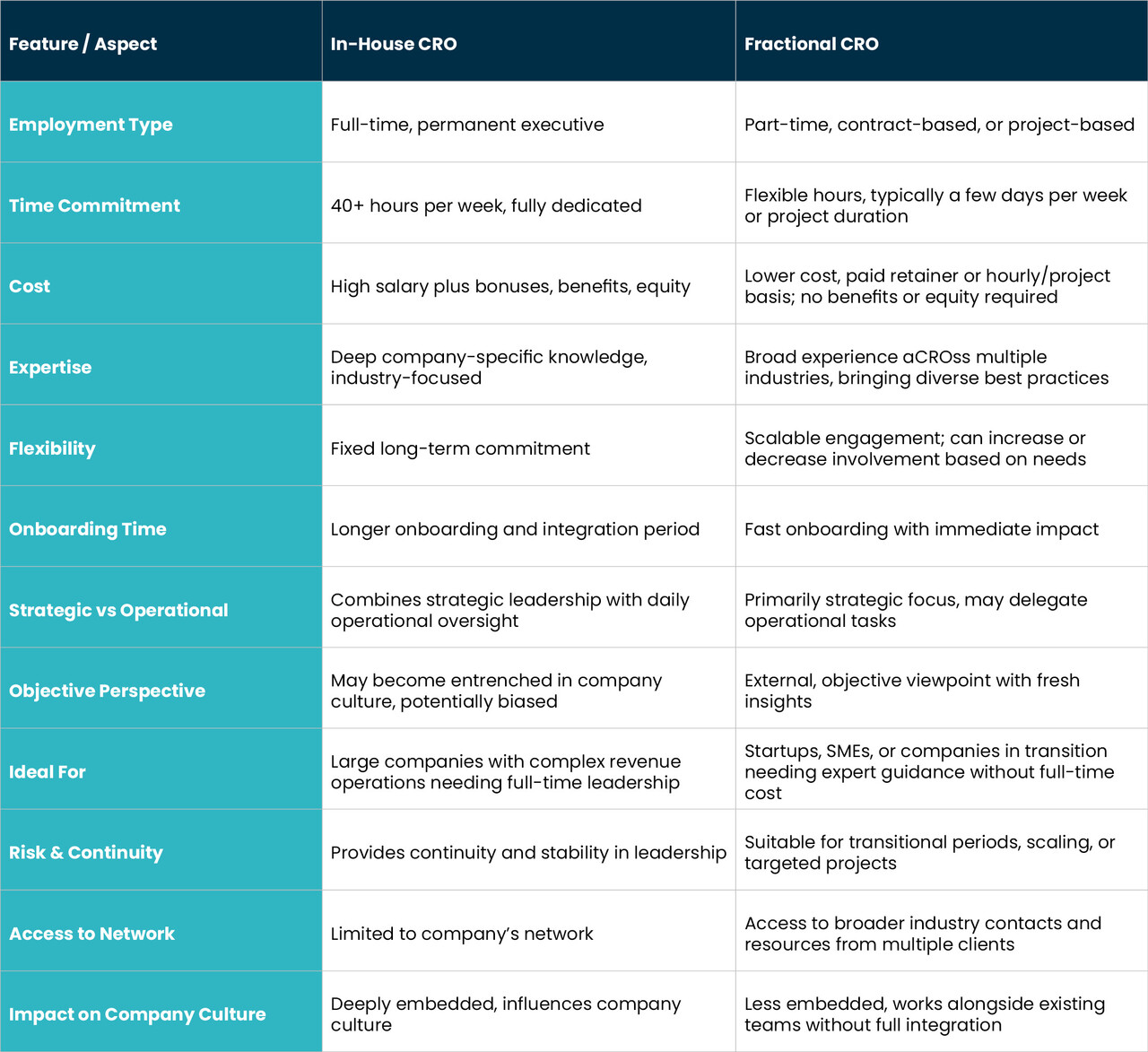
If you are moving upmarket and your deals have grown longer, multi-threaded, and technically complex, hiring a fractional CRO is often the right move — but only when you already have some revenue signal and need senior go-to-market architecture rather than more headcount. A fractional CRO gives you 10 to 20 hours a week of executive-level pattern recognition to redesign your sales motion, qualification, and forecasting for enterprise buyers, usually at a fraction of a full-time base salary. The wrong time to hire one is when the real problem is product-market fit, cash runway, or a founder who has not yet sold the first ten deals personally.
Going upmarket is not "the same sale, but bigger." Deal complexity changes the physics of your revenue engine: more stakeholders, longer cycles, procurement and security reviews, and a buying committee that can stall for reasons no rep can see. A fractional Chief Revenue Officer is a part-time, seasoned operator who has built and scaled these motions before. The question is not whether the title sounds impressive — it is whether a specific, diagnosable gap in your go-to-market system is one that senior experience solves faster and cheaper than a full-time hire or another individual contributor. This essay walks through when the answer is genuinely yes.
What does a fractional CRO actually do when deals get complex?
A fractional CRO is not a part-time closer you rent to work your pipeline. That is the single most common — and most expensive — misunderstanding. The role is architectural. When deals get complex, the failure points move upstream of the individual rep: qualification lets bad-fit deals in, discovery misses the economic buyer, forecasts become fiction because nobody can map the buying committee, and the founder becomes the bottleneck on every deal over a certain size. A fractional CRO diagnoses which of those failure points is actually costing you revenue and rebuilds the system around it.

In practice, the first 90 days usually look like a forensic audit followed by a rebuild. They will pull apart your closed-won and closed-lost deals to find the real patterns, rewrite your qualification framework for enterprise buyers, install a deal-review cadence, and often introduce a formal methodology like MEDDIC or Command of the Message so that "complex" becomes a repeatable process instead of heroics. They also coach your existing sellers and sales leaders — a fractional CRO who does not make your current team better is just an expensive contractor. Much of the value is in the questions they force you to answer: who is the economic buyer, what is the compelling event, what happens in legal and security review, and where do deals actually die. If your team cannot answer those crisply, that gap is exactly what you are buying help to close. For a deeper primer on the mechanics, see PULSE's breakdown of the fractional CRO operating model.
The upmarket-specific work is where a good fractional CRO earns their fee. Moving from SMB to mid-market or enterprise means your sales cycle can triple, your average contract value jumps, and a single stalled deal now materially moves the quarter. That shift demands multi-threading (selling to five or six people, not one champion), value-based pricing conversations instead of feature demos, and a forecast that accounts for procurement and legal drag. Someone who has personally carried an enterprise number and built the motion at another company brings that pattern library on day one, which is the entire point of buying seniority part-time instead of learning it live at full-time cost.

How do I know if the problem is my sales motion or something deeper?
Before you hire anyone, you have to diagnose honestly, because a fractional CRO cannot fix a problem that lives outside the revenue engine. The classic trap is hiring a revenue leader to patch what is actually a product-market fit gap. If deals are stalling because the product genuinely does not solve the enterprise buyer's problem yet, no methodology or forecast discipline will save you — you will just have a more organized way of losing. The tell is in the loss reasons: if you are losing to "no decision" and "not a priority" far more than to named competitors, the issue is usually value or fit, not execution.

The second trap is hiring for scale before you have a repeatable motion at all. If the founder has closed the first handful of complex deals but nobody has written down how, a fractional CRO is perfect — they codify the founder's intuition into a system. But if nobody, including the founder, has closed a genuinely complex enterprise deal yet, you are asking a part-time operator to invent product-market fit from the outside, and that rarely works. The honest question is: has this motion worked at least a few times, and do I just need to make it repeatable and hand it off? If yes, that is squarely the fractional CRO's job. PULSE covers the diagnostic in more depth under sales motion versus product-market fit.
The following decision flow captures the honest triage most founders skip.

Read that chart as a filter, not a formula. The two "no" branches near the top are where money gets wasted — founders skip them because hiring a senior title feels like progress. The genuine sweet spot is the middle: you have proof the complex deal can be won, you just cannot yet win it predictably or without the founder in every room.

When is a fractional CRO better than a full-time hire or a VP of Sales?
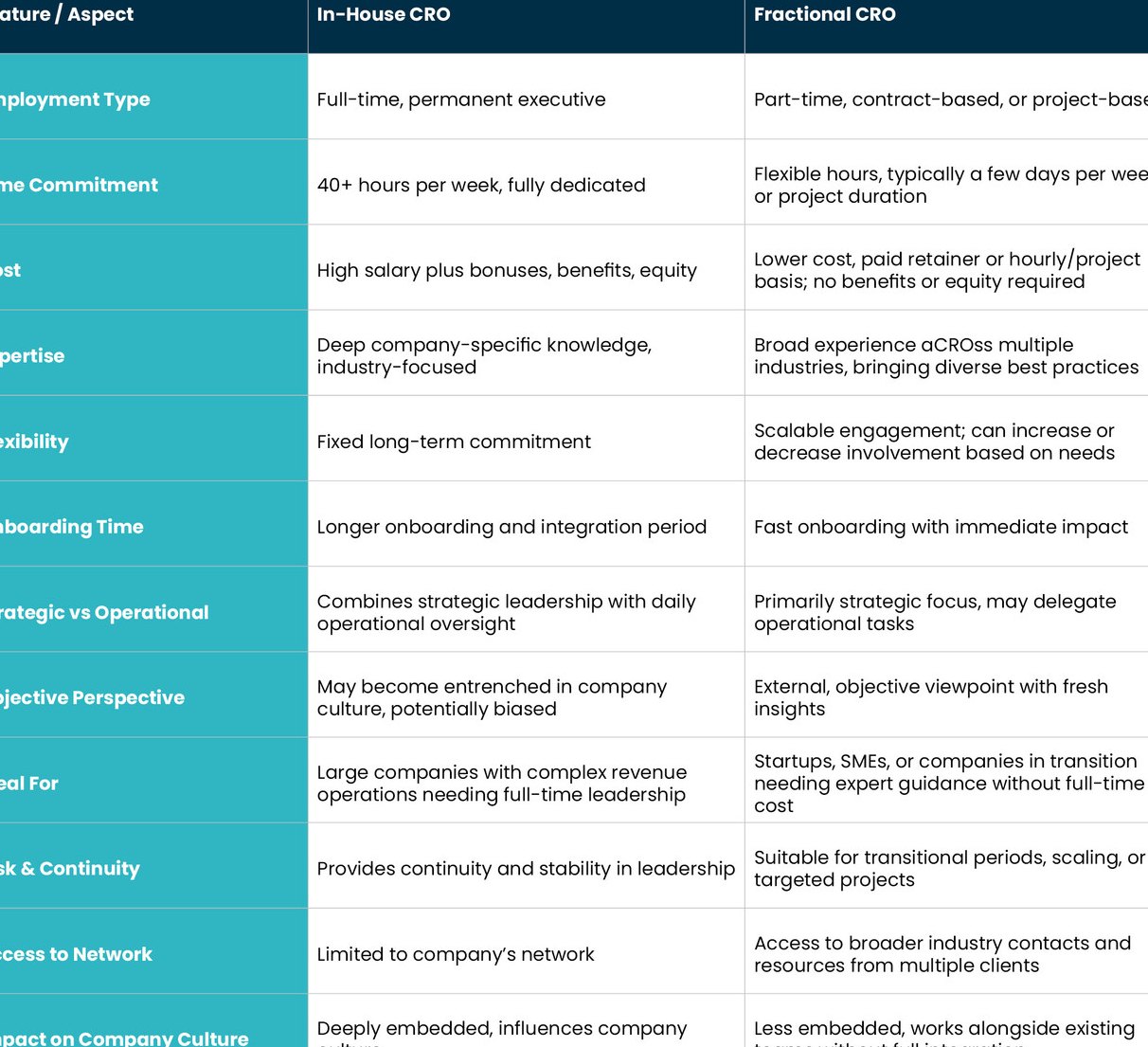
The economics are the easiest place to start, but they are not the whole story. A full-time CRO in the US commands a substantial base plus equity plus variable comp, and the fully loaded cost is well into six figures before they have closed a dollar. A fractional CRO typically engages for a monthly retainer covering 10 to 20 hours a week — real senior time, but a fraction of the full-time load. For a company doing a few million in revenue and still figuring out the upmarket motion, paying full freight for a name-brand CRO who is under-utilized is a classic over-hire. The fractional model matches the cost to the actual scope of the problem.
But cost is only half the argument. The deeper reason to go fractional is stage-fit. A great full-time CRO wants to build and lead a large organization — that is what pulls them in and keeps them. If your company only needs go-to-market architecture and part-time coaching for the next nine to twelve months, a full-time CRO will either get bored, over-build, or leave. A fractional operator is designed for exactly this window: senior enough to redesign the motion, flexible enough to leave once the system runs without them. The right sequencing is often fractional first to build the machine, then full-time once the machine justifies a leader to scale it.

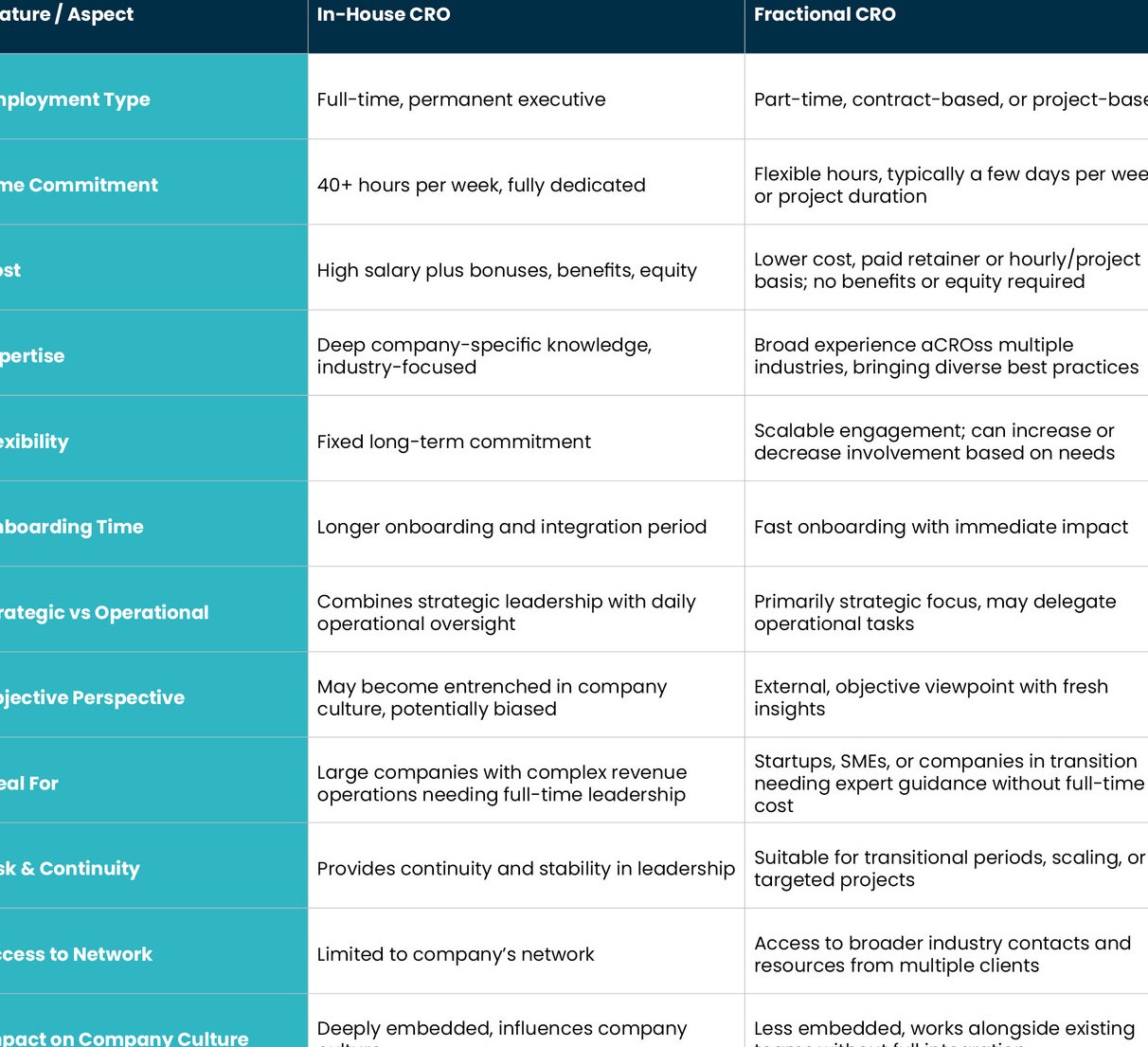
The distinction from a VP of Sales matters too. A VP of Sales is typically a builder-manager who owns quota attainment, hires and coaches reps, and runs the day-to-day. A CRO — fractional or not — owns the whole revenue system: sales, but also the handoffs to marketing and customer success, pricing, packaging, and the forecast the board sees. If your gap is "we have reps but no manager," you may want a VP, not a fractional CRO. If your gap is "our entire go-to-market wasn't built for enterprise and nobody senior owns that redesign," that is CRO-shaped work. The diagram below maps the trade-offs.

Use this as a scoping tool. If both the cost box and the part-time box under fractional describe your reality, and you do not yet need a full org built, fractional is very likely the correct first hire. PULSE's guide to revenue leadership sequencing walks through how companies chain these roles as they scale.
What should I expect in the first 90 days, and what does good look like?
Set expectations before the engagement starts, because a fractional CRO who is measured only on this quarter's bookings will optimize for the wrong things. The early value is diagnostic and structural, and much of it will not show up in the pipeline number for a full sales cycle — which, for enterprise deals, may be two or three quarters. A good engagement front-loads clarity: within the first month you should have a written diagnosis of where deals die, a rebuilt qualification and discovery framework, and a deal-review cadence that surfaces risk early instead of at quarter-end.

By the end of 90 days, "good" looks like a forecast you can actually trust, a documented sales motion that a new hire could follow, and at least a few complex deals moving through the new process with visible multi-threading and identified economic buyers. You should also see your existing team leveling up — better discovery questions, cleaner deal notes, more disciplined qualification. Leading indicators matter more than lagging ones this early: stage-conversion rates, meetings with economic buyers, and the shrinking of "no decision" losses tell you the system is working before the revenue confirms it.

Watch for two failure modes. The first is a fractional CRO who does everything themselves and builds no system — when they leave, you are back where you started. The second is analysis without installation: a beautiful strategy deck and no operational change in how deals actually run. The best operators leave behind assets — frameworks, playbooks, dashboards, a trained team — so that their departure is a graduation, not a relapse. Agree up front on what artifacts you will own when the engagement ends, and review them monthly.
How much should this cost, and how do I structure the deal?
Be precise about structure, because "fractional CRO" pricing varies widely and vague deals go bad. Most engagements are a monthly retainer tied to a defined time commitment and scope — commonly a set number of days or hours per week over a three-to-twelve-month term. Some operators layer in a performance component tied to specific, measurable outcomes like forecast accuracy or pipeline coverage, though tying part-time senior comp purely to bookings on a long enterprise cycle usually misaligns incentives. Avoid pure success-fee structures for this role; they push the operator toward short-term closing behavior and away from the system-building you are actually paying for.

Do not anchor on a specific dollar figure you saw in a blog post — rates depend heavily on the operator's background, your stage, and the scope. Instead, anchor on value and scope: what is the cost of another year of unpredictable enterprise deals versus the cost of senior part-time help to fix the motion. Structure the contract with a clear scope of work, defined deliverables and owned artifacts, a notice period, and a review checkpoint at 90 days where either side can adjust or exit. The goal is a relationship that ends cleanly when the machine runs on its own — which is the entire premise of hiring fractionally in the first place.
Related questions
Is a fractional CRO the same as a sales consultant?
No. A consultant typically advises and hands you a report; a fractional CRO takes operational ownership of the revenue motion, installs the changes, coaches the team, and is accountable for the system working — closer to an embedded part-time executive than an outside adviser.
Can a fractional CRO work if I already have a VP of Sales?
Yes, and it is common. The fractional CRO owns strategy, forecast, and cross-functional revenue architecture while the VP of Sales runs the team day-to-day. Clarify the boundary in writing so the VP is empowered, not undermined.
How long should a fractional CRO engagement last?
Most run three to twelve months. Long enough to diagnose, rebuild, and see leading indicators move through at least one enterprise sales cycle; short enough that it ends when the motion is repeatable and owned by your team.
Will a fractional CRO close deals for me?
Sometimes they will jump into strategic deals to model the motion or unblock a stalled enterprise opportunity, but that is coaching-by-doing, not their core job. If you need someone to carry a bag full-time, you want a rep or a VP, not a fractional CRO.
What is the difference between a fractional CRO and fractional VP of Sales?
Scope. A fractional CRO owns the entire revenue system across sales, marketing handoffs, pricing, and forecasting; a fractional VP of Sales focuses on building and running the sales team and its quota. Upmarket complexity usually needs the wider CRO scope.
FAQ
What size company hires a fractional CRO? Typically post-revenue companies from roughly a few million to the low tens of millions in ARR that are moving upmarket but not yet large enough to justify or afford a full-time CRO. Below that, founder-led selling usually still makes sense.
Does moving upmarket really require changing my sales process? Almost always. Enterprise buyers bring buying committees, procurement, security reviews, and longer cycles. A motion tuned for a single SMB decision-maker breaks under that weight — multi-threading, value selling, and formal qualification become necessary, not optional.
How is a fractional CRO paid? Usually a monthly retainer tied to a defined weekly time commitment and scope, sometimes with a performance component tied to measurable outcomes. Structures vary by operator and stage, so define scope, deliverables, and term explicitly in the contract.
What is the biggest risk of hiring a fractional CRO? Hiring one to fix a problem that is not a revenue-motion problem — product-market fit, runway, or a not-yet-proven complex deal. The second risk is an operator who does the work themselves and leaves no repeatable system behind.
Should I hire a fractional CRO or just promote my best rep? Your best rep may be a great future leader but rarely has the pattern library to redesign an enterprise go-to-market motion from scratch. A fractional CRO brings that experience and can coach your rep toward the leadership role over time.
How do I measure whether the fractional CRO is working? Track leading indicators early: stage-conversion rates, meetings with economic buyers, forecast accuracy, and shrinking "no decision" losses. Documented playbooks and a leveled-up team are the durable proof; bookings confirm it a sales cycle or two later.
Can a fractional CRO help with the marketing and customer success side too? Yes — that breadth is part of the CRO scope. Complex upmarket deals depend on tight handoffs between marketing, sales, and post-sale success, and a good fractional CRO aligns the whole revenue funnel, not just the closing motion.
When should I transition from a fractional to a full-time CRO? When the motion is repeatable, the team is scaling, and the revenue organization is large enough to need full-time leadership and continuous org-building. The fractional operator can often help you scope and hire their full-time successor.
Sources
- Harvard Business Review — Selling to the Buying Committee
- MEDDIC Academy — Enterprise Sales Qualification Methodology
- First Round Review — Scaling a Sales Organization
- SaaStr — When to Hire Your VP of Sales
- Gartner — B2B Buying Journey Research
- Bessemer Venture Partners — State of the Cloud
- OpenView Partners — Sales Benchmarks
- Winning by Design — Revenue Architecture
Related on PULSE
- [Should I Hire a Fractional CRO If My Founder-Led Deals Do Not Transfer to Reps in 2027?](/knowledge/tl0580)
- [Should I Hire a Fractional CRO If I Am Losing Deals to a Cheaper Competitor in 2027?](/knowledge/tl0554)
- [Should I Hire a Fractional CRO If My Deals Close Then Churn in Six Months in 2027?](/knowledge/tl0588)
- [Should I Hire a Fractional CRO If My Deals Keep Stalling in Procurement and Legal in 2027?](/knowledge/tl0553)
- [Should I Hire a Fractional CRO If I Am Moving From Founder-Led to Repeatable Sales in 2027?](/knowledge/tl0369)
- [Should I Hire a Fractional CRO If I Am Moving From SMB to Enterprise in 2027?](/knowledge/tl0362)
This page will be disappearing soon. Save it to your device for $1 — or read it free while it is here.
@Kory-White- · if Venmo asks, the last 4 of my number are 2012
 pulse-toolsShould I Hire a Fractional CRO If I Need to Stand Up RevOps From Scratch in 2027?
 pulse-toolsShould I Hire a Fractional CRO If I Need to Build My First Sales Playbook in 2027?
 pulse-toolsHow do I find a fractional CRO in Oakton in 2027?
 pulse-toolsHow do I find a fractional CRO for a life sciences company in Central Texas in 2027?
 pulse-toolsShould I Hire a Fractional CRO If I Need a 30-60-90 Plan Before a Board Meeting in 2027?
 pulse-toolsShould I Hire a Fractional CRO If I Need to Build a Partner Channel in 2027?
 pulse-toolsWhat does a fractional CRO cost in Fulton in 2027?
 pulse-toolsWhere do I find a fractional head of revenue in Charlotte in 2027?
 pulse-toolsWhere do I find a fractional head of revenue in Pasadena in 2027?
 pulse-toolsWhere do I find an interim CRO in Fort Lauderdale in 2027?