
Should I Hire a Fractional CRO If My Win Rate Is High but Volume Is Low?
 Curated byKory White · Fractional CRO · Maryland
 PULSEKNOWLEDGE LIBRARY
Usually yes — but hire the fractional CRO to fix demand generation, not closing. A high win rate with low volume means your motion converts and your funnel starves. A fractional CRO diagnoses whether the cause is pipeline generation, targeting, or a genuinely capped market, then builds the system. If your total addressable market is truly tiny, skip it.
What "high win rate, low volume" is actually telling you
Before the process, get the diagnosis language right, because the two numbers together mean something neither means alone. A 65% win rate on 8 opportunities a quarter is not the same business as a 65% win rate on 80. The first is a sample so small that a single lost deal swings the percentage 8 points; the second is a repeatable motion. When founders quote a win rate without quoting the denominator, they are quoting noise.
There are four distinct root causes that all present identically on a dashboard:
Demand generation is under-built. You have one working channel — usually referrals or the founder's network — and no second one. Volume is low because nothing systematic is feeding the top. This is the most common cause and the one a fractional CRO is genuinely built to fix.
Targeting is too narrow. Your ICP was defined three years ago around the first ten customers, and nobody has revisited it. There are adjacent segments — a neighboring vertical, a company-size band up or down, a different buyer persona inside the same account — that would convert nearly as well, but no one has tested them because the current definition still produces wins.
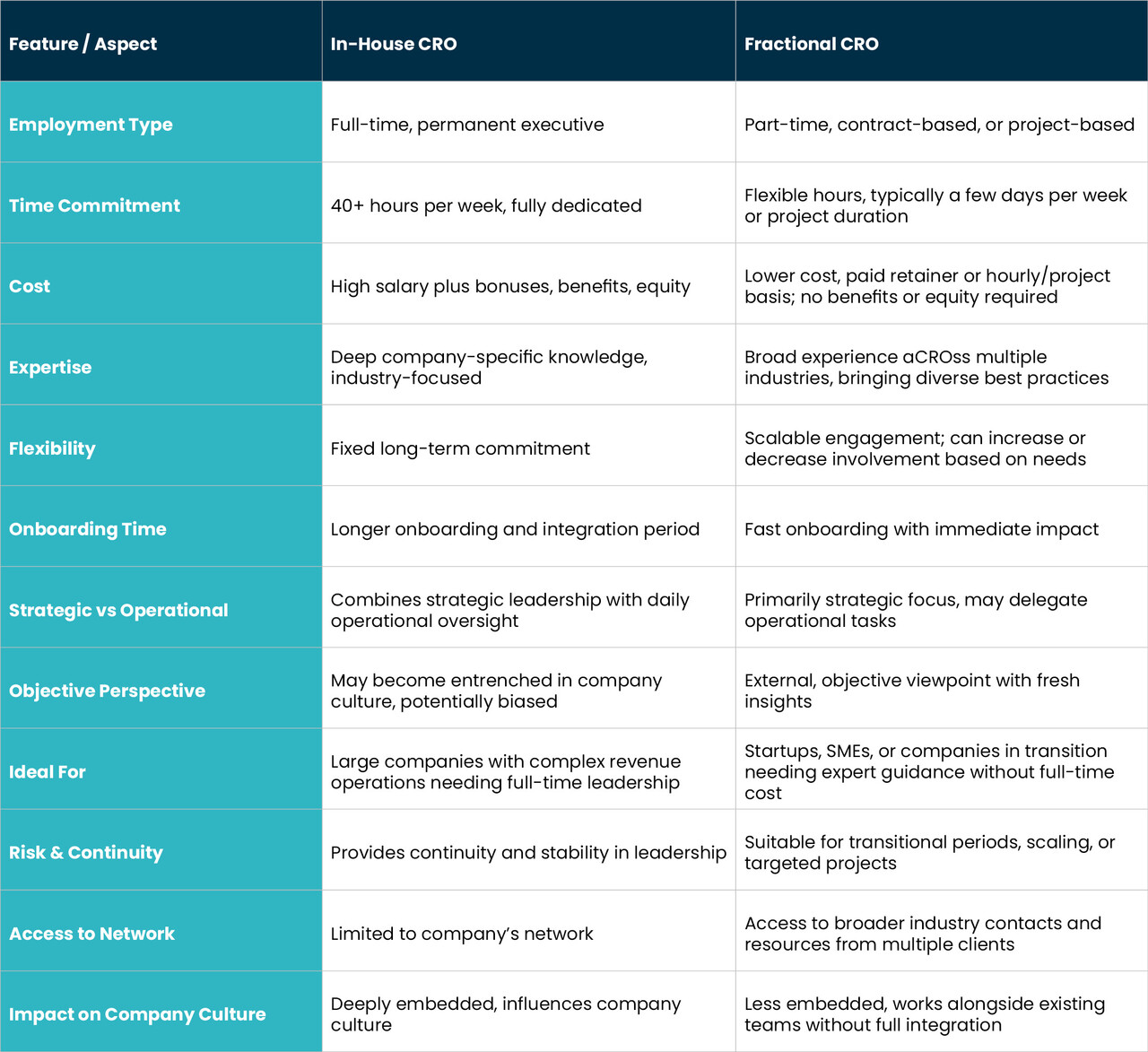
Qualification is over-tight. Reps are disqualifying anything that looks like work. The win rate is high because the pipeline is pre-filtered to near-certainties. This is the vanity case, and it's dangerous because it looks like excellence right up until the referral well runs dry.
The market is genuinely capped. You sell to 180 accounts in North America, you've talked to 90 of them, and 40 are customers. No leadership hire creates prospects that do not exist. This is the case where a fractional CRO is the wrong purchase and an honest one will tell you so in week three.
The diagnostic that separates these is cheap. Pull 12 months of CRM data and answer four questions: how many net-new opportunities entered per month and is that trending down; what percentage came from a single source; how many accounts in your ICP have you never contacted at all; and how many opportunities did each rep personally source versus receive. If one channel is above 70% of sourced pipeline, you have a concentration problem. If untouched ICP accounts exceed 60% of the list, you have a coverage problem, not a market problem. If reps sourced under 20% of their own opportunities, you have a prospecting-culture problem.
Run this before you talk to a single candidate. It costs a week of an analyst's time and it changes which of three very different hires you make. It also gives you a baseline — you cannot measure a 90-day engagement against a number you never wrote down.
The end-to-end process from diagnosis to decision
The engagement has a shape, and the shape matters more than the résumé. Fractional revenue leadership fails most often not because the operator was weak but because nobody defined what "done" looked like. Here is the sequence that works for the high-win-rate, low-volume case specifically, which is different from the standard fractional CRO playbook because you are not fixing closing — you are fixing supply.
Weeks 0–1, baseline lock. Before the operator touches anything, freeze the numbers: net-new opportunities per month for 12 months, win rate by source, average deal size, sales cycle length in days, and count of ICP accounts never contacted. Sign these as the baseline. Skipping this step is the single most common reason engagements end in an argument about whether they worked.
Weeks 1–4, diagnosis. Call recordings from won and lost deals, customer interviews with your three most recent wins and any churned accounts, a CRM hygiene audit, and an honest TAM count built from a real source list rather than a slide. The deliverable at week four is a written root-cause statement naming which of the four causes above is dominant, with evidence. Many operators sell this as a standalone paid discovery sprint, and buying only this is a legitimate, low-risk way to start.
Weeks 4–6, mandate. Convert the diagnosis into one measurable 90-day objective. "Increase net-new qualified opportunities from 12 to 20 per month via outbound and partner channels while holding win rate above 55%" is a mandate. "Help us grow" is not.

Weeks 6–12, build. Sequences, ICP refresh, lead scoring, partner motion, whatever the diagnosis pointed at. Critically, the fractional CRO designs and coaches; someone else executes volume. A part-time operator cannot personally send 400 emails a week, and if they try, you are paying executive rates for SDR labor.
Weeks 12–14, decision gate. Compare against the frozen baseline. Three outcomes: the system works and you convert to a longer engagement or hire full-time; the system works but needs an SDR to run it and you hire that instead; or the market is capped and you redirect the budget to product or partnerships.
Where this creates revenue and where it quietly leaks
The revenue case for fractional revenue leadership in this scenario is arithmetic, not vibes. You already know your conversion rate — that is the whole point of a high win rate. So every incremental qualified opportunity has a knowable expected value: opportunities × win rate × average deal size. If you win 60% of a $40,000 ACV product, each additional qualified opportunity is worth $24,000 in expected bookings. Six more per quarter is $144,000. That is the number the engagement has to beat, and unlike most consulting spend, you can calculate it in advance.
The leaks are more interesting because they're where these engagements actually die.

Paying executive rates for execution labor. The single biggest leak. A fractional CRO working ten days a month who spends six of them building lists and writing sequences is delivering SDR output at CRO cost. The fix is structural: the mandate says "design and coach," and you staff execution separately, even if that means a contractor or an agency for the first 90 days.
Volume that dilutes the win rate. If you triple outreach without tightening targeting, you fill the pipeline with poor-fit accounts, the win rate falls from 60% to 35%, and your reps burn cycles on deals that were never going to close. Watch win rate and opportunity count together on the same chart every week. A volume increase that drops win rate proportionally is not progress — total wins are flat and cost-per-win went up.
Forecast distortion during the ramp. New-channel pipeline behaves differently from referral pipeline. Referrals close fast because trust is pre-loaded; cold outbound takes 1.5x to 2x longer through the same stages. If you don't segment the forecast by source, month four looks like a disaster — pipeline is up, closed-won is flat, and someone declares the experiment failed six weeks before the first cohort was ever going to land.
RevOps debt surfacing all at once. Low volume hides bad data. When volume triples, every gap in your CRM becomes operationally expensive: stages that mean different things to different reps, no source attribution on half the records, lead scoring that was never tuned. Budget two to three weeks of RevOps cleanup inside the engagement or the reporting you use to judge it will be unreliable.

Founder pipeline never getting transferred. In most high-win-rate, low-volume companies, the founder is the best salesperson and the primary source. If the engagement builds a system that runs parallel to the founder rather than replacing founder-sourced pipeline, you've added cost without removing the bottleneck. An explicit transfer plan — founder-sourced share of pipeline drops from 70% to 40% over two quarters — belongs in the mandate.
The upstream effect worth naming: fixing supply changes what you need from marketing, from your data stack, and eventually from your hiring plan. Companies that solve the volume problem usually discover within two quarters that their next constraint is rep capacity, then implementation capacity, then support. Plan the engagement knowing it moves the bottleneck rather than removing it.
Concrete numbers and benchmarks to hold the engagement to
Pricing varies by market, scope, and stage, so treat any single figure as a starting point rather than a quote — but the structural ranges are stable enough to plan against.
Time commitment. Fractional CRO engagements typically run one to three days a week, most commonly quoted as 5–10 days a month. Below 4 days a month you get advisory only; above 12 you are approaching a part-time employee and should ask why you aren't hiring one.

Cost shape. Monthly retainers are the norm, with a diagnosis sprint often priced separately and shorter. Relative to a full-time CRO or VP of Sales — where total comp including variable and equity typically runs well into the low-to-mid six figures — a fractional engagement costs a fraction of loaded cost, but you should expect proportionally less coverage. Some operators take partial equity in lieu of cash; if you go that route, structure it with a vesting cliff tied to the mandate, not to time served.
Engagement length. Ninety days is the standard minimum and the right first commitment: 30 diagnostic, 30 build, 30 measure. Engagements that deliver a durable system tend to run 6–12 months. Anything sold as a 30-day fix is either advisory-only or overpromising.
Volume targets. Set them from your own denominator, not an industry average. If you currently generate 12 net-new opportunities a month, a defensible 90-day target is 18–20 — a 50–65% increase — with win rate held within 10 points of baseline. Doubling in one quarter from a cold start is rare when the channel is new and the sales cycle is long.
Timing expectations. Outbound sequences show reply-rate signal in 3–4 weeks. Meetings booked lag by another 2–3. First closed-won from a cold channel typically lands one full sales cycle plus 30 days after launch, so if your cycle is 60 days, that's roughly month four. Judge month three on leading indicators — contacts touched, reply rate, meetings booked, opportunities created — and month five or six on bookings.

Metrics to lock at baseline and re-measure at the gate. Net-new opportunities per month; win rate segmented by source; sales cycle by source; pipeline coverage against quota; founder-sourced share of pipeline; ICP accounts contacted as a share of total ICP; and cost per qualified opportunity. That last one is the honest ROI figure — it takes the full engagement cost plus tooling plus SDR labor and divides by qualified opportunities produced. Compare it to expected value per opportunity. If cost per qualified opportunity exceeds expected value per opportunity, the motion is not economic regardless of how the pipeline chart looks.
The TAM math that decides everything. Count real accounts, not a market-size slide. If your ICP contains fewer than roughly 200 accounts and you already have relationships with half of them, sales leadership cannot manufacture demand — your growth levers are pricing, expansion revenue inside existing accounts, adjacent segments, or product. If your ICP is 2,000+ accounts and you've touched 300, you have a coverage problem and the fractional hire is well aimed.
Pitfalls, and the moves that avoid them
Hiring a manager when you need a builder. The most common mis-hire. A candidate who ran a 60-person sales org at a company with a mature demand engine has never personally built pipeline from nothing. Ask for a specific story: a company under $10M ARR, a narrow market, what channels they stood up, what the opportunity count was before and after, and what broke. Vague answers about "scaling the team" are a signal they inherited pipeline rather than created it.
Never running the expansion experiment. If you suspect over-tight qualification, test it before you buy a system. For 30 days, have the team work 2–3x the normal number of prospects, deliberately including accounts they'd normally skip. If win rate holds near baseline, your bottleneck is purely volume and the fractional hire is correctly aimed. If it collapses, your win rate was cherry-picking and you have a qualification and messaging problem that more volume will make worse, not better. This experiment costs one month and reframes the entire decision.

No mandate, so the operator does whatever is loudest. Without a single written 90-day objective, a part-time executive drifts into firefighting — sitting in on deals, fixing the deck, coaching a struggling rep. All useful, none of it the thing you hired them for. One mandate, one number, reviewed weekly in 30 minutes.
Unclear decision rights. Write down who owns pricing, discounting, headcount, and product roadmap input. Standard split: the founder or CEO keeps veto on pricing, hiring, and product; the fractional CRO owns sales process, forecast discipline, coaching, and pipeline strategy. One page, signed, on day one. Ambiguity here is where month two turns political.
Buying strategy when you needed hands. If your two reps each carry 15 live deals and neither has an hour for prospecting, a beautiful outbound playbook will sit unopened. Capacity is the constraint. A part-time SDR or an outsourced outbound contractor may move your opportunity count more in 60 days than any strategist will, at a fraction of the cost. Reassess the leadership hire after the pipeline exists.
Ignoring a working viral or referral loop. If your wins come from customers referring customers, the highest-leverage work is making that loop faster — formalizing the referral ask, instrumenting it in the CRM, shortening onboarding time-to-value so referrals happen sooner. That's growth marketing and lifecycle work, not sales leadership. A fractional CRO can absolutely help you see this; they are rarely the best person to build it.

Letting the engagement end without a written verdict. Every engagement should conclude with a document: what we tested, what the numbers did against the frozen baseline, what we now believe about the market, and what the next hire should be. Companies that skip this repeat the same diagnosis 18 months later with a different operator.
Selection checklist before you sign
Work the decision as a filter, not a preference. Each gate below eliminates a wrong answer, and most companies stop before the last one — which is the point.
Gate 1 — Is the market real? Count ICP accounts from a source list. Under ~200 with heavy penetration: stop, this is a product, pricing, or expansion problem. Over that: continue.
Gate 2 — Is the win rate real? Run the 30-day expansion experiment or, at minimum, check the denominator. Fewer than 10 opportunities a quarter means your win rate is not yet a measurement. If the rate collapses under volume, fix qualification and messaging first.

Gate 3 — Is capacity available? If reps have zero prospecting hours, buy hands before strategy. If they have bandwidth and no system, buy the system.
Gate 4 — Is one channel over 70% of pipeline? Concentration risk is the clearest signal that a demand-generation builder pays for themselves.
Gate 5 — Can you write the mandate? If you cannot state the 90-day objective as a number, you are not ready to hire. Write it first, then interview against it.
Gate 6 — Does the candidate match the mandate? Builder versus manager, hands-on versus advisory, comfortable in your stack — CRM, sales engagement, conversation intelligence, revenue intelligence — and able to name a comparable-stage reference you can actually call.
Related questions
What is the difference between a fractional CRO and a VP of Sales here?
A fractional CRO works part-time on revenue strategy, demand generation, and go-to-market design. A VP of Sales is full-time and owns quota attainment and daily team management. When the bottleneck is supply rather than closing, the fractional option targets the actual constraint at lower cost.
Can volume increase without hurting my win rate?
Yes, if the increase comes from better targeting rather than broader spray. Refresh the ICP, tighten lead scoring, and expand into adjacent segments that resemble your best customers. Track win rate and opportunity count on the same chart weekly — proportional decline means you added volume, not revenue.
How long before results show?
Reply-rate signal appears in 3–4 weeks; booked meetings 2–3 weeks after that. First closed-won from a new cold channel typically lands one full sales cycle plus 30 days post-launch. Judge month three on leading indicators, month five or six on bookings.
Does this work with only two salespeople?
Yes, but capacity becomes the binding constraint fast. A fractional CRO can design the system; two reps carrying full deal loads cannot also run it. Plan to add SDR or contractor capacity alongside, or the playbook stays unopened.
Should I buy just the diagnosis first?
Often the smartest move. A 4–6 week paid discovery sprint produces a written root-cause statement for a fraction of a full engagement, and it may tell you the honest answer is a different hire entirely. Low risk, high information.
FAQ
Is a high win rate always a good sign?
Not by itself. It's only meaningful against a denominator. Sixty percent of ten opportunities a year is a small sample, not a proven motion. A high rate paired with thin volume frequently means the team is only pursuing near-certain deals, which caps growth and hides the reasons you lose the deals you never chase.
How do I tell a market-size problem from an execution problem?
Build a real account list — not a slide. If your ICP holds fewer than roughly 200 accounts and you've already engaged half, volume is structurally capped. If the list runs into the thousands and you've contacted a few hundred, the constraint is coverage and demand generation, which is exactly what this hire addresses.
What should the fractional CRO actually work on?
Auditing lead sources and channel concentration, refreshing the ICP and TAM, designing outbound and partner motions, cleaning RevOps data so reporting is trustworthy, coaching messaging, and writing a 90-day plan with owners and metrics. Not working your live deals — your team already wins those.
What if I can't afford a fractional CRO right now?
Buy the diagnosis sprint alone, or start with a part-time SDR if capacity is the obvious constraint. Both are meaningfully cheaper than a full engagement and both produce information. The worst option is a full-time executive hire made on a hunch about a bottleneck you haven't measured.
How do I measure ROI honestly?
Cost per qualified opportunity versus expected value per opportunity. Total engagement cost plus tooling plus execution labor, divided by qualified opportunities created. Compare that to opportunities × win rate × average deal size. If cost exceeds expected value, the motion isn't economic no matter how good the pipeline chart looks.
What's the biggest mistake buyers make?
Hiring a manager when they need a builder. Someone who ran a large team inside a company with mature demand has never created pipeline from zero. Ask for a specific comparable-stage story with before-and-after opportunity counts, and call the reference.
Sources
- Harvard Business Review — Sales topic
- First Round Review
- SaaStr
- Pavilion — revenue leadership community
- McKinsey — Growth, Marketing & Sales insights
- Bain & Company — Customer Strategy & Marketing
- Y Combinator Library
- Gartner — Sales practice
Related on PULSE
- [Should I Hire a Fractional CRO If My Product Is Great but Nobody Can Sell It in 2027?](/knowledge/tl0559)
- [Should I Hire a Fractional CRO If My Win Rates Are Dropping Against a New Competitor in 2027?](/knowledge/tl0381)
- [Should I Hire a Fractional CRO If I Have Great Marketing but Weak Sales in 2027?](/knowledge/tl0552)
- [Should I Hire a Fractional CRO If My GTM Works in the US but Not Abroad in 2027?](/knowledge/tl0591)
- [Should I Hire a Fractional CRO If My Reps Are Great Hunters but Poor Farmers in 2027?](/knowledge/tl0597)
- [Should I hire a fractional CRO in Dupont Circle in 2027?](/knowledge/tl19206)
This page will be disappearing soon. Save it to your device for $1 — or read it free while it is here.
@Kory-White- · if Venmo asks, the last 4 of my number are 2012
 tlHow Many Salespeople Should I Schedule Each Day on My Furniture Store Floor?
 pulse-toolsWhere do I find a fractional CRO experienced in international market expansion in 2027?
 pulse-toolsHow Does a Fractional CRO Build a Compensation Plan in 2027?
 pulse-toolsHow do I structure onboarding for a newly hired fractional CRO's first 90 days in 2027?
 pulse-toolsHow do I compare fractional CRO onboarding timelines across candidates in 2027?
 pulse-toolsHow Many Employees Should I Schedule Each Shift at My Deli?
 pulse-toolsWhere do I find a fractional CRO who can build an outbound sales playbook from scratch in 2027?
 pulse-toolsWhere do I find a fractional CRO who can operate remotely across multiple time zones in 2027?
 tlWhat is the best way to structure a fractional CRO's onboarding plan for the first 90 days in 2027?
 pulse-toolsHow do I calculate the total cost of a fractional CRO engagement over 12 months in 2027?