

Where do I find a fractional head of revenue in Vermont in 2027?
 Curated byKory White · Fractional CRO · Maryland
Quality
Certified

Treat this as a sourcing problem in a low-liquidity market, not a conventional hiring search. There is no public marketplace where qualified part-time revenue leaders queue up for Vermont companies, so the winning move is to work the three channels where they actually surface: a specialist matching network that has already pre-vetted operators by go-to-market motion, a direct handoff from an investor, accountant, or founder who has personally watched the person deliver, and the operator guilds — Pavilion, RevOps Co-op — where fractional executives trade engagements among themselves.
Before any of that, spend an afternoon writing a single page that names the revenue problem, the motion, the budget, and the outcome you'll measure. Lead with that scope, treat the candidate's home address as the last variable you optimize, and structure the first engagement as a paid three-to-six-month pilot with a 30-day off-ramp baked into the contract. Founders who run that playbook are usually in real conversations within a week or two and under contract inside a month — not because the talent is abundant, but because they stopped fishing where it isn't. The sections below break the playbook into its parts: reading the market honestly, ordering your sourcing channels, vetting for the right things, and grading the engagement on outcomes rather than hours.
What kind of market is Vermont for fractional revenue talent?
To source well here you first have to be honest about what kind of market Vermont actually is, because the mistake that sinks most searches is importing assumptions built for a coastal tech hub. Roughly four archetypes drive growth in the state as of 2027, and each pulls revenue in a different direction. There are the food-and-beverage makers — cider, cheese, cold brew, maple-adjacent CPG — graduating from farm stands and co-ops into regional grocery and national e-commerce. There are the outdoor and hard-goods brands juggling wholesale accounts, specialty retail, and a direct storefront that competes with their own dealers. There are precision manufacturers whose customers are procurement departments at aerospace and medical-device firms, buying on multi-quarter cycles with signed specs. And there is a scattered, remote-native software cohort that took root during the 2020–2022 relocation wave and simply never left. A revenue leader who is world-class at one of those motions can be actively harmful in another.
Everything else follows from a single hard number: supply. A Denver or Atlanta founder can pull a shortlist of credible fractional CROs inside an afternoon; a Vermont founder is realistically working from a statewide bench of a couple dozen true part-time revenue executives, and the strongest of those are already committed to several clients apiece. Once you internalize that, the sourcing logic inverts. You are no longer selecting the best fit from a wide field — you are trying to reach a small number of people at all, which means the referral network and the pre-vetted syndicate stop being conveniences and become the only channels with real depth. A founder who bolts "must live within an hour of the office" onto that already-narrow pool is not narrowing a search; they are dismantling it.

The most useful reframe is to stop treating Vermont's location as a tax on the search and start treating it as a filter that surfaces the right operating style. The best fractional revenue leaders in 2027 already run distributed by default — the way a seasoned fractional CFO or an outside general counsel does. The bulk of the work lives in shared documents, recorded forecast reviews, and async decision logs, with on-site time rationed for the few moments that genuinely need a room: a board session, a sales kickoff, the close of a signature enterprise account, the first day of a newly hired VP of Sales. A leader flying in from Providence or logging in from Nashville one week a month, if their motion experience is dead-on, will consistently beat a nearby generalist chosen because the commute was easy. And Vermont's business community runs on a tight web of reputation — an asset when a warm introduction carries a decade of earned trust, and a liability the moment a rushed, ill-fitting hire spreads the same way. Mine that trust network to find people, and defer to it when you check them out.
Where do you actually find fractional revenue candidates in Vermont?
Order your channels by how much pre-filtering someone else has already done, not by how many results a search box returns. Sitting at the top is the specialist matching network — the CRO Syndicate and its peers — because the reference calls, the motion-tagging, and the availability checks that would otherwise consume three or four weeks of your calendar have been done in advance. Crucially, these networks index leaders by go-to-market shape — product-led, enterprise field sales, channel and distribution, high-velocity transactional — rather than by job title or home region. That is exactly the axis a Vermont founder needs to sort on when the local supply is too thin to give you the luxury of a proximity filter. If you have never mapped your own motion before shopping, our guide to writing a one-page revenue scope is the prerequisite that makes every one of these channels sharper.

Running a close second, and frequently the channel that produces the person who actually signs, is the warm referral from someone who has seen the candidate under fire. There is information in "we brought her in to fix wholesale forecasting and she rebuilt the whole distributor model in a quarter" that no résumé, portfolio, or LinkedIn headline can carry. Work your immediate orbit systematically: your investors, your fractional CFO, your outside accountant, your corporate attorney, and — most valuable of all — the two or three founders who are one growth stage ahead of you in an adjacent category. In a state this small, three of those conversations tend to converge on the same short list of names, and that convergence is not a coincidence to shrug off; it is one of the strongest signals you will get. If those channels keep coming up dry, our notes on finding fractional leaders in small markets cover how to widen the net without abandoning the referral economy.
The third tier is the operator community, where fractional leaders openly swap and refer engagements: Pavilion for the executive-caliber revenue and sales leaders, the RevOps Co-op for the operations-and-systems practitioners who make any serious pipeline rebuild stick. A tightly written post describing your need — or, better, a direct ask for referrals to members' trusted collaborators — reaches people who are already committed to the fractional life and would never think to answer a job listing. Only after all of that comes the fourth channel: a LinkedIn search narrowed hard to profiles that self-identify as fractional or interim revenue leaders. Treat it as a tool for confirming and fleshing out names you've already gathered, not as a cold-start engine, because the operators worth hiring rarely broadcast their availability there. Conventional job boards don't make the list at all — they are engineered for full-time headcount and will flood you with unqualified applicants for a role that lives entirely inside the referral economy.
How do you vet and structure the fractional hire?
Interviewing for a fractional seat is a fundamentally different exercise than interviewing for a permanent executive, and treating them the same is how founders overpay for the wrong person. You are not buying a decade of loyalty or a culture-carrier; you are buying a defined outcome inside a short, expensive window. Collapse your evaluation down to the handful of criteria that actually forecast success in that window:
- Does the motion match, before anything on the résumé? The load-bearing question is whether this person has personally built and scaled the specific revenue motion you run today — not whether their logos are impressive or their vertical matches yours. Someone who assembled a national dealer-and-distributor engine will stall out trying to stand up a self-serve, product-led funnel, no matter how gilded their history. Put a live deal in front of them, one that mirrors your own, and ask what they'd change in the first fourteen days to win more like it. Grade the answer on concrete moves, not on the vocabulary of a framework.
- Are they a builder or a briefer? The classic way fractional money gets wasted is paying senior rates for a strategy memo that a junior hire then can't execute. Ask, in plain terms, what this person will construct with their own hands during the engagement: the pipeline model living in the CRM, the comp plan, the forecast ritual, the scorecards for the first two reps. If every one of those answers hands off to unnamed subcontractors, you're purchasing consulting, not leadership.
- Are the references calibrated to your stage? A rave from a company ten times your size is nearly noise. Demand a call with a founder who brought this person in at roughly your revenue and your motion, and ask the pointed version of the question: which number actually moved — pipeline coverage, stage-to-stage conversion, forecast accuracy, new-rep ramp time — and, knowing what you now know, would you write the check again.
- Is the scope, cadence, and exit written down before day one? The healthiest engagements put their deliverables, their weekly operating rhythm, and a 30-day termination clause on paper, and they treat the leader's own succession into a future full-time hire as an explicit goal, not an afterthought. A candidate who dodges defining an exit is quietly angling for an indefinite retainer — the precise opposite of what fractional exists to provide.
- Will they land at the leadership table? This person will coach your reps, brief your board, and set the tone for how the company talks about revenue at all. They have to win over a wary sales floor and a jittery board in the same two weeks. Watch how they handle pushback in the interview itself — that reflex is exactly what your team will absorb.

Fluency with the stack is a floor, not a differentiator, but it still reveals something worth watching for. Expect fluent command of a modern revenue toolset — Salesforce or HubSpot anchoring the CRM, Gong or Clari driving revenue intelligence and forecasting, Outreach or Salesloft running sequencing and engagement — because the operating system they hand off has to keep running after they've gone. The specific logos matter far less than the discipline behind them: clean pipeline data, one agreed forecast number instead of three dueling spreadsheets, and unflinching visibility into every stage of the funnel. A leader who simply refuses to tolerate a dirty CRM or a forecast propped up on optimism will leave you a healthier engine than the one they inherited.
Then structure the deal to fit. Open with a scoped three-to-six-month pilot at a fixed monthly retainer — in the Vermont market of 2027 that commonly runs somewhere between roughly eight and eighteen thousand dollars a month, tracking with days committed and seniority — carrying named deliverables, a weekly operating cadence, and the 30-day exit intact. At the end of the term you review against outcomes, and only then decide whether to renew the fractional arrangement, widen it, or use it as the bridge to a full-time chief revenue officer. The decision that gets you to that pilot in the first place looks like this:

What should a fractional head of revenue deliver in the first 90 days?
Judge the engagement against artifacts and moving numbers, not against a timesheet, and put a 90-day clock on it. By the end of the first quarter a competent fractional head of revenue should have pinpointed exactly where the funnel leaks, stood up or rebuilt a pipeline model the team genuinely maintains, rewired compensation so it pays for the behavior you actually want, installed a forecast cadence grounded in Clari or Gong that yields a single defensible number, and either made or unblocked the first pivotal revenue hire. If those deliverables exist and the metrics beneath them have begun to bend, the arrangement is earning its keep. If ninety days yield a handsome deck and a new shared vocabulary but no changed numbers, it isn't — and the 30-day exit clause exists precisely so you can act on that verdict cleanly, without a negotiation.
The arc usually paces itself in three roughly month-long stages: diagnose first, install second, coach and tune third, and only then decide whether to scale up or graduate the seat to a full-time hire. Sequenced well, each stage compounds on the last rather than restarting it.

Hold every one of those milestones against the numbers you agreed on in the first thirty days. A leader who can't tie their diagnosis to a metric that will move by day 90 is describing activity, not outcomes — and activity is exactly what the fractional model is supposed to let you stop paying for.
How does a fractional CRO differ from a VP of Sales or interim CRO?
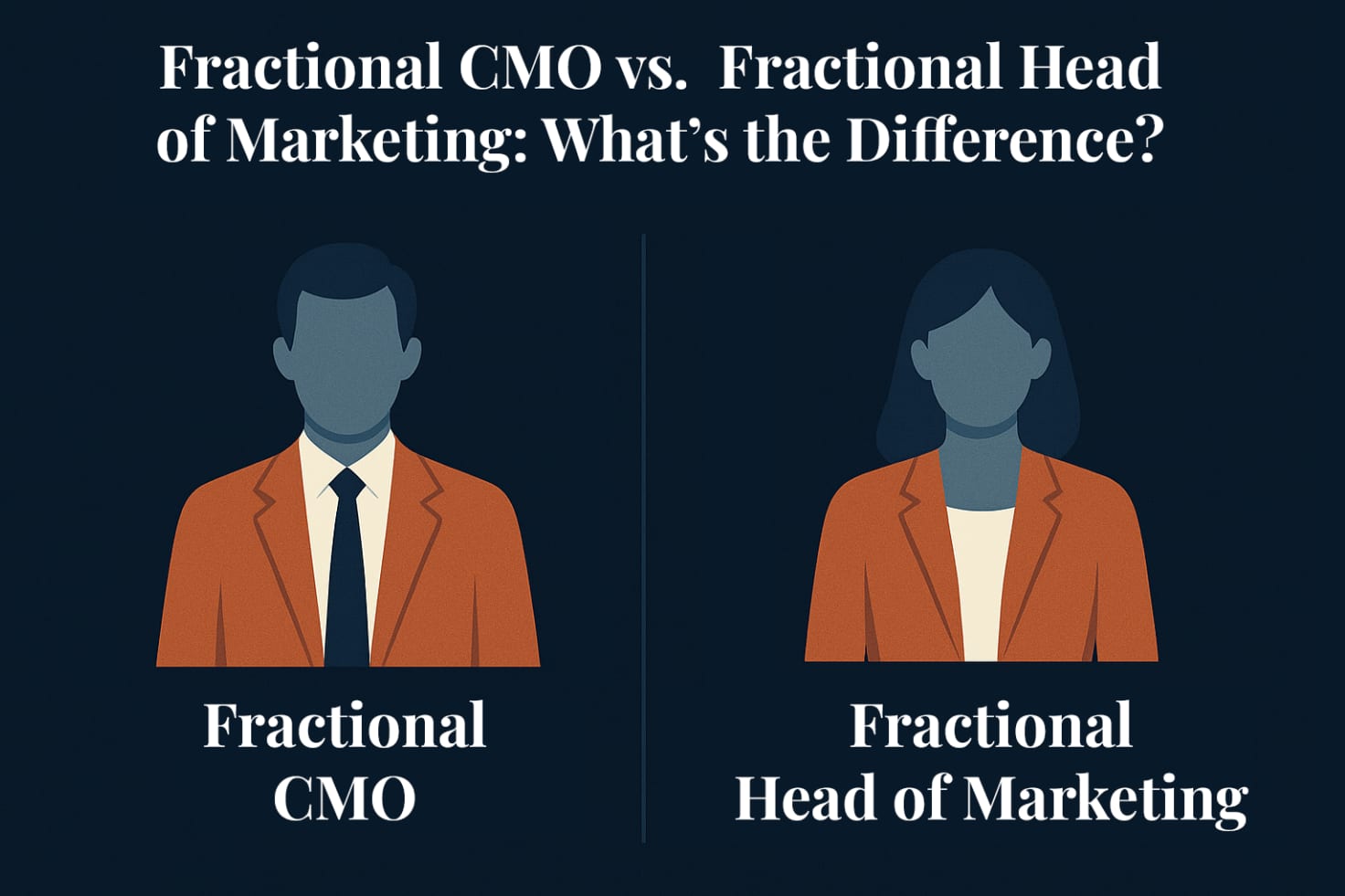
The vocabulary in this corner of the market is loose enough to cost you real money if you take titles at face value, so pin the definitions down before a contract crosses your desk. A fractional CRO is a part-time chief revenue officer who owns the whole revenue engine — the marketing-to-sales handoff, pipeline, forecasting, compensation, and the go-to-market team — on a capped number of days per month. A fractional VP of Sales sits one level down and considerably narrower: their remit is the selling team, the quota, and attainment, not the entire revenue architecture above it. An interim CRO is typically near-full-time but explicitly time-boxed, parachuted in to hold a vacated seat or to steer a turnaround across a fixed stretch, and priced to reflect that intensity. The labels outsourced CRO and fractional head of revenue are just common synonyms for the fractional model, and a Vermont founder should expect to hear all of these terms used interchangeably by providers who each have their own house style.

Picking correctly is a matter of scope, not status. If your bottleneck is whole-funnel strategy and cross-functional alignment — marketing and sales rowing in opposite directions, no shared forecast, no coherent motion to speak of — you need CRO-level leadership even though it costs more. If your strategy is already sound and what you're missing is someone to build, staff, and drive the sales team against a working plan, a fractional VP of Sales fits better and runs materially cheaper. A Montpelier B2B-software startup with a clean product-led motion but no forecasting rigor needs something entirely different from a Rutland manufacturer trying to assemble an enterprise sales team out of nothing, and buying the wrong title for either burns both a budget and a quarter. A trustworthy provider will help you right-size the role and will cheerfully steer you toward the cheaper title when that's the honest call; read any pitch that always lands on the most expensive option as a warning about the provider, not a diagnosis of your need.
What separates founders who win with the fractional model?
The whole point of the fractional model is timing — it lets you buy senior revenue leadership at the exact moment the problem turns acute, without pre-committing to a full-time salary a quarter or two before the seat can carry its own weight. The Vermont founders who wring the most value out of it behave the same way whether they're selling craft cider, machined aerospace parts, or SaaS. They put the scope on paper before they source a single name. They filter without sentiment on motion and stage fit and treat geography as background noise, which frees them to hire the strongest available leader rather than the nearest one. They hand that leader genuine authority to tear out broken systems and install working ones, and they grade the engagement on pipeline coverage, forecast accuracy, and net new revenue instead of hours logged.

Do all of that and a part-time leader leaves behind a repeatable, measurable revenue engine and a team trained to keep it running. Skip the discipline — hire for proximity, avoid defining an exit, measure nothing — and you'll pay executive rates for advice that never touches the numbers. Start with a scoped pilot, hold it to outcomes, keep the 30-day exit real, and let the results dictate whether you extend, expand, or graduate to a full-time chief revenue officer.
Related questions
What does a fractional CRO actually cost in a small market like Vermont?
Plan on monthly retainers in roughly the eight-to-eighteen-thousand-dollar band for 2027, scaling with committed days and seniority; a diagnostic-and-advisory engagement lands at the low end, a hands-on build with weekly rep coaching toward the top. Price the pilot on deliverables, not a headline day rate.
How is hiring a fractional revenue leader in Vermont different from a major metro?
The available bench is roughly an order of magnitude thinner, which flips the search: referral networks and pre-vetted syndicates matter far more than any regional job search, and you should plan for a remote-first arrangement with occasional on-site bursts. Geography is the tiebreaker between two strong finalists, never the opening filter.
Should a craft-beverage brand and a precision manufacturer look for the same leader?
No, because the go-to-market motions barely overlap. A beverage brand needs fluency in wholesale forecasting, retailer relationships, and channel management; an aerospace or medical manufacturer needs long-cycle, multi-stakeholder enterprise selling. Match the leader to the motion first; the shared Vermont address tells you almost nothing about fit.
When do I graduate from a fractional head of revenue to a full-time CRO?
When the problem has migrated from acute-and-strategic to permanent-and-operational — a durable pipeline exists, the motion is proven, and the daily job is now running the machine rather than building it. A good fractional leader will be the first to flag the moment, because they've been planning their own succession from day one.
What are the warning signs that a fractional engagement is going badly?
A first ninety days that yields a polished deck and fresh vocabulary but no movement in pipeline coverage, forecast accuracy, or new-rep ramp; a leader who keeps deferring any conversation about an exit; and work that quietly drains to unnamed contractors while you pay senior rates for the name on the contract.
FAQ
What is the difference between a fractional CRO and a full-time CRO? The line is drawn by commitment and cost structure, not by caliber of talent. A fractional CRO delivers the same grade of revenue leadership but distributes it across a capped number of days per month — often while running one or two other engagements — so a Vermont company pays a fraction of a full executive package for equivalent expertise. A full-time CRO is embedded in the revenue function every single day and only pencils out once the problem is large, permanent, and clearly worth a six-figure salary plus equity. Reach for fractional when the need is strategic, time-bounded, or simply not yet big enough to justify a standing seat.
How long do fractional CRO engagements usually last? Three to twelve months is the typical band, and the correct length is set by the problem rather than the calendar. A turnaround or an interim bridge to a permanent hire tends to run intense and short; an ongoing advisory relationship can stretch past a year once the core systems are stable and the leader has shifted from building to fine-tuning. What separates a healthy engagement from an open-ended retainer is that the scope and the intended exit were written down at the outset, so both sides share a definition of "done" before the work begins.
Can a fractional CRO work remotely? Almost entirely, and in Vermont that's usually the whole point. The substantive work — architecting the pipeline model, writing the comp plan, running the forecast cadence, coaching reps — happens over video and in shared documents, with on-site visits saved for the events that genuinely reward a physical room: a sales kickoff, a board meeting, a leadership offsite, a pivotal enterprise close. Given how shallow the local pool of revenue executives runs, a remote or hybrid setup here isn't a concession you make; it's frequently the exact arrangement that lands you the strongest possible leader.
How do I measure whether a fractional CRO is working? Track two tiers of metric in parallel. The leading indicators tell you early whether the machine is genuinely being repaired — pipeline coverage against target, conversion by funnel stage, forecast accuracy versus actuals, and time-to-ramp for new reps. The lagging indicators confirm it stuck — net new revenue, win rate, and customer retention. A capable leader commits to explicit targets for both inside the first thirty days and reviews them on a fixed cadence, so you never have to guess whether the engagement is paying off; the numbers make the argument for you.
Does the fractional head of revenue need to live in Vermont? No, and holding out for it usually costs you the better candidate. The overwhelming majority of the work is virtual, punctuated by a handful of on-site visits, so residence is at most a tiebreaker between two otherwise equal finalists. When the local pool is as small as Vermont's, a remote or hybrid leader with the precise motion experience you need will beat a nearby hire chosen for convenience nearly every time. Optimize for fit first and let location settle wherever it settles.
How quickly can we get started? Faster than most founders expect, as long as you source through warm channels instead of job boards. With a vetted matching network or a couple of strong referrals in hand, you can typically be in substantive conversations within a week or two and running a scoped engagement inside a month. The gating factor is almost never the candidate's availability — it's whether you've written a crisp one-page scope. Do that first and the whole timeline compresses around it.
Sources
- Bureau of Labor Statistics: Top Executives
- Harvard Business Review: When to Hire Senior Talent
- SaaStr: Fractional Executives in SaaS
- Pavilion: Revenue Leadership Community
- Gartner: B2B Sales and Revenue Insights
- RevOps Co-op: Revenue Operations Community
Related on PULSE
- Where do I find a fractional head of revenue in Oregon?
- Where do I find a fractional head of revenue in Michigan?
- Where do I find a fractional head of revenue in Montana in 2027?
- Where do I find a fractional head of revenue in Hawaii?
- Where do I find a fractional head of revenue in Washington?
- Where do I find a fractional head of revenue in Missouri?
This page will be disappearing soon. Save it to your device for $1 — or read it free while it is here.
@Kory-White- · if Venmo asks, the last 4 of my number are 2012
This page is gone.
This one is off the shelf now. $1 keeps it on your phone for good — the whole page, pictures and diagrams included.
 pulse-toolsWhat does a fractional CRO do for a IoT business in 2027?
 pulse-toolsWhere do I find a fractional CRO in Charleston in 2027?
 pulse-toolsWhere do I find a fractional CRO in Pasadena in 2027?
 pulse-toolsHow do I hire a fractional revenue leader for a B2B SaaS company in 2027?
 pulse-toolsWhere do I find a fractional CRO in Gilbert in 2027?
 pulse-toolsWhere do I find a fractional CRO in San Mateo in 2027?
 pulse-toolsWhere do I find a fractional CRO in Providence in 2027?
 pulse-toolsWhere do I find a fractional CRO in Lincoln in 2027?
 pulse-toolsWhat does a fractional CRO do for a supply chain software business in 2027?
 pulse-toolsWhere do I find a fractional CRO in Grand Rapids in 2027?