

Where do I find a fractional head of revenue in Iowa in 2027?
 Curated byKory White · Fractional CRO · Maryland
Quality
Certified

The mistake most Iowa founders make is searching for a person when they should be searching for a fit. There is no shortage of impressive résumés; there is a shortage of operators who have already rebuilt the exact revenue motion you are trying to fix. So invert the search: write down in one sentence what your revenue actually does — who buys, how long they take, and where deals stall — then hunt for the handful of people who have lived that same sentence three or four times. You will find them across three channels at once: a curated matching network that has already reference-checked senior part-timers, a warm handoff from a founder or fund who watched the person deliver, and a narrow LinkedIn pass that surfaces operators who publicly market themselves as fractional.
Geography is a tiebreaker, not a filter. The best candidate for a Des Moines insurtech may sit in Denver or Atlanta, and that is fine — the overwhelming majority of the work is remote, punctuated by the few on-site moments that genuinely need a body in the room. Cap your downside by opening with a fixed-scope trial that carries a 30-day exit, so a wrong call costs you a month of runway instead of a year of momentum. The rest of this page walks the search channel by channel, the vetting lens that separates a builder from a slide deck, the way to structure the engagement, and how the role differs from the adjacent titles that get sold as the same thing.
What makes Iowa's revenue market different from other states?
Iowa reads as a single, quiet market from the outside, but the revenue leaders who succeed here treat it as at least four distinct economies stacked on top of one another, each with a different clock and a different buyer. There is the agriculture-technology belt that radiates out from Ames and the John Deere and Corteva orbit — precision-ag platforms, input-and-seed software, on-equipment hardware — and it runs on a seasonal, weather-bound purchase calendar that no generic SaaS playbook prepares you for. A leader here has to be comfortable with a pipeline that goes dormant at harvest and a channel that flows through dealers, co-ops, and agronomists rather than a self-serve signup. Then there is the dense financial-services and insurance cluster in Des Moines, where Principal, Wellmark, a regional Nationwide presence, and a wave of insurtech challengers all buy through compliance-gated, committee-heavy enterprise cycles in which a single logo can take several quarters and multiple stakeholders to land.
The eastern corridor around Cedar Rapids adds a third texture entirely: advanced manufacturing and industrial software with roots in aviation electronics and Collins Aerospace, selling into procurement organizations that prize documented reliability and long-term supplier relationships over a slick demo. Beneath all of that runs a genuinely national fourth economy — the SaaS and fintech scene threaded through Des Moines, Iowa City, and Ames, companies that sell to buyers in Austin and Boston from their first month and whose "Iowa revenue problem" is really just a growth problem that happens to be headquartered in Iowa. The lesson is that no single résumé maps cleanly onto all four; the operator who can scale an agtech dealer channel is rarely the same one who can navigate an insurance carrier's procurement maze. This is why matching the motion, not the map, is the first move, and why a diagnostic like the one in our readiness guide starts with the shape of your buyer rather than your zip code.

That fragmentation has a direct consequence for supply. Executives who have run a complete revenue function and want to do it part-time are scarce in any state, and Iowa's talent is spread thin across mid-sized metros rather than pooled in one gravity well. The winning pattern is not to lower your bar until a local generalist clears it — it is to widen your geography until a real motion match appears. The strongest Iowa engagements almost always run on a leader who anchors the strategy remotely and shows up in person only for the moments that require presence: the quarterly board session, the first marquee customer's on-site, the sales offsite where a new motion gets taught rep-to-rep. An operator two time zones away who has scaled your precise motion repeatedly will beat a nearby generalist learning your buyer from scratch, and in practice the gap is not even close.
Where do you actually find fractional revenue candidates in Iowa?
Treat sourcing as four channels ranked by signal strength rather than by how easy they are to work. The cleanest signal comes from a vetted matching network, and the value there is not the size of the roster but the screening that sits behind it — someone has already confirmed these operators are who they say, has references on file, and has verified they genuinely want fractional work instead of using it as a waiting room between full-time seats. The channel that most often produces your actual finalist, though, is the warm referral: a fellow founder or, better still, an investor who has personally watched a fractional leader turn a portfolio company around will hand you a name whose track record you can verify in a single phone call rather than a full diligence cycle.

Third are the operator communities where these people already congregate — practitioner groups like Pavilion and the RevOps Co-op — where a well-scoped ask gets answered by people who do not need you to explain the difference between a chief revenue officer and a VP of Sales. Fourth, and mostly for calibration, is a disciplined LinkedIn pass: filter titles for "fractional," "interim," or "part-time," layer in your industry and motion keywords, and read for evidence they built durable systems rather than merely carried a quota. Run the top three in parallel from day one and expect the network and the referral to converge on the same short list; use LinkedIn less as a sourcing engine and more as a yardstick for what a strong candidate should look like before you commit budget to anyone.
The channel to consciously refuse is the mass job board. Posting a fractional revenue role to a general job site does two kinds of damage at once. It floods you with full-time seekers who treat "fractional" as a placeholder and vanish the instant a salaried offer lands, and it broadcasts to the genuinely senior operators — who are never refreshing those listings — that you do not yet understand where this talent actually lives. The best fractional leaders are recruited through trust, not harvested through applications. If you want a deeper breakdown of how each channel performs by company stage, our sourcing playbook ranks them the same way and adds the outreach scripts that tend to get answered.
How do you vet and structure a fractional CRO hire?
Vetting a fractional leader demands a different lens than vetting a full-time one, because you are buying a compressed, high-velocity engagement rather than placing a multi-year bet, and you have almost no runway to absorb a miss. Weigh these in strict priority order:
- Motion match over marquee logos. An operator who has personally scaled your specific motion — product-led, enterprise field sales, dealer-and-channel, or high-velocity transactional — will read your funnel in a week, while a decorated generalist burns a month decoding your buyer. Make them narrate a real deal cycle from their past that rhymes with yours, and name the two or three concrete changes that lifted win rates. Weigh the mechanics they describe, not the adjectives they reach for.
- A builder with hands on the keyboard. The classic failure of fractional leadership is the advisor who arrives with a deck and leaves with a deck. Ask precisely what this person will construct themselves in the first stretch of the engagement — the pipeline model, the comp plan, the forecast ritual, the scorecards for the next hires. If the real work gets routed to junior contractors while they "provide strategic direction," you are paying executive rates for slides, not a rebuilt engine.
- References matched to your stage. A glowing reference from a company many times your size is close to worthless, because the problems at that scale do not rhyme with yours. Insist on a founder who hired this person at your revenue and your motion, and push for the numbers that actually moved — pipeline coverage, stage conversion, forecast accuracy, ramp time for new reps — plus the blunt question of whether they would sign the same contract again tomorrow.
- A scope with a door built into it. The strongest fractional operators volunteer their deliverables, their cadence, and an exit clause before you ask, and they tell you unprompted how they intend to work themselves out of the role by leaving a healthy system behind for a future full-time hire. A leader angling to become permanently indispensable is optimizing for their own invoice, not your engine.
- Credible in the boardroom and the bullpen. This person will shape your board's confidence and your reps' daily habits in the same week, sometimes the same afternoon. In the interview, watch whether they can deliver you an uncomfortable truth without flinching and still be the kind of presence a rattled first-year AE would want beside them in a deal review.

Fluency with the tooling is table stakes, and you should probe it directly rather than assume it. Expect genuine command of a modern stack — a CRM as the system of record, a revenue-intelligence layer for forecasting, and a sequencing tool for engagement — but understand that the tools are only a proxy for a deeper discipline. What you are actually buying is the rigor the stack enforces: a single clean source of truth, one forecast number the whole company is willing to defend, and honest stage-by-stage visibility instead of a spreadsheet engineered to flatter the pipeline. A leader who refuses to run on dirty data, quietly kills the vanity metrics, and insists every forecast be defensible will leave behind a revenue operation measurably healthier than the one they inherited — and it stays healthier long after they roll off.
Structure the arrangement so it protects both parties from the start. Open with a scoped multi-month engagement, write the specific deliverables that define success into the letter, and preserve a 30-day out clause so either side can walk away from a bad fit cheaply. The decision that follows is easier to see as a flow than as prose:

By the end of that first window you will have accumulated enough real evidence to make the actual decision without guessing: extend the fractional arrangement, scale the leader's hours as the function grows, or graduate to a full-time CRO who inherits an operating system that already runs.
What should a fractional head of revenue deliver in 90 days?
Ninety days is enough time to know whether the engagement is working, so hold it to visible outcomes rather than hours on a timesheet. Inside that window a strong fractional leader should diagnose the funnel end to end and say plainly where deals go to die, install or repair the pipeline model until the numbers finally reconcile, redesign a comp plan that pays for the behavior you want instead of subsidizing the behavior you are stuck with, stand up a forecast cadence that yields one number the whole company will defend, and either make or unblock the one or two hires that were quietly capping your growth. Write those five outcomes into the engagement letter in the first week, review against them on a fixed rhythm, and let the deliverables — never the invoice — tell you whether to keep going.

It helps to picture the engagement as three phases that build on each other, with a decision point at the end rather than an open-ended renewal:
The phase most founders underweight is the last one. Diagnosis is visible and installation feels productive, but the coaching-and-tuning stretch is where a system either takes root in the team's daily habits or evaporates the moment the leader's calendar frees up. A fractional operator worth the fee spends the final third of the engagement making themselves progressively less necessary — writing the playbook down, training the person who will own the forecast, and handing off the scorecards — so that whatever you decide at the ninety-day mark, the engine keeps running. Measure that handoff explicitly, because a dependency only the departing leader can maintain is a failure dressed up as a success.

How does a fractional CRO differ from other revenue roles?
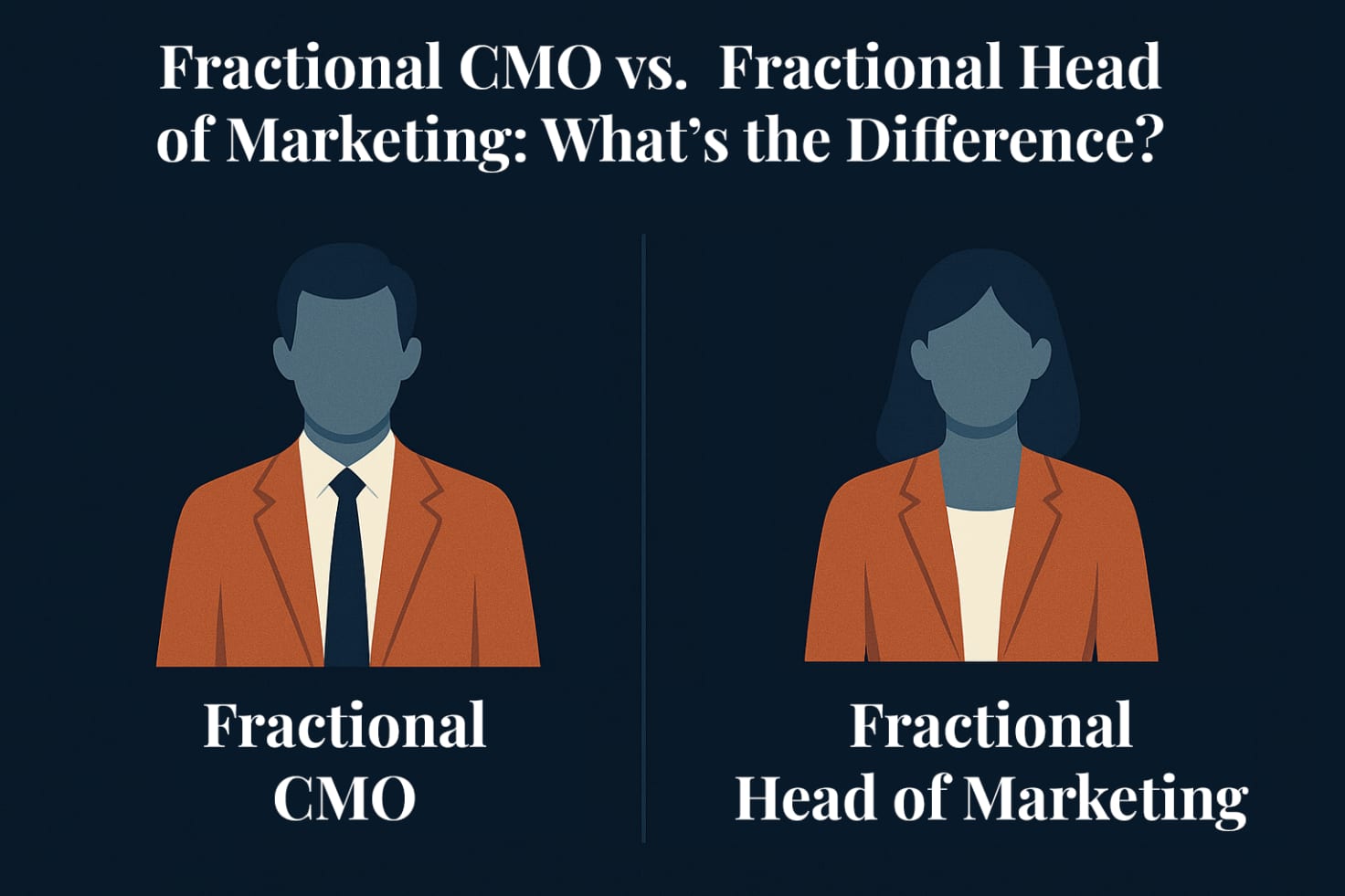
The titles in this corner of the market are used loosely enough to cost you real money if you buy the wrong one, so precision about what each role actually owns is worth the paragraph it takes to get right. A fractional CRO is a part-time chief revenue officer who owns the whole revenue function — the seam where marketing hands off to sales, pipeline creation, forecasting, and the team that executes all of it — but does so across a fraction of a full week and at a fraction of a full-time cost. A fractional VP of Sales sits one rung down and narrows the mandate to the sales organization itself: quota attainment, rep coaching, and closing execution, without necessarily owning marketing alignment or the cross-functional revenue model above it. An interim CRO is a different creature again — usually near-full-time but explicitly time-boxed, parachuted in to hold a vacated seat or steer a turnaround through a defined window before handing off. And "outsourced CRO" or "fractional head of revenue" are simply the market's synonyms for the same fractional model, so do not let the shifting vocabulary trick you into thinking you are comparing distinct products.
Choosing the right title is a question of scope, not prestige, and answering it honestly is what keeps you from overpaying. If your genuine problem is whole-funnel strategy — marketing and sales pulling in different directions, a forecast nobody trusts, no coherent motion to speak of — you need CRO-level leadership with cross-functional authority, and a fractional VP of Sales will simply lack the mandate to fix the parts that are broken. If instead your funnel strategy is sound and what you actually need is someone to build, staff, and drive a sales team against quota, a fractional VP of Sales does that job at a lower price point, and paying for a CRO you will only half-use is money set on fire. A trustworthy provider scopes the role down to what you truly need and will tell you when the cheaper, smaller title is the correct answer — the ones who reflexively upsell you into a CRO engagement you cannot yet justify are telling you exactly how they will behave the day after the contract is signed.

Should the fractional head of revenue live in Iowa?
Almost never — and treating location as a requirement is how good Iowa companies talk themselves into a weaker hire. The overwhelming majority of a fractional leader's work is virtual: designing the pipeline model, rebuilding comp, standing up a forecast cadence, and coaching leaders all happen over video and inside the CRM. On-site visits earn their keep only for the moments that genuinely need a room — the board review, a marquee customer, the offsite where a new motion gets taught rep-to-rep — and those can be scheduled in advance around a leader who lives anywhere in the country. Because senior part-time revenue talent is scarce in any single state, insisting on a local hire usually means trading down on motion experience, the one variable that most determines whether the engagement succeeds.
There is a reasonable version of the local preference, and it is worth naming so you can weigh it honestly. Some founders value a leader who can be in the building on short notice, who already knows the Des Moines or Cedar Rapids operator networks, and who can recruit local reps from personal relationships. Those are real advantages, but they are secondary to whether the person has rebuilt your exact motion before. The strongest arrangement is usually hybrid: anchor the engagement on the best motion-matched operator you can find nationally, then layer in local recruiting help or an in-market advisor if proximity turns out to matter for hiring. Do not invert that priority. A remote leader who has scaled your precise motion three times will out-deliver a nearby generalist learning your buyer from scratch, and the plane ticket for the four days a quarter that truly require presence is trivial next to the cost of a wrong hire.
Related questions
How much does a fractional CRO cost per month?
It blends a day-rate, the hours per week you contract, and whether equity is part of the package. The number swings far more on motion complexity and seniority than on which state you are in, so scope the deliverables first and let the price follow.
What is the difference between a fractional CRO and a RevOps consultant?
The fractional CRO owns the number and the team; the RevOps consultant builds the systems and hands them back. Conflating them is how companies buy process when what they actually needed was leadership with authority over the funnel.
When is a company ready for a fractional head of revenue?
Roughly when you have closed a repeatable set of deals with your own hands and the next constraint is scaling the motion, not proving it. If you have not yet found repeatability, founder-led selling usually earns its keep before any executive layer does.
Do agtech and insurance motions need different revenue leaders?
Usually, yes. The seasonal, dealer-channel cadence of agtech and the compliance-gated committee sale of insurance reward nearly opposite instincts, so the right operator for a Cedar Rapids manufacturer is rarely the right one for a Des Moines insurtech.
What should a fractional CRO hand off when they leave?
A documented operating system a full-time hire can run on day one — pipeline model, comp plan, forecast cadence, and scorecards — not a relationship only the departing leader knows how to maintain. The handoff is the deliverable, not an afterthought.
FAQ
What is the difference between a fractional CRO and a full-time CRO? The dividing line is time, cost, and commitment — not caliber. A fractional CRO brings the same executive-grade revenue leadership but distributes their week across one or several companies, so you pay for a slice of a proven operator rather than a full salary, an equity grant, and a benefits load. A full-time CRO owns revenue every single day and becomes the right call once the function is big and permanent enough to keep one person genuinely occupied. The fractional version fits best while the need is still strategic, interim, or simply not yet large enough to fill an executive's calendar.
How long do fractional CRO engagements usually last? Most land in a multi-month band that can taper into ongoing advisory. At the short end you find turnarounds and interim bridges that hold an open seat until a full-time hire arrives; at the long end you find engagements that wind down once the core systems — pipeline model, comp, forecast cadence — are built and self-sustaining. What separates a healthy engagement from an open-ended dependency is that the scope and the planned exit were both written down at the start, not improvised somewhere in the middle.
Can a fractional CRO work remotely? Yes, and most of the highest-leverage work is remote by its nature. Designing the pipeline model, rebuilding comp, standing up a forecast cadence, and coaching leaders all happen over video and inside the CRM, with on-site visits reserved for the moments that truly need a room: the board review, a marquee customer, the offsite where a new motion gets taught. Remote and hybrid are not compromises here; for a state with thin local supply, they are usually the arrangement that lands you the strongest operator available.
How do I measure whether a fractional CRO is working? Watch both ends of the funnel at once. Leading indicators — pipeline coverage against target, stage-by-stage conversion, forecast accuracy versus actuals, and new-rep ramp time — tell you early whether the machine is genuinely being repaired. Lagging indicators — net new revenue, win rate, and customer retention — confirm it. A leader worth the fee sets those targets in writing inside the first month and reviews them with you on a fixed cadence, rather than waiting for you to come asking.
Does the fractional head of revenue need to live in Iowa? Almost never. The overwhelming majority of the work is virtual, punctuated by periodic on-site visits you can schedule around whatever actually requires physical presence. Because senior part-time revenue talent is scarce in any single state, insisting on a local hire usually means trading down on motion experience — the one variable that most determines whether the engagement succeeds. A remote or hybrid leader who has already scaled your exact motion is the stronger bet in very nearly every case.
How quickly can we get started? Far faster than a full-time search. Working a vetted network or strong referrals, you can usually be in serious conversations within a week or two and running a live, scoped engagement inside a month — no drawn-out recruiter cycle, no relocation, and no notice period at a prior full-time employer to wait out before the work begins.
What should the first written agreement actually contain? Keep it short and concrete: the specific deliverables that define success, the weekly hours and cadence, the tools and systems the leader will build or repair, a clear review checkpoint at ninety days, and a 30-day exit clause that either side can invoke. If a prospective leader resists putting scope and an off-ramp on paper, treat that resistance as data — the operators who protect your downside without being asked are the same ones who will protect your pipeline once they are inside it.
Sources
- Bureau of Labor Statistics: Top Executives
- Harvard Business Review
- SaaStr
- Pavilion: Revenue Leadership Community
- Gartner: Sales and Revenue Insights
- RevOps Co-op
- First Round Review
Related on PULSE
- Where do I find a fractional head of revenue in Oregon?
- Where do I find a fractional head of revenue in Michigan?
- Where do I find a fractional head of revenue in Montana in 2027?
- Where do I find a fractional head of revenue in Hawaii?
- Where do I find a fractional head of revenue in Washington?
- Where do I find a fractional head of revenue in Missouri?
This page will be disappearing soon. Save it to your device for $1 — or read it free while it is here.
@Kory-White- · if Venmo asks, the last 4 of my number are 2012
This page is gone.
This one is off the shelf now. $1 keeps it on your phone for good — the whole page, pictures and diagrams included.
 pulse-toolsWhere do I find a fractional CRO in Providence in 2027?
 pulse-toolsHow do I hire a fractional VP of Sales in Orlando in 2027?
 pulse-toolsWhere do I find a fractional CRO in Santa Clara in 2027?
 pulse-toolsWhat KPIs should a fractional CRO own in 2027?
 pulse-toolsWhere do I find a fractional CRO in Palo Alto in 2027?
 pulse-toolsWhat does a fractional CRO do for a supply chain software business in 2027?
 pulse-toolsHow do I hire a fractional CRO in Hartford in 2027?
 pulse-toolsWhere do I find a fractional CRO in Chandler in 2027?
 pulse-toolsWhat does a fractional CRO do for a dev tools business in 2027?
 pulse-toolsWhat does a fractional CRO do for a IoT business in 2027?