


How do I evaluate a fractional Chief Revenue Officer in Los Angeles in 2027?
Quality
Certified

You evaluate a fractional CRO by verifying their direct experience with your specific go-to-market motion (enterprise SaaS, marketplace, professional services), checking references from companies at a similar stage, and assessing their ability to diagnose your revenue operations without a sales pitch. In Los Angeles, the market is bifurcated: you’ll find strong candidates in B2B SaaS, media, and entertainment tech, but many top fractional CROs work remote-first or hybrid, so geography alone isn’t a filter. Cost is driven by the number of days per month they commit, whether they manage a team or advise only, and the complexity of your sales stack (e.g., Salesforce + Gong + Outreach requires more ramp time). The most honest evaluation includes a trial project—two weeks of discovery and a written revenue plan—before signing a longer retainer.
Why Los Angeles in 2027 Matters
Los Angeles has a distinct revenue market compared to San Francisco or New York. The dominant industries here are media, entertainment technology, direct-to-consumer (DTC) brands, and health/wellness tech. A fractional CRO who cut their teeth on enterprise SaaS in Palo Alto may struggle with the longer deal cycles and relationship-driven buying patterns common in LA’s B2B media and production services sectors. Conversely, a CRO who has only sold to Hollywood studios might lack the rigor needed for a VC-backed B2B SaaS company with quarterly board targets.
In 2027, remote work is standard, but many LA-based fractional CROs prefer local clients for occasional in-person meetings. This can be an advantage: you get the flexibility of a fractional arrangement with the option for face-to-face strategy sessions. However, do not over-weight geography. The best fractional CRO for your business might be based in Austin or Denver and willing to fly in monthly. Evaluate on revenue domain expertise first, location second.

The Evaluation Framework: Four Dimensions
1Revenue Operations Diagnostic Ability
A competent fractional CRO should be able to look at your sales process and identify the single biggest bottleneck within 30 minutes. They should ask pointed questions about your lead sources, conversion rates by stage, sales rep ramp time, and CRM hygiene. If they start pitching you a methodology (e.g., "We use MEDDICC and Challenger") without first understanding your current state, that is a red flag. The diagnostic interview is the most important part of your evaluation. Ask them to walk through a fictional scenario based on your real data (sanitized) and have them produce a written summary of what they found.

2Stage and Motion Alignment
Fractional CROs tend to specialize by company stage and sales motion. A pre-revenue founder needs a CRO who can build a sales process from scratch, hire the first reps, and define ICP. A company at $5M ARR with a repeatable inbound model needs a CRO who can optimize conversion rates and build a scalable outbound engine. Ask for specific examples of companies they have worked with at your ARR level and with your sales motion (transactional, enterprise, self-serve + sales-assisted). If they cannot name three relevant examples, move on.
3Cultural and Communication Fit
Fractional CROs work with multiple clients simultaneously. You need someone who can integrate into your team culture without causing friction. Ask how they handle conflicts between sales and marketing, how they communicate with the board, and how they manage underperforming reps. The best fractional CROs are transparent about their bandwidth and will tell you when they cannot attend a critical meeting. If they promise 24/7 availability, they are either lying or not busy enough.

4Contract and Scope Clarity
A fractional CRO engagement should be clearly scoped in a written agreement. The contract should specify the number of days per month, the deliverables (e.g., weekly pipeline reviews, monthly board decks, quarterly revenue plans), and the termination terms. Standard is 30 days notice from either party. Avoid long-term lockups (6+ months) unless there is a proven track record. Also clarify IP ownership: all data, plans, and processes you develop together belong to your company, not the CRO.
The Cost Breakdown: What You Actually Pay
Fractional CRO pricing in Los Angeles in 2027 is driven by three variables: time commitment, scope, and equity. A pure advisory role (2–4 days per month, no direct reports) runs $6,000–$10,000/month. A hands-on role (8–12 days per month, managing a sales team) runs $12,000–$20,000/month. A heavy engagement (12–16 days per month, including board presentations and fundraising support) runs $18,000–$25,000/month.

Equity is common but not universal. Some fractional CROs will accept a lower cash retainer in exchange for stock options or a profit share. This aligns incentives but complicates the relationship if the engagement ends. Be explicit about vesting schedules and what happens to equity upon termination. Never offer equity without a vesting cliff and a clear definition of the CRO’s role.
Travel costs are rarely included. If you want in-person meetings, budget separately for flights and lodging if the CRO is not local. In LA, traffic is a real factor; a CRO based in Santa Monica may have a 90-minute commute to your office in Burbank. Clarify this in the contract.

How to Compare Fractional CRO vs VP of Sales
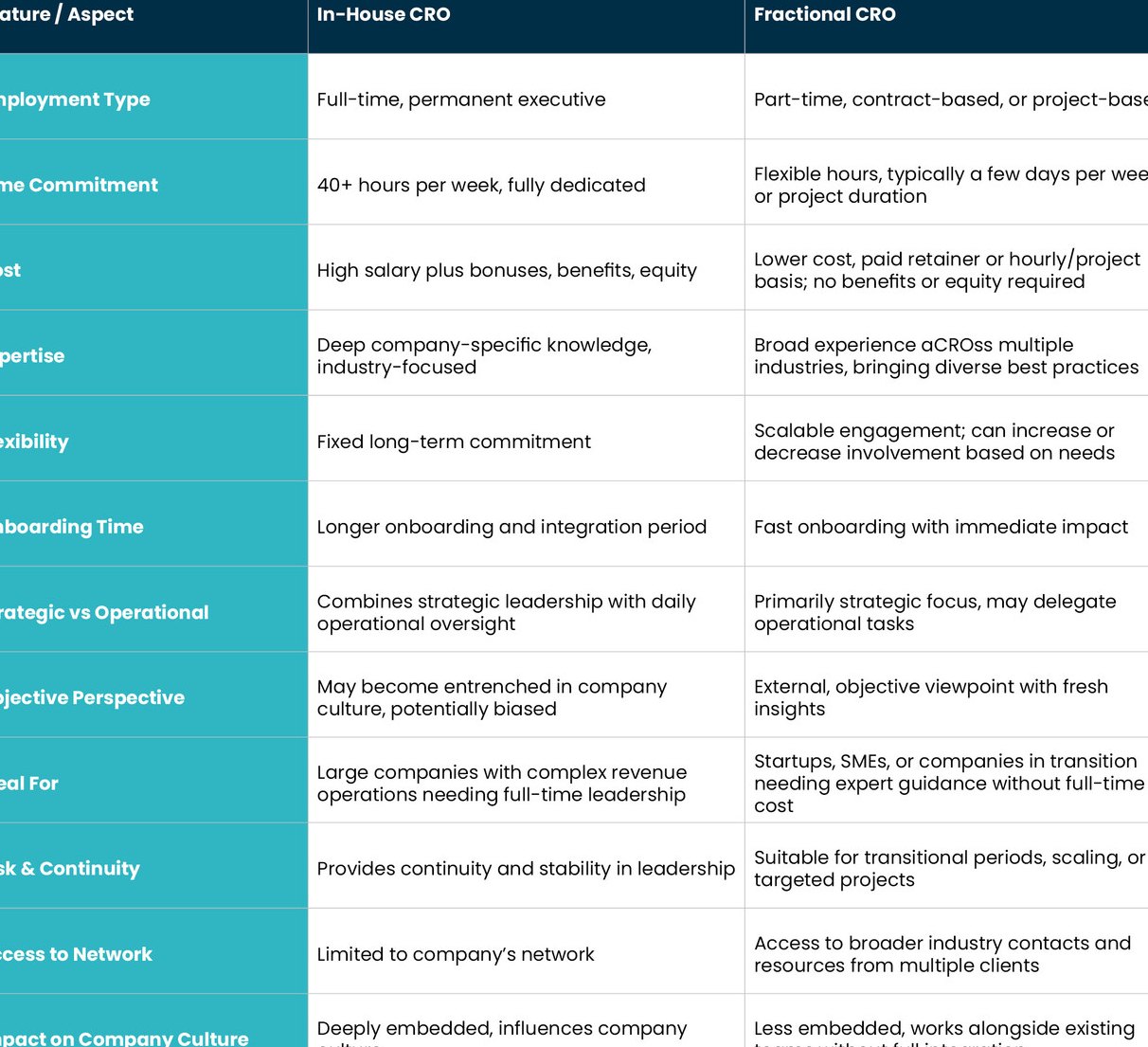
Many founders confuse the roles. A fractional CRO owns the entire revenue function: sales, marketing, customer success, and sometimes partnerships. A VP of Sales typically owns only the sales team. If your problem is messy handoffs between marketing and sales, or churn in the customer base, you need a CRO. If your problem is simply not enough qualified pipeline, a VP of Sales might suffice.
Fractional CROs are also better suited for strategic pivots—for example, moving from founder-led sales to a sales team, or expanding into a new vertical. A VP of Sales is usually hired to execute an existing playbook. Evaluate your primary need before deciding which role to fill.

The Diagnostic Project: Your Best Bet
The single most effective evaluation method is a paid diagnostic project. Offer $3,000–$5,000 for a two-week engagement where the fractional CRO reviews your CRM data, interviews your team, and produces a written revenue audit with a 90-day plan. This gives you a tangible deliverable and lets you assess their analytical rigor, communication style, and ability to work with your team. It also reduces the risk of a bad hire. Most reputable fractional CROs will agree to this. If they refuse, that is a red flag.
During the diagnostic, pay attention to how they handle sensitive information. If they share details about other clients without permission, they will do the same with your data. Trust is non-negotiable in a fractional relationship.

FAQ
What is the typical notice period for a fractional CRO? Standard is 30 days. Some contracts allow for 14 days during an initial trial period. Avoid contracts with 60+ day notice periods unless the CRO is deeply embedded in your operations.
Should I require the fractional CRO to be local to Los Angeles? Not necessarily. Many top fractional CROs work remotely and will fly in for key meetings. However, if your business requires frequent in-person collaboration (e.g., live pipeline reviews, team coaching), prioritize candidates within driving distance or willing to visit monthly.
How do I verify a fractional CRO's past results? Ask for references from founders at companies with similar ARR and sales motion. Do not rely on written testimonials. Speak directly to at least three references and ask specific questions: Did they meet their milestones? How did they handle underperformance? Would you hire them again?
Can a fractional CRO work alongside my existing sales leadership? Yes, but only if roles are clearly defined. If you already have a VP of Sales, the fractional CRO should act as a coach and strategist, not a replacement. Conflict arises when the CRO tries to override the VP’s decisions. Define the reporting structure in the contract.
What happens if the fractional CRO is not delivering? You terminate with 30 days notice. That is the primary advantage of fractional over full-time. Have a candid conversation first; many issues are fixable with clearer scope. If the problem persists, exercise the termination clause and move on.
Is equity standard for fractional CROs? Common but not universal. Equity is more likely for early-stage startups with limited cash. For companies with $5M+ ARR, cash compensation is the norm. If you offer equity, use a standard option grant with a 4-year vest and 1-year cliff, and ensure it is tied to performance milestones.
Sources
- Pavilion - Community for Revenue Leaders
- RevOps Co-op - Revenue Operations Community
- Harvard Business Review - Sales & Marketing
- First Round Review - Startup Sales Advice
- SaaStr - SaaS Revenue Leadership
- LinkedIn - Fractional CRO Discussions
People also search for: fractional chief revenue officer Los Angeles · hire a fractional chief revenue officer in Los Angeles · Los Angeles fractional chief revenue officer · fractional chief revenue officer near me
Related on PULSE
- Related operating topics on PULSE
- Adjacent playbooks
This page will be disappearing soon. Save it to your device for $1 — or read it free while it is here.
@Kory-White- · if Venmo asks, the last 4 of my number are 2012
This page is gone.
This one is off the shelf now. $1 keeps it on your phone for good — the whole page, pictures and diagrams included.
 pulse-toolsShould I Hire a Fractional CRO If I Need to Build My First Sales Playbook in 2027?
 pulse-toolsHow do I evaluate a fractional Chief Revenue Officer in Chicago in 2027?
 pulse-toolsHow do I hire a fractional VP of Sales in Ogden in 2027?
 pulse-toolsShould I Hire a Fractional CRO If I Am Consolidating Regional Sales Teams in 2027?
 pulse-toolsWhat does a fractional Chief Revenue Officer engagement cost in Maryland in 2027?
 pulse-toolsShould I Hire a Fractional CRO If I Need Interim Coverage During a Medical Leave in 2027?
 pulse-toolsDo I Need a Fractional CRO for My Franchise in 2027?
 pulse-toolsHow do I evaluate a fractional Chief Revenue Officer in Texas in 2027?
 pulse-toolsHow do I hire a fractional CRO in Denver in 2027?
 pulse-toolsShould I Hire a Fractional CRO If I Need to Stand Up RevOps From Scratch in 2027?