


Should I hire a fractional CRO in Poolesville in 2027?
Quality
Certified

Hire a fractional CRO in Poolesville when you have roughly $500K–$5M ARR, a repeatable offer, and no revenue leader — but can't justify a full-time executive's fully-loaded cost. Expect a monthly retainer for 4–12 days, modest equity, and a 90-day pilot with written KPIs. Below product-market fit, skip it.
How a Poolesville engagement actually runs end to end
Poolesville sits in upper Montgomery County, about 45 minutes from downtown DC and 30 from the Rockville–Gaithersburg biotech corridor. The practical consequence is that your local bench of senior revenue operators is thin — you are not going to find five qualified candidates inside the town limits. That is fine, because the fractional model is remote-native by construction. What matters is not the commute; it is whether the engagement has a defined arc instead of an open-ended advisory drip.
A well-run engagement moves through five phases. Scoping (week 0): you write down the problem in one sentence — "we close 18% of qualified opportunities and I don't know why" — and the candidate proposes a day count against it. Audit (weeks 1–4): CRM hygiene review, stage-definition rewrite, win/loss interviews with 8–12 recent closed deals, rep ride-alongs or call-recording reviews, and a read of your pipeline math. Plan (end of week 4): a 30-60-90 with named owners and a small number of metrics. Build (weeks 5–10): the actual work — qualification framework, forecast cadence, comp plan revision, territory or ICP narrowing, hiring scorecards. Transfer (weeks 11–13): documentation, a trained internal owner, and an honest recommendation about whether to renew, taper, or hire full-time.
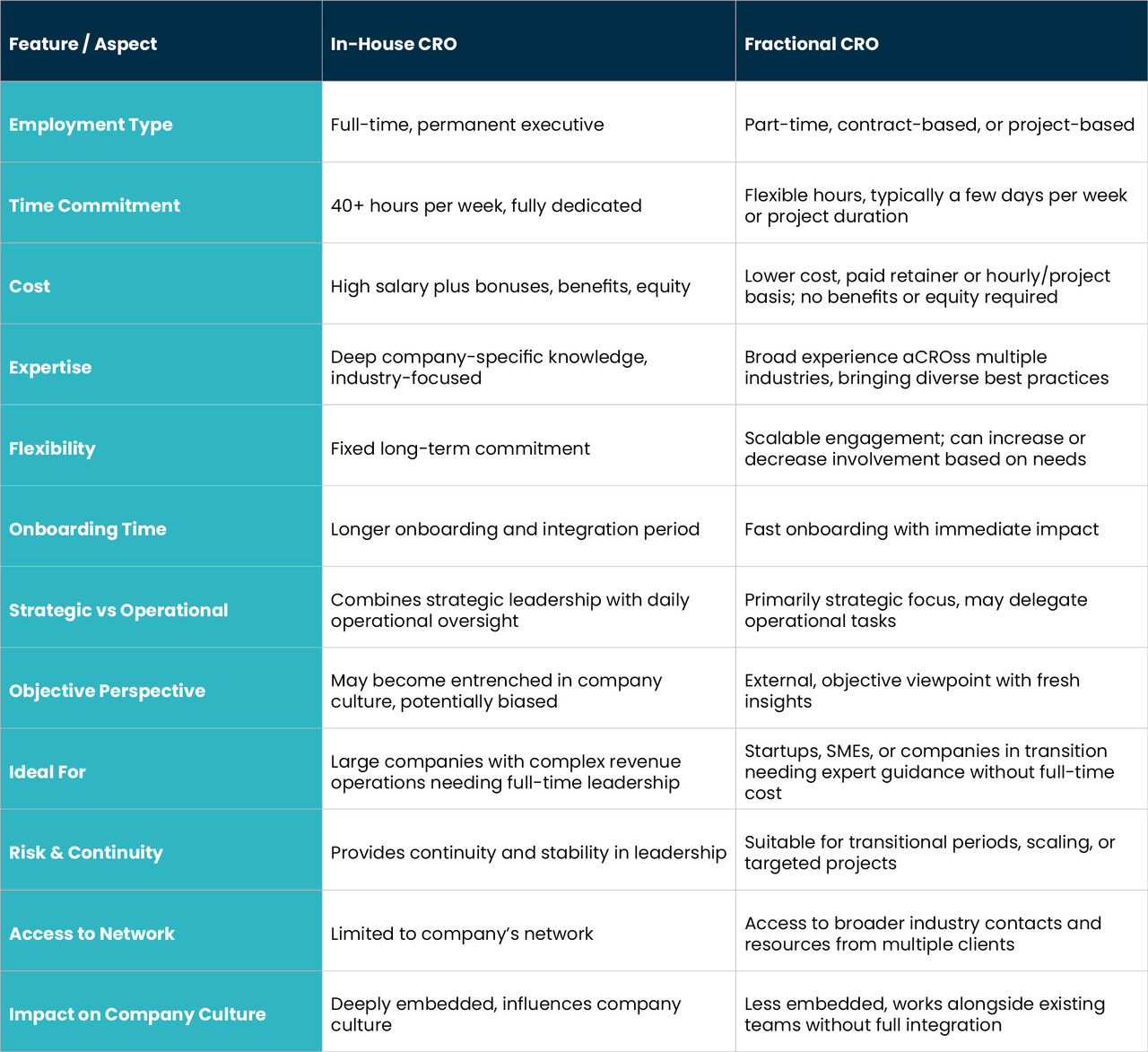
The transfer phase is the one founders skip, and skipping it is what turns a fractional hire into a permanent dependency. Insist that the operating cadence — pipeline review agenda, forecast call, deal-desk rules — is written down in your own wiki, not living in the CRO's head or their private Notion.
Two adjacent workflows deserve the same treatment because founders often confuse them with this decision. A fractional VP of Sales owns quota-carrying reps and pipeline execution; a fractional CRO owns sales plus marketing plus retention and answers "what should our revenue engine look like." A RevOps contractor owns systems — CRM architecture, routing, attribution, reporting — and is frequently the cheaper first hire if your real problem is that nobody trusts the numbers. Diagnose which of the three you need before you write a job spec, because hiring the wrong one costs you a full quarter.

Where the engagement creates revenue — and where it leaks
Fractional revenue leadership creates value in four reliable places. First, qualification discipline: most sub-$5M companies carry a pipeline that is 30–50% fantasy, and the first honest scrub feels like a loss but makes forecasting possible. Second, ICP narrowing: cutting the two segments where you win least and lose slowest usually frees more capacity than hiring another rep. Third, pricing and packaging — often the single highest-leverage lever an outside operator touches, because founders anchor on their earliest customers' willingness to pay. Fourth, manager coaching: turning your best rep, who you promoted without training, into an actual manager.
The leaks are just as predictable. The biggest is scope inflation without day inflation — you agreed to 6 days a month, then asked for board prep, a recruiting loop, and a partner negotiation on top. The work gets thinner everywhere. The second leak is authority ambiguity: if the CRO can recommend but not decide, every initiative queues behind your calendar and the engagement produces documents instead of outcomes. Name explicitly what they can decide alone (pipeline stage definitions, deal-desk approvals under a threshold), what needs your sign-off (comp changes, terminations), and what they only advise on.
Third leak: tool sprawl mistaken for progress. A new call-recording platform, a new forecasting layer, and a new sequencer in the same quarter will produce three half-adopted systems. Cap it at one new system per quarter and require an adoption metric before the next one. Fourth: the handoff that never happens. If month nine looks exactly like month two, you are not buying leadership, you are renting a crutch.

Downstream effects are worth planning for. A good engagement usually surfaces one or two personnel decisions you have been avoiding, changes what your next two hires should be, and often delays a full-time CRO search by two to four quarters — which is the point. It also tends to raise marketing's accountability, because a CRO who owns the number will not accept MQL volume as a success metric. Prepare your marketing lead for that conversation before day one rather than after.
The numbers: cost, scope, and what to benchmark
Be concrete about money. A full-time CRO in the DC metro carries a substantial base, a 20–30% variable component, benefits, payroll taxes, and equity typically in the 2–5% range over four years with a one-year cliff. Fully loaded, that is a serious annual commitment plus a 4–8 week notice period and a 3–6 month ramp before you see anything. The severance and cultural cost of getting it wrong at your stage is what actually hurts.

A fractional engagement is priced by day count and scope, not by geography — do not expect a "Poolesville discount," and be suspicious of anyone who offers one, because it usually signals an underemployed operator rather than a selective one. Typical structures: 4 days/month for strategy, forecast review, and board prep; 6–8 days/month for the same plus process build and manager coaching; 10–12 days/month for hands-on pipeline management and personally working a few strategic deals. Equity, when included, commonly lands in the 0.5–2% range vesting over 2–3 years, frequently with a cliff or milestone gate. Cash-plus-equity typically runs a third to a half of a full-time hire's loaded cost.
Benchmark the engagement on a small, boring set of numbers, measured at day 0 and day 90:
- Qualified pipeline coverage against the next two quarters' target — 3x is a common working floor for mid-market motions; the real signal is whether coverage is *stable*, not spiky.
- Stage-to-stage conversion on your two widest funnel gaps, not the whole funnel.
- Sales cycle length by segment, median rather than mean, because one 400-day whale distorts everything.
- Forecast accuracy — commit-to-close variance inside ±15% by the second full quarter is a reasonable ask; before the engagement most founders cannot compute this at all.
- Ramp time to first closed deal for any rep hired during the engagement.
- Net revenue retention, if you have enough cohorts to make it meaningful.
Two cautions on benchmarks. Do not tie a bonus to a headline revenue number in the first 90 days — pipeline built in month two closes in month seven for most B2B cycles, so you would be paying for luck or punishing good work. And insist the CRO computes these from your CRM, not from a spreadsheet they maintain separately. If the numbers only exist in their deck, you have bought reporting, not operations.

On contract mechanics: pay monthly in arrears for days worked, keep a 30-day termination clause on both sides, avoid large cash guarantees, and never pay a full engagement upfront. A short written scope — days, decision rights, KPIs, transfer deliverables — is worth more than a long MSA.
Where these engagements go wrong
Hiring a logo instead of a stage-match. A CRO who ran a $50M organization with 40 reps, three managers, and a full RevOps team may have no muscle for the thing you need: two reps, no analyst, and a founder who is still the best closer in the building. Ask directly what they personally did — not what their team did — at a company your size. Ask for a reference from a company that was between $1M and $5M when they worked with it.
Buying vision when you need plumbing. If your CRM has four "qualified" stages nobody agrees on, opportunities without close dates, and a lead-routing rule written in 2023, a strategy retainer will not help. That is RevOps work first. It is entirely reasonable to run a two-month systems cleanup before the CRO engagement starts, or to scope the first month of the engagement explicitly as data remediation.

Confusing DC-market fluency with generic SaaS fluency. The regional economy skews toward government contracting, cybersecurity, biotech, and professional services. If any part of your revenue touches federal, state, or heavily regulated buyers, procurement cycles, FedRAMP-style compliance questions, teaming arrangements, and reseller channels are the actual bottleneck — and a commercial-SMB CRO will optimize the wrong stage of your funnel. If you sell to commercial mid-market, that specialization is irrelevant and you should not pay a premium for it.
Treating the pilot as a formality. Write the 90-day exit criteria before day one, and mean them. A pilot you would never fail is not a pilot.
Underestimating internal resistance. Your existing reps will read a fractional CRO as either a threat or a tourist. Introduce them with explicit authority in an all-hands, not in a Slack message. If a tenured rep quietly refuses to use the new pipeline definitions, that is a personnel decision you own — the fractional CRO cannot make it for you, and pretending otherwise wastes the engagement.
Ignoring the adjacent hire. Sometimes the honest answer after 90 days is that you did not need a CRO at all; you needed a demand-gen contractor, a solutions engineer, or to fire one bad rep. A good fractional operator will tell you that, and it is the cheapest possible outcome. Treat it as a win, not a refund request.
A checklist for choosing and structuring the hire

Work this sequence rather than starting with interviews. One: write the single sentence describing the revenue problem and the number that would prove it solved. Two: decide CRO vs. VP of Sales vs. RevOps contractor against that sentence. Three: set a day count and a monthly budget ceiling before you talk to anyone, so scope conversations do not drift. Four: source from operator networks and referrals rather than general job boards — communities such as Pavilion and RevOps Co-op, LinkedIn searches filtered by your buyer type and deal size, and founders in DC-area and Montgomery County tech circles. Five: interview three to five people; ask each what mistake early-stage founders most commonly make in sales and listen for specificity ("hiring reps before the ICP is written") over platitudes. Six: check two references from stage-matched companies and ask each what the CRO was *bad* at. Seven: run a paid 90-day pilot with written KPIs, decision rights, and transfer deliverables. Eight: at day 90, choose deliberately — renew at the same scope, taper to a lighter advisory cadence, convert toward a full-time search, or stop.
One red flag worth naming: anyone promising to double revenue in a quarter. No one can guarantee that, and the promise itself tells you they sell outcomes they do not control. The operators worth hiring talk about process, data, decision rights, and team development — and are comfortable telling you the engagement might end at day 90.
Related questions
Does the CRO need to live near Poolesville?

No. Remote-first is the norm, with quarterly on-site visits for kickoff, planning, and board meetings. What matters is CRM access, a standing weekly cadence, and real decision rights — not proximity. Budget travel separately if you want reliable in-person time.
What if I only have one salesperson?
Then you likely need coaching plus process, not a revenue executive. Consider a lighter 2–4 day monthly advisory scope, or a fractional VP of Sales. A full CRO scope with one rep tends to produce strategy documents no one has capacity to execute.
Can a fractional CRO help with fundraising?
Often yes — revenue narrative, cohort and pipeline math, and diligence prep are common asks. Scope it explicitly as extra days rather than assuming it fits inside the operating retainer, or the operating work quietly stops during the raise.
Should marketing report to them during the engagement?
Functionally yes, if you want the number owned end to end. Formally, a dotted line for the pilot period is usually enough. Tell your marketing lead before day one; discovering a new boss in a Slack thread poisons the engagement fast.
How do I convert a fractional CRO to full-time?

Discuss it before month six so expectations are aligned. Many fractional operators deliberately do not want a full-time seat. If they do, you already have 90+ days of evidence — cheaper and more reliable diligence than any external search process.
FAQ
How do I know whether I need a fractional CRO or a fractional VP of Sales?
A CRO owns the entire revenue function — sales, marketing, and retention — and answers strategic questions about what the engine should look like. A VP of Sales owns quota-carrying reps and pipeline execution. If you have no marketing or customer success leadership and the strategy itself is unclear, the CRO scope fits. If strategy is settled and execution is the gap, the VP scope is usually cheaper and faster.
What should the first 30 days actually produce?
A CRM and pipeline audit, rewritten stage definitions with entry and exit criteria, win/loss findings from a batch of recent closed deals, and a written 30-60-90 with named owners. If month one produces only a framework deck and no changes to how your team runs its pipeline review, escalate immediately rather than waiting for day 90.
Is equity always part of the deal?
No. Plenty of engagements are cash-only, particularly shorter or narrower scopes. Equity is more common when the day count is high, the engagement is expected to run multiple quarters, or the operator is deliberately taking cash risk for upside. If you grant it, use a vesting schedule with a cliff or milestone gate rather than a large upfront allocation.

What happens if the engagement isn't working?
That is exactly what the 30-day termination clause and the 90-day exit criteria are for. Pay monthly in arrears for days worked so ending costs you nothing beyond the current month. Before ending, check honestly whether the failure was theirs or a decision-rights problem on your side — that distinction determines whether your next hire will work any better.
Will this delay or replace hiring a full-time CRO?
Usually delay, sometimes replace. Many companies run fractional leadership for two to four quarters, cross a revenue or headcount threshold, then convert to a full-time search with a far clearer job spec because they now know what the role actually needs to do. That clarity alone often justifies the engagement.
Do I need RevOps in place before starting?
Not fully, but you need trustworthy basics: opportunities with owners and close dates, consistent stage usage, and a source-of-truth report. If those are missing, either scope the first month as data remediation or run a short RevOps cleanup engagement first. A revenue leader working from numbers nobody believes will spend their days arguing about the data instead of fixing the motion.
Sources
- Pavilion
- RevOps Co-op
- Harvard Business Review
- First Round Review
- SaaStr
- Bureau of Labor Statistics — Occupational Employment and Wage Statistics
- U.S. Small Business Administration
- Montgomery County Economic Development Corporation
Related on PULSE
- How do I find a fractional Chief Revenue Officer in Poolesville?
- What does a fractional Chief Revenue Officer cost in Poolesville?
- How do I hire a fractional Chief Revenue Officer in Poolesville?
- Who is the best fractional Chief Revenue Officer in Poolesville?
- Does a PE-backed martech company need a fractional CRO?
- Should I hire a fractional CRO in Bethany Beach?
This page will be disappearing soon. Save it to your device for $1 — or read it free while it is here.
@Kory-White- · if Venmo asks, the last 4 of my number are 2012
This page is gone.
This one is off the shelf now. $1 keeps it on your phone for good — the whole page, pictures and diagrams included.
 pulse-toolsWhere do I find a fractional CRO in Houston in 2027?
 pulse-toolsWhat should I look for in a fractional CRO in Oregon in 2027?
 pulse-toolsWhat should I look for in a fractional CRO in New Mexico in 2027?
 pulse-toolsWhat does a fractional Chief Revenue Officer engagement cost in Arizona in 2027?
 pulse-toolsHow do I hire a fractional CRO in Philadelphia in 2027?
 pulse-toolsHow do I evaluate a fractional Chief Revenue Officer in Georgia in 2027?
 pulse-toolsWhat should I look for in a fractional CRO in Rhode Island in 2027?
 pulse-toolsIs there a fractional Chief Revenue Officer available near me in Houston in 2027?
 pulse-toolsHow do I evaluate a fractional Chief Revenue Officer in Arkansas in 2027?
 pulse-toolsHow do I evaluate a fractional Chief Revenue Officer in South Carolina in 2027?