
How do I hire a fractional Chief Revenue Officer in Waco, Texas in 2027?
 Curated byKory White · Fractional CRO · Maryland
 PULSEKNOWLEDGE LIBRARY
Quality
Certified

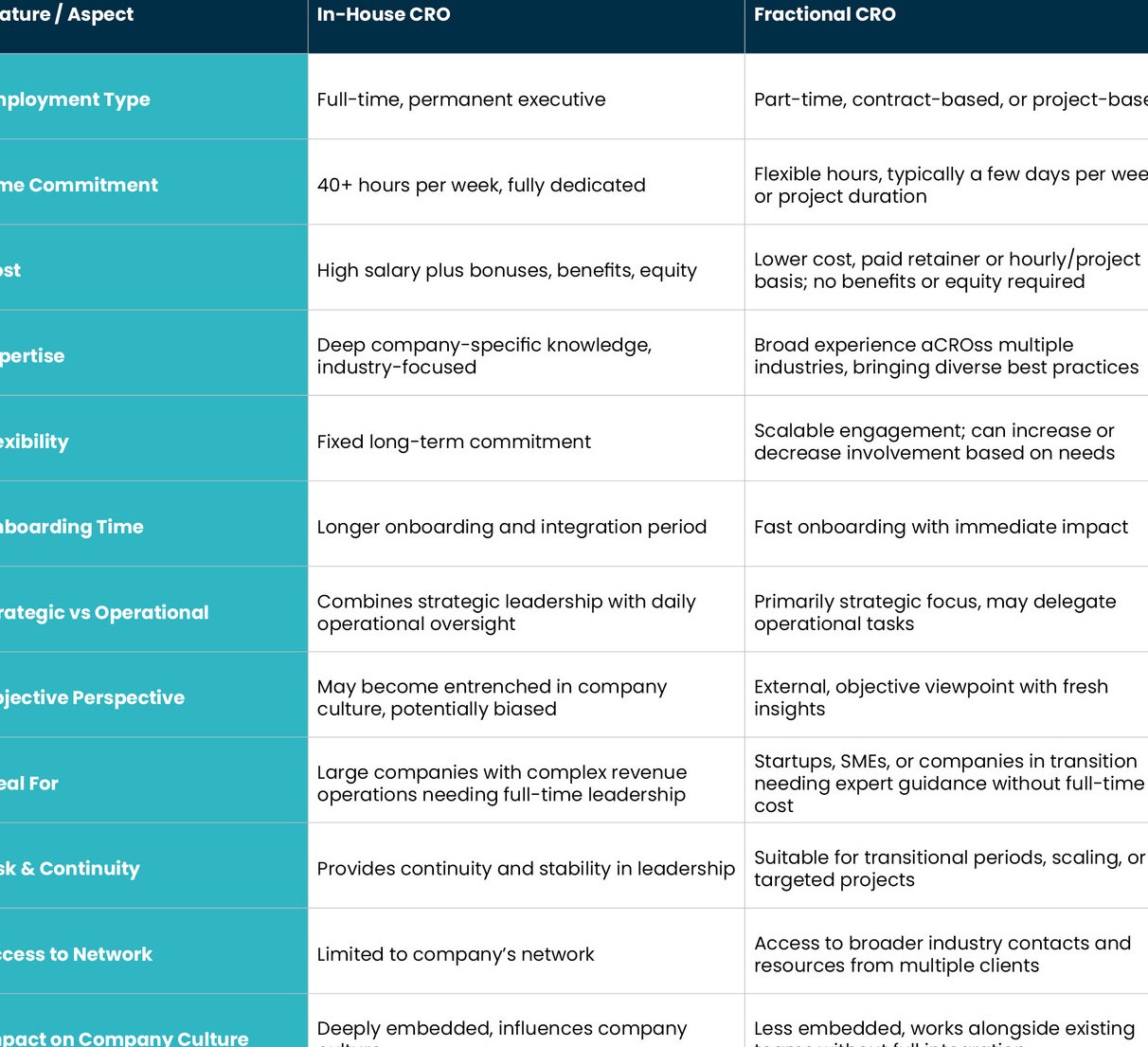
Hire a fractional Chief Revenue Officer in Waco by scoping the revenue problem first, then contracting a proven operator for 10–20 hours weekly at roughly $6,000–$18,000 per month. Source candidates through Central Texas networks and national fractional talent marketplaces, run a paid two-week diagnostic before signing, and tie the engagement to written 90-day revenue milestones.
The end-to-end process for landing a fractional revenue leader
The hiring sequence for a fractional Chief Revenue Officer looks nothing like a full-time executive search, and treating it like one is the first mistake most Waco founders make. A full-time CRO search runs four to seven months, costs a retained recruiter 25–33% of first-year cash compensation, and ends with an executive who needs another quarter to produce anything. A fractional engagement should go from first conversation to first working session in three to five weeks, sometimes faster.
Start with a written revenue diagnosis before you talk to a single candidate. Not a job description — a diagnosis. Pull twelve months of closed-won and closed-lost data out of whatever CRM you run, and answer four questions in plain numbers. What is your average deal size and has it moved? What is your win rate on qualified opportunities? How long does a deal sit between first meeting and signature? And where in the funnel does volume actually die — top-of-funnel starvation, mid-funnel stall, or a closing problem? A company with 40 qualified opportunities and a 12% win rate has a completely different problem than a company with 6 opportunities and a 45% win rate. The first needs sales process and qualification discipline. The second needs demand generation. A fractional CRO who is excellent at one is frequently mediocre at the other, and the diagnosis is what tells you which one to buy.
Write a one-page scope from that diagnosis. It should name the specific outcome — "get pipeline coverage to 3x quota by end of Q2," "rebuild the commercial comp plan and get rep attainment above 60%," "stand up an outbound motion that produces 25 qualified meetings a month" — plus the time commitment you expect, the systems the operator will touch, and who they will manage. Vague scopes produce vague invoices. This is the single highest-leverage document in the entire process and it takes an afternoon.
Then source. In a market the size of Waco you are running three channels at once rather than picking one. Channel one is local and relational: the Greater Waco Chamber, the Baylor University business school network and its alumni base, the McLennan County business community, and whatever peer CEO group you belong to. Central Texas has a real density of operators who scaled something and then stepped back, and they surface through relationships far more reliably than through job boards. Channel two is the I-35 corridor. Austin is roughly 100 miles south, Dallas-Fort Worth roughly 90 miles north, and both are deep pools of go-to-market executives. A fractional arrangement absorbs that geography comfortably because the work is mostly remote with a monthly or twice-monthly onsite. Channel three is national fractional marketplaces and executive networks — Chief Outsiders, Bespoke Partners' fractional practice, various boutique fractional-executive firms, and the increasingly organized independent-operator networks on LinkedIn. Run all three simultaneously and expect somewhere between eight and fifteen names to be worth a first call.

Screening calls should be short and blunt. Thirty minutes, and you are testing one thing: can this person describe a revenue problem structurally rather than anecdotally? Ask them to walk through a company they took from one revenue stage to the next and listen for whether they talk about mechanisms — pipeline math, conversion rates, territory design, comp levers — or whether they talk about vibes and relationships. Both types exist in the fractional market. Only one is worth $12,000 a month.
The deep interviews with three or four finalists should include your actual sales team, not just the founder. A fractional CRO who cannot earn the respect of two account executives in a forty-five-minute conversation will not earn it in a Tuesday operating cadence either. Have them review a real closed-lost deal from your CRM and tell you what they see. The gap between candidates on that exercise is usually enormous and immediately clarifying.
Then run a paid diagnostic sprint before the long engagement. Two weeks, ten to twenty hours total, a fixed fee somewhere in the $3,000–$7,500 range. Deliverable is a written assessment: what is actually broken, what they would change in the first 90 days, what they would need from you. This is the closest thing to a working interview that exists at the executive level, and it converts a hiring decision that is mostly instinct into one that is mostly evidence. It also gives you a cheap, dignified exit if the fit is wrong — you paid for a useful document and both parties move on.
Where a fractional revenue hire creates or leaks value
The economic case for fractional is straightforward on paper and messier in practice. A full-time CRO at a company doing $5–20 million in revenue commands somewhere in the $220,000–$350,000 base range nationally, plus variable comp, plus equity, plus 20–30% in loaded benefits and employer taxes. In the Waco market you may shave meaningfully off the top of that range compared to Austin or Dallas, but the executive talent you are competing for is often being recruited nationally now, and remote work has flattened a lot of the old geographic discount. Call the fully loaded cost of a real CRO somewhere north of $350,000 a year.

A fractional arrangement at 12 hours a week and $10,000 a month costs $120,000 a year. That is the headline saving and it is real, but it is not where most of the value actually sits. The value sits in three less obvious places.
First, seniority arbitrage. Fractional lets a $6 million company buy an operator who has actually scaled a business past $50 million — a person who would never take the full-time job at that stage and could not be afforded if they would. You are buying pattern recognition. The person has already seen the failure mode you are about to walk into, and the cost of avoiding one bad comp plan rollout or one premature territory split can exceed the entire annual fee.
Second, speed of correction. A full-time hire that goes wrong costs you the search, the severance, the six months of drift, and then the second search. Industry estimates on failed executive hires run to multiples of annual salary once you count opportunity cost. A fractional engagement with a 30-day out is a fundamentally different risk posture. You can be wrong cheaply.

Third, the RevOps clarification effect. A good fractional Chief Revenue Officer will usually surface, within their first month, that the company's actual constraint is not selling ability but revenue operations — dirty CRM data, no shared definition of a qualified opportunity, forecast built on hope, marketing and sales counting leads differently, no closed-loop attribution. This is the most common finding in small and mid-market companies and it is frequently worth more than anything else the engagement produces, because it redirects spend away from hiring more reps into fixing the machine the existing reps are running.
Now the leaks, because they are just as real. The first leak is context tax. A fractional Revenue Officer working ten hours a week spends the first two of those hours every week reloading context — what happened, what changed, who said what. At a small company with a chaotic week-to-week, that tax can eat 20% of the engagement. You reduce it by having a single internal point of contact, a standing written update, and clean CRM data the operator can read rather than ask about.
The second leak is authority ambiguity. If the fractional CRO advises but cannot decide, and the founder overrides half the decisions, you get a very expensive consultant producing recommendations that die in the inbox. Write down what they can decide unilaterally — comp plan design, pipeline hygiene standards, deal review process, hiring recommendations — and what needs founder sign-off. Get it in the agreement.
The third leak is the handoff cliff. Fractional engagements end. If everything the operator built lives in their head or their personal spreadsheets, the value evaporates in ninety days. Contract for documented artifacts: written playbooks, CRM configuration in your instance not theirs, recorded training, a documented forecast methodology. The deliverable is the system, not the person.

The fourth, and the one most Waco companies underestimate: the fractional executive has other clients. Three to five is typical. That is fine and it is the model working as designed, but it means your Tuesday emergency is competing for attention. Ask directly how many clients they carry, whether any are in your industry or competitive with you, and what their response-time commitment is. Get the answer in writing.
Concrete numbers, rates, and what the market actually pays
Fractional CRO pricing in 2027 clusters into a few recognizable bands, and knowing them keeps you from overpaying for a coach or underpaying for an operator who then disengages.
The low band runs roughly $4,000–$7,000 a month for something like five to eight hours a week. Realistically this buys advisory: a weekly leadership call, a monthly pipeline review, availability by text. It is genuinely useful for a founder who is running sales themselves and needs a sounding board with scar tissue. It does not buy someone who will rebuild your comp plan and manage your reps.
The middle band, $8,000–$15,000 a month for ten to twenty hours a week, is where most real operating engagements live. This buys a person who runs your weekly forecast call, manages or coaches your sales leaders directly, rebuilds process, and owns a number. For a Waco company doing $3–15 million in revenue, this is the band to plan for.

The upper band, $18,000–$30,000 a month, is two to three days a week — effectively a part-time executive with deep operational involvement, often at a company in an acute situation: a failed sales leader, a post-acquisition integration, a fundraise where the go-to-market story has to hold up under diligence. It is expensive relative to fractional norms and cheap relative to the alternative if the situation is genuinely acute.
Hourly arrangements exist and generally run $200–$500. Avoid them for operating work. Hourly billing creates a perverse incentive against the efficiency you hired for, and it makes the operator hesitant to take the extra call. Monthly retainer with a defined hour band is cleaner for both sides.
On structure: six-month initial terms with a 30-day termination clause are the market norm. Shorter than six months and the operator cannot produce compounding results; longer and you have given up your leverage. Roughly a third of fractional agreements include some performance component, and where they do, tie it to something the operator genuinely controls — pipeline created, qualified meeting volume, win-rate improvement, forecast accuracy within a stated variance — rather than to total company revenue, which is influenced by a dozen things outside their reach. Equity appears occasionally, usually in the 0.1–0.5% range vesting over two to four years, and it is more common when the fractional arrangement is explicitly a path to a full-time seat.
Timeline benchmarks worth holding people to: a diagnostic assessment inside 30 days, visible process changes by day 45, leading-indicator movement — meeting volume, pipeline coverage, stage conversion — by day 90. Lagging revenue results realistically land somewhere between month four and month eight depending on your sales cycle. If your average deal takes five months to close, demanding revenue proof at day 90 is asking for a number that mathematically cannot exist yet. Know your own cycle length before you set the milestone.

Two adjacent budget items people forget. First, the tooling the operator will want: CRM cleanup, a conversation-intelligence tool, a sales-engagement platform, maybe a forecasting layer. Budget $1,000–$4,000 a month depending on headcount, and expect the recommendation in month one. Second, the fractional CRO frequently needs a RevOps resource underneath them to execute — someone to actually build the reports, clean the data, and configure the workflows. Sometimes that is a fractional RevOps contractor at $3,000–$8,000 a month, sometimes an existing analyst you redeploy. An operator with no execution capacity underneath them produces strategy documents.
Pitfalls that sink these engagements and how to avoid them
The consultant-in-executive-clothing problem is the most common failure and the hardest to detect in an interview. The tell is that they describe outputs — frameworks, assessments, playbooks, workshops — rather than owned numbers. Ask: "What number did you personally own, and what did it do while you owned it?" An operator answers instantly and specifically. A consultant reframes the question. Both have value, but if you need someone to run a forecast call and hold two AEs accountable, the consultant will disappoint you and you will not know why for four months.
Scope creep in the wrong direction is next. You hire for revenue leadership and six weeks later they are rebuilding your marketing website, sitting in product roadmap meetings, and advising on a funding round. Some adjacency is healthy — revenue leadership legitimately touches marketing, pricing, customer success, and partnerships. But every hour spent outside the scope is an hour not spent on the thing you are actually paying to fix. Quarterly scope review, in writing, with a decision each time about whether to formally expand the engagement or push back.
The internal-resistance failure kills more engagements than incompetence does. Your existing sales team hears "fractional CRO" and hears "the founder hired someone to find out who to fire." That interpretation is not paranoid; sometimes it is accurate. If it is not, say so explicitly and early, and give the operator real authority visibly. A fractional executive introduced as an advisor and then expected to hold people accountable is being set up to fail. If your team learns about the hire from a calendar invite, you have already lost a month.

Data-quality shock is the underrated one. The operator arrives, opens your CRM, and finds 40% of opportunities with no close date, a pipeline stage nobody uses consistently, and two years of deals marked closed-lost with no reason code. They now have a choice: spend six weeks fixing data before they can diagnose anything, or diagnose from bad data. Both are bad. Spend two weeks before they start doing basic hygiene — require close dates, enforce stage definitions, backfill loss reasons on the last two quarters. It sounds trivial and it will save you a month of an expensive person's time.
Founder shadow-selling deserves its own paragraph because it is nearly universal in companies at this stage. The founder hires a revenue leader and then keeps taking the important deals themselves, keeps calling the biggest customer directly, keeps overriding pricing in the moment. Every one of those actions is individually defensible and collectively fatal to the engagement. Decide in advance which accounts the founder keeps and which the revenue function owns, and write it down. If the honest answer is "I am not ready to hand this over," that is fine — hire an advisor at the low band instead and save $80,000.
Geographic assumptions are worth checking too. A candidate who has only ever sold in Austin's venture-backed software market may misread a Waco company's reality — longer relationship cycles, more regional and manufacturing-adjacent buyers, less tolerance for aggressive outbound, a labor market where you cannot simply hire three more AEs next month. Central Texas outside the major metros runs on relationships more than on velocity. Ask candidates directly how they would adapt a playbook to a market where the buyer expects to meet you in person and the talent pool for sales hires is measured in dozens, not thousands.
Finally, the no-off-ramp trap. Twelve-month agreements with no termination clause, prepaid annually, are a bad deal for the buyer and a signal about the seller. Any operator confident in their work will accept 30-day mutual termination. If they will not, ask why, and listen carefully to the answer.

A selection checklist you can actually run
Reduce the decision to a scored evaluation rather than a gut call, because gut calls at the executive level are where founders reliably overweight charisma. Four dimensions, weighted.
Operating evidence, weighted heaviest. Have they owned a revenue number at a company at your stage, in a comparable motion? A CRO who scaled enterprise software with a nine-month cycle and a $200,000 average contract value is a poor match for a services business selling $15,000 engagements in ninety days. Stage and motion fit matter more than logo prestige. Reference-check two former clients and ask one question that cuts through everything: "Would you hire them again, and if not, why not?"
Fractional-specific track record. Running a full-time revenue org and running a fractional portfolio are different disciplines. The fractional version requires ruthless prioritization, working through other people, producing artifacts that survive their departure, and managing multiple clients without shorting any of them. Ask how many fractional engagements they have run, how long the average lasted, and how they ended. A pattern of three-month engagements that ended quietly is a signal.

Systems and RevOps fluency. They do not need to be a CRM administrator, but they need to read a funnel report without hand-holding, know what good forecast hygiene looks like, and be able to specify what they need built. If they cannot articulate the difference between a lead, an MQL, and a qualified opportunity in your business, they will not fix your pipeline.
Cultural and geographic fit. Will they show up in Waco, and how often? Monthly onsite is a reasonable baseline for an operating engagement; quarterly is thin. Do they understand a business where the CEO knows every customer by name? Can your sales team hear hard feedback from them without shutting down?
Score each finalist one to five on the four dimensions, weight operating evidence at double, and be suspicious of a candidate who scores a four everywhere and a five nowhere. Fractional executives earn their fee on a sharp edge, not on being generally competent.
What the engagement should look like once it starts
Onboarding sets the ceiling. Week one is access and listening: CRM, financials, the last four board or investor updates, recordings of recent sales calls if you have them, and one-on-ones with every commercial employee. Week two is customer contact — five to eight conversations with recent wins, recent losses, and one churned account. The pattern in those calls is usually where the real diagnosis lives, and it is the step most often skipped.

Weeks three and four produce the written 90-day plan: three to five prioritized initiatives, each with an owner, a deadline, and a measurable success criterion. Fewer than three and they are not being ambitious enough. More than five and nothing will finish.
The operating cadence matters more than the hours. A weekly pipeline and forecast call they run, not attend. A biweekly one-on-one with the founder that is about strategy rather than status. A monthly written update covering leading indicators, initiative progress, and blockers requiring founder action. A quarterly reset on scope and priorities. Put the cadence in the agreement so it does not quietly erode into ad-hoc calls.
Watch the leading indicators rather than revenue in the early months, because revenue lags and will tell you nothing useful at day 45. Track pipeline coverage ratio, qualified meetings created per week, stage-to-stage conversion, average sales cycle length, forecast accuracy against actuals, and rep quota attainment distribution. If those move in the right direction by day 90, the revenue follows on your cycle length. If they are flat at day 90, you have a problem now, not in month six.
Plan the exit from day one. Most engagements should end in one of three ways: the operator hires and trains a full-time VP of Sales or CRO and hands off; the scope shrinks to a light advisory retainer once the system is stable; or the arrangement converts to full-time. All three are successes. The failure mode is the indefinite engagement that has become comfortable furniture, where you are paying $10,000 a month for a weekly call because nobody wants to have the conversation. Set a review point at month six and month twelve where continuation has to be affirmatively re-justified.
Related questions
Should I hire a fractional CRO or a full-time VP of Sales?
If your problem is executing a known playbook with more reps, hire a VP of Sales — it is cheaper and more hands-on. If you do not yet know what the playbook is, or the problem spans marketing, sales, and retention, a fractional Chief Revenue Officer is the better first move. Many companies do both sequentially.
How long should a fractional CRO engagement last?
Six to eighteen months is typical. Under six months rarely allows compounding results on any normal sales cycle. Past eighteen, ask honestly whether you are avoiding a full-time hire. Structure a six-month initial term with defined renewal checkpoints and a 30-day mutual termination clause.
Do I need to be in Waco to hire one, or can they be remote?
Fully remote works for advisory and analytics-heavy engagements. For operating work involving coaching reps and changing behavior, insist on a monthly onsite in Waco at minimum. The Austin and Dallas-Fort Worth corridors both put qualified operators within a comfortable two-hour drive.
What size company actually needs a fractional Revenue Officer?
Roughly $2–25 million in revenue with a commercial team of three or more. Below that, the founder should still be selling and a coach is a better fit. Above it, you likely need a full-time executive with a fractional operator only for a specific transition or turnaround.
How do I measure whether it is working before revenue moves?
Track leading indicators: pipeline coverage ratio, qualified meetings created, stage-to-stage conversion, sales cycle length, and forecast accuracy. These should show movement by day 90 even when your deal cycle means booked revenue cannot respond for another quarter.
FAQ
What does a fractional Chief Revenue Officer actually do day to day?
They own the commercial system rather than individual deals. In practice that means running the weekly forecast and pipeline review, designing and enforcing the sales process, building or rebuilding comp plans and territories, coaching sales managers, aligning marketing's lead definitions with sales' acceptance criteria, and specifying what RevOps needs to build. They spend very little time selling directly, which surprises founders who expect a rainmaker.
How much should a company in Waco budget in 2027?
Plan on $8,000–$15,000 a month for a genuine operating engagement at ten to twenty hours a week, with advisory-level arrangements starting around $4,000 and intensive two-to-three-day-a-week engagements running $18,000–$30,000. Add $1,000–$4,000 monthly for tooling and consider whether you also need a RevOps contractor underneath them to execute the build work.
Where do I actually find qualified candidates near Waco?
Run three channels at once: local relationship networks including the Greater Waco Chamber and the Baylor University alumni base; the Austin and Dallas-Fort Worth executive pools roughly ninety to a hundred miles in either direction along I-35; and national fractional-executive firms and independent-operator networks on LinkedIn. Expect eight to fifteen names worth a screening call.
What contract terms protect me if it goes badly?
A six-month initial term with 30-day mutual termination, monthly retainer billing rather than annual prepayment, explicit written deliverables and cadence, a clause requiring documented artifacts to live in your systems rather than theirs, defined decision rights, and disclosure of concurrent client count with any competitive conflicts named. Decline twelve-month prepaid agreements with no off-ramp.
Can a fractional CRO fix my RevOps problems, or do I need a separate hire?
They will diagnose RevOps problems reliably and specify the fix, but most fractional Revenue Officers are not the ones building reports and configuring workflows. Expect to pair them with an existing analyst or a fractional RevOps contractor at $3,000–$8,000 a month. An operator with no execution capacity underneath them produces strategy decks instead of working systems.
When should the engagement end and what does a clean handoff look like?
It ends when they have hired and trained a full-time revenue leader, when the system is stable enough to shrink to light advisory, or when they convert to full-time. A clean handoff means written playbooks, CRM configuration living in your instance, a documented forecast methodology, recorded training, and thirty days of overlap with whoever takes over.
Sources
- https://www.bls.gov/oes/current/oes_47380.htm — Bureau of Labor Statistics occupational employment and wage statistics for the Waco, TX metropolitan area
- https://www.sba.gov/business-guide/manage-your-business/hire-manage-employees — U.S. Small Business Administration guidance on hiring and managing employees and contractors
- https://www.irs.gov/businesses/small-businesses-self-employed/independent-contractor-self-employed-or-employee — IRS criteria distinguishing independent contractors from employees
- https://hbr.org/2017/05/the-new-rules-of-sales-and-marketing — Harvard Business Review on modern commercial organization design
- https://www.mckinsey.com/capabilities/growth-marketing-and-sales/our-insights — McKinsey Growth, Marketing & Sales practice research on commercial operating models
- https://www.gartner.com/en/sales/topics/revenue-operations — Gartner overview of revenue operations structure and function
- https://www.wacochamber.com/ — Greater Waco Chamber of Commerce, regional business and workforce resources
- https://www.dol.gov/agencies/whd/flsa — U.S. Department of Labor Fair Labor Standards Act guidance relevant to contractor classification
- https://www.score.org/ — SCORE mentorship and small business advisory resources
Related on PULSE
- [How do I hire a fractional Chief Revenue Officer in Oshkosh in 2027?](/knowledge/tl21716)
- [How do I hire a fractional Chief Revenue Officer in Ogden in 2027?](/knowledge/tl21709)
- [How do I evaluate a fractional Chief Revenue Officer in Texas in 2027?](/knowledge/tl16974)
- [How do I evaluate a fractional Chief Revenue Officer in Phoenix in 2027?](/knowledge/tl16999)
- [Is there a fractional Chief Revenue Officer available near me in Houston in 2027?](/knowledge/tl16998)
- [Is there a fractional Chief Revenue Officer available near me in Chicago in 2027?](/knowledge/tl16997)
This page will be disappearing soon. Save it to your device for $1 — or read it free while it is here.
@Kory-White- · if Venmo asks, the last 4 of my number are 2012
 pulse-toolsHow do I hire a part-time CRO in Lafayette, Louisiana in 2027?
 pulse-toolsHow do I hire a fractional CCO in Appleton in 2027?
 pulse-toolsHow do I hire a fractional COO in Ogden in 2027?
 pulse-toolsShould I Hire a Fractional CRO If I Need to Build a Partner Channel in 2027?
 pulse-toolsHow much does a fractional CRO cost for a real estate company in 2027?
 pulse-toolsHow do I hire a fractional CSO in Roswell in 2027?
 pulse-toolsHow do I hire a fractional Chief Revenue Officer in Ogden in 2027?
 pulse-toolsHow do I hire a fractional CRO in Reading in 2027?
 pulse-toolsHow do I hire a fractional CSO in Biloxi in 2027?
 pulse-toolsHow do I hire a fractional CCO in Myrtle Beach in 2027?