

How do I hire a fractional CRO in Delaware?
 Curated byKory White · Fractional CRO · Maryland
Quality
Certified

You hire a fractional Chief Revenue Officer in Delaware by first confirming you need revenue *strategy* rather than daily sales *execution*, then sourcing vetted operators through curated executive networks and screening them for fit with your industry, your revenue stage, and remote-first working habits. Because Delaware is not a dense concentration of fractional revenue talent, your strongest candidates will almost always work remotely, so the decisive factors are their track record and their ability to diagnose your revenue engine from a distance — not their zip code. Hiring well is less about finding someone nearby and more about running a disciplined process: define the gap, write a tight brief, source from the right places, screen for diagnosis over credentials, and start with a time-boxed pilot tied to measurable outcomes. The sections below walk through each stage — what a fractional CRO does, where to find one, how engagements are typically priced, how to evaluate candidates, how to structure a remote engagement, and the mistakes that quietly sink these hires.
What does a fractional Chief Revenue Officer actually do, and do you need one?
A fractional CRO is a part-time, executive-level revenue leader who owns your go-to-market strategy without the cost or commitment of a full-time hire. Their job is to see the whole revenue system — marketing, sales, customer success, pricing, and operations — and make it work as one engine. They are not a senior salesperson you can point at a pipeline and tell to close deals. They design the system, coach the leaders who run it, and hold the number accountable at the strategy level.
The most common mistake founders make is confusing this role with a VP of Sales. A VP of Sales manages a team and is responsible for hitting the number through direct execution. A fractional CRO sits a level up: they decide what the number *should* be, how the go-to-market motion should be built, and how the sales leader should be coached to deliver it. If you already have a capable VP of Sales who is struggling with strategy, a fractional CRO can coach them. If you have no sales leadership at all, a fractional CRO can help you hire one — but you should not expect them to personally run daily sales operations for more than a short transition window. If you want to sanity-check whether your situation calls for strategy or execution, PULSE has a companion breakdown at https://pulserevops.com/knowledge/tl9428 that maps symptoms to the right role.
Where do you find fractional CRO candidates who understand the Delaware market?
Delaware's economy is not a generic software hub, and that shapes where you should look. The state's revenue-generating base leans heavily on regulated and long-cycle industries — pharmaceutical and life sciences, financial and banking services, and logistics tied to the Port of Wilmington and the I-95 corridor. A candidate whose entire career was spent selling low-cost software to small businesses will struggle with the multi-stakeholder, compliance-heavy, long-evaluation sales motions those sectors demand. So your search should filter for *motion fit* before geography.
The best sourcing channels are curated communities of revenue operators rather than open freelance marketplaces. Executive networks such as Pavilion and the RevOps Co-op maintain pools of vetted revenue leaders, many of whom take fractional engagements. Fractional-executive firms that specialize in placing part-time C-suite talent are another strong channel because they pre-screen for seniority and reference-check track records. LinkedIn remains useful for warm-intro sourcing, especially when you search for operators who have carried revenue in your specific vertical. Because most of these people work remotely, you are drawing from a national talent pool — which is an advantage, not a limitation. For a deeper look at what "vetted" should mean, PULSE covers the evaluation criteria at https://pulserevops.com/knowledge/tl9427.
How much does hiring a fractional CRO typically cost, and what drives the range?
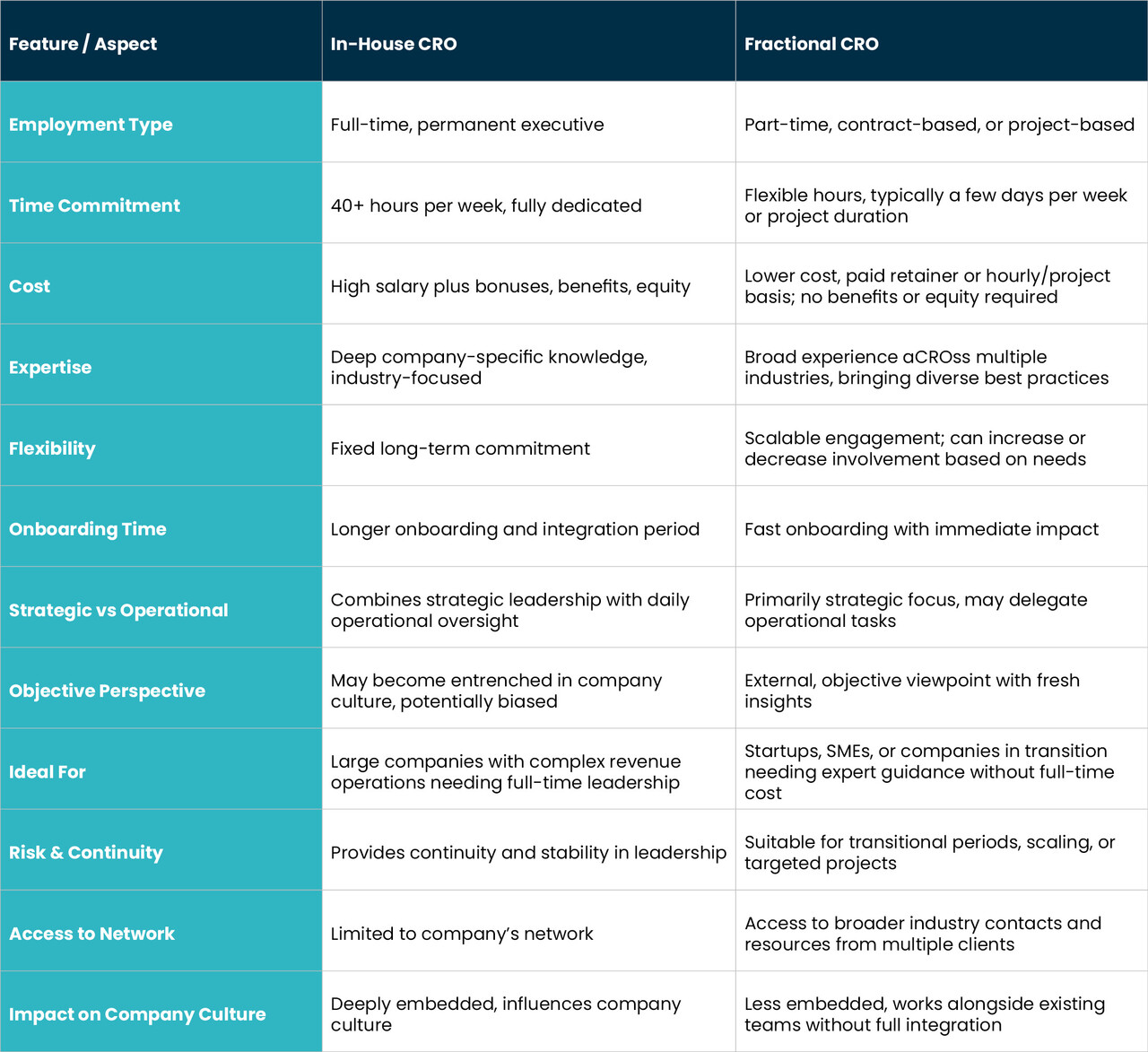
Fractional CRO engagements are usually structured as monthly retainers or day rates, and the honest answer is that the range is wide because your specific situation sets the price far more than your location does. There is no meaningful "Delaware discount" — rates are driven by the operator's experience and the complexity of the problem, and the strongest candidates are pulled from a national market that prices consistently across regions.
Several factors move the number. The first is *time commitment*: an operator giving you two to three days a week costs materially more than one giving you a single day. The second is *company stage*: earlier-stage companies sometimes negotiate lower cash rates in exchange for an equity component, betting the operator on upside, while later-stage companies typically pay a fuller cash retainer. The third is *revenue-stack complexity*: if your CRM is disorganized, your pipeline hygiene is poor, and your lead-to-cash process is broken, the operator will spend early cycles on cleanup before they can do strategic work — and that operational lift carries a premium. The fourth is *equity*: some fractional CROs will trade cash for a small equity stake with a multi-year vest, which is common in early-stage companies and worth modeling honestly against your cap table. Rather than fixating on a single quoted figure, ask each candidate to walk you through *what* they will do for the retainer and *how* they will measure return.

How should you evaluate and screen a fractional CRO candidate?
Do not hire on a résumé — hire on a diagnosis. The single most predictive signal in a first call is whether the candidate can quickly identify the most likely bottleneck in your revenue engine and ask sharp questions about it. If they probe your sales motion, your customer acquisition economics, your churn, and your team composition, that is a strong signal. If they immediately pitch a proprietary methodology or a favorite tool before understanding your business, treat that as a warning.
Structure your screening around motion fit and evidence of outcomes. Ask how they have designed a sales process for a product with a long, multi-stakeholder evaluation cycle, or how they have sold into a regulated environment — both directly relevant to Delaware's dominant sectors. Then ask for references, and choose references from companies with *similar dynamics* rather than similar geography: regulated industries, long sales cycles, committee-based buying. The most useful reference is a founder who will tell you plainly whether the operator actually improved revenue outcomes or merely produced a stack of reports. Below is a simple decision path for matching your situation to the right hire.

How do you structure a remote fractional CRO engagement for success?
Since your fractional CRO will almost certainly work remotely, the engagement model matters more than proximity. Start with a written charter that removes ambiguity before work begins. Define decision rights — what the operator can approve on their own versus what requires founder or board sign-off. Define a communication cadence: a weekly one-to-one with you, a periodic revenue review with the broader team, and a regular board update, ideally anchored by a short written summary rather than another meeting. Grant full access to your CRM and revenue dashboards, and require that activity be logged promptly, because a fractional leader who is flying blind on data cannot help you.
Just as important, agree on success metrics that go beyond top-line bookings. Leading indicators — pipeline coverage, average deal size, ramp time for new reps, and win rate by segment — protect you from an operator who only chases short-term wins. A healthy first engagement produces a revenue audit and a pipeline-health assessment early, then a concrete plan with named metrics, then hands-on coaching and a revised playbook, with a formal review at the end of the pilot to decide whether to extend, convert, or wind down. The diagram below shows how the working relationships and reporting lines typically flow in a remote-first setup.

A useful discipline: treat the fractional CRO as a strategic advisor with clear deliverables, not as a part-time employee you manage by hours. The goal of a good engagement is to build a revenue engine that runs without them. If you still depend on them long after the initial ramp, you either hired the wrong person or you have a deeper organizational problem to solve. PULSE keeps a working checklist for engagement structure and handoff planning at https://pulserevops.com/knowledge/tl12036.
How do you avoid the most common mistakes when hiring a fractional CRO?
A handful of predictable errors sink these hires. The first is *overvaluing local presence* — filtering by who lives nearby instead of who has actually sold into your kind of market. A remote operator with deep experience in your vertical will almost always outperform a local generalist. The second is *under-scoping the role* by expecting a strategy-level leader to personally cold-call, demo, and close every day; if that is the work you need, hire a full-time salesperson or a VP of Sales instead.

The third mistake is a *shallow reference check* — ask references specifically how the operator adapted to a company with a similar industry or regulatory profile, and whether results showed up within the agreed window or required an indefinite ramp. The fourth is *ignoring time-zone and availability alignment*: remote does not mean unavailable, so confirm the operator can work during the hours you actually need real-time collaboration. The fifth, and most costly over time, is *failing to plan the exit*. Decide upfront how the work transitions back to an internal team — whether the operator documents their playbook and trains a successor — so momentum doesn't collapse when the engagement ends. Get these five right and the hire becomes an accelerant instead of an expensive experiment.
Related questions
How do I know whether I need a fractional CRO or a full-time CRO?
Choose fractional when you need senior revenue *strategy* part-time and want flexibility; choose full-time when your revenue engine is large and stable enough to justify daily executive ownership. Stage, complexity, and whether the problem is strategic or operational should drive the decision.
Does a fractional CRO need to live in Delaware to be effective?
No. The strongest fractional CROs work remotely and build systems that run without them. Prioritize their track record in your industry and their remote-collaboration discipline over their physical location; plan for occasional on-site visits for planning or board sessions.
What should a fractional CRO deliver in the first 90 days?
Early on, expect a revenue audit and pipeline-health assessment, followed by a concrete plan with named leading indicators, then hands-on coaching and a revised playbook. By the review point you should see measurable movement in at least a couple of the agreed metrics.
How do equity-for-cash tradeoffs work with a fractional CRO?
Some operators accept a lower cash retainer in exchange for a small equity stake with a multi-year vest, common in early-stage companies betting on upside. Model it honestly against your cap table and confirm the vesting and cliff terms are appropriate for a part-time role.
Can a remote fractional CRO manage a local sales team?
Yes, provided you establish clear decision rights, a firm communication cadence, and disciplined CRM data hygiene. Accountability comes from structure and metrics, not from being in the room — most well-run fractional engagements are managed entirely through remote reviews and dashboards.
FAQ
What exactly is a fractional CRO, and how is it different from a full-time VP of Sales? A fractional CRO is a part-time, executive-level revenue leader who provides strategic oversight — often on a retained, limited-hours basis — without the cost of a full-time salary and benefits. Unlike a VP of Sales, who focuses on execution and managing a team day to day, a fractional CRO concentrates on high-level revenue strategy, go-to-market design, and process optimization. For a Delaware company, the right strategic guidance can accelerate growth without overcommitting resources you don't yet have.
Can a fractional CRO really understand Delaware's business market? Yes, but only if you screen for it. The best fractional CROs are adaptable and have cross-industry experience, so you should specifically ask about their work in pharma and life sciences, financial services, or logistics — Delaware's dominant sectors. They don't need to live in the state, but they must grasp the regulatory pressures, long sales cycles, and committee-based buying that differ from a typical software company in a coastal tech hub.
How long does it typically take to hire a good fractional CRO? Plan for a few weeks from defining your needs to signing an agreement, and allow more time if you screen thoroughly. Because Delaware isn't a dense talent hub, you'll rely on curated networks and warm introductions, which can speed sourcing. Rushing the screen for industry context or communication style is the most common cause of a mismatch, so build in time for deliberate evaluation.
Engagements are usually structured as monthly retainers or day rates, and the range is wide because scope, stage, and revenue-stack complexity move the price far more than geography does. There is no meaningful local discount in Delaware. Instead of anchoring on a single quoted figure, ask each candidate to explain exactly what they'll do for the retainer and how they'll measure the return so you can compare offers on value, not just cost.
How do I ensure a remote fractional CRO is effective? Effectiveness hinges on clear expectations and structured communication from day one. Define a time-boxed plan with specific outcomes, require regular written updates plus a periodic strategic review, and grant full access to your revenue data. Probe during interviews for async work habits and disciplined reporting. A strong operator will proactively surface progress and flag risks, which is what makes remote collaboration work.
What if I only need help with one specific revenue problem, not a full overhaul? That's an ideal fractional scenario. You can engage an operator for a targeted mandate — redesigning an enterprise sales process, cleaning up pipeline hygiene, or building a go-to-market motion for a new segment. Start with a one-page brief that names the specific problem and the outcome you want, and structure the engagement so you can scale it up or wind it down without a long-term commitment.
Should a fractional CRO take equity instead of a full cash rate? It depends on your stage and how you value control of your cap table. Early-stage companies commonly trade some cash for a small equity stake with a multi-year vest, aligning the operator to long-term upside. Confirm the vesting schedule, cliff, and dilution are appropriate for a part-time role, and make sure the arrangement doesn't crowd out equity you'll need for full-time hires later.
Sources
- Pavilion — Revenue leadership community
- RevOps Co-op — Revenue operations community
- Harvard Business Review — Research on fractional and interim leadership
- First Round Review — Sales and go-to-market leadership essays
- SaaStr — Go-to-market and revenue leadership guidance
- Chief Outsiders — Fractional executive practice and models
- Delaware Prosperity Partnership — Delaware key industries and economy
- LinkedIn — Professional network for sourcing and references
Related on PULSE
- Should I hire a fractional CRO in Dupont Circle in 2027?
- How do I hire a fractional CRO in Ellicott City in 2027?
- How do I hire a fractional CRO for a martech business in 2027?
- How do I hire a fractional CRO in Ocean View in 2027?
- How do I hire a fractional CRO in Cheswold in 2027?
- How do I hire a fractional CRO in Bowers in 2027?
This page will be disappearing soon. Save it to your device for $1 — or read it free while it is here.
@Kory-White- · if Venmo asks, the last 4 of my number are 2012
This page is gone.
This one is off the shelf now. $1 keeps it on your phone for good — the whole page, pictures and diagrams included.
 pulse-toolsHow do I hire a fractional CSO in Biloxi in 2027?
 pulse-toolsWhere do I find an interim CRO in New Mexico in 2027?
 pulse-toolsWhat is the best way to approach Pulse Tools in 2027?
 pulse-toolsWhat red flags should I watch for in a fractional CRO in 2027?
 pulse-toolsWhat should I look for in a fractional CRO in Buffalo in 2027?
 pulse-toolsWhat should I look for in a fractional CRO in San Diego in 2027?
 pulse-toolsHow do I hire a fractional VP of Sales in Monroe in 2027?
 pulse-toolsWhat should I look for in a fractional CRO in Cleveland in 2027?
 pulse-toolsHow do I hire a fractional VP of Sales in South Bend in 2027?
 pulse-toolsHow do I hire an interim CRO in Los Angeles in 2027?