
The 10 Best AI Tools for Stock Trading Research in 2027
 Curated byKory White · Fractional CRO · Maryland
 PULSEKNOWLEDGE LIBRARY
For a professional researcher who needs to read more, faster, and miss less, AlphaSense is the best overall AI tool for stock trading research in 2027 — its AI search and "Generative Search" engine sit on top of an enormous corpus of earnings calls, broker research, filings, and expert-call transcripts. The strongest runner-up is the Bloomberg Terminal, whose AI-assisted document summaries and Q&A now ride on the deepest real-time data set on the desk.
AlphaSense is for analysts and PMs doing fundamental and event-driven work; Bloomberg is for anyone who also needs live pricing, execution, and cross-asset coverage in one seat. Budget-conscious independent traders should jump to Koyfin (our Best Value pick).
#
How We Ranked These
We weighted five things that matter to people who research equities for a living, not for entertainment:
- Data depth and provenance — Does the AI sit on primary sources (filings, transcripts, vetted research) or on scraped web text? Hallucination risk drops when the model cites a real document.
- Explainability and citations — Every AI claim needs a clickable source. Tools that show their work scored higher than black boxes that spit out a "buy."
- Workflow fit — Screening, charting, monitoring, and writing live in different tools. We rewarded platforms that handle a real research loop instead of one trick.
- Cost vs. value — A $30,000 terminal and a $49 subscription serve different readers; we judged each against its own buyer.
- Track record and transparency — We favored vendors that publish methodology and, where relevant, audited or third-party-verified performance over those that advertise vague "win rates."
We excluded pure copy-trading apps and "signal" Telegram bots. Everything below is a real, operating product as of 2027.
1. AlphaSense 🏆 BEST OVERALL
AlphaSense is a market-intelligence search engine built for institutional research. After acquiring Tegus in 2024, it pairs its document index with one of the largest libraries of expert-call transcripts anywhere, so an analyst can search across SEC filings, earnings-call transcripts, sell-side broker research, and primary-expert interviews from a single query bar.
Its Generative Search and Smart Summaries features let you ask a plain-English question — "What did semiconductor management teams say about inventory levels last quarter?" — and get a synthesized answer with inline citations back to the exact sentence in the source document. The platform's older "Smart Synonyms" technology, which expands a search for "headwind" to related phrasing, still underpins recall so you don't miss a mention buried in a footnote.
AlphaSense is best for buy-side and sell-side teams, corporate strategy groups, and serious independent analysts who read hundreds of documents a week. Pricing is enterprise-only by quote (no public price), which is the main reason a solo trader might start lower on this list. For the reader whose job is synthesizing primary sources, nothing else combines this corpus with this quality of AI retrieval.
2. Bloomberg Terminal

The Bloomberg Terminal remains the institutional standard, and its AI layer has matured into a genuine research aid rather than a gimmick. The terminal can now generate AI summaries of earnings-call transcripts and answer questions about documents directly in the workflow, while BloombergGPT-derived tooling supports tasks like sentiment scoring and headline classification.
What sets Bloomberg apart is breadth: real-time pricing across equities, fixed income, FX, commodities, and derivatives, plus news, fundamentals, and the BQL query language for quant work — all in one seat. The AI features are most useful precisely because they're grounded in that proprietary, structured data rather than the open web.
The catch is cost. A single terminal runs around $30,000 per year, which makes it a tool for funds, banks, and well-capitalized desks rather than retail. For a professional who already lives on the terminal, the new AI features are a free upgrade to a workflow they aren't leaving anyway.
3. Koyfin 💎 BEST VALUE

Koyfin delivers a large slice of Bloomberg-style coverage — company financials, estimates, dividend histories, macro dashboards, and watchlists — at a fraction of the price. It has become the default research terminal for independent analysts, RIAs, and self-directed investors who can't justify a five-figure data bill.
Koyfin offers a free tier plus paid plans starting around $49/month for its Plus level, with higher tiers adding more screening power and analyst estimates. Its AI and natural-language features focus on fast company snapshots, customizable financial-analysis templates, and side-by-side comparisons that would take far longer to assemble manually.
It's the Best Value pick because the cost-to-coverage ratio is unmatched for fundamental research. You won't get Bloomberg's real-time depth or AlphaSense's transcript corpus, but for building a thesis on a public company, Koyfin gives you 80% of the workflow for low double-digit dollars a month.
4. Trade Ideas (Holly AI)
Trade Ideas is a real-time stock-scanning platform whose AI engine, Holly, simulates thousands of strategy combinations overnight and surfaces a curated set of trade candidates each morning. It's built for active intraday and swing traders rather than long-horizon fundamental researchers.
Holly's value is the backtested, statistically filtered watchlist it produces before the open, complete with entry, stop, and target logic. The platform also offers live scanning, charting, and broker integration. The AI-driven Premium tier runs around $167/month billed annually, with a cheaper Standard plan that omits Holly.
For a research workflow centered on technical setups and momentum, Trade Ideas automates the grunt work of scanning the entire market. It is not a tool for reading 10-Ks — but as a quantitative idea generator for short-term traders, it has one of the longest track records in the category.
5. TrendSpider
TrendSpider is a charting and technical-analysis platform that leans hard into automation. Its standout features are automatic trendline detection, multi-timeframe analysis, and a no-code strategy tester that lets you build and backtest rule-based systems without writing scripts.
Its Raindrop charts and dynamic price alerts are genuinely distinctive, and the platform supports automated alerting on complex multi-condition setups. AI-assisted pattern recognition handles chores — like drawing support and resistance — that traders used to do by hand. Plans scale from entry-level monthly subscriptions up to roughly $97+/month for the full feature set, often discounted heavily on annual billing.
TrendSpider is best for technically driven traders who want to systematize a chart-reading process and validate it against history. It complements a fundamental tool rather than replacing one.
6. Danelfin
Danelfin is an explainable-AI stock-scoring platform that rates U.S. and European stocks on a 1-to-10 "AI Score", where a 10 historically signaled the highest probability of beating the market over the following weeks. Crucially, it shows feature-level explanations — which fundamental, technical, and sentiment factors drove the score — rather than hiding behind a black box.
It analyzes a large universe of indicators per stock daily and publishes its methodology, including third-party-referenced performance backtests of high-AI-Score baskets. Paid plans typically run in the $24–$48/month range depending on tier and billing.
Danelfin suits systematic, factor-aware investors who want an AI second opinion that's auditable. Treat the AI Score as one input alongside your own work — but as a screening and ranking aid, its transparency is a notable strength.
7. Boosted.ai

Boosted.ai brings machine-learning research to institutional investors — hedge funds, asset managers, and family offices. Its platform, often referenced through its "Boosted Insights" tooling, lets portfolio managers build ML models to rank stocks, analyze portfolio risk, and surface drivers without a data-science team.
The AI assistant can answer portfolio-level questions, flag factor exposures and concentration risk, and generate idea lists grounded in the user's own universe. It's designed to augment a PM's judgment, with explainability built into the model outputs.
Pricing is enterprise/institutional and not publicly listed, placing it firmly in the professional tier. For a fund that wants ML-driven equity research without building infrastructure from scratch, Boosted.ai is one of the few purpose-built options.
8. Fiscal.ai (formerly FinChat)

Fiscal.ai — the platform that launched as FinChat — is an AI research assistant focused on fundamental data and financial Q&A. You can ask for a company's revenue by segment, KPI trends, or management commentary and get cited answers with charts, drawn from filings and standardized financials rather than open-web guesses.
Its strengths are clean KPI data, segment-level breakdowns, and visualizations that would otherwise require building spreadsheets by hand. It offers a free tier plus paid plans (Plus around $25/month, with higher Pro tiers) that unlock deeper history and more usage.
Fiscal.ai is best for fundamental analysts and long-term investors who want a fast, citation-backed way to interrogate company numbers. It's lighter than AlphaSense on broker research and expert calls, but far cheaper and faster for everyday financial questions.
9. Tickeron
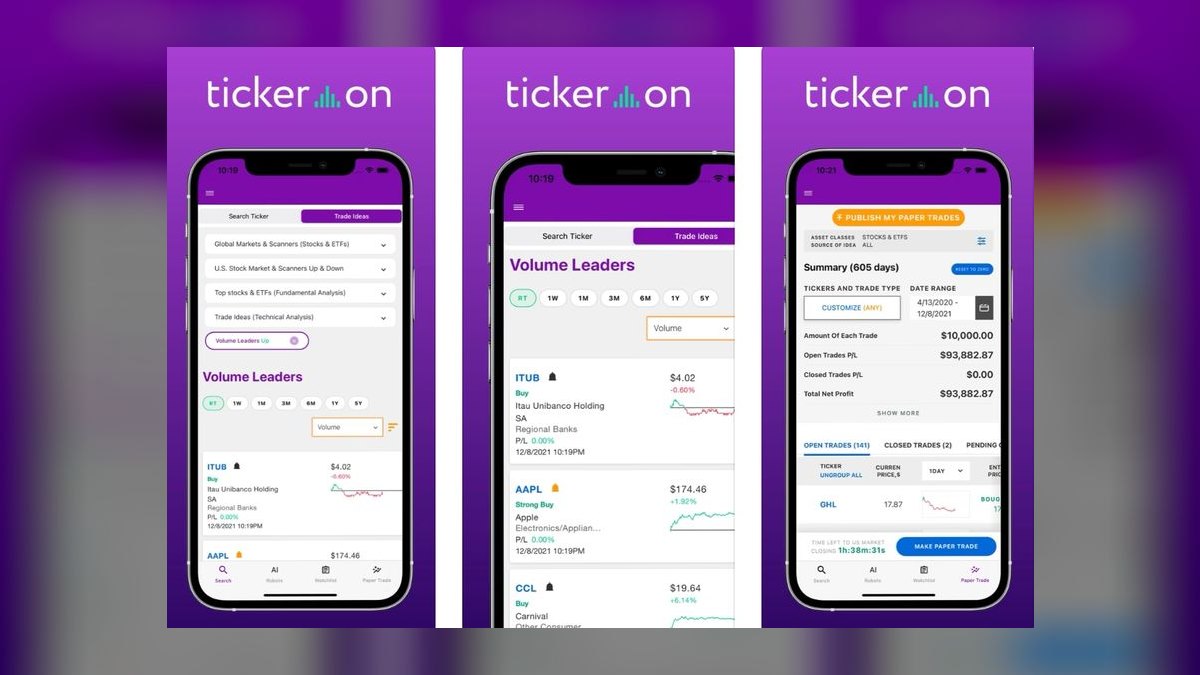
Tickeron offers AI pattern recognition and "AI Robots" — automated agents that scan for chart patterns and generate trade ideas with confidence levels. Its pattern-search engine identifies classic technical formations (head-and-shoulders, triangles, channels) across thousands of tickers in real time.
The platform publishes AI-generated signals with stated odds, plus trend-prediction and real-time-pattern tools across stocks, ETFs, crypto, and forex. Subscription tiers vary widely by the robots and scanners included.
Tickeron fits technically oriented traders who want automated pattern detection and signal generation. As with any signal product, validate the published statistics against your own testing — but the breadth of automated scanning is real and useful for idea sourcing.
10. Magnifi by TIFIN
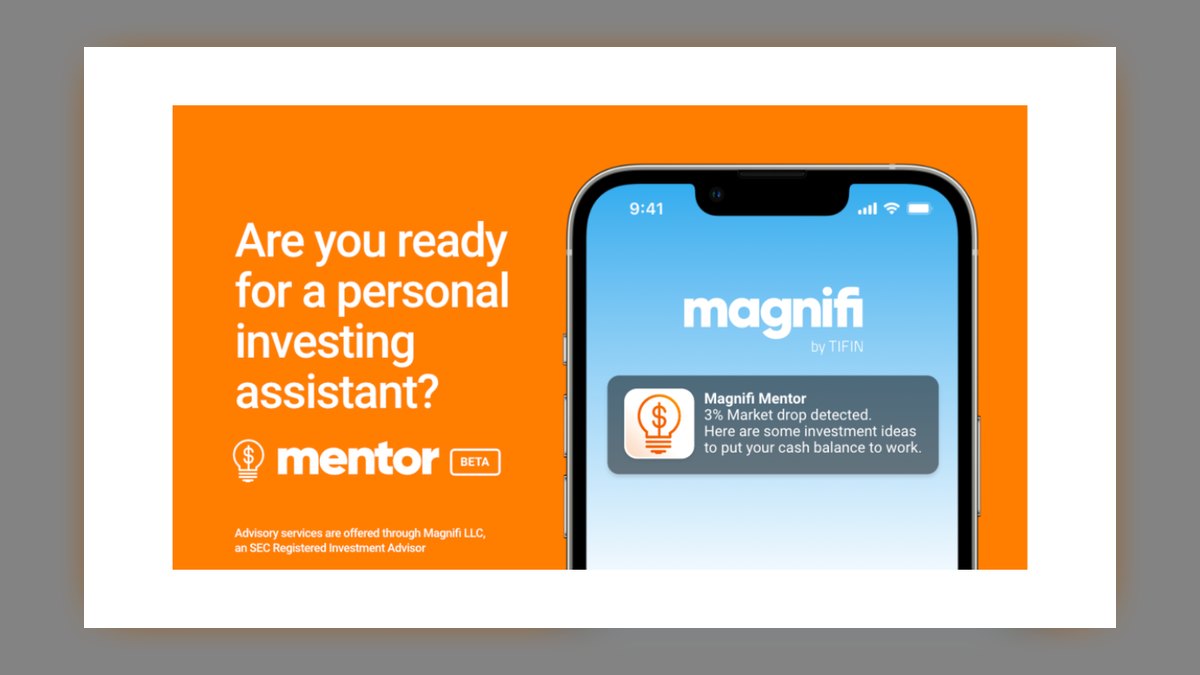
Magnifi, from TIFIN, is a conversational AI investing assistant aimed at self-directed investors and advisors. You chat with it the way you'd query a research analyst — "compare dividend growth for these three stocks" — and it returns data-backed comparisons, fund and stock screens, and portfolio insights in plain language.
It's priced for individuals at roughly $11/month or ~$111/year, making it one of the most accessible AI tools on this list. The assistant can monitor holdings, surface diversification and overlap analysis, and explain investment concepts on demand.
Magnifi is best for retail investors and advisors who want a friendly, low-cost AI co-pilot rather than an institutional research terminal. It won't replace deep fundamental tooling, but as an entry point to AI-assisted investing, it's hard to beat on price and ease of use.
FAQ
Can AI tools actually pick winning stocks? No tool reliably predicts prices. The best ones — AlphaSense, Koyfin, Fiscal.ai — accelerate *research* by finding and summarizing real information faster. Scoring tools like Danelfin publish backtests, but past probability is not future return.
What's the cheapest credible option here? Magnifi at roughly $11/month and Koyfin's free tier are the lowest-cost entry points. Fiscal.ai and Danelfin also offer free or sub-$50 tiers that cover most independent-investor needs.
Do I still need a Bloomberg Terminal in 2027? Only if you need real-time cross-asset data and execution in one seat. For pure equity research, AlphaSense plus Koyfin covers most of the workflow at far lower cost.
How do these tools avoid AI hallucinations? The strongest ones ground answers in primary documents with inline citations — AlphaSense, Fiscal.ai, and Bloomberg all link claims back to filings or transcripts. Always click the citation to confirm before acting.
Which tool is best for technical, short-term traders? Trade Ideas (for AI-built watchlists via Holly), TrendSpider (for automated charting and backtesting), and Tickeron (for pattern recognition) are the three built for that workflow.
Are these tools regulated or audited? They are software providers, not registered advisers, so treat outputs as research inputs. For any performance claim, look for published methodology and third-party verification rather than a marketing headline.
Bottom Line
For 2027, AlphaSense is the best overall AI tool for serious stock research because it grounds generative AI in a deep, citable corpus of filings, transcripts, and expert calls. The Bloomberg Terminal wins for full-desk professionals who need live data and execution alongside AI summaries. If you're paying out of your own pocket, Koyfin delivers the most research per dollar, with Fiscal.ai, Danelfin, and Magnifi rounding out strong budget options.
Match the tool to your actual job — document synthesis, scanning, scoring, or charting — and verify every AI-generated number against the source filing before you trade.
Related on PULSE
- [The 10 Best AI Tools for Stock Photos in 2027](/knowledge/ai0136)
- [The 10 Best AI Tools for Market Research in 2027](/knowledge/ai0102)
- [The 10 Best AI Tools for Keyword Research for Websites in 2027](/knowledge/ai0281)
- [The 10 Best AI Tools for Research in 2027](/knowledge/ai0034)
Sources
- AlphaSense
- Bloomberg Terminal
- Koyfin
- Trade Ideas
- TrendSpider
- Danelfin
- Boosted.ai
- Fiscal.ai (formerly FinChat)
- Tickeron
- Magnifi by TIFIN
- SEC EDGAR Full-Text Search
*Best AI tools for stock trading research in 2027 — AlphaSense vs Bloomberg Terminal, Koyfin, Trade Ideas, TrendSpider, Danelfin, and the top AI stock analysis software for investors and traders.*
People also search for: best ai tools for stock trading research 2027 · top ai tools for stock trading research 2027 · top rated ai tools for stock trading research 2027 · top ranked ai tools for stock trading research 2027 · highest rated ai tools for stock trading research 2027 · ai tools for stock trading research reviews 2027
This page will be disappearing soon. Save it to your device for $1 — or read it free while it is here.
@Kory-White- · if Venmo asks, the last 4 of my number are 2012
 pulse-ai-infrastructureThe 10 Best AI Tools for Newsletter Writing in 2027
 pulse-ai-infrastructureThe 10 Best AI Tools for Children's Books in 2027
 pulse-ai-infrastructureThe 10 Best AI Tools for Home Organization in 2027
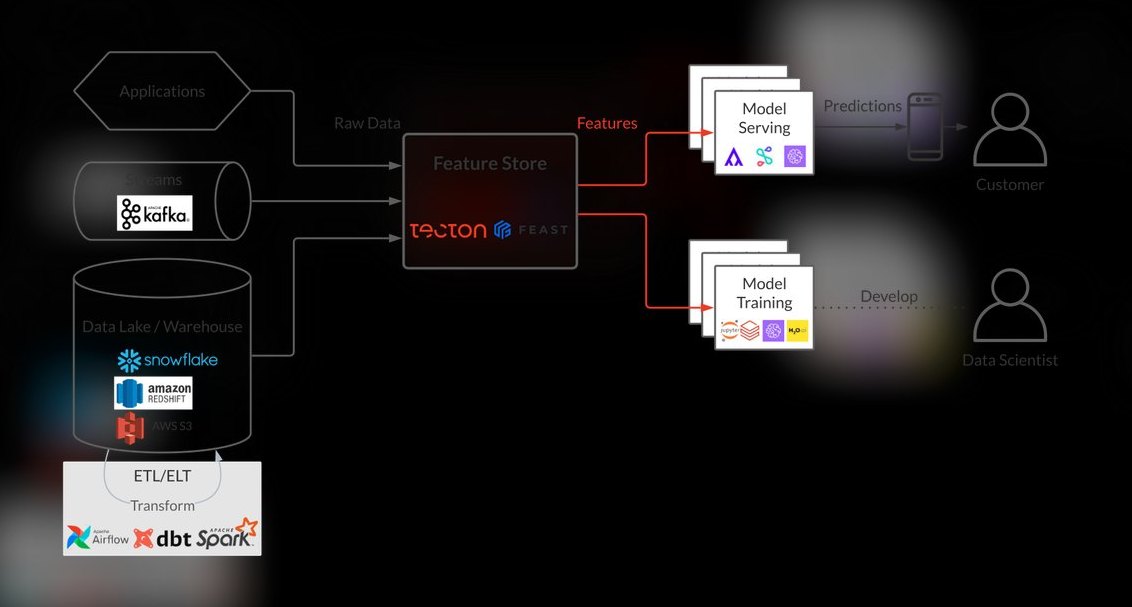 pulse-ai-infrastructureWhat is a feature store and do you still need one for LLM apps?
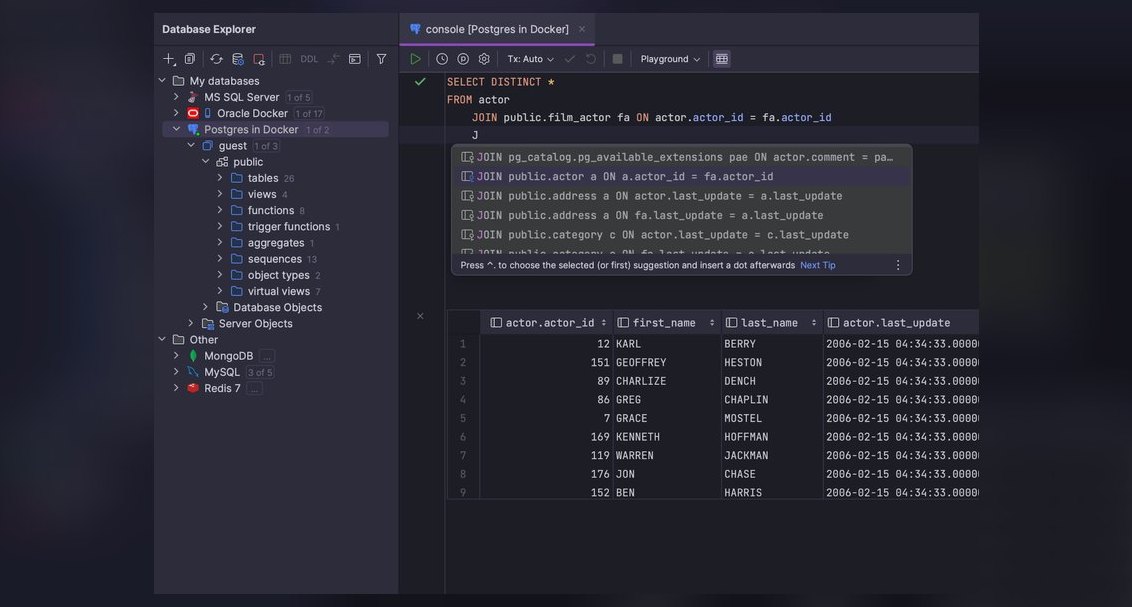 pulse-ai-infrastructureThe 10 Best AI Tools for Database Design in 2027
 pulse-ai-infrastructureThe 10 Best AI Tools for Brand Voice Guides in 2027
 pulse-ai-infrastructureThe 10 Best GPU Cloud Providers for AI Training in 2027
 pulse-ai-infrastructureThe 10 Best AI Tools for Business Dashboards in 2027
 pulse-ai-infrastructureThe 10 Best AI Tools for Summarizing Books in 2027
 pulse-ai-infrastructureThe 10 Best AI Tools for SEO in 2027