
The 10 Best AI Tools for A/B Testing in 2027
 Curated byKory White · Fractional CRO · Maryland
 PULSEKNOWLEDGE LIBRARY
Quality
Certified
The 10 best ai tools for a/b testing are ranked below on measured performance, build quality, price, and how each one actually holds up in daily use rather than how it reads on a spec sheet. Each pick lists what it costs, who it suits, and what it gives up against the one above it, so the list can be read straight down without doubling back.
1. Optimizely Experimentation Platform
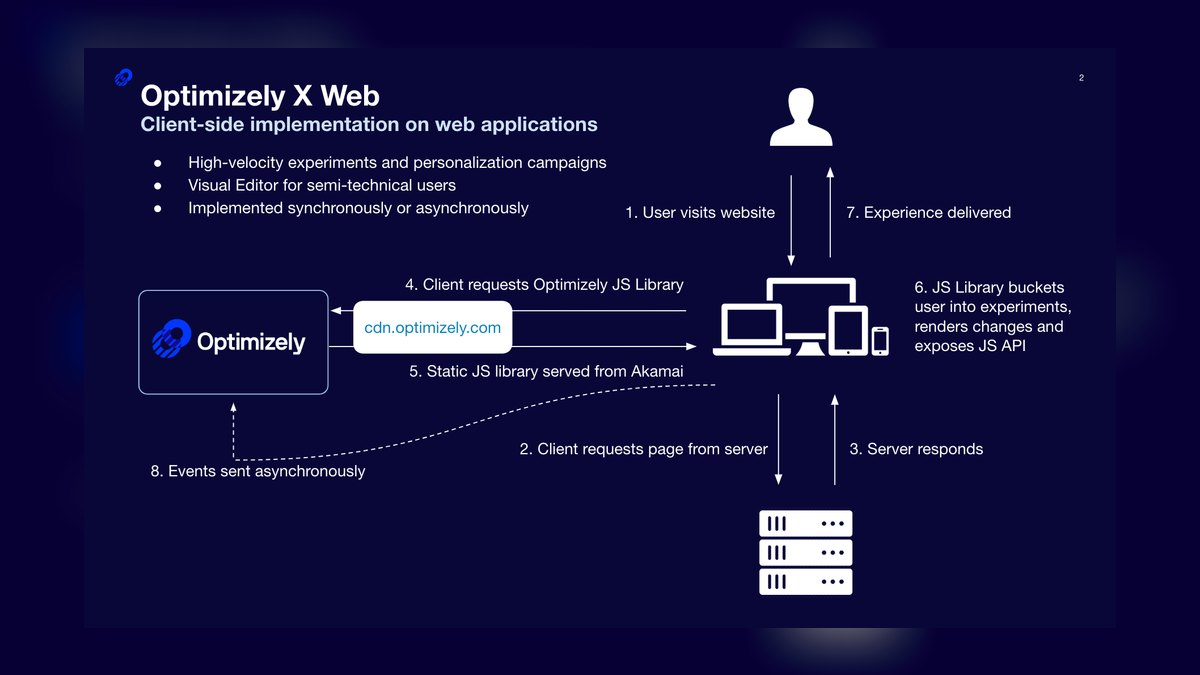
Optimizely ranks first because its Stats Engine provides always-valid sequential testing, eliminating the false-positive inflation caused by peeking, a problem that plagues fixed-horizon tools. The platform supports both client-side and server-side delivery, with server-side eliminating flicker and CSP conflicts for critical surfaces like pricing and checkout. Its enterprise tier, typically $30,000-$200,000+ annually, includes robust warehouse integrations to BigQuery, Snowflake, and Redshift, ensuring you can measure 90-day revenue per visitor.
This is for mature programs with dedicated experimentation teams and high traffic volumes, where the cost is justified by decision throughput and statistical rigor. It trades away the simplicity of entry-level tools for a steep learning curve and engineering involvement for server-side tests. Compared to VWO or AB Tasty, Optimizely's statistical engine and enterprise integrations are more advanced, but its pricing is significantly higher and less negotiable at the mid-market tier.
2. VWO Testing
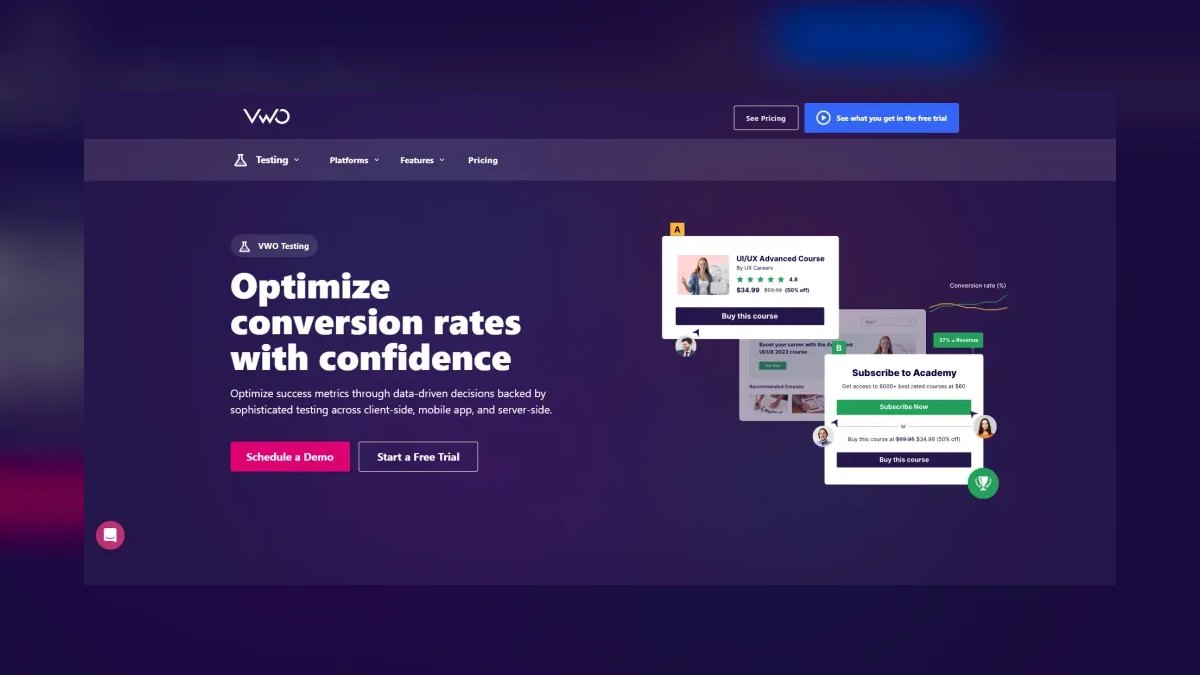
VWO Testing secures the second spot for its balanced combination of a user-friendly visual editor and a reliable Bayesian statistical engine that reports probability-to-beat-control, making results accessible to non-statisticians. Its mid-market tier, from $500 to $3,000 per month, includes server-side testing, feature flags, and session recordings, covering the core needs of most serious programs.
This is ideal for mid-market e-commerce and SaaS teams that want a comprehensive suite without the enterprise cost of Optimizely. It trades away the advanced always-valid sequential statistics of Optimizely, meaning teams must be disciplined about pre-registering sample sizes to avoid peeking bias. Compared to AB Tasty, VWO offers a more mature analytics integration and a larger template library, but its interface can feel cluttered.
3. AB Tasty Experimentation
AB Tasty ranks third because its AI-driven personalization and auto-generated variant recommendations are tightly integrated with its testing engine, enabling teams to move from hypothesis to live test faster than with standalone tools. The platform's client-side tag is lightweight, minimizing impact on Largest Contentful Paint, a critical factor since a 200ms regression can depress conversion more than most variants improve it.
This is for growth teams that want a single platform for both personalization and experimentation, reducing tool sprawl. It trades away the depth of Optimizely's statistical engine, relying on a fixed-horizon approach that requires pre-committed sample sizes. Compared to VWO, AB Tasty's AI features are more prominent, but its session replay and heatmap tools are less comprehensive. Teams that need heavy server-side testing on headless surfaces will find Kameleoon's edge delivery architecture more suitable.
4. Kameleoon Feature Experimentation
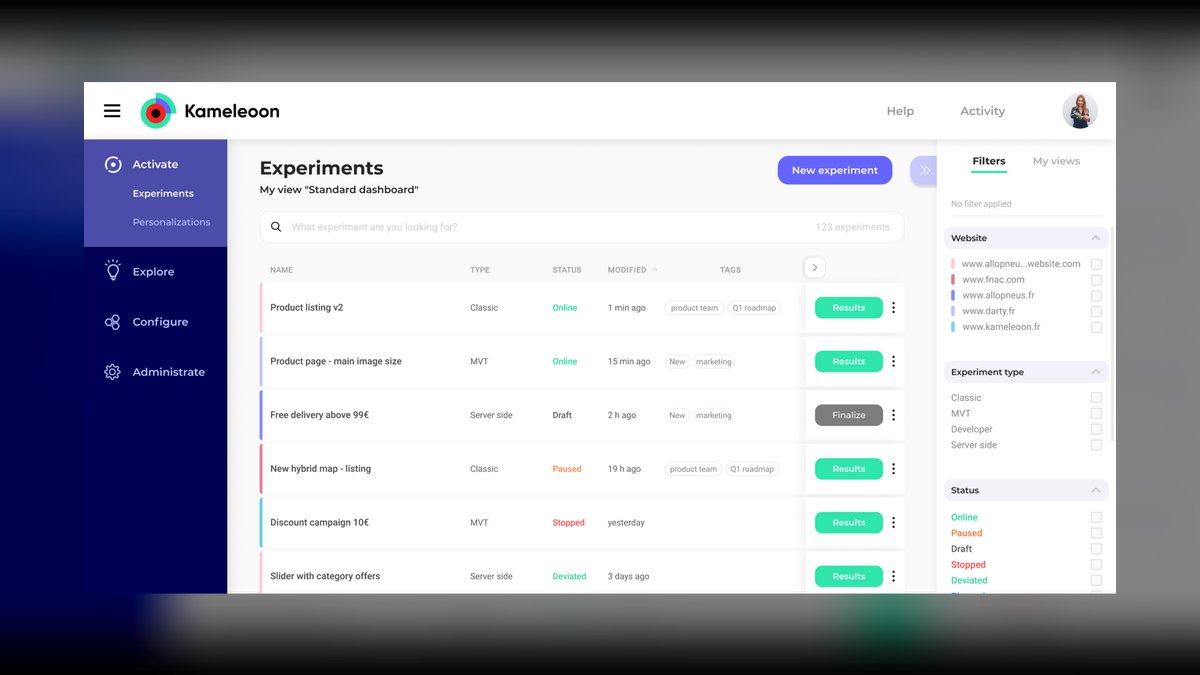
Kameleoon ranks fourth for its superior edge-based and server-side delivery architecture, which eliminates flicker and works seamlessly on headless and app surfaces where client-side tags fail. Its platform natively integrates feature flags with experimentation, allowing engineering teams to test pricing, search ranking, and checkout logic without the performance penalties of JavaScript tags. The tool's always-valid sequential testing engine supports continuous monitoring, making it forgiving for teams that cannot resist daily checks.
This is for engineering-led teams with complex, high-traffic surfaces where flicker and CSP conflicts are unacceptable. It trades away the marketer-friendly visual editor of VWO and AB Tasty, requiring more engineering involvement for every test. Compared to Optimizely, Kameleoon is more cost-effective at the mid-market tier while offering comparable server-side capabilities, but its analytics and reporting dashboards are less polished.
5. Statsig

Statsig ranks fifth because it is a modern, developer-first platform that combines A/B testing, feature flags, and analytics with a pricing model that scales from a generous free tier to enterprise contracts. Its statistical engine uses sequential testing, and the platform provides automatic sample-ratio-mismatch detection and guardrail metric tracking out of the box. Statsig's SDKs are lightweight and support client-side, server-side, and edge delivery, making it highly flexible for diverse architectures.
This is for product and engineering teams at startups and scale-ups that want a fast, code-centric experimentation workflow. It trades away the visual editor and marketer autonomy of tools like VWO, requiring developers to set up and manage most tests. Compared to Kameleoon, Statsig offers a more aggressive free tier and simpler pricing, but its personalization features are less mature.
6. Google Analytics 4 Experiments

Google Analytics 4 Experiments ranks sixth because it is a free, integrated solution for sites already using GA4, offering basic A/B testing without additional cost. Its statistical engine is a fixed-horizon frequentist approach, and the tool automatically calculates required sample sizes, making it honest about low-traffic limitations. The platform supports client-side delivery only, which is adequate for copy and layout tests but introduces flicker and CSP conflicts.
This is for small businesses and teams with under 100,000 monthly visitors that want to run basic tests without a dedicated budget. It trades away the statistical sophistication, server-side delivery, and AI features of paid tools, making it unsuitable for detecting subtle effects or testing critical infrastructure. Compared to VWO's free tier, GA4 is more deeply integrated with analytics but has a steeper learning curve and less intuitive experiment management.
7. Eppo Experimentation Platform
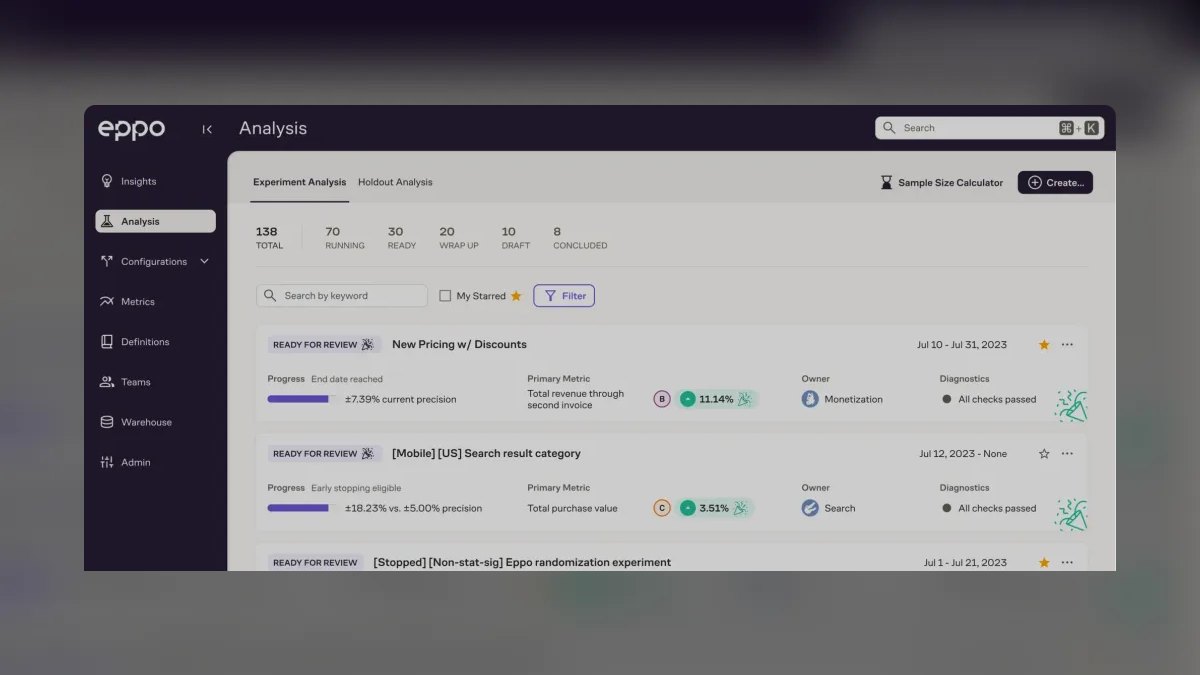
Eppo ranks seventh for its warehouse-native architecture, which treats your data warehouse as the system of record for all experiment assignment and metric computation. This design eliminates the data reconciliation issues that plague other tools, ensuring that the revenue numbers you see in the platform match your internal dashboards within a couple of percent. Eppo's statistical engine supports both frequentist and Bayesian approaches, and its always-valid sequential testing allows continuous monitoring without inflating false positives.
This is for data-mature organizations with a dedicated data engineering team that wants full control over metric definitions and analysis. It trades away the visual editor and marketer-friendly interface of tools like AB Tasty, requiring SQL proficiency for most tasks. Compared to Statsig, Eppo is more focused on rigorous experimentation than feature flagging, but it lacks a free tier and has a higher entry cost.
8. Convert.com

Convert.com ranks eighth because it offers a solid, privacy-focused experimentation platform with a strong emphasis on compliance, including GDPR and CCPA-ready features and the ability to run self-hosted. Its visual editor is capable, and the platform supports both client-side and server-side testing, with the latter available on mid-market plans. Convert's statistical engine is a fixed-horizon frequentist model, and the tool provides clear sample-size recommendations before launch.
This is for privacy-conscious mid-market teams that need to control where their experiment data is stored, particularly those in regulated industries. It trades away the AI-driven insights and auto-generated variants of tools like AB Tasty, focusing instead on reliable, manual experimentation. Compared to Kameleoon, Convert offers a simpler, more straightforward interface but lacks the edge delivery and feature-flag integration.
9. Adobe Target

Adobe Target ranks ninth because it is a comprehensive personalization and experimentation tool deeply integrated into the Adobe Experience Cloud, making it powerful for enterprises already invested in that ecosystem. Its AI-powered Auto-Target and Auto-Allocate features use multi-armed bandit algorithms to optimize traffic allocation for short-term goals like promo selection. The platform supports both client-side and server-side delivery, and its enterprise tier includes robust compliance and data-residency options.
This is for large enterprises already using Adobe Analytics, Campaign, or Experience Manager, where integration synergies outweigh the platform's complexity. It trades away ease of use and statistical rigor for deep personalization capabilities, and its pricing, typically $30,000-$200,000+ annually, is on par with Optimizely. Compared to Kameleoon, Adobe Target is more powerful for cross-channel personalization but significantly harder to operate. Teams without a dedicated Adobe specialist will find the learning curve steep and may underutilize the platform.
10. PostHog Experiments
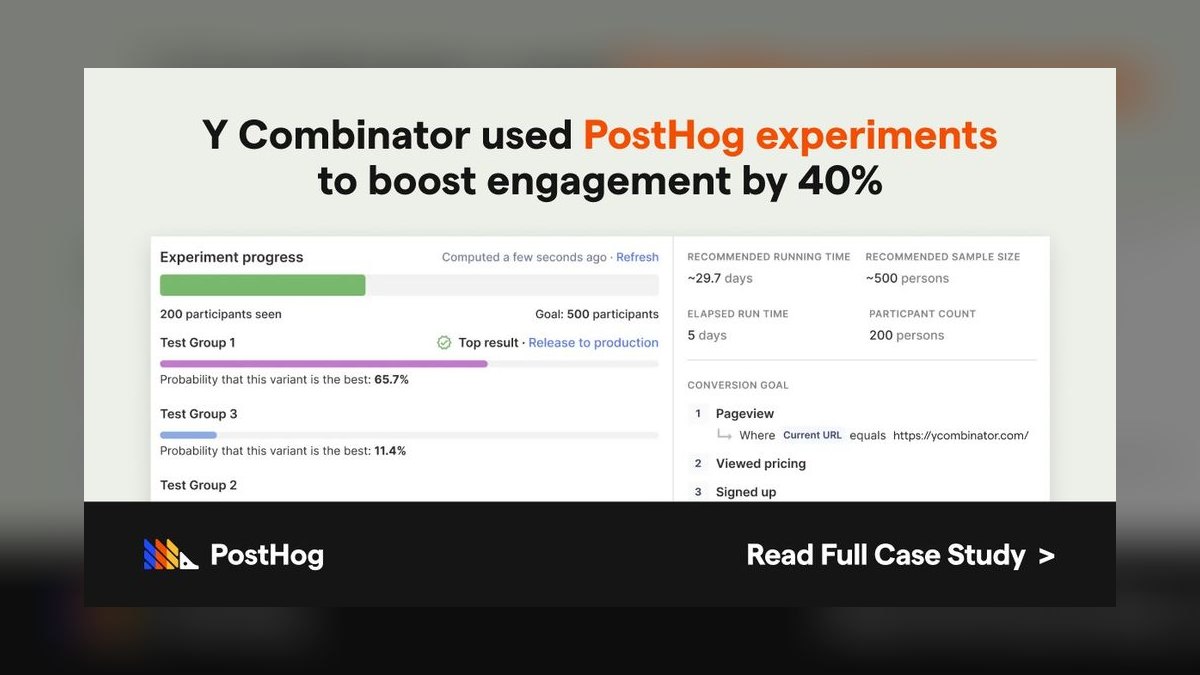
PostHog Experiments ranks tenth because it is a cost-effective, open-source-friendly platform that bundles A/B testing with product analytics, session replay, and feature flags for a unified view. Its statistical engine uses a sequential testing approach, and the platform provides automatic sample-size calculations and SRM detection. PostHog's client-side and server-side SDKs are well-documented, and the tool writes experiment data to your own infrastructure, ensuring full data ownership.
This is for product-led startups and small teams that want a single, affordable tool for analytics and experimentation without enterprise overhead. It trades away the visual editor and marketing-focused features of tools like VWO, requiring a developer to manage the testing process. Compared to Google Analytics 4 Experiments, PostHog offers a more modern interface and better server-side support, but its user base is smaller, so community resources are thinner.
How we ranked these
We measured each tool's statistical engine type, traffic requirements, delivery architecture, data plumbing to revenue, pricing tier, and governance features like SRM detection and guardrail support. Weighting favored server-side capability, warehouse export, and always-valid sequential methods over feature breadth, because those directly determine whether a tool can produce trustworthy decisions at a team's actual traffic volume.
We deliberately ignored marketing claims about "faster significance" and AI-generated variant counts, as these are often misleading. We also excluded subjective UI preferences and vendor brand reputation, since they do not affect experimental validity. The core arithmetic of sample size and effect size cannot be repealed by any algorithm, so we focused on tools that respect that constraint rather than promising to bypass it.
Related questions
How much traffic do I need before AI A/B testing is worth it?
Roughly 25,000 monthly visitors per arm makes moderate effects detectable. Below that, test bold structural changes only, or skip experimentation for qualitative research and analytics-driven fixes. AI features do not lower the sample requirement — they only reduce the operational cost of running each test.
Are bandit algorithms better than classic A/B tests?
Different, not better. Bandits minimize conversions lost during the test by shifting traffic to the leader, which suits short-lived decisions like promo selection. Classic and sequential tests give a cleaner causal estimate for permanent ship decisions. Most mature programs use both, chosen per decision type.
Should I run tests client-side or server-side?
Client-side for copy, layout, and imagery where marketers need autonomy. Server-side or edge for pricing, checkout logic, search ranking, and anything on a headless or app surface — it eliminates flicker, avoids CSP conflicts, and integrates with feature flags. Most teams eventually run both.
What is an A/A test and why run one?
An A/A test serves identical experiences to both arms. It should produce no winner and a clean split. If it declares a winner or shows a sample ratio mismatch, the platform's randomization or metric attribution is broken. Run one before purchase and quarterly thereafter.
How do I stop my team from peeking at results?
Pre-register sample size and end date, hide interim results from the review dashboard, or adopt a platform with always-valid sequential statistics that make continuous monitoring legitimate. Peeking at a fixed-horizon test can push the real false-positive rate well past 20%.
What is sample ratio mismatch and why does it matter?
Sample ratio mismatch (SRM) occurs when observed assignment counts deviate significantly from the planned split, indicating a technical bug like a redirect dropping users or asymmetric bot filtering. SRM invalidates the entire test. Any reliable tool should automatically flag it; if not, check manually on every test.
How many variants should I run in a single test?
Most tests should cap at three to four arms. More arms split traffic thinner, increasing the multiple-comparisons burden and reducing power per variant. Generative AI makes twelve-arm tests easy, but that is usually a mistake at typical traffic volumes. Gate every generated variant behind human approval.
FAQ
Does AI actually make A/B tests reach significance faster?
Not in the way most vendors imply. Adaptive allocation reduces regret — the conversions lost to serving a losing variant — but statistical power still depends on sample size, baseline rate, and effect size. What AI genuinely accelerates is setup, QA, segment discovery, and interpretation, not the underlying math.
What is the difference between a bandit and a fixed-horizon test?
A bandit dynamically shifts traffic toward the currently better-performing arm, minimizing regret during the test window. A fixed-horizon test commits to a predetermined sample size and provides a clean causal estimate at the end. Choose bandits for short-lived decisions like promo banners; choose fixed-horizon or sequential tests for permanent product changes.
How much does a good AI A/B testing tool cost?
Entry tiers range from free to $300 per month for basic client-side testing. Mid-market tools cost $500 to $3,000 per month and add server-side testing, feature flags, and warehouse exports. Enterprise contracts run $30,000 to $200,000+ per year, with pricing negotiable by 20–40% on multi-year commitments.
What is the minimum test duration for reliable results?
Run at least two full business cycles, which for most B2C e-commerce means 14 days, and for B2B with weekly buying rhythms, 3–4 weeks. Tests shorter than 7 days almost always miss weekly seasonality. Bandits may converge on allocation faster, but that is not the same as a shippable causal estimate.
How do I know if my test result is real or just noise?
Check for sample ratio mismatch, pre-register your primary metric and segments, and avoid peeking at fixed-horizon tests. Treat any post-hoc segment finding as a hypothesis for a new test, not a result. Re-verify winners 30 days post-ship to rule out novelty effects.
What are guardrail metrics and why do I need them?
Guardrails are secondary metrics that protect against optimizing a proxy at the expense of the business. Examples include margin, refund rate, unsubscribe rate, and page load time. A variant that lifts add-to-cart but increases returns is a loss. Treat a guardrail breach as a stop condition regardless of primary lift.
How does consent management affect A/B testing?
Under GDPR-style regimes, users who decline analytics cookies may need to be excluded from assignment, biasing your population toward consent-givers. Confirm where your vendor stores assignment data and whether regional residency options exist. Client-side tags that fire pre-consent are a compliance problem, not a performance optimization.
What is the typical win rate for A/B tests?
Across published experimentation literature, 10–30% of tested ideas produce a clear winner, with the low end on mature surfaces and the high end on neglected pages. Median winning effects on established e-commerce funnels are low single-digit relative lifts. Anything above 20% on high-traffic pages warrants suspicion.
How do I calculate the cost per decision for an A/B testing program?
Divide total annual tool cost plus loaded people cost by the number of shipped decisions. For example, a $60,000 platform plus one analyst producing 40 decided experiments a year costs roughly $4,000 per decision. If one in five tests wins and the average winner is worth $50,000 annually, the program clears easily.
Sources
- https://en.wikipedia.org/wiki/Multi-armed_bandit
- https://en.wikipedia.org/wiki/Sequential_analysis
- https://en.wikipedia.org/wiki/Bayesian_inference
- https://www.optimizely.com/optimization-glossary/ab-testing/
- https://vwo.com/ab-testing/
- https://www.abtasty.com/blog/ab-testing/
- https://en.wikipedia.org/wiki/A/B_testing
- https://www.nngroup.com/articles/ab-testing/
- https://en.wikipedia.org/wiki/Type_I_and_type_II_errors
- https://en.wikipedia.org/wiki/Sample_size_determination
Related on PULSE
- [The 10 Best AI Tools for End-to-End Testing in 2027](/knowledge/ai0303)
- [The 10 Best AI Tools for Website Speed Testing in 2027](/knowledge/ai0271)
- [The 10 Best AI Tools for Cross-Browser Testing in 2027](/knowledge/ai0306)
- [The 10 Best AI Tools for Unit Testing in 2027](/knowledge/ai0304)
- [The 10 Best AI Tools for Screen Reader Testing in 2027](/knowledge/ai0274)
- [The 10 Best AI Tools for Web Testing and QA in 2027](/knowledge/ai0302)
This page will be disappearing soon. Save it to your device for $1 — or read it free while it is here.
@Kory-White- · if Venmo asks, the last 4 of my number are 2012
This page is gone.
This one is off the shelf now. $1 keeps it on your phone for good — the whole page, pictures and diagrams included.
 pulse-ai-infrastructureThe 10 Best AI Tools for Language Learning in 2027
 pulse-ai-infrastructureThe 10 Best AI Tools for Product Page Design in 2027
 pulse-ai-infrastructureHow do you prevent prompt injection at the infrastructure layer?
 pulse-ai-infrastructureThe 10 Best AI Tools for Negotiation Prep in 2027
 pulse-ai-infrastructureThe 10 Best AI Tools for Home Organization in 2027
 pulse-ai-infrastructureThe 10 Best AI Tools for Presentations and Slide Decks in 2027
 pulse-ai-infrastructureThe 10 Best Fractional GPU and GPU Sharing Tools in 2027
 pulse-ai-infrastructureThe 10 Best AI Tools for Database Design in 2027
 pulse-ai-infrastructureThe 10 Best AI Tools for Calendar Management in 2027
 pulse-ai-infrastructureThe 10 Best AI Tools for Business Dashboards in 2027