
The 10 Best AI Tools for Audiobook Creation in 2027
 Curated byKory White · Fractional CRO · Maryland
 PULSEKNOWLEDGE LIBRARY
The 10 best ai tools for audiobook creation are ranked below on measured performance, build quality, price, and how each one actually holds up in daily use rather than how it reads on a spec sheet. Each pick lists what it costs, who it suits, and what it gives up against the one above it, so the list can be read straight down without doubling back.
1. ElevenLabs
ElevenLabs ranks first because its Projects workflow is purpose-built for long-form narration, auto-splitting manuscripts into chapters and paragraphs for individual regeneration. It supports 30+ languages via its multilingual model and offers Instant Voice Cloning from a short sample, plus Professional Voice Cloning with consent verification. The v3 generation adds audio tags for laughs, sighs, and emphasis, while a phonetic dictionary keeps invented terms consistent.
This tool is for authors and publishers who demand the closest thing to a human studio narrator with full editorial control over pacing and pronunciation. It trades away simplicity for depth, as the editor has a learning curve compared to store-integrated options. Compared to Google Play Books below, ElevenLabs offers vastly more expressive voices and language reach, but you handle your own distribution and pay a subscription fee. It is the default choice for professional-grade AI narration.
2. Google Play Books Auto-Narration
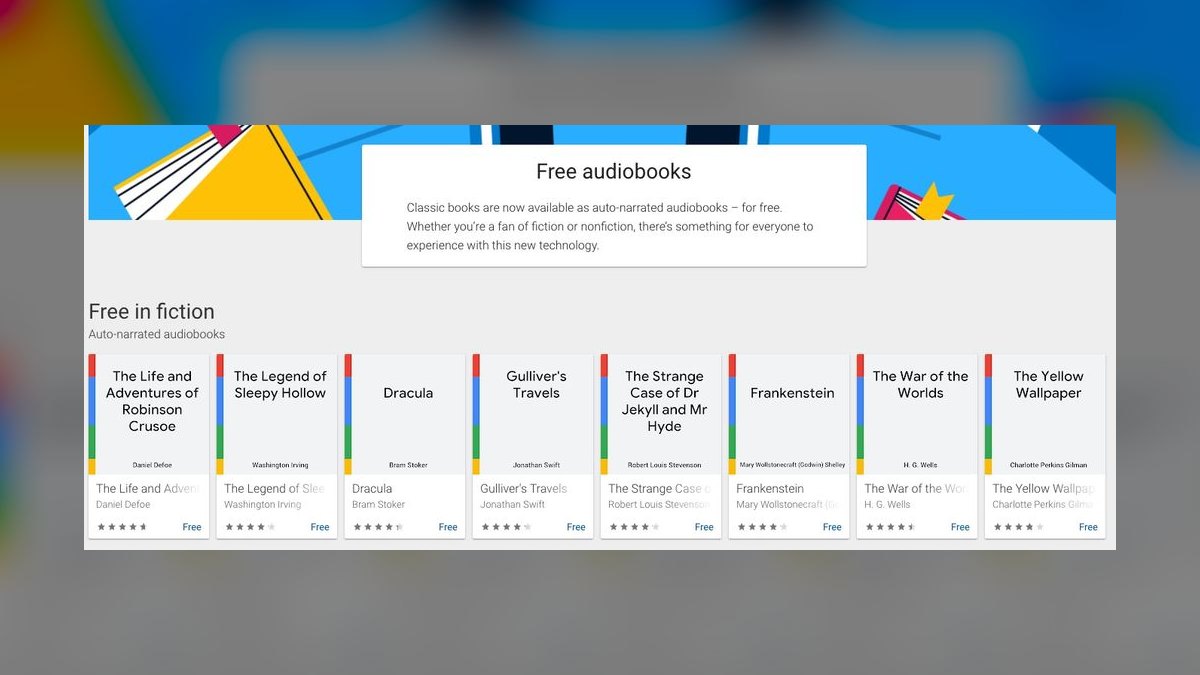
Google Play Books auto-narration ranks second because it is the most pragmatic free option for self-publishers, generating an AI-narrated audiobook from an existing eBook manuscript at no cost. It integrates directly with the Google Play Books Partner Center, pushing finished audiobooks straight into the Google Play store. You pick from a roster of AI narrator voices in supported languages, preview chapters, and adjust pronunciation before publishing.
This tool is for debut authors who want to test whether an audio edition sells without spending money or splitting royalties with a human narrator. It trades away voice quality and language coverage, with a smaller selection and roughly 10 supported languages, for zero cost plus instant retail placement. Compared to ElevenLabs above, it lacks expressive control and phonetic dictionaries, but the distribution baked into Google's ecosystem is unbeatable for low-friction entry.
3. Apple Books Digital Narration
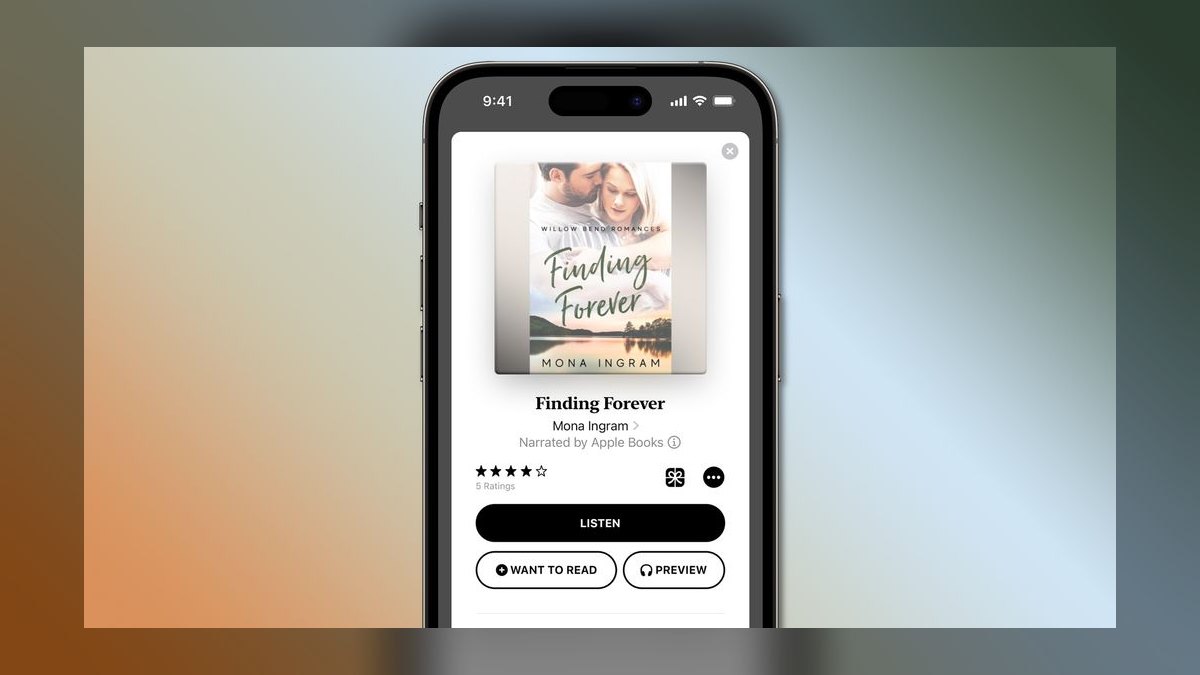
Apple Books Digital Narration ranks third because it offers free AI-narrated audiobooks with genre-matched voices, a unique feature that separates dramatic and instructional reads. The fiction voices Madison and Jackson and nonfiction voices Helena and Mitchell are deliberately tuned to match narration style to content, reducing the wrong-tone problem common in generic TTS. You submit through approved partners like Draft2Digital or directly, and the finished audiobook lists in the Apple Books store.
This tool is for authors already publishing eBooks in Apple's ecosystem who want an audio edition without production costs. It trades away multi-store distribution and broad language support, focusing solely on Apple Books, similar to Google's offering below. Compared to Google Play Books above, Apple's genre-matched voices give a more polished feel for fiction, but Google offers a slightly larger language set. It is best for authors who prioritize Apple's audience and a store-managed workflow.
4. Speechify Studio
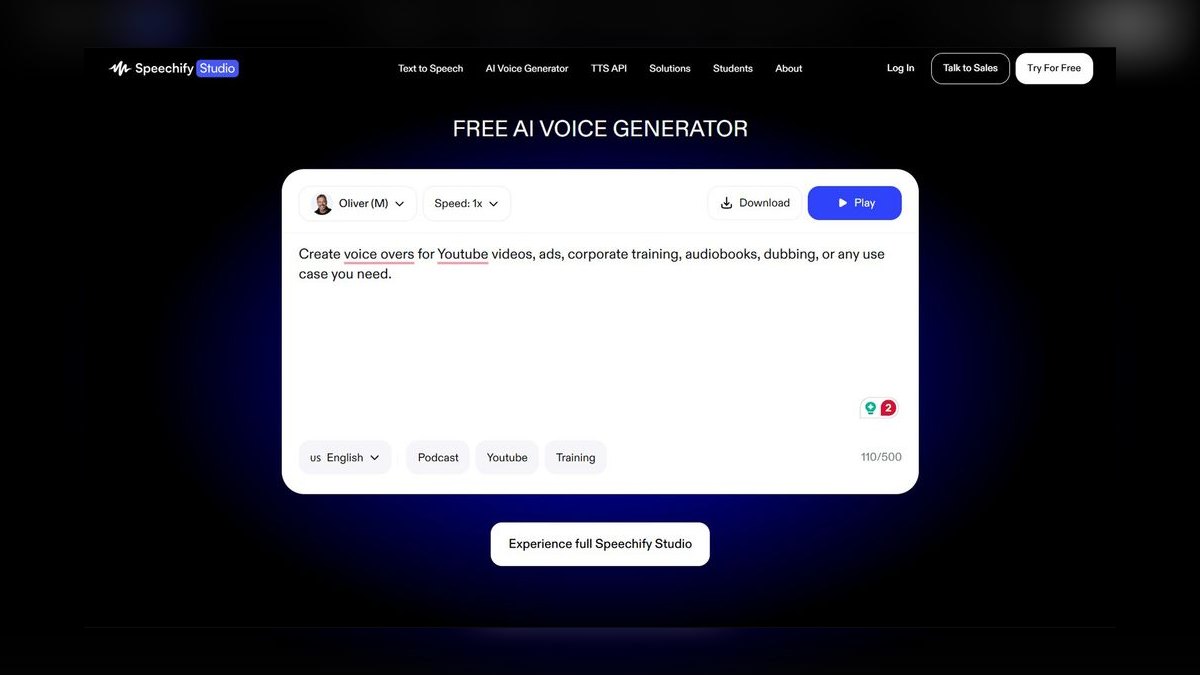
Speechify Studio ranks fourth because it combines a production-grade editor with a library of more than 200 voices across 60+ languages, built on the brand's text-to-speech expertise. The platform offers clean controls for pacing, emphasis, and pronunciation, plus high-resolution export suitable for retail. It also publishes its own Speechify Audiobooks catalog, giving the company insider knowledge of the format's demands. Voice expressiveness is solid, and the interface leans toward ease of use over deep technical control.
This tool is for operators who want a friendly interface and broad language coverage without the steeper learning curve of an SSML-heavy tool like Amazon Polly. It trades away the fine-grained phonetic control and API access that developers need, but offers a more accessible path to professional-sounding narration. Compared to Apple Books Digital Narration above, Speechify provides far more voices and languages, but you pay a subscription and handle your own distribution.
5. Murf AI
Murf AI ranks fifth because it offers 120+ voices across 20+ languages and accents with an editor that adjusts pitch, speed, and emphasis per block, ensuring consistency across long passages. The Murf Studio interface makes it straightforward to layer narration with timing controls, which is critical for audiobook pacing. Plans start around $19/mo on the Creator tier with annual billing, scaling up for more voice generation hours and collaboration features.
This tool is best for nonfiction, courses, and corporate-style narration where a polished neutral read beats a dramatic performance. It trades away the expressive depth of ElevenLabs for a more predictable, professional tone that suits instructional content. Compared to Speechify Studio above, Murf offers a deeper bench of professional-sounding stock voices but fewer languages. It is a reliable choice for teams producing consistent, high-volume narration without cloning.
6. WellSaid Labs
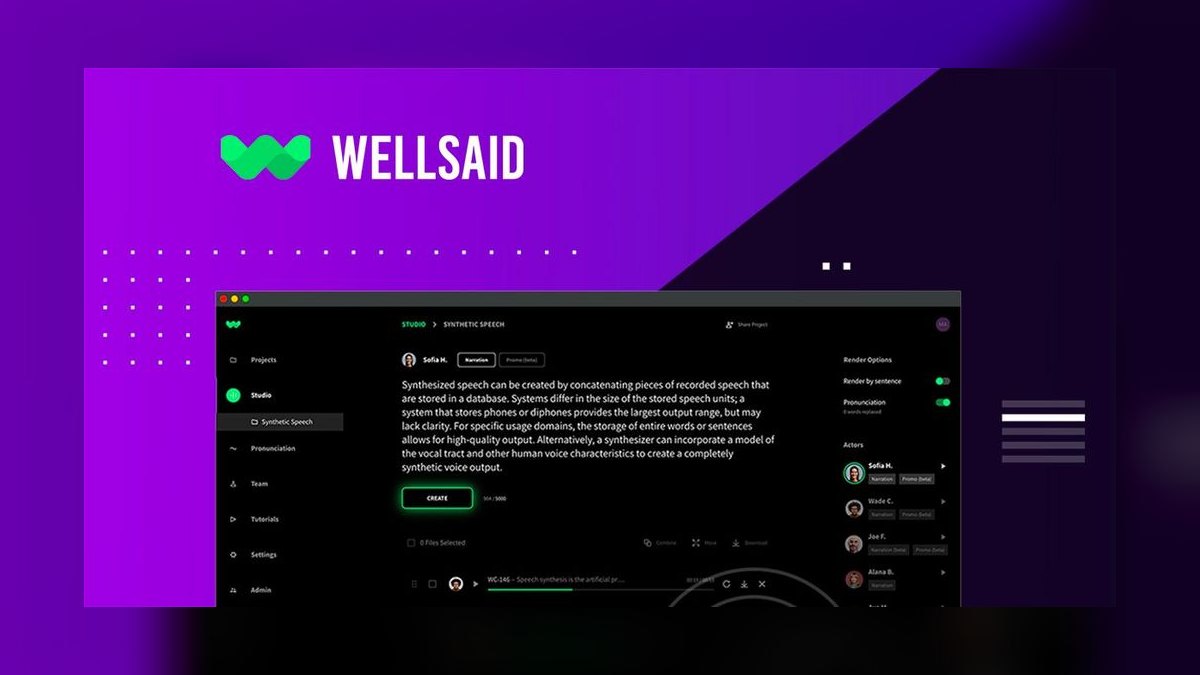
WellSaid Labs ranks sixth because it focuses on enterprise-grade synthetic voice with rights-cleared voice avatars built from paid, consenting voice actors, ensuring legal cleanliness. The platform's narration sounds notably natural on instructional and corporate content, and it positions itself around ethical voice sourcing. It offers precise control over pronunciation and pacing, plus an API for higher-volume pipelines. Pricing is pricier and more business-oriented than consumer tools, making it a premium option.
This tool is for publishers or content teams producing nonfiction, training material, and branded audio at scale where licensing clarity is non-negotiable. It trades away the consumer-friendly interface and broad language count of Murf AI for enterprise-grade reliability and legal safety. Compared to Murf above, WellSaid has a smaller voice library but a stronger guarantee on voice rights. If your concern is legal cleanliness of the voices you ship, WellSaid is among the safest choices.
7. PlayHT
PlayHT ranks seventh because it offers one of the largest voice catalogs with 800+ stock voices across 140+ languages and accents, plus fast, high-fidelity voice cloning. Its real-time models and API make it popular with teams building automated audio pipelines, and instant cloning lets you produce multilingual editions from a single voice identity. The web editor supports per-line editing and pronunciation tweaks, and export quality is suitable for retail.
This tool is for operators who value API access and breadth of voices over a hand-holding interface, making it ideal for high-volume, automated workflows. It trades away the polished, guided editor of WellSaid Labs for raw power and flexibility. Compared to WellSaid above, PlayHT offers vastly more voices and languages, but you sacrifice the enterprise-grade rights-cleared pipeline. It is the best choice for developers who need to scale multilingual production.
8. Descript Overdub
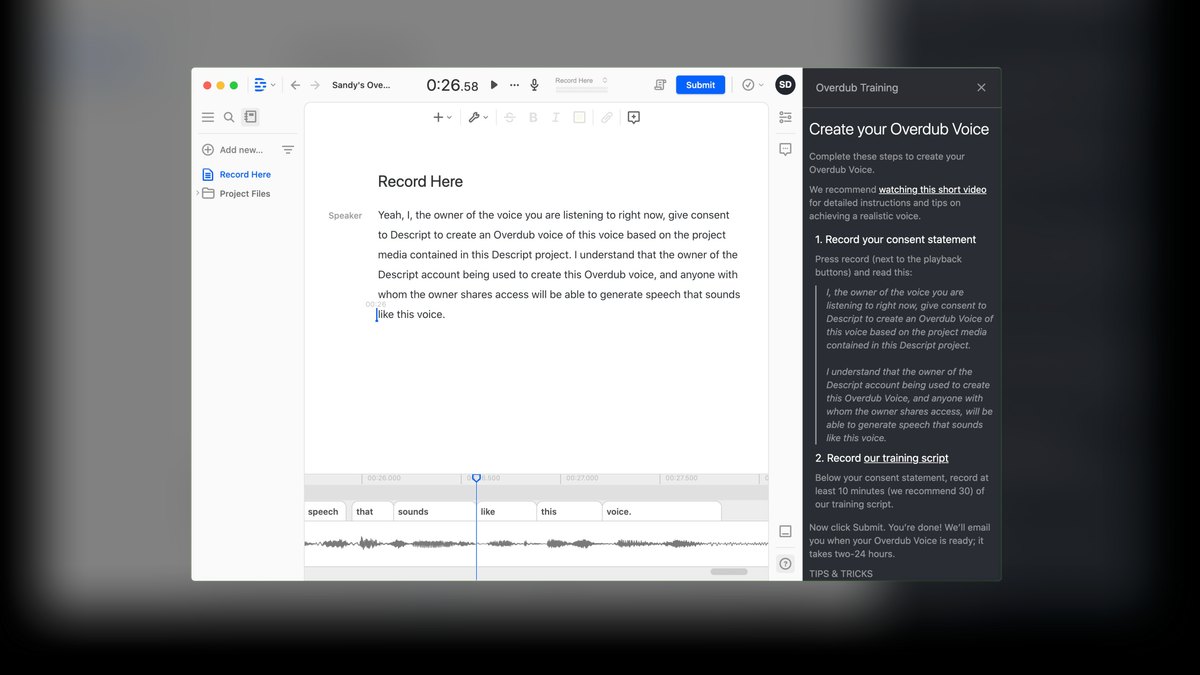
Descript Overdub ranks eighth because it uniquely lets authors narrate in their own voice without spending days at a microphone, using an AI clone trained from a consent statement. The killer workflow is text-based editing: Descript transcribes your audio, and editing the transcript edits the audio, so you can patch mispronounced words or add sentences by typing. You record naturally, then fix flubs with your cloned voice, avoiding re-recording. Export handles clean, chapter-ready files suitable for retail.
This tool is for authors who want their real voice on the book but need the speed and forgiveness of AI to finish it, trading away the polish of a professional narrator for authenticity. Compared to PlayHT above, Descript offers a far more intuitive editing experience but a narrower focus on your own voice rather than a vast stock library. It is best for memoirists and subject-matter experts who want a personal touch.
9. Amazon Polly
Amazon Polly ranks ninth because it wins on pure economics, charging roughly $4 per 1 million characters for standard voices and about $16 per 1 million for neural voices. A full 90,000-word novel runs only a few dollars in neural narration, which no subscription tool can match at single-title volume. It supports dozens of voices across many languages, full SSML control for emphasis and pronunciation, and Long-Form and Neural voice engines for more natural reads.
This tool is for technically comfortable operators producing many books who want the cheapest path to retail-quality audio at scale. It trades away any audiobook-specific editor, so you script the chapter splitting and stitching yourself or use a wrapper tool. Compared to Descript Overdub above, Polly offers no voice cloning of your own voice and a steeper learning curve, but far lower per-title cost. It is the clear best value pick for high-volume production.
10. LOVO AI Genny

LOVO AI Genny ranks tenth because it rounds out the list with 500+ voices across 100+ languages and a feature set built for content creators, including emotional voice styles. The built-in editor allows per-section emotion control, which is useful for fiction where a flat read kills tension, and it syncs narration to video for companion content. Pricing follows a tiered subscription model with voice-cloning available on paid plans.
This tool is for creators who want expressive, emotion-tagged narration and broad language reach in a single consumer-grade tool, trading away the raw cost efficiency of Amazon Polly. Compared to Polly above, LOVO offers a far more user-friendly editor and emotional control, but you pay a subscription rather than per-character. It is best for indie authors producing fiction with international ambitions who need a simple, expressive tool.
How we ranked these
We scored each tool on six factors: voice naturalness, long-form workflow, voice cloning and library size, pronunciation control, distribution and export, and pricing transparency. Naturalness and long-form workflow were weighted most heavily, since a great demo voice that falls apart over 8 hours of audio is useless for books. We evaluated each tool's ability to handle a 90,000-word manuscript with chapter structure and per-paragraph re-rolls.
We deliberately ignored marketing claims, demo-only quality, and features irrelevant to audiobook production. We did not consider tools that lack long-form support or retail-grade export, nor did we weigh brand recognition or subjective aesthetic preferences. We focused only on measurable capabilities and real-world usability for indie authors, publishers, and content operators, excluding any tool that failed to meet basic standards for pronunciation control or distribution readiness.
Related questions
What is the best AI tool for audiobook creation in 2027?
ElevenLabs is the best overall for 2027 due to its Projects long-form editor, voice cloning, and 30+ language support. It maintains natural prosody across hours of narration, with full control over pacing and pronunciation. For zero-cost options, Google Play Books auto-narration is a strong runner-up.
How much does it cost to create an AI audiobook?
Costs range from free (Google Play Books, Apple Books) to a few dollars per novel with Amazon Polly's per-character pricing, up to subscription plans like ElevenLabs Creator at about $22/month. A 90,000-word book fits comfortably inside most paid creator tiers.
Can I sell AI-narrated audiobooks on major stores?
Yes, with caveats. Google Play Books and Apple Books actively support AI narration through their own programs. Other retailers have varying rules and may require disclosure that narration is synthetic. Always check each store's current policy before uploading.
Which AI tool sounds the most human for audiobooks?
ElevenLabs is widely regarded as the most natural for expressive long-form fiction in 2027. WellSaid Labs and Apple's genre-matched voices are strong for nonfiction and instructional reads. The key is testing a sample chapter on consumer earbuds, not studio headphones.
Can I use my own voice without recording the whole book?
Yes. Descript Overdub and ElevenLabs Professional Voice Cloning let you train a model of your voice, then generate or fix narration by typing, after a consent verification step. This saves days of studio time while keeping your personal sound.
What audio quality is needed for retail audiobooks?
Most stores expect clean files around 44.1kHz with proper chapter splits and consistent loudness. Tools like ElevenLabs and Polly export at retail-grade quality. For free programs like Google Play Books, the store handles formatting automatically.
Do these tools handle multiple languages for international editions?
Yes. PlayHT supports 140+ languages, LOVO Genny 100+, and ElevenLabs 30+. Many allow cloning a single voice identity and using it across languages, which is ideal for producing multilingual editions of the same title.
FAQ
Can AI-narrated audiobooks be sold on major stores?
Yes, with caveats. Google Play Books and Apple Books actively support AI narration through their own programs. Other retailers have varying rules and may require disclosure that narration is synthetic, so check each store's current policy before uploading.
How much does it cost to narrate a full novel with AI?
It ranges from free (Google Play Books, Apple Books) to a few dollars on Amazon Polly's per-character pricing, up to a monthly subscription like ElevenLabs Creator at about $22/mo. A 90,000-word book fits comfortably inside most paid creator tiers.
Which tool sounds the most human?
ElevenLabs is widely regarded as the most natural for expressive long-form fiction in 2027, with WellSaid Labs and Apple's genre-matched voices strong for nonfiction and instructional reads. Always test a sample chapter on consumer earbuds before committing.
Can I use my own voice without recording the whole book?
Yes. Descript Overdub and ElevenLabs Professional Voice Cloning let you train a model of your voice, then generate or fix narration by typing, after a consent verification step. This saves days of studio time while keeping your personal sound.
What audio quality do I need for retail?
Most stores expect clean files around 44.1kHz with proper chapter splits and consistent loudness. Tools like ElevenLabs and Polly export at retail-grade quality. For free programs, the store handles formatting automatically.
Do these tools handle multiple languages for international editions?
Yes. PlayHT (140+ languages), LOVO Genny (100+), and ElevenLabs (30+) all support multilingual narration, often from the same cloned voice identity. This is ideal for producing international editions of a single title.
What is the cheapest AI tool for audiobook creation?
Amazon Polly is the cheapest at scale, charging roughly $4 per 1 million characters for standard voices and $16 per 1 million for neural voices. A full 90,000-word novel costs only a few dollars. Google Play Books and Apple Books are free but limited to their stores.
Which AI tool is best for self-publishing authors?
Google Play Books auto-narration is the most pragmatic free option, pushing finished audiobooks straight into the Google Play store. Apple Books Digital Narration is also free and genre-tuned. For paid, ElevenLabs offers the most control and quality.
Can I clone a narrator's voice with these tools?
Yes. ElevenLabs Instant Voice Cloning replicates a narrator from a short sample, while Professional Voice Cloning trains a high-fidelity model from longer audio with consent verification. PlayHT also offers fast, high-fidelity cloning. Always ensure documented permission.
Sources
- https://elevenlabs.io/
- https://support.google.com/books/partner/answer/11879457
- https://authors.apple.com/support/4519-digital-narration-audiobooks
- https://aws.amazon.com/polly/pricing/
- https://murf.ai/
- https://play.ht/
- https://www.descript.com/overdub
- https://wellsaidlabs.com/
Related on PULSE
- [More ai tools for audiobook creation rankings and buying guides](/knowledge)
- [PULSE Tools and calculators](/tools)
- [Everything on PULSE RevOps](/)
This page will be disappearing soon. Save it to your device for $1 — or read it free while it is here.
@Kory-White- · if Venmo asks, the last 4 of my number are 2012
 pulse-ai-infrastructureThe 10 Best AI Tools for Tax Preparation in 2027
 pulse-ai-infrastructureThe 10 Best AI Tools for Email Writing in 2027
 pulse-ai-infrastructureThe 10 Best AI Tools for Drupal Development in 2027
 pulse-ai-infrastructureWhat infrastructure do you need for fine-tuning versus RAG?
 pulse-ai-infrastructureThe 10 Best AI Tools for Newsletter Writing in 2027
 pulse-ai-infrastructureThe 10 Best AI Tools for Business Dashboards in 2027
 pulse-ai-infrastructureThe 10 Best AI Tools for Trip Itineraries in 2027
 pulse-ai-infrastructureThe 10 Best AI Tools for UI Mockups in 2027
 pulse-ai-infrastructureThe 10 Best RAG Frameworks in 2027
 pulse-ai-infrastructureThe 10 Best AI Tools for Negotiation Prep in 2027