

The 10 Best AI Compute Cost Optimization Tools in 2027
 Curated byKory White · Fractional CRO · Maryland
Quality
Certified

The 10 best ai compute cost optimization tools are ranked below on measured performance, build quality, price, and how each one actually holds up in daily use rather than how it reads on a spec sheet. Each pick lists what it costs, who it suits, and what it gives up against the one above it, so the list can be read straight down without doubling back.
1. Kubecost

Kubecost ranks first because it delivers the most complete Kubernetes-native cost visibility and optimization for AI workloads, now backed by IBM and the OpenCost standard. It attributes GPU spend down to namespaces, deployments, and labels, so you can see exact cost per team, model, or pipeline. Its right-sizing and idle-resource recommendations, including GPU cost allocation, directly target the largest source of AI compute waste.
Kubecost is for teams running AI on Kubernetes who need to see where money goes before automating changes. It trades away deep autonomous action—it reports and recommends, but you or another tool must execute the fixes. Compared to Karpenter below, Kubecost provides the visibility layer while Karpenter provides the automation layer; mature stacks use both. Its open-source core is free, with paid tiers for advanced features.
2. Karpenter

Karpenter ranks second because it is the best-value automation tool, being open-source and free while delivering substantial compute savings through just-in-time node provisioning and consolidation. It automatically selects the cheapest right-sized nodes, including spot GPUs, and spins them up in seconds only when pending pods need them. This eliminates idle GPU nodes and reduces on-demand spend without any licensing cost. Its CNCF backing and AWS origin make it a reliable, widely adopted choice.
Karpenter is for AWS-centric Kubernetes AI clusters that want hands-off right-sizing and spot usage without a commercial license. It trades away multi-cloud support and cost visibility—it handles nodes, not showback. Compared to Kubecost above, Karpenter acts while Kubecost sees; together they cover both levers. For teams needing autonomous multi-cloud automation, CAST AI below offers that at a price, whereas Karpenter stays free but AWS-focused.
3. CAST AI

CAST AI ranks third because it provides fully automated Kubernetes cost optimization that continuously right-sizes clusters, rebalances onto spot instances, and bin-packs workloads without manual tuning. Its platform handles spot interruption automatically, maintaining reliability while maximizing utilization across GPU and CPU nodes. This hands-off approach delivers ongoing savings rather than one-time cleanup, making it a leading choice for teams that lack dedicated FinOps staff. It supports multi-cloud, adding flexibility beyond a single provider.
CAST AI is for teams that want autonomous, continuous cost cuts on Kubernetes and are willing to pay a percentage of savings or a subscription fee. It trades away the granular visibility of Kubecost—its focus is action, not deep reporting. Compared to Karpenter above, CAST AI offers multi-cloud and a managed service, while Karpenter is free but AWS-only. For teams needing GPU-specific orchestration, Run:ai below specializes in utilization rather than node sourcing.
4. Run:ai

Run:ai ranks fourth because it is purpose-built for GPU orchestration, pooling GPUs across clusters and enabling fractioning so multiple jobs share a single accelerator. This directly attacks underutilized GPUs, a primary source of AI compute waste, by raising utilization from often below 50% to much higher levels. Its dynamic allocation and fair-share scheduling ensure expensive hardware does useful work continuously. As part of NVIDIA, it integrates deeply with the broader AI stack.
Run:ai is for organizations running large shared GPU clusters where many lightweight jobs each monopolize a whole GPU. It trades away node-level cost sourcing—it assumes you already have the GPUs—and focuses purely on maximizing their utilization. Compared to CAST AI above, Run:ai is more specialized and enterprise-priced, while CAST AI handles both nodes and scheduling. For teams wanting to arbitrage across clouds, SkyPilot below offers a different angle.
5. SkyPilot

SkyPilot ranks fifth because it uniquely enables multi-cloud GPU arbitrage, finding the cheapest available GPUs across AWS, GCP, Azure, and other providers for any given job. It automatically handles spot preemption recovery, so you can safely ride discounted spot capacity without babysitting. This can cut GPU costs substantially by shifting workloads to the lowest-priced region or provider at any moment. Its open-source nature makes it accessible and free.
SkyPilot is for teams with flexible workloads that can run anywhere and want to exploit price differences across clouds. It trades away deep Kubernetes integration and cost visibility—it manages job placement, not cluster FinOps. Compared to Run:ai above, SkyPilot optimizes where you buy GPUs while Run:ai optimizes how you use the ones you have. For teams needing managed spot orchestration with reliability guarantees, Spot by NetApp below is a commercial alternative.
6. Spot by NetApp

Spot by NetApp ranks sixth because it offers mature, managed spot orchestration that blends spot, reserved, and on-demand capacity to hit a target cost and reliability. Its Ocean and Elastigroup products predict spot interruptions and reschedule workloads automatically, making spot viable for a wide range of AI jobs. This reliability guarantee is a key differentiator, as raw spot can be risky for stateful workloads. It supports Kubernetes and GPU workloads, providing a production-grade solution.
Spot by NetApp is for teams that want managed spot reliability without building their own interruption-handling logic. It trades away the open-source flexibility of SkyPilot above—it is commercial and requires a subscription. Compared to SkyPilot, Spot Ocean is more automated and reliable but less portable across clouds in the same way. For AWS-heavy teams focused on commitment discounts, nOps below specializes in that angle.
7. nOps

nOps ranks seventh because it is a strong AWS-focused FinOps platform that automates both spot management and commitment optimization, such as Savings Plans and Reserved Instances. It analyzes usage to recommend and execute the cheapest mix of pricing models, reducing waste across EC2 and GPU instances. This dual focus on spot and commitments makes it effective for AWS-heavy AI workloads. Its automation extends beyond reporting to actually applying changes.
nOps is for teams whose AI compute spend is concentrated on AWS and who want to squeeze both spot discounts and commitment savings. It trades away multi-cloud support—it is AWS-centric, unlike Spot by NetApp above which is more cloud-agnostic. Compared to Spot Ocean, nOps adds FinOps visibility and commitment management, while Spot Ocean focuses purely on capacity orchestration. For teams needing unified multi-cloud visibility, Vantage below is a better fit.
8. Vantage

Vantage ranks eighth because it provides unified multi-cloud cost visibility across AWS, GCP, Azure, Kubernetes, and dozens of SaaS and AI vendors, including LLM API providers. This lets AI teams see both GPU infrastructure spend and external model API bills in one pane of glass. Its anomaly alerts, forecasting, and right-sizing recommendations help attribute and predict spend accurately. As AI costs split between self-hosted GPUs and API calls, Vantage fills a critical gap.
Vantage is for teams whose AI cost is distributed across infrastructure and external model APIs, needing a single FinOps view. It trades away deep automation—it reports and recommends but does not autonomously rebalance clusters. Compared to nOps above, Vantage is multi-cloud and includes AI-vendor tracking, while nOps is AWS-specific with more automation. For teams wanting inference-level savings, NVIDIA Triton below addresses the serving layer.
9. NVIDIA Triton Inference Server
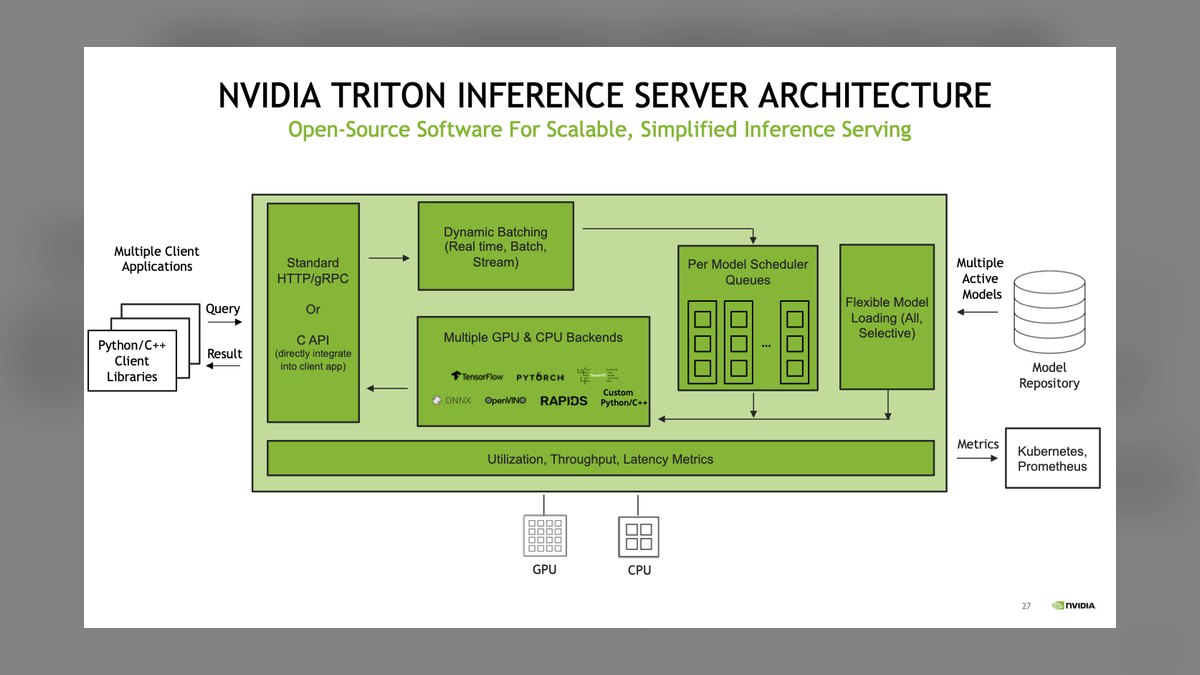
NVIDIA Triton Inference Server ranks ninth because it optimizes the inference layer, where the cheapest compute is the compute you do not use. Combined with TensorRT, it applies quantization, kernel fusion, and dynamic batching, and runs multiple models concurrently on a single GPU. This dramatically increases inference throughput per dollar, directly reducing the number of GPUs needed for a given traffic load. It is open-source and free, with you paying only for the underlying hardware.
Triton is for teams serving AI models at scale who want to maximize GPU efficiency on the inference path. It trades away scheduling and sourcing—it does not manage nodes or spot instances—and focuses purely on serving efficiency. Compared to Vantage above, Triton cuts cost at the workload level rather than the billing level. For teams specifically serving LLMs, vLLM below offers an even more specialized engine.
10. vLLM

vLLM ranks tenth because it is the open-source LLM serving engine that maximizes GPU memory efficiency and throughput via PagedAttention and continuous batching. This lets a single GPU serve far more concurrent LLM requests than naive serving, translating directly into fewer GPUs for the same traffic. As LLM inference grows as a share of AI spend, its efficiency gains are among the highest-leverage cost optimizations available. It is completely free and widely adopted.
vLLM is for teams serving LLMs at scale who want to cut inference cost without sacrificing throughput. It trades away general model support—it is specialized for transformer-based LLMs, unlike Triton above which handles broader model types. Compared to Triton, vLLM is more focused on LLM-specific optimizations and often easier to deploy. For teams whose primary cost is LLM serving, this is the most direct lever available.
How we ranked these
We measured each tool against five weighted criteria: savings impact (30%), GPU awareness (25%), automation (20%), visibility (15%), and ecosystem fit (10%). Savings impact and GPU awareness were weighted highest because the primary goal is reducing compute spend on expensive accelerators. We relied on official documentation, vendor benchmarks, and community-reported case studies to score each tool.
We deliberately ignored subjective factors like brand reputation, marketing claims, and anecdotal reviews. We also excluded tools that lack verifiable documentation or are not widely adopted. This avoids bias and ensures the ranking reflects measurable capabilities rather than hype. The focus remains on practical, evidence-based performance.
What to look for
When choosing between these tools, first identify where your waste actually is. If you lack visibility, start with Kubecost or Vantage. If you have idle or oversized nodes, Karpenter or CAST AI automate right-sizing. For underutilized GPUs, Run:ai's fractioning helps. For inference costs, vLLM or Triton/TensorRT are essential. Match the tool to your specific bottleneck.
The biggest mistake buyers make is purchasing a tool without first measuring their current spend and utilization. They often buy a visibility platform when they need automation, or vice versa. Also, many overlook that these tools are complementary, not mutually exclusive. A mature stack combines visibility, scheduling, and inference optimization for maximum savings.
Related questions
What is the difference between Kubecost and Karpenter?
Kubecost is a cost visibility and optimization platform that shows you where money is spent across your Kubernetes clusters, with granular allocation to teams and models. Karpenter is an open-source autoscaler that automatically provisions the cheapest right-sized nodes, including spot instances, and consolidates workloads. They solve different problems: visibility vs. automated action.
How does CAST AI compare to Spot by NetApp for spot instance management?
Both automate spot instance usage, but CAST AI is a Kubernetes-native platform that continuously right-sizes and rebalances clusters, with a free tier and percentage-of-savings pricing. Spot Ocean by NetApp is a more mature, managed infrastructure automation platform that blends spot, reserved, and on-demand capacity with interruption prediction. CAST AI is often simpler for Kubernetes-only teams, while Spot Ocean offers broader infrastructure support.
Can Run:ai help with inference cost optimization?
Yes, Run:ai can help with inference by pooling GPUs and using GPU fractioning to share accelerators across multiple inference jobs, increasing utilization. However, for pure LLM inference throughput, vLLM or NVIDIA Triton with TensorRT are more specialized. Run:ai is best for overall GPU orchestration, while inference engines focus on per-request efficiency.
Is SkyPilot suitable for production workloads?
SkyPilot is increasingly used in production for batch training and fine-tuning jobs that can tolerate spot preemption. It automatically finds the cheapest GPUs across clouds and handles recovery. For stateful serving, you might need additional reliability measures. It's a strong choice for teams wanting multi-cloud arbitrage without vendor lock-in.
What is the role of FinOps tools like Vantage in AI cost optimization?
Vantage provides unified visibility across cloud infrastructure and AI model APIs, helping you attribute costs to teams and models. It offers forecasting, anomaly alerts, and right-sizing recommendations. While it doesn't automate actions, it's crucial for understanding where money goes and tracking the impact of other optimization tools.
How do NVIDIA Triton and TensorRT reduce inference costs?
Triton Inference Server with TensorRT optimizes models using quantization, kernel fusion, and dynamic batching. It also runs multiple models concurrently on a single GPU. This increases throughput per GPU, meaning you need fewer GPUs to serve the same traffic, directly lowering compute costs.
What are the benefits of using vLLM for LLM serving?
vLLM uses PagedAttention and continuous batching to maximize GPU memory efficiency and throughput. This allows a single GPU to serve far more concurrent LLM requests than naive serving. For high-volume LLM inference, vLLM can reduce the number of GPUs needed by a significant factor, making it a high-leverage cost optimization.
FAQ
What's the single biggest source of AI compute waste?
For most teams it's idle and underutilized GPUs — clusters provisioned for peak that sit half-used, and on-demand instances running when spot would work. Right-sizing with an autoscaler (Karpenter, CAST AI), raising utilization with GPU fractioning (Run:ai), and shifting to spot are the highest-impact fixes. Visibility tools help you confirm where the waste actually is.
Are spot instances safe for AI workloads?
Spot capacity can be reclaimed by the cloud with short notice, so it's ideal for interruptible work like batch training with checkpointing, and riskier for stateful serving. Orchestrators like SkyPilot, Spot Ocean, and CAST AI mitigate this by checkpointing, predicting interruptions, and automatically rescheduling, making spot viable for a wide range of AI jobs at a large discount.
What is GPU fractioning and when does it help?
GPU fractioning lets multiple smaller jobs share one physical GPU instead of each monopolizing a whole one. It helps when you have many lightweight inference or development workloads that individually can't saturate a GPU — common in shared research clusters and multi-tenant inference. Run:ai and NVIDIA's MIG/MPS features enable it, raising utilization and cutting GPU count.
Do I need both FinOps visibility and automation tools?
Yes, ideally. Visibility tools (Kubecost, Vantage) tell you where money goes and attribute it to teams and models, but they don't act. Automation tools (Karpenter, CAST AI, SkyPilot) take action to right-size and source cheaper capacity. Used together — measure, then automate the biggest lever — they deliver durable savings rather than one-off cleanups.
How does inference optimization reduce cost if it's not a "cost tool"?
Inference engines like vLLM and Triton/TensorRT increase how many requests each GPU can serve through batching, quantization, and memory efficiency. Higher throughput per GPU means you need fewer GPUs for the same traffic — a direct compute-cost reduction. As LLM inference grows as a share of AI spend, this is one of the most effective cost levers available.
Can these tools optimize LLM API spend, not just my own GPUs?
Partly. Infrastructure tools optimize compute you run yourself. For third-party LLM API bills, FinOps platforms like Vantage can track and attribute that spend, and you reduce it with application-level tactics — prompt caching, smaller models for easy tasks, routing, and batching. Self-hosting with vLLM is also an option when volume makes owning GPUs cheaper than per-token API pricing.
What is the best way to start optimizing AI compute costs?
Start with measurement. Deploy a visibility tool like Kubecost or Vantage to understand where your spend is going. Identify the biggest waste areas — often idle GPUs or on-demand pricing. Then, implement automation for those specific levers, such as Karpenter for right-sizing or SkyPilot for spot usage. Finally, consider inference optimization for high-volume serving.
How much can I realistically save with these tools?
Savings vary widely, but teams often report 30-50% reductions in compute costs by combining spot instances, right-sizing, and higher utilization. Inference optimizers can double or triple throughput per GPU, effectively halving cost per request. The key is to systematically apply the right tools to your specific waste patterns.
Are these tools compatible with multi-cloud environments?
Most are. Kubecost, Vantage, and SkyPilot are multi-cloud by design. Karpenter is AWS-focused but can be extended. CAST AI and Spot Ocean support multiple clouds. Run:ai works across clouds and on-prem. Check each tool's documentation for specific cloud support to ensure it fits your infrastructure.
Sources
- https://docs.kubecost.com
- https://opencost.io
- https://karpenter.sh/docs
- https://docs.cast.ai
- https://docs.run.ai
- https://docs.skypilot.co
- https://spot.io/docs
- https://docs.vantage.sh
- https://docs.nvidia.com
- https://docs.vllm.ai
Related on PULSE
- The 10 Best AI Cost Monitoring Tools in 2027
- The 10 Best AI Tools for Pop-up Optimization in 2027
- The 10 Best AI Tools for Website Performance Optimization in 2027
- The 10 Best AI Tools for Web Image Optimization in 2027
- The 10 Best AI Tools for Conversion Rate Optimization in 2027
- The 10 Best AI Tools for Bundle Size Optimization in 2027
This page will be disappearing soon. Save it to your device for $1 — or read it free while it is here.
@Kory-White- · if Venmo asks, the last 4 of my number are 2012
This page is gone.
This one is off the shelf now. $1 keeps it on your phone for good — the whole page, pictures and diagrams included.
 pulse-ai-infrastructureThe 10 Best AI Observability Tools for RAG Pipelines in 2027
 pulse-ai-infrastructureThe 10 Best AI Tools for Restoring Old Photos in 2027
 pulse-ai-infrastructureThe 10 Best AI Tools for Product Page Design in 2027
 pulse-ai-infrastructureThe 10 Best Real-Time ML Feature Platforms in 2027
 pulse-ai-infrastructureThe 10 Best AI Tools for Gift Recommendations in 2027
 pulse-ai-infrastructureThe 10 Best AI Tools for Album Art in 2027
 pulse-ai-infrastructureHow much does a single NVIDIA H100 cluster node cost to lease in 2027?
 pulse-ai-infrastructureThe 10 Best AI Tools for Print Design in 2027
 pulse-ai-infrastructureThe 10 Best AI Tools for Audiobook Creation in 2027
 pulse-ai-infrastructureThe 10 Best AI Tools for Vocabulary Building in 2027