
Should I Lease or Buy My Commercial Space in 2027?
 Curated byKory White · Fractional CRO · Maryland
 PULSEKNOWLEDGE LIBRARY
Quality
Certified
Lease if you're growing, cash-tight, or unsure of your five-year footprint; buy if your business is stable, you'll occupy the space seven-plus years, and you can fund 10% to 25% down. Leasing preserves flexibility and capital but builds zero equity; buying locks occupancy cost, builds equity, and delivers depreciation and appreciation. Run the breakeven before deciding.
The real cost of leasing over a decade
Leasing looks cheap month to month and expensive over a decade, because every dollar of rent leaves your balance sheet and never comes back as an asset. Ten years of rent at $30 per square foot on a 5,000-square-foot space runs well past $1.5 million once escalations are layered in — and at the end you own nothing. A typical 3% annual escalation quietly compounds a $30-per-foot rate into more than $40 per foot within the same decade, so the "affordable" number you signed for is not the number you pay in year eight.
Renewal is the second exposure most tenants underestimate. When the term ends, the landlord can reset your rate to fair market rent, which in a tight submarket means a 10% to 20% jump you have almost no leverage to refuse once you've sunk buildout dollars into the space and your customers know the address. You are, in effect, renting your own switching costs back to the person who benefits from them.
The counterweight is real, though. Leasing buys maximum optionality: you can right-size, relocate, or exit cleanly at term end, which for a company adding headcount unpredictably is worth genuine money. Just as important, the capital you did not sink into a down payment stays deployed in operations, where a healthy business often earns 15% to 25% on invested capital — far above the 6% to 8% cap rates commercial real estate throws off. Leasing wins for high-growth firms, uncertain headcount, prime locations you could never afford to purchase, and any operator whose money works harder inside the business than parked in a building.
What ownership actually costs and pays back
Ownership is as much a financing and tax play as a real estate one, and treating it purely as "buying a building" misses most of the return. Conventional commercial mortgages typically want 20% to 25% down, but the SBA 504 program lets an owner-occupier who fills at least 51% of the building buy with as little as 10% down. On a $1.5 million property that is the difference between roughly $150,000 and $375,000 of dead capital tied up at closing — a swing large enough to change whether the deal is even reachable.

From there the mechanics compound in your favor. Every mortgage payment amortizes principal, so you build equity monthly instead of handing it to a landlord, and any appreciation in the underlying value accrues to you. On the tax side, commercial buildings depreciate over 39 years, mortgage interest is deductible, and a cost-segregation study can reclassify portions of the property into shorter recovery periods to pull depreciation forward into the early, cash-hungry years. Occupy 51% and lease the balance, and you become your own landlord — outside tenants help service the very mortgage that is building your equity.
A fixed-rate mortgage also freezes your single largest occupancy cost while the rents around you keep climbing 3% a year, which over a long hold is a quiet form of inflation insurance. The catches are equally real: commercial property is illiquid and can take months to sell; maintenance you used to push onto a landlord — roof, HVAC, parking-lot resurfacing — is now squarely your problem, often $5,000 to $25,000 per incident; and the down payment is genuinely dead capital until a sale or refinance frees it. Ownership rewards patience and punishes anyone who might need to move.

Run the breakeven, not the monthly number
Do not decide on vibes or on the monthly payment — the monthly number is exactly how tenants and buyers get talked into the wrong choice. Compare total cost across your realistic holding period. Start with the annual lease cost: base rent times square footage, plus operating-expense pass-throughs, plus utilities and any tenant-side maintenance. A 3,000-square-foot space at $25 per foot triple-net runs about $75,000 in base rent plus roughly $15,000 in operating expenses, or $90,000 a year — $630,000 over seven years, with zero equity to show for it.
Now model ownership. On a $1.2 million property with 20% down at roughly 6.5% on a 20-year commercial loan, expect mortgage, taxes, insurance, and maintenance near $8,500 a month, or about $102,000 a year — roughly $714,000 over seven years. That looks worse until you net out what the payments build: something like $200,000 to $300,000 in equity through principal paydown and modest appreciation, plus the deductions for mortgage interest and depreciation. Suddenly the "more expensive" option is cheaper on a net basis.

The breakeven formula is simply: total lease cost over the hold versus net ownership cost, where net ownership cost equals total payments minus equity gained minus tax benefits minus appreciation. At a five-year horizon, leasing frequently wins, because transaction costs — closing costs of 2% to 5% and broker fees of 3% to 6% — eat the young equity before it can compound. At seven to ten years, buying usually wins, as appreciation and principal paydown overrun those upfront frictions. The single most important input is honest opportunity cost: if your business returns 20% on capital, leasing and redeploying the down payment into growth can beat owning even past year ten.
The SBA 504 loan is the owner-occupier's edge
For small and mid-size businesses, the SBA 504 loan is the most overlooked instrument in commercial real estate, and it changes the buy-versus-lease math more than any single negotiation ever will. The headline is the 10% down payment versus 20% to 25% conventional — on a seven-figure building that keeps $100,000 to $200,000 working inside your business instead of frozen in a closing. The SBA portion carries a below-market, long-term fixed rate, typically on a 25-year term for real estate, which locks your financing cost against decades of rate risk.

The structure is a three-way split: a conventional bank lends about 50% in first position, a Certified Development Company backed by the SBA lends roughly 40% at the fixed below-market rate, and you contribute the remaining 10%. The core requirement is owner-occupancy — you must occupy at least 51% of an existing building, or 60% for new construction — which means you can legally lease out the remainder and let those tenants defray your payment. It is the cleanest path to becoming your own landlord with minimal cash in.
The trap is the mirror image of the benefit. Because the down payment is small, it is dangerously easy to stretch into a building you cannot actually carry. Maintenance surprises, a vacancy on the leased portion that was supposed to cover part of the note, and a balloon or refinance event down the road can all sink an over-leveraged owner. Qualify the deal on the assumption that the rental income disappears for six months and the roof needs replacing — if it still pencils, the leverage is a tool rather than a trap.

Hidden lease costs most tenants overlook
Even when leasing is right, several less-obvious expenses can quietly rewrite the total. Tenant-improvement allowances are the first: landlords commonly offer $10 to $30 per square foot, but finishing a real space — plumbing, electrical upgrades, a kitchen buildout — often costs $40 to $80 per foot, and the shortfall comes straight out of your pocket or gets amortized back into your rent at interest. The allowance headline rarely covers the construction reality.
Operating-expense pass-throughs are the second leak. Common-area maintenance, property taxes, and insurance can escalate faster than base rent, and many triple-net leases let the landlord pass through 100% of those increases. A property-tax reassessment after the building changes hands can spike your monthly bill 15% to 30% overnight, entirely outside your control. Always negotiate a cap — typically 3% to 5% annually on controllable expenses — before you sign.

Exit costs are the third and most punishing. Breaking a commercial lease usually costs six to twelve months of rent plus legal fees and any unamortized TI, so an early downsize or relocation can leave you owing $50,000 to $200,000 or more. Finally, in a net lease you shoulder HVAC repairs, roof leaks, and parking resurfacing directly, and you often pay a management fee of 4% to 8% of gross rent indirectly. Run a full occupancy-cost analysis including every one of these before you compare the lease to a purchase — the base-rent figure alone is not the decision.
How to structure a lease that protects you
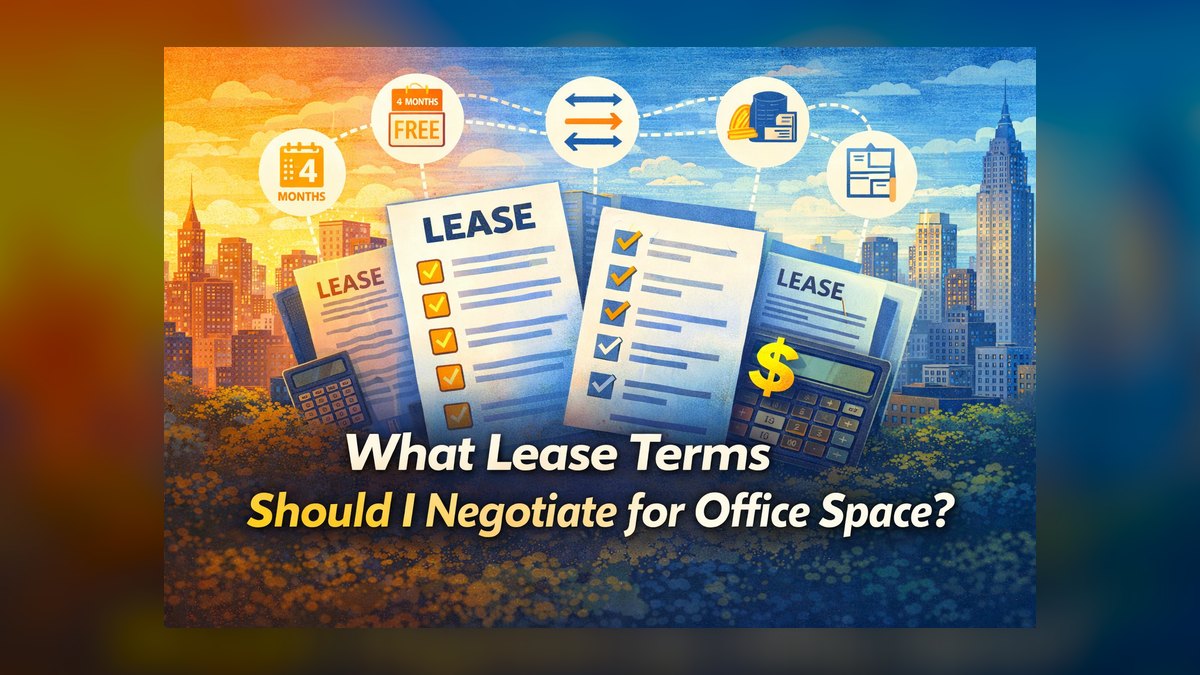
If leasing wins, the terms you negotiate can save tens of thousands over the life of the deal. Lead with rent abatement — three to six months of free rent up front is standard, especially on spaces that need work, and it directly offsets buildout cash. Then attack escalations: instead of accepting a flat 3% annual bump, push for 2%, or tie increases to CPI with a 2% floor and a 4% ceiling so a single inflationary year cannot run away from you.

Renewal options are the hedge that keeps you from being held hostage at term end. Secure two or three five-year renewal options with predetermined increases baked in, so the landlord cannot reset you to a spiked market rate after you've invested in the space. If expansion is plausible, add a right of first refusal on adjacent square footage; if contraction is a risk, negotiate the ability to shed 10% to 20% of your space after year three with a matching rent reduction.
Sublease and assignment rights matter more than most tenants realize — ensure you can sublease with the landlord's consent "not to be unreasonably withheld," and that the lease is assignable if you sell the business, or you may find you cannot exit or transact when it matters most. Resist a personal guarantee; offer a larger deposit or corporate guarantee instead, and if a guarantee is truly unavoidable, negotiate a burn-off clause that retires it after three to five years of on-time payments. Finally, document building condition with dated photos and a $500-to-$2,000 commercial inspection before move-in, so pre-existing damage and an aging HVAC or roof do not silently become your liability under the net-lease terms.

Due diligence so you don't get screwed either way
Whichever path you choose, the failure mode is skipping diligence to hit a deadline. If you lease, the checklist is contractual: cap escalations at 2% to 3%, win a renewal option at a capped rate, push base-building systems — HVAC, roof, and ADA compliance — back onto the landlord, and pin down the TI allowance and free-rent period in writing before you sign anything. Every one of those items is cheaper to negotiate than to litigate later.
If you buy, the checklist is physical and legal. Order a Phase I environmental site assessment, because contamination liability transfers to you at closing and can dwarf the purchase price if there's a buried tank or a solvent history next door. Commission a professional building inspection with specific attention to roof age and HVAC life — those two systems are the budget-killers that turn a good deal into a cash drain in year two. Get a current survey and title insurance to flush out easements, encroachments, and liens, and lock a fixed-rate or rate-capped loan so a future refinance cannot ambush you with payment shock.
Either way, the discipline is identical: model the all-in cost over your real holding period rather than the monthly figure, and stress-test it against the things that go wrong — a lost tenant, a failed compressor, a soft resale market, a rate reset. The operators who regret their choice almost never regret the math they did; they regret the diligence they skipped because the deal "felt" right and the monthly number looked friendly.
Related questions
How long do I need to stay for buying to beat leasing?
Roughly seven years is the common breakeven. Below five years, transaction costs — 2% to 5% closing plus 3% to 6% broker fees — usually eat any equity you build. Past seven to ten years, appreciation and principal paydown overtake those upfront costs and ownership pulls ahead.
Can I buy a building bigger than I need and lease the rest?
Yes, and it's a core owner-occupier strategy. SBA 504 requires you occupy at least 51% of an existing building (60% new construction), so you can lease the remainder to outside tenants whose rent helps service your mortgage while you build equity.
Is a triple-net (NNN) lease cheaper than owning?
Not always. In an NNN lease you pay property taxes, insurance, and maintenance on top of base rent, which can add 30% to 50% to your effective monthly cost. Compare full occupancy cost, not base rent, before assuming leasing is the cheaper path.
What's the smallest down payment to buy commercial space?
About 10% through the SBA 504 program if you occupy the majority of the building. Conventional commercial mortgages typically require 20% to 25% down, plus reserves for closing costs of 2% to 5% and initial repairs or buildout.
FAQ
What's the biggest financial risk of leasing? You build no equity — every payment goes to your landlord's asset, not yours. On top of that, rent typically rises 2% to 3% a year, and under a triple-net structure you also owe property taxes, insurance, and maintenance above base rent, so your real cost climbs faster than the headline rate suggests.
How much cash do I need to buy commercial space? Plan on 10% to 25% of the purchase price for the down payment — 10% via SBA 504 if you owner-occupy, 20% to 25% on a conventional commercial mortgage. Add reserves for closing costs of roughly 2% to 5% and a cushion for initial repairs, buildout, or a slow-to-lease vacant portion.
What if my business outgrows the space in a few years? Leasing is the safer bet under uncertainty. Negotiate a three-to-five-year term with renewal and expansion options and, ideally, a contraction right after year three. Buying locks you in; selling early exposes you to transaction costs and market timing that can erase your equity.
Can I negotiate tenant-improvement allowances in a lease? Yes. Landlords commonly offer $10 to $50 per square foot in TI for new buildouts, and the amount scales with market conditions and lease length — longer terms earn larger allowances. Just remember real finish costs often run $40 to $80 per foot, so the allowance rarely covers everything.
How do NNN costs affect the lease-versus-buy decision? They narrow the gap. Triple-net charges — taxes, insurance, maintenance — can add 30% to 50% to your monthly cost and often escalate faster than base rent. Always negotiate an annual cap on controllable NNN increases, and fold the full figure into any comparison against ownership.
Is buying commercial space a good retirement strategy? It can be. Own the building 10-plus years and you may sell it or keep it as rental income after you retire, effectively turning your occupancy cost into a retirement asset. The catch is that it ties up capital and demands ongoing maintenance, so it fits best when your business is durably stable.
Sources
- U.S. Small Business Administration — https://www.sba.gov/funding-programs/loans/504-loans
- CBRE — https://www.cbre.com/insights
- JLL — https://www.us.jll.com/en/views
- Cushman & Wakefield — https://www.cushmanwakefield.com/en/insights
- NAIOP, Commercial Real Estate Development Association — https://www.naiop.org/research-and-publications/
- IREM, Institute of Real Estate Management — https://www.irem.org/resources
- BOMA International — https://www.boma.org/
- Internal Revenue Service, depreciation of business property — https://www.irs.gov/publications/p946
Related on PULSE
- What Is the Complete Commercial Lease Negotiation Checklist?
- How Do I Get a Commercial Lease With Bad or Thin Credit?
- How Do I Negotiate My First Commercial Lease as a New Business Owner?
- How Do I Negotiate Parking in a Commercial Lease?
- Who Pays for ADA Compliance in a Commercial Lease?
- What Questions Should I Ask Before Signing Any Commercial Lease?
This page will be disappearing soon. Save it to your device for $1 — or read it free while it is here.
@Kory-White- · if Venmo asks, the last 4 of my number are 2012
This page is gone.
This one is off the shelf now. $1 keeps it on your phone for good — the whole page, pictures and diagrams included.
 buildoutsHow Do I Negotiate a Dollar Cap on My Personal Guarantee in 2026?
 buildoutsWhat's a Fair Load Factor (Common-Area Add-On) and How Do I Fight It in 2027?
 buildoutsHow Do I Structure Rent for a Seasonal Business in 2026?
 buildoutsAs-Is vs Warm Shell vs Turnkey: Which Delivery Saves Me the Most?
 buildoutsHow Do I Negotiate a Kick-Out Clause for Low Sales in 2026?
 buildoutsHow Do I Challenge My Property Tax Pass-Through as a Tenant in 2026?
 buildoutsHow Do I Audit My CAM Reconciliation to Claw Back Overcharges in 2027?
 buildoutsHow Do I Negotiate a Cannabis Dispensary Lease Without Getting Gouged in 2026?
 buildoutsWhat Is Gross-Up in a Lease and How Does It Cost Me in 2026?
 buildoutsHow Do I Negotiate Co-Working or Flex-Space Terms in 2026?