
How Do I Use a 1031 Exchange to Buy My Building in 2027?
 Curated byKory White · Fractional CRO · Maryland
 PULSEKNOWLEDGE LIBRARY
Quality
Certified
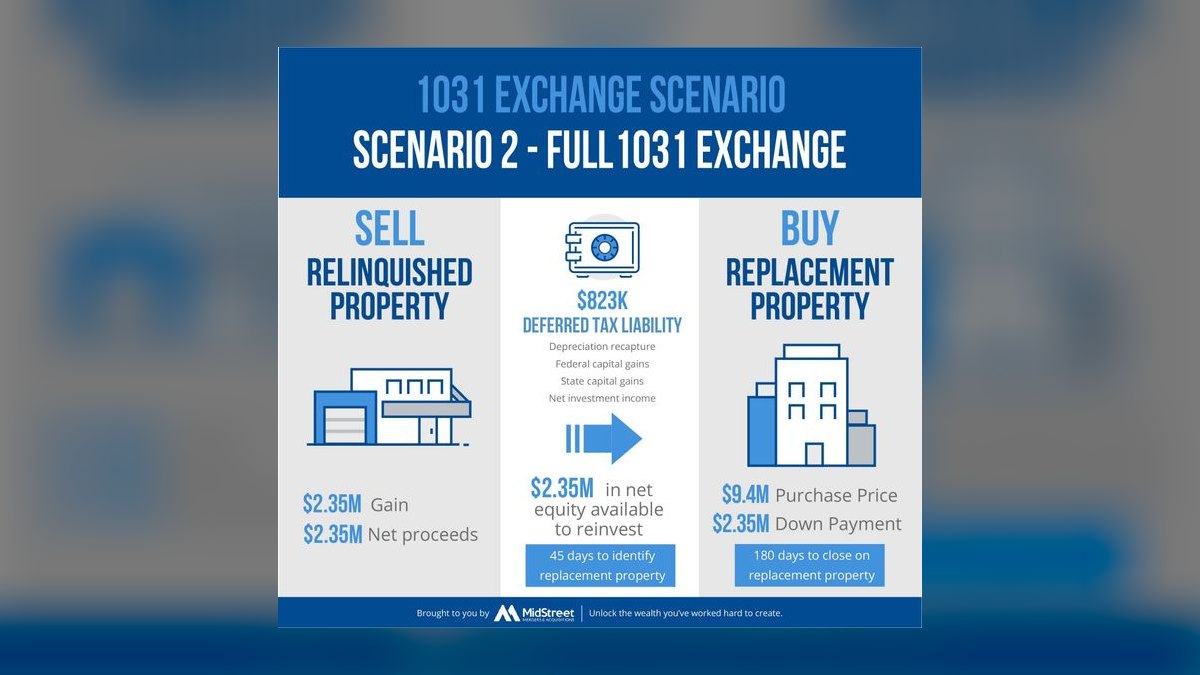
A 1031 exchange, named after Section 1031 of the Internal Revenue Code, allows you to sell an investment or business property and reinvest the proceeds into a like-kind replacement property while deferring all capital gains taxes. The mechanics are precise and unforgiving: you must identify replacement property within 45 calendar days and close within 180 days, all while a Qualified Intermediary holds the proceeds to prevent constructive receipt. This strategy converts what would be a significant tax bill into equity that powers your next acquisition, making it one of the most powerful wealth-building tools available to commercial property owners. For business owners specifically, this creates a pathway to own the very building where they operate while deferring taxes that would otherwise reduce their purchasing power.
The process is not a loophole but a deliberate congressional incentive to encourage real estate investment and economic growth. When executed correctly, a 1031 exchange allows you to treat your real estate portfolio as a continuously growing asset base rather than a series of taxable transactions. The key is understanding that every dollar not paid in taxes is a dollar working for you in your next property. This fundamental shift in perspective transforms how successful commercial property owners approach acquisitions and dispositions throughout their careers.
What Are the Specific Requirements for a Valid 1031 Exchange?
The IRS imposes several hard requirements that must be met exactly to achieve tax deferral. First, both the relinquished property and the replacement property must be held for investment or productive use in a trade or business. This means your personal residence does not qualify, but the building where your business operates does qualify if it is owned through a separate entity and leased back to your operating company. Second, the properties must be like-kind, which in commercial real estate means any real property can be exchanged for any other real property — an office building for a warehouse, a retail center for raw land, or any combination thereof. The like-kind standard is remarkably broad, encompassing virtually all types of real estate held for business or investment purposes.
The timeline is the most unforgiving element of the exchange. You have only 45 calendar days from the closing date of your relinquished property to identify potential replacement properties in a written document delivered to your Qualified Intermediary. This identification must be signed and clearly describe each property by legal description, street address, or assessor's parcel number. You then have 180 calendar days from the closing date to close on one or more of the identified properties. These deadlines are strict; the IRS does not grant extensions for any reason, including holidays, weekends, or natural disasters. For a deeper look at how these deadlines interact with financing, read our guide on SBA 504 vs Conventional Loan: How Do I Pay Less to Buy My Building?.
Another critical requirement is the use of a Qualified Intermediary (QI). The QI is a third-party facilitator who holds the sales proceeds from your relinquished property and ensures you never have actual or constructive receipt of the funds. If you take possession of the money, even for a moment, the entire exchange is disqualified, and you owe taxes on the full gain. The QI must be an independent party; using your attorney, real estate agent, or related entity as the QI violates IRS rules. Choosing a reputable QI with errors and omissions insurance is essential to protect your transaction.
How Does the Identification Process Work Under the Three-Property Rule?
The identification rules provide three distinct methods for designating replacement properties, and the three-property rule is the most commonly used. Under this rule, you may identify up to three properties of any value without restriction. This means you can identify a $2,000,000 building as your primary target, a $1,500,000 building as your first backup, and a $5,000,000 building as your second backup, regardless of the sale price of your relinquished property. The flexibility of this rule makes it the preferred choice for most commercial property owners because it allows for ambitious targeting while maintaining safety nets.

If you cannot limit yourself to three properties, the 200% rule allows you to identify any number of properties as long as their combined fair market value does not exceed 200% of the sale price of your relinquished property. For example, if you sold a building for $1,000,000, you could identify up to $2,000,000 worth of properties spread across as many candidates as you wish. The 95% rule is the least flexible option: it allows you to identify any number of properties of any value, but you must close on at least 95% of the total value of all identified properties. Most professional advisors recommend using the three-property rule because it provides maximum flexibility with minimal risk of failure.
The identification letter must be delivered to your QI before midnight on the 45th day. It should include the full purchase price, legal description, and street address for each property. You cannot change your identification after the deadline, so careful selection is critical. Many exchangers identify only one property, which then falls through during due diligence, leaving them with no valid identification. This is why the three-property rule is strongly recommended; it provides backup options without additional complexity.
What Is Boot and How Can You Eliminate It Entirely?
Boot is any value you receive from the exchange that is not like-kind real property, and it is immediately taxable as capital gain and depreciation recapture. There are three distinct types of boot that can trigger taxation even in an otherwise valid exchange. Cash boot occurs when you receive any cash proceeds from the sale that are not reinvested into the replacement property. Mortgage boot occurs when the debt on your replacement property is less than the debt you had on your relinquished property, with the difference treated as taxable proceeds. Non-like-kind property boot occurs when you receive personal property, such as furniture or equipment, as part of the transaction.
The calculation of boot can be complex, but the principle is straightforward: any economic benefit you take out of the exchange that is not reinvested in real estate is subject to tax. For example, if you sell a building for $1,500,000 with a $500,000 mortgage and buy a replacement for $1,200,000 with a $300,000 mortgage, you have $300,000 in cash boot (the $300,000 you kept) plus $200,000 in mortgage boot (the $200,000 reduction in debt). Total boot of $500,000 is taxed as capital gain and depreciation recapture. The only way to eliminate boot entirely is to acquire a replacement property that costs at least as much as you sold for and carries at least as much debt. If you want to understand how boot interacts with financing structures, see our article on Should I Buy My Commercial Building Through a Separate LLC?.

Eliminating boot requires careful planning. You must invest all net proceeds from the sale into the replacement property, meaning the purchase price must be equal to or greater than the net sale price after transaction costs. Additionally, the debt on the replacement property must be equal to or greater than the debt on the relinquished property. If you need to reduce debt, you can add cash to the transaction to offset the mortgage boot, but this cash is not itself boot. The goal is to match or exceed both the equity and debt positions to achieve 100% tax deferral.
Can You Use a 1031 Exchange to Buy the Building Your Business Occupies?
Yes, this is one of the most common and strategically beneficial applications of a 1031 exchange for business owners. The IRS requires that the replacement property be held for investment or productive use in a trade or business, and owner-occupied commercial real estate clearly satisfies this requirement when properly structured. The standard approach involves creating a separate LLC that purchases the building through the exchange and then leases the property to your operating company at fair market rent. This structure satisfies the IRS requirement while providing liability protection and operational separation.
The lease between your property LLC and your operating company must be at market rates to avoid IRS scrutiny. If you charge below-market rent, the IRS could argue that the property is not truly held for business use and disqualify the exchange. The rental income from your operating company to the property LLC creates a legitimate income stream that covers mortgage payments, property taxes, insurance, and maintenance. Over time, the building appreciates in value and builds equity through mortgage principal reduction, all while you depreciate the building value (excluding land) against your rental income. This creates a powerful cycle where your business pays rent to your investment entity, building wealth in the property while deducting the rent as a business expense.
Many business owners use a 1031 exchange to transition from renting to owning their facility. This strategy provides long-term cost stability, eliminates landlord risk, and builds equity through appreciation and mortgage paydown. The exchange defers taxes that would otherwise reduce your purchasing power, allowing you to acquire a larger or better-located building than you could with after-tax proceeds. This is particularly valuable for growing businesses that need to expand their physical footprint.

How Does the "Swap Till You Drop" Strategy Work for Intergenerational Wealth Transfer?
The ultimate power of 1031 exchanges lies in the ability to defer taxes indefinitely through successive exchanges, a strategy often called "swap till you drop." As your business grows and your real estate needs change, you can trade up to larger, better-located, or more profitable properties, rolling all your accumulated equity forward without tax erosion. Each exchange resets the basis clock for depreciation purposes, allowing you to continue claiming depreciation deductions on the new property. This means you can keep deferring taxes year after year, decade after decade, as long as you continue to exchange.
The strategy culminates at death, when your heirs receive the property with a stepped-up basis equal to its fair market value. This step-up permanently eliminates all deferred capital gains and depreciation recapture taxes that you accumulated over your lifetime. Consider an owner who bought a building for $500,000, exchanged into progressively larger properties over 30 years, and dies owning a $5,000,000 building. Their heirs receive the building with a $5,000,000 basis, meaning zero capital gains tax liability on the entire $4,500,000 of appreciation and recapture. This makes the 1031 exchange one of the most effective intergenerational wealth transfer tools in commercial real estate. For more on long-term property strategies, see our guide on When Should I Demolish an Old Building Versus Build-to-Suit?.

The "swap till you drop" strategy requires disciplined planning and professional guidance. Each exchange must be structured correctly to maintain the deferral chain. As you age, you may want to consolidate multiple properties into one or trade into a property that generates passive income without active management. The beauty of the 1031 exchange is that it accommodates these life transitions without triggering taxes, allowing you to optimize your portfolio for retirement while preserving wealth for the next generation.
What Happens If You Cannot Complete the Exchange Within 180 Days?
If you miss either the 45-day identification deadline or the 180-day closing deadline, the exchange fails completely, and you must recognize all deferred gain on your tax return for the year of the sale. The proceeds held by your Qualified Intermediary are released to you, and you report the sale as if no exchange occurred, paying capital gains tax and depreciation recapture on the entire gain. This outcome is entirely avoidable with proper planning, but it happens frequently when owners underestimate the time required to identify and close on commercial properties.
The most common failure scenario involves the 45-day identification period. Owners often identify only one property, which then falls through during due diligence, leaving them with no valid identification within the window. The remedy is simple: always identify at least two or three properties using the three-property rule. If your primary choice fails, you have backup candidates already identified. Another common failure point is the 180-day closing deadline, especially when financing delays push closing past the deadline. To mitigate this risk, work with lenders who understand 1031 exchange timelines and have your financing pre-approved before you identify the replacement property. Having multiple backup properties and a lender experienced in exchange transactions dramatically reduces your risk of failure.
Some exchangers attempt to use a reverse exchange, where the replacement property is acquired before the relinquished property is sold. This strategy requires a safe harbor under Revenue Procedure 2000-37, which allows an exchange accommodation titleholder to hold the replacement property for up to 180 days while you sell your relinquished property. Reverse exchanges are more complex and require additional fees, but they can be valuable when you find the perfect replacement property but have not yet sold your current building. Proper planning with an experienced QI is essential for reverse exchanges.
Related Questions
Can I include personal property like furniture or equipment in a 1031 exchange?
No, only real property qualifies for like-kind treatment under Section 1031. Personal property such as furniture, equipment, and vehicles must be handled separately and will typically trigger immediate tax liability.
What happens to depreciation recapture in a 1031 exchange?
Depreciation recapture is deferred along with capital gains, but it is not eliminated. The recapture amount carries forward to the replacement property and will be taxed when you eventually sell without exchanging.
Can I use a 1031 exchange if I sell a property at a loss?
No, 1031 exchanges only apply when you have a realized gain. If you sell at a loss, there is no gain to defer, and the exchange rules do not apply to losses.
How many times can I do a 1031 exchange?
There is no limit on the number of exchanges you can execute. You can exchange repeatedly throughout your lifetime, deferring gains each time until you either sell without exchanging or pass away.
Do I have to use the same QI for the sale and purchase sides?
Yes, you must use a single Qualified Intermediary for the entire exchange. Using different QIs for the sale and purchase would violate the requirement that the QI holds the proceeds continuously throughout the exchange period.
FAQ
Can I live in part of the building and still use a 1031 exchange? You can allocate value between the qualifying business portion and the personal residential portion, but only the business portion qualifies for tax deferral. The residential share is treated as a separate transaction and any gain on that portion is taxable.
What is the minimum holding period for property in a 1031 exchange? The IRS does not specify a minimum holding period, but tax advisors generally recommend holding for at least one to two years to demonstrate investment or business intent. Shorter periods risk IRS scrutiny that the property was held primarily for resale.
Can I do a 1031 exchange with a property I inherited? Yes, inherited property qualifies for 1031 exchange treatment as long as you hold it for investment or business use. The stepped-up basis at inheritance affects your gain calculation but does not prevent you from exchanging.
Do state taxes apply to 1031 exchanges? Many states conform to federal 1031 treatment and defer state capital gains taxes, but some states like California and Pennsylvania have different rules. You must consult your state tax authority or a CPA familiar with your state's laws.
Can I exchange into multiple properties with one 1031 exchange? Yes, you can acquire multiple replacement properties as long as their total value and debt meet the equal-or-greater requirements. This is common when business owners want to diversify their real estate holdings.
What happens to the exchange if the replacement property deal falls through after 45 days? If the identified property falls through after the 45-day identification deadline, you lose the ability to replace it with a new property. This is why identifying multiple backup candidates is essential.
Can I use a 1031 exchange for a property I already own but want to trade for another? Yes, as long as you have not already sold the property. You can structure the sale and purchase as a forward exchange by selling first and buying second within the 180-day window.
Does the replacement property have to be in the same state as the relinquished property? No, there is no geographic restriction on like-kind exchanges. You can sell a property in one state and buy a replacement property in any other state or territory of the United States.
Can I use exchange funds to pay for improvements on the replacement property? Yes, through an improvement or build-to-suit exchange. Your Qualified Intermediary holds title to the property and pays for improvements using exchange proceeds, with the cost of improvements counting toward the equal-or-greater value requirement.
What records do I need to keep for a 1031 exchange? You must retain all documents related to the exchange, including the sales contract, settlement statements, identification letter, purchase contracts, and Qualified Intermediary agreements. These records should be kept for at least seven years after the exchange is completed.
Sources
- IRS, "Like-Kind Exchanges Under IRC Section 1031" (Fact Sheet FS-2008-18 and updates)
- IRS Form 8824, "Like-Kind Exchanges," and instructions
- IRS Treasury Regulation §1.1031(k)-1 (deferred exchange rules, identification rules, deadlines)
- Rev. Proc. 2000-37 (reverse exchange and parking safe harbor)
- Federation of Exchange Accommodators (FEA) Qualified Intermediary standards
- Journal of Accountancy, "Navigating 1031 Exchange Rules and Deadlines"
- The CPA Journal, "Boot Calculation and Tax Consequences in 1031 Exchanges"
- National Association of REALTORS, "1031 Exchange Guide for Commercial Properties"
- American Institute of CPAs, "Tax Strategies for Real Estate Investors"
Related on PULSE
- [Can I use my TI allowance to buy furniture and equipment instead of construction?](/knowledge/bo0238)
- [Should I Buy My Commercial Building Through a Separate LLC?](/knowledge/bo0037)
- [SBA 504 vs Conventional Loan: How Do I Pay Less to Buy My Building?](/knowledge/bo0036)
This page will be disappearing soon. Save it to your device for $1 — or read it free while it is here.
@Kory-White- · if Venmo asks, the last 4 of my number are 2012
This page is gone.
This one is off the shelf now. $1 keeps it on your phone for good — the whole page, pictures and diagrams included.
 buildoutsHow Does a Cost Segregation Study Cut My Buildout Taxes in 2026?
 buildoutsHow Do I Depreciate Leasehold Improvements (QIP) to Save on Taxes in 2026?
 buildoutsSBA 7(a) vs 504: Which Is Cheaper for a Buildout?
 buildoutsHow Do I Finance a Buildout: TI Loan vs Landlord vs Cash in 2026?
 buildoutsSBA 504 vs Conventional Loan: How Do I Pay Less to Buy My Building?
 buildoutsHow Do I Vet a General Contractor So I Don't Overpay in 2026?
 buildoutsShould I Buy My Commercial Building Through a Separate LLC in 2026?
 buildoutsHow Do Change Orders Blow Up a Buildout Budget, and How Do I Cap Them in 2026?
 buildoutsWhat Is a Construction Draw Schedule and How Do I Avoid Overpaying in 2026?
 pulse-recentHow much does it cost to build out a movie theater auditorium in 2027?