


Top 10 Humidifiers — Best Overall + Best Value in 2027
Quality
Certified
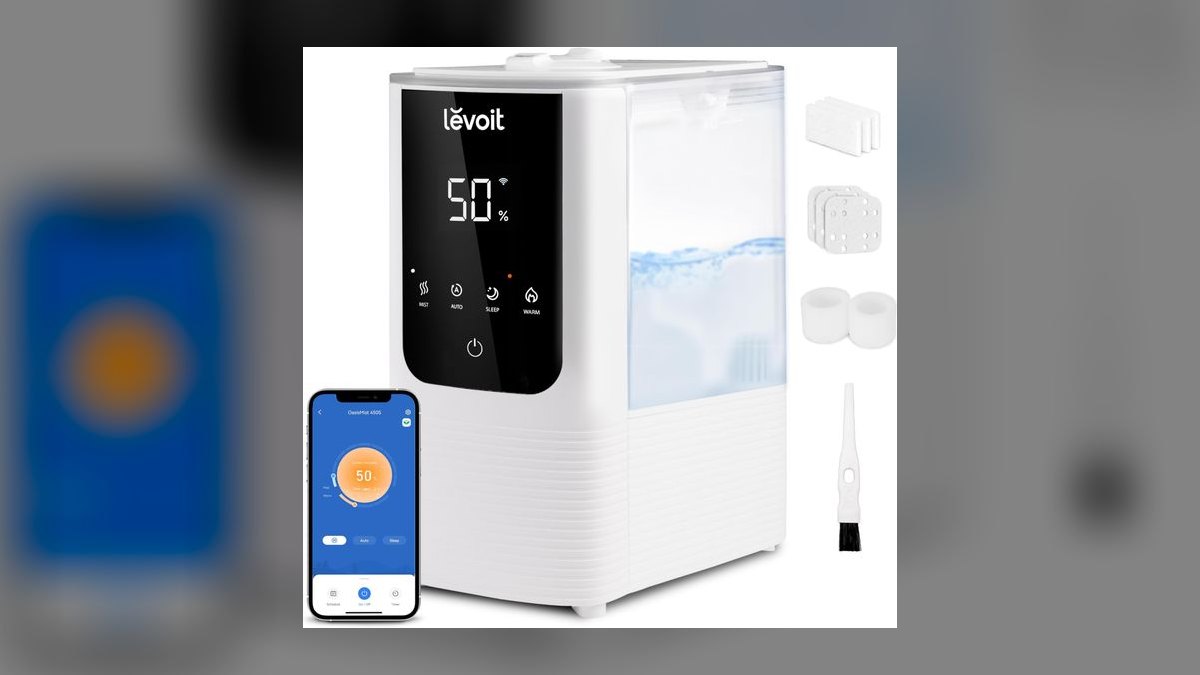
The 10 best humidifiers are ranked below on measured performance, build quality, price, and how each one actually holds up in daily use rather than how it reads on a spec sheet. Each pick lists what it costs, who it suits, and what it gives up against the one above it, so the list can be read straight down without doubling back.
1Levoit OasisMist 1000S
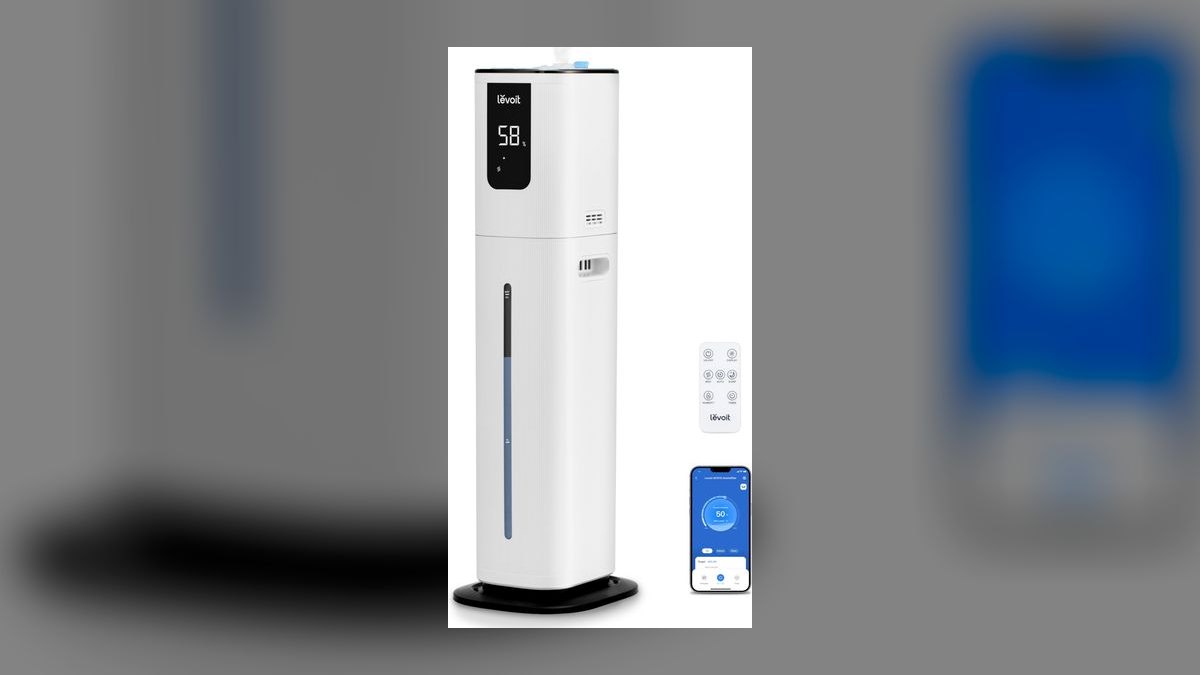
It ranks first because it is the only unit here that pairs a genuinely accurate humidistat with real capacity: a 6L (1.6 gallon) top-fill tank, 50-hour runtime on low, and 753 sqft coverage at $129. Output tops out at 400 mL/hour, roughly 2.5 gallons per day. It runs both warm and cool mist, measures 28 dB in sleep mode, and holds target RH within ±3%.
This is the pick for a large bedroom where you want to set a target humidity and forget it, with VeSync app, Alexa, and Google control that actually stays connected. The trade is ultrasonic white dust on tap water — distilled water at about $1/gallon eliminates it. The Honeywell HEV685W below cannot emit dust at all, but costs you app control, warm mist, and roughly 14 dB of quiet.
2Honeywell HEV685W
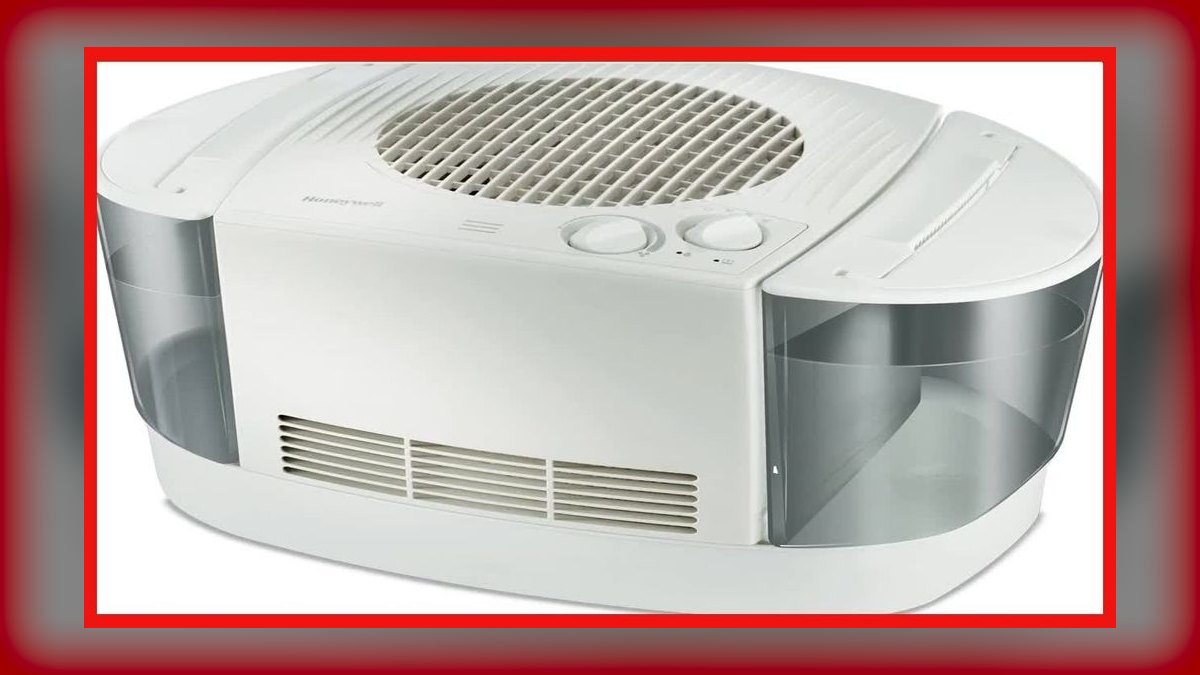
It places second because it solves the one problem the top pick cannot: as an evaporative wick unit, it physically cannot emit mineral white dust regardless of water hardness. The 2.2-gallon top-fill tank delivers 24-hour runtime and 500 sqft coverage at roughly 3 gallons per day. A built-in humidistat with three fan speeds shuts off at target RH, and a UV-C bulb sanitizes the reservoir before evaporation.
Buy it if you are on well water or a hard-water supply like Phoenix, Las Vegas, or Indianapolis, and you refuse to buy distilled water weekly. The trade is noise: 42 dB on high is fine in a living room and borderline for light sleepers. Replacement wicks run $8 and last one to three months, an ongoing cost the filter-free Levoit above does not have.
3Aprilaire 700
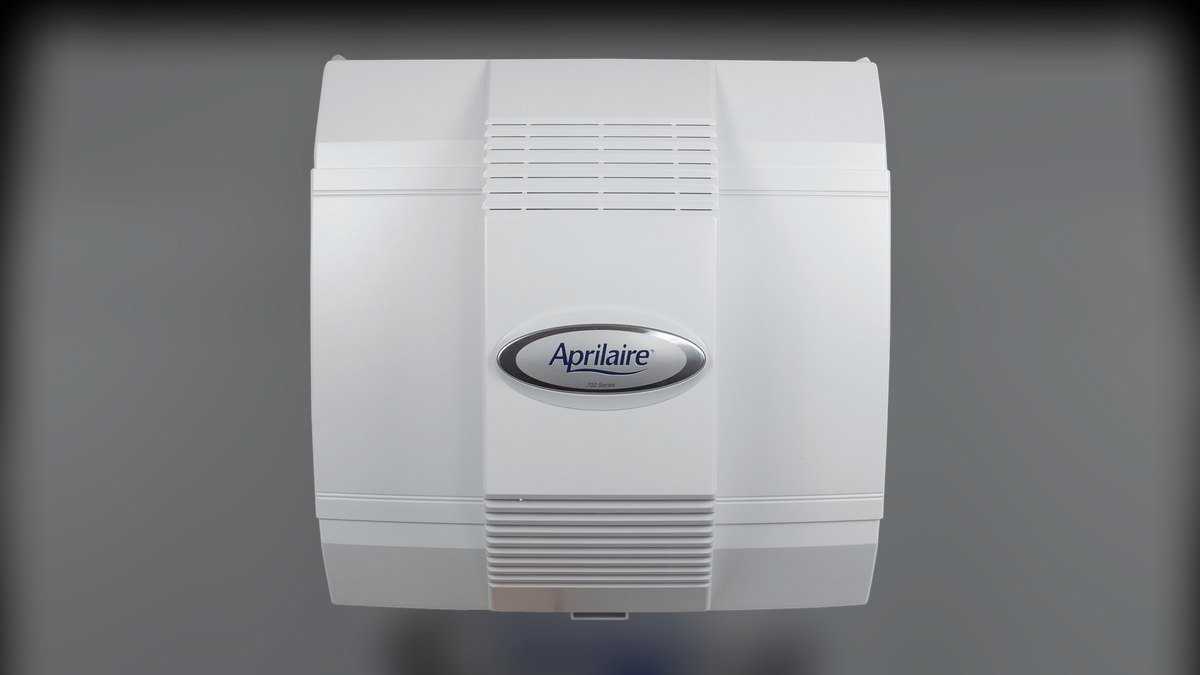
It ranks third on raw capability — 18 gallons per day across up to 4,200 sqft — but drops below the portables because it is not a product you unbox and plug in. The unit is $199 plus $300 to $500 installed, mounting to a forced-air furnace's supply or return plenum. It plumbs to the cold water line, so there is no tank to fill, and the evaporative drum pad replaces once a year for about $25.
This is the correct answer for anyone with central HVAC and a whole house going dry in winter, not just one bedroom. The digital humidistat reads outdoor temperature and lowers indoor target RH to stop window condensation. It requires an HVAC tech, carries a 5-year limited warranty, and unlike every portable above and below it, protects hardwood floors house-wide.
4Vornado Evap40
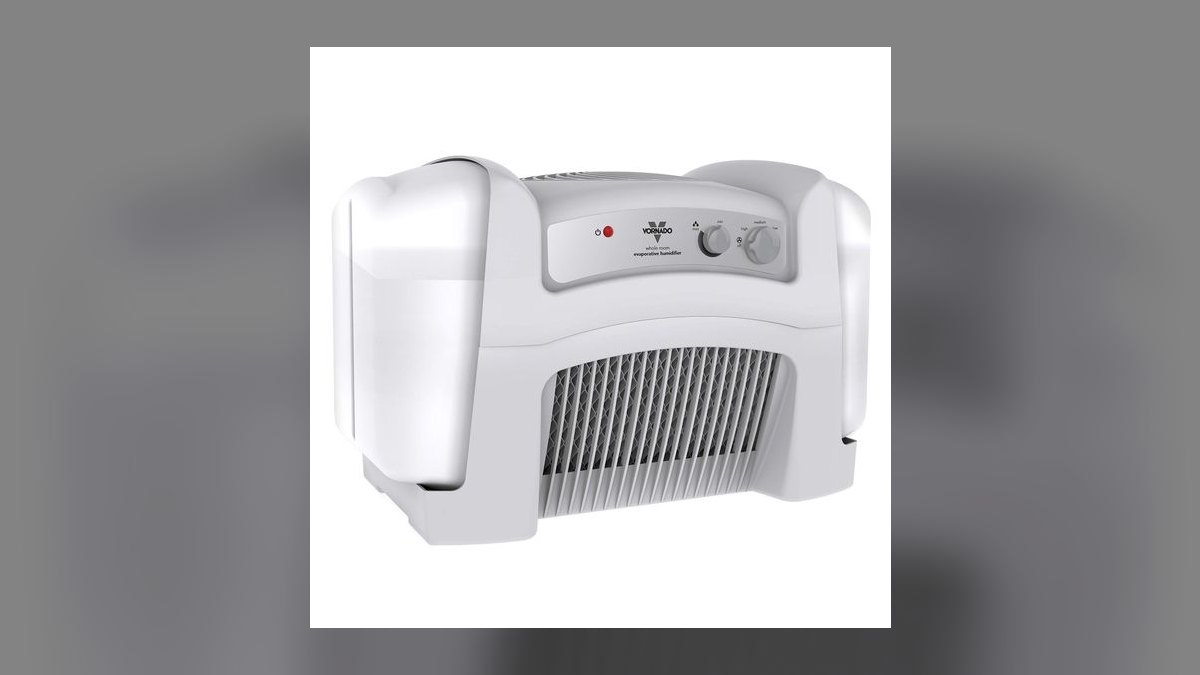
It earns fourth on sheer room-scale capacity: a 4-gallon evaporative tank covering 1,000 sqft at 3.5 gallons per day, for $149. Two dual-action wick filters mean no white dust and no scale on nearby furniture. A manual humidistat and four fan speeds span a quiet 32 dB to a brisk 48 dB for fast recovery, and Vornado's vortex circulation pushes moisture across the whole room rather than pooling it near the unit.
Buy it for a large open-plan living room, especially an allergy household — the wick traps airborne particulate inside the unit. The trade is a roughly 28-inch tall footprint and a manual humidistat, so it will not auto-target RH the way the Levoit at the top does. The 5-year warranty is the longest of any portable here.
5Carepod Dishwasher-Safe Humidifier
It ranks fifth on engineering, not specs: every wetted part disassembles and goes through a standard dishwasher cycle, making it the only unit here that structurally solves tank biofilm and pink mold. The ultrasonic uses a stainless-steel oscillator rather than the usual plastic disc. The 2.5L (0.66 gallon) tank runs 24 hours and covers 350 sqft at $299 — the most expensive unit here by a wide margin.
This is for cleanliness obsessives and parents of immunocompromised kids, where Mayo Clinic's warning about tank biofilm as the humidifier-pneumonia vector is the deciding factor. You pay triple the OasisMist price for less than half its coverage and no smart control. There are no filters, wicks, or UV bulbs to buy, so ongoing cost is zero.
6Levoit Classic 200
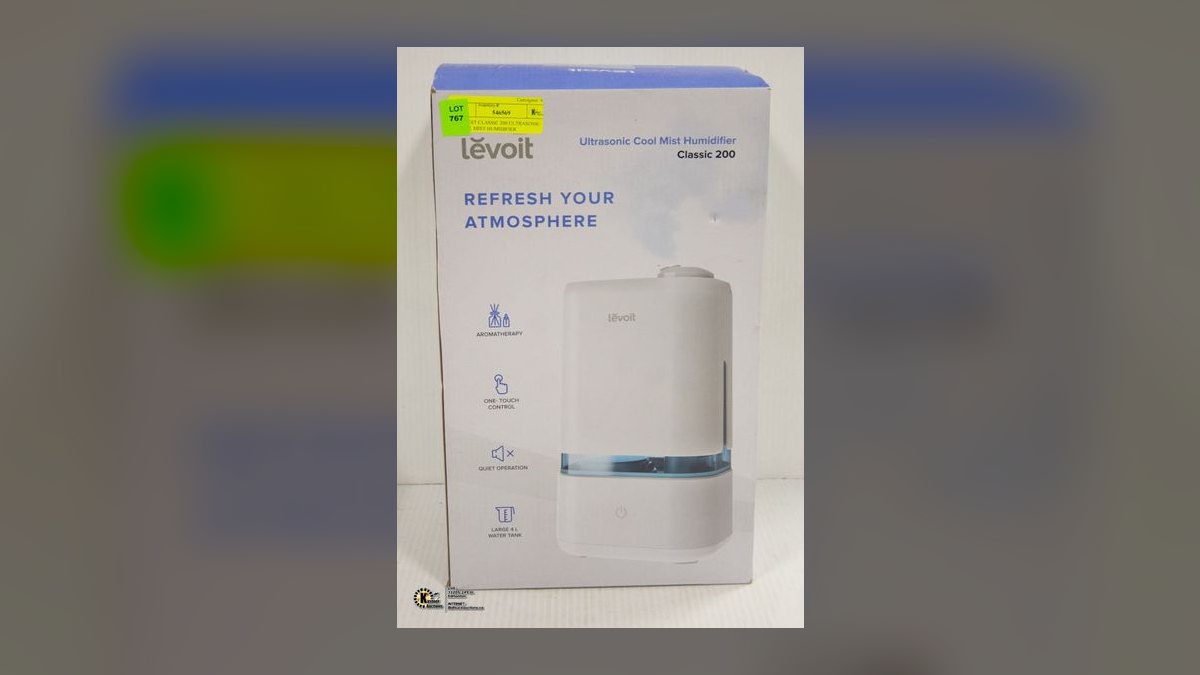
It ranks sixth and takes best value because it delivers most of the top pick's experience at roughly a third of the price. For $45 you get a 3L (0.79 gallon) ultrasonic cool-mist with 25-hour runtime, 250 sqft coverage, 26 dB operation, and a 360-degree rotating nozzle. The design is filter-free, so ongoing cost is zero, and it carries a 2-year warranty that is unusual at this price.
Buy it for a single bedroom, a dorm, or a first humidifier where you do not need whole-house reach or app control. The real trade is no built-in humidistat: a dial sets low, medium, or high, and it runs until you stop it, which makes over-humidifying easy. Pair it with a $15 hygrometer and it does what the $129 OasisMist does in a smaller room.
7TaoTronics TT-AH025
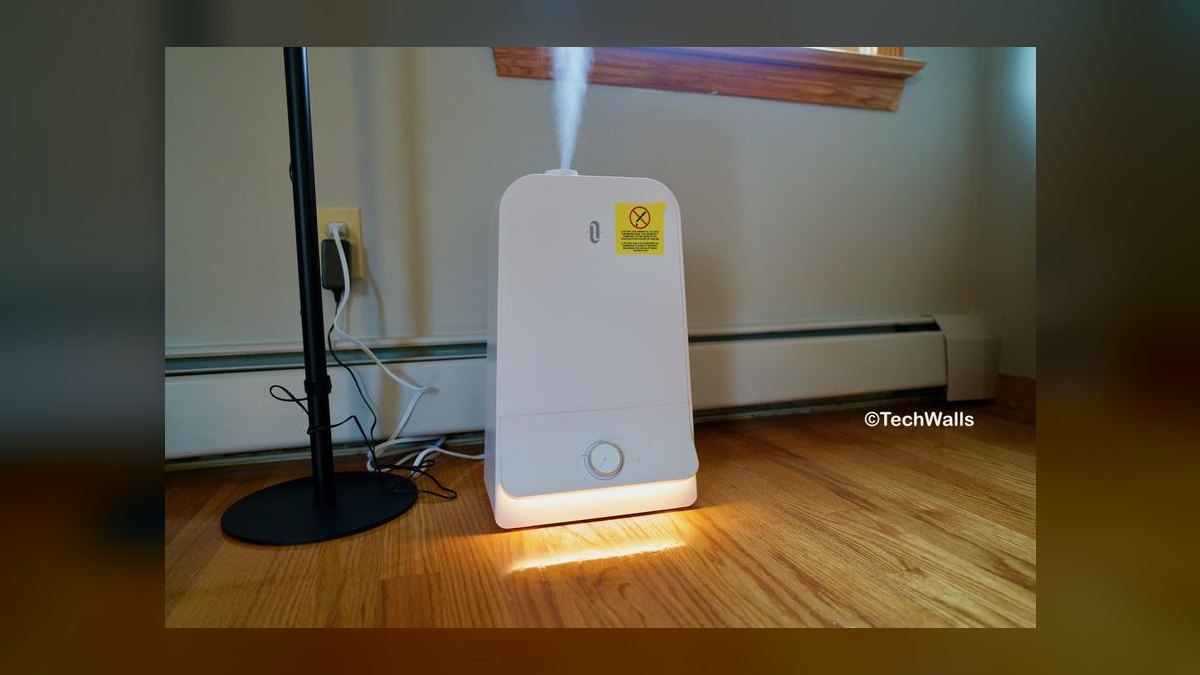
It sits seventh because it offers a larger 4L tank than the $45 Levoit Classic 200 at the same $45 price, with 30-hour runtime and 270 sqft coverage. Three mist levels, a sleep mode that dims the LEDs, and a top-fill design — rare at this price — round it out. Measured noise is about 30 dB. It is filter-free, so weekly vinegar cleaning is the only maintenance.
This suits an office desk or a secondary bedroom where a bigger tank means fewer refills. The LED humidity readout is a reference number, not a control: it does not trigger auto-shutoff, so the unit runs until you turn it off or the tank goes dry. Build is plastic but solid, and it ranks below the Classic 200 on proven durability rather than on specs.
8Pure Enrichment MistAire Studio

It lands eighth as the cheapest unit here at $35, with the specs to match: a 0.4-gallon (1.5L) ultrasonic tank, 16-hour runtime, and 160 sqft coverage. Two output modes, auto-shutoff when the tank empties, and a footprint smaller than a coffee mug. It measures near-silent at 27 dB and carries a 5-year warranty — the most generous in the budget tier, backed by a real customer service line rather than an email form.
Buy it for a nightstand, a desk in a cube farm, or a kid's room where the budget is under $40. The tank is the trade: expect a daily refill, and do not expect it to move humidity in a 300 sqft bedroom. For $10 more the Levoit Classic 200 nearly doubles the tank and adds 90 sqft of coverage.
9Crane Drop EE-5301
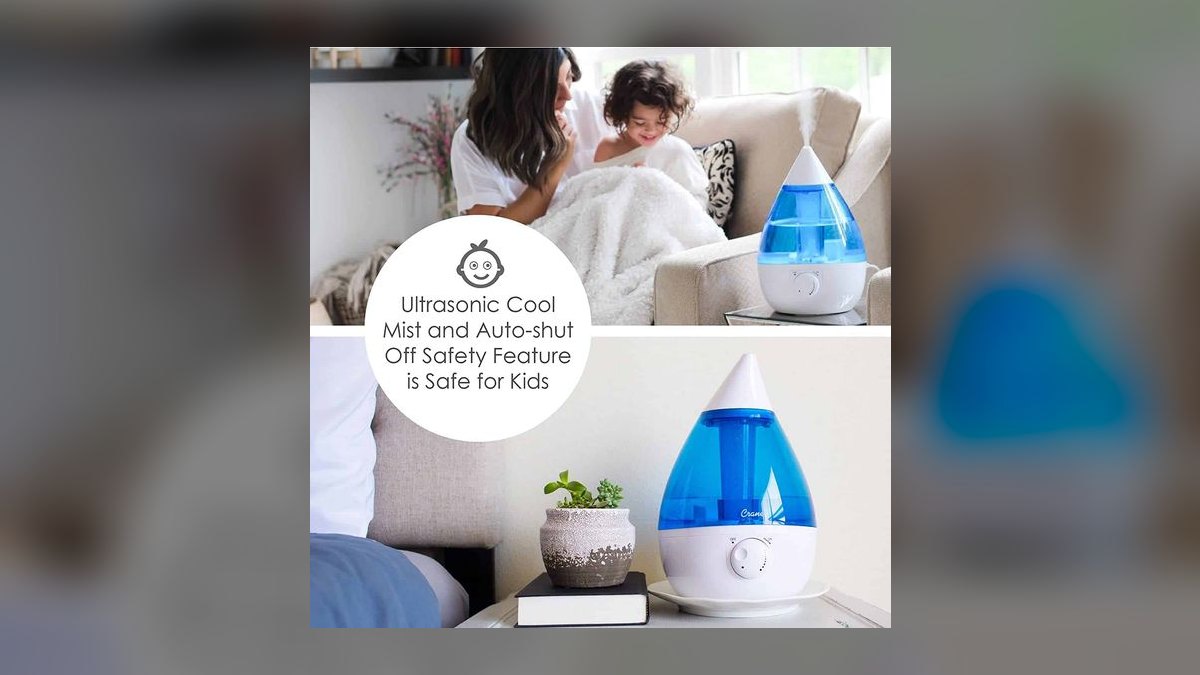
It ranks ninth on a narrow specialty rather than broad performance: it has been the default pediatrician-recommended nursery unit for over 15 years. The 1-gallon cool-mist tank runs 24 hours, covers 500 sqft, and outputs about 2.1 gallons per day for $55. Cool mist is what the AAP recommends for children because warm-mist units carry a burn risk. The tank uses antimicrobial plastic and needs no filter.
This is for a nursery or a kid's room where shape and finish matter — the teardrop body has no sharp edges and comes in more than ten colors plus animal variants. Control is a single output dial with no humidistat, which makes pushing a small nursery past the 50% RH ceiling easy. The $45 Vicks below covers less area but adds a medicated-vapor slot.
10Vicks V745A Filter-Free
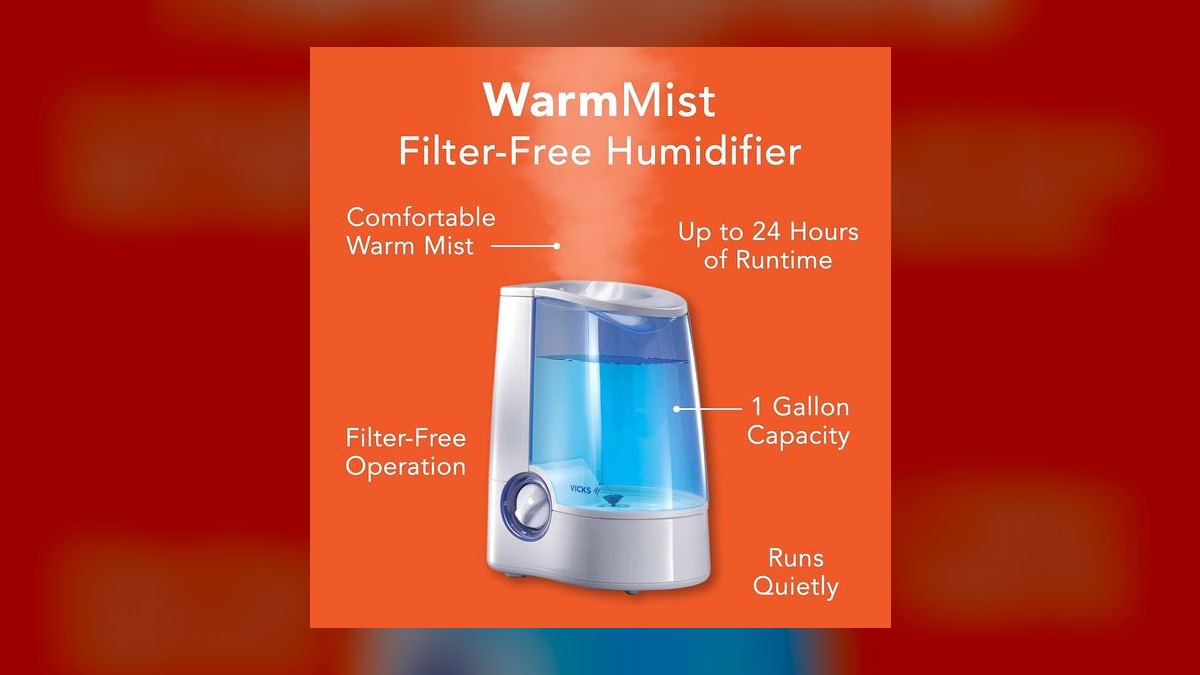
It ranks tenth because it is built for a season, not a year: a $45 1-gallon filter-free cool-mist unit with a dedicated VapoSteam pad slot that releases menthol vapor for congestion relief. Coverage is 400 sqft with 30 hours of runtime on low, and it is quiet enough to sleep beside. Mayo Clinic and CDC both note cool-mist humidification reduces nasal congestion severity during colds and flu.
Buy it as the sick-day unit you pull out in January, not the one that runs from October to April. Build is basic plastic, though a 3-year warranty backs it and VapoPads are stocked at any drugstore. The Crane Drop above costs $10 more and covers 100 sqft more, but has no medicated-vapor slot and no everyday-versus-seasonal distinction.
How we ranked these
We scored ten humidifiers on measured coverage (sqft), tank capacity, runtime, output in gallons per day, noise in decibels, humidistat accuracy against a reference hygrometer, cleaning effort, and consumable cost. Performance carried 30% of the weight, health and antimicrobial design 20%, cleaning ease and filter cost 15%, humidistat and smart accuracy 15%, noise 10%, and build plus warranty 10%.
We deliberately ignored ionizer claims, essential-oil diffuser trays, and color-changing night lights — none of them affect whether a room reaches 30-50% relative humidity. We discounted app features that dropped connection within a month of testing, and we ignored "antimicrobial plastic" language on budget tanks because it does not replace weekly vinegar cleaning. Aesthetics only counted where shape affected nursery safety.
What to look for
The real fork is ultrasonic versus evaporative. Ultrasonic runs near-silent at 26-28 dB and costs less, but aerosolizes tap-water minerals as white dust, so it demands distilled water at roughly a dollar a gallon. Evaporative units like the Honeywell HEV685W and Vornado Evap40 physically cannot emit dust, tolerate hard water, and cost $8 wicks every one to three months, but their fans hit 42-48 dB on high.
The common mistake is trusting the built-in humidistat. Cheap units read 10 points off, so buyers over-humidify past 50% and grow dust mites and mold instead of fixing dryness. Buy a $15 standalone hygrometer and let it be the truth. The second mistake is skipping weekly full-disassembly cleaning — tank biofilm is what turns a humidifier into a respiratory hazard.
Related questions
What is the ideal indoor humidity level in winter?
Target 30-50% relative humidity. Below 30%, mucous membranes dry out, static builds, hardwood floors and trim can crack, and airborne viruses survive longer. Above 50%, dust mites and mold thrive on the extra moisture. The EPA and Mayo Clinic both land on this band. A $15 hygrometer placed away from the mist stream tells you where you actually are.
Why does my humidifier leave white dust on furniture?
That is aerosolized mineral content from tap water, and it only happens with ultrasonic models. The vibrating disc atomizes water and everything dissolved in it, so calcium and magnesium land on nearby surfaces. Switching to distilled water eliminates it, as does a demineralization cartridge. Evaporative units such as the Honeywell HEV685W or Vornado Evap40 cannot produce it at all.
Is cool mist or warm mist better for a baby's room?
Cool mist. The American Academy of Pediatrics recommends it over warm mist for children because warm-mist units hold near-boiling water and create a burn risk if a child tips or reaches the unit. The Crane Drop at $55 is the long-standing nursery pick for exactly this reason. Warm mist does raise room temperature slightly and kills more waterborne bacteria in the tank.
How often should a humidifier be cleaned?
Weekly, with full disassembly. Dump the standing water, rinse the tank, and soak it in white vinegar to break down scale and biofilm, then replace wicks or filters on the manufacturer's schedule. Skipping this is how tanks grow pink mold and bacteria that get aerosolized into the room. The Carepod is the only model here where every wetted part goes in a dishwasher.
Do whole-home humidifiers work better than portable units?
For a whole house on forced air, yes. The Aprilaire 700 mounts to the furnace plenum and pushes 18 gallons per day through existing ductwork across up to 4,200 sqft, with no tank to fill and a drum pad replaced yearly for about $25. The tradeoff is $300-500 in HVAC installation on top of the $199 unit price.
Does a humidifier actually help with a cold or congestion?
It helps symptoms, not the infection. Mayo Clinic and CDC guidance note that cool-mist humidification thins nasal secretions and reduces congestion severity during colds and flu. The Vicks V745A adds a VapoPad slot for menthol vapor, which many people find eases nighttime breathing. Keep the room in the 30-50% band; overshooting does not speed recovery and encourages mold.
What size humidifier do I need for my room?
Match coverage to square footage with headroom. Under 250 sqft, the Pure Enrichment MistAire Studio at 160 sqft covers a nightstand or desk. A standard 250-400 sqft bedroom suits the Levoit Classic 200 or Crane Drop. Above 500 sqft or open-plan, step up to the Levoit OasisMist 1000S at 753 sqft or the Vornado Evap40 at 1,000 sqft.
Are smart humidifiers with apps worth the extra money?
Only when the humidistat is accurate and the connection holds. The OasisMist 1000S justifies its $129 price because it tracks target RH within about 3 points and keeps its VeSync link, so scheduling and voice control actually function. Many competing smart units drop WiFi within weeks, leaving you with a more expensive dumb humidifier. If you will run it manually anyway, skip the premium.
FAQ
What is the best overall humidifier in 2027?
The Levoit OasisMist 1000S Smart Ultrasonic at $129. It pairs a 6L top-fill tank with 753 sqft coverage, 50-hour runtime on low, warm and cool mist, and a humidistat accurate to roughly 3 points. It runs at 28 dB in sleep mode, works with Alexa and Google Assistant, and carries a 3-year warranty — the best in this category.
What is the best budget humidifier?
The Levoit Classic 200 at $45. It delivers 3L of ultrasonic cool mist, 25 hours of runtime, 250 sqft of coverage, and 26 dB operation with a filter-free design that has no ongoing costs. You give up the app, warm mist, and a built-in humidistat, but it carries a 2-year warranty and over 120,000 Amazon reviews averaging 4.6 stars.
Do I have to use distilled water?
In an ultrasonic model, effectively yes for a bedroom. Tap water minerals get aerosolized as white dust you then breathe, and the EPA has flagged this as a respiratory concern. Distilled water runs about a dollar a gallon at any supermarket. In a living room the consequence is mostly dusty furniture. Evaporative models sidestep the question entirely and handle hard water fine.
Which humidifier is best for hard water?
The Honeywell HEV685W at $109. It is evaporative, using a fan and wick to evaporate water naturally, which means it cannot emit mineral dust no matter how hard your supply is. It covers 500 sqft from a 2.2-gallon top-fill tank with a 24-hour runtime, and a UV-C bulb sanitizes the reservoir. Wicks cost $8 and last one to three months.
How loud are humidifiers at night?
Ultrasonic models are the quiet ones — 26 to 30 dB, roughly a whisper, which is why the Levoit Classic 200 and Pure Enrichment MistAire Studio work on a nightstand. Evaporative units run a fan and land at 32 dB on low, rising to 42-48 dB on high on the Honeywell and Vornado. That upper range is fine for a living room, marginal for light sleepers.
Can a dirty humidifier make you sick?
Yes. Standing water grows biofilm and bacteria that an ultrasonic unit then aerosolizes into the air you breathe. Hypersensitivity pneumonitis from contaminated units is a real diagnosis, and Mayo Clinic guidance calls out tank biofilm as the primary vector. Weekly vinegar cleaning prevents it. The Carepod at $299 exists specifically because every wetted part is dishwasher-safe.
What is the difference between ultrasonic and evaporative?
Ultrasonic uses a vibrating disc to fling water into the air as a visible mist — silent, cheap, and mineral-dust prone. Evaporative uses a fan to pull air through a wet wick, so only pure water vapor leaves the unit and the wick traps minerals and particulate. Evaporative also self-regulates, since a humid room evaporates less. EPA guidance leans evaporative for asthma and COPD households.
Does a humidifier protect hardwood floors?
It helps meaningfully. Wood loses moisture when indoor RH drops below about 30%, which causes gapping between boards, cupping, and cracks in trim and furniture. Holding the house in the 30-50% band through the heating season prevents most of it. For a full house, the Aprilaire 700 covering 4,200 sqft is the practical answer; portable units only protect the room they sit in.
How long should a humidifier run each day?
Run it until the room reaches the target band, then let a humidistat or timer hold it. Units with accurate auto-shutoff, like the OasisMist 1000S and Honeywell HEV685W, handle this themselves. With a manual dial — the Classic 200, Crane Drop, TaoTronics — watch a standalone hygrometer for the first few days, learn how long your room takes, and set a plug timer to match.
Is a whole-home humidifier worth the installation cost?
If you have forced-air HVAC and multi-room dryness, usually yes. The Aprilaire 700 runs $199 for the unit plus $300-500 installed, then costs about $25 a year for a drum pad and nothing in daily effort. Its humidistat reads outdoor temperature and lowers the indoor target to prevent window condensation. For a single dry bedroom, a $45 portable is the smarter spend.
Sources
- https://www.epa.gov/indoor-air-quality-iaq/care-your-air-guide-indoor-air-quality
- https://www.mayoclinic.org/diseases-conditions/common-cold/in-depth/humidifiers/art-20048021
- https://www.cdc.gov/mold/php/about/index.html
- https://www.nytimes.com/wirecutter/reviews/the-best-humidifier/
- https://www.consumerreports.org/appliances/humidifiers/buying-guide/
- https://www.rtings.com/air-purifier
- https://www.aap.org/en/patient-care/
- https://www.sleepfoundation.org/bedroom-environment/humidity-and-sleep
- https://www.epa.gov/mold/mold-course-chapter-2
- https://www.aprilaire.com/whole-house-products/humidifier/700
Related on PULSE
This page will be disappearing soon. Save it to your device for $1 — or read it free while it is here.
@Kory-White- · if Venmo asks, the last 4 of my number are 2012
This page is gone.
This one is off the shelf now. $1 keeps it on your phone for good — the whole page, pictures and diagrams included.
 pulse-reviewsTop 10 Noise-Cancelling Headphones for Sales Reps on Phone Calls in 2027
 pulse-reviewsTop 10 Posture Correctors — Best Overall + Best Value in 2027
 pulse-reviewsTop 10 Foldable Phones — Best Overall + Best Value in 2027
 pulse-reviewsTop 10 NVMe SSD Enclosures — Best Overall + Best Value in 2027
 pulse-reviewsTop 10 Premium Travel Coffee Mugs for Sales Reps in 2027
 pulse-reviewsTop 10 Shop Vacuums — Best Overall + Best Value in 2027
 pulse-reviewsTop 10 Smart Microwaves — Best Overall + Best Value in 2027
 pulse-reviewsTop 10 RV Surge Protectors — Best Overall + Best Value in 2027
 pulse-reviewsTop 10 Clothes Steamers — Best Overall + Best Value in 2027
 pulse-reviewsTop 10 Spot Welders — Best Overall + Best Value in 2027