


Top 10 Bench Power Supplies — Best Overall + Best Value in 2027
Quality
Certified
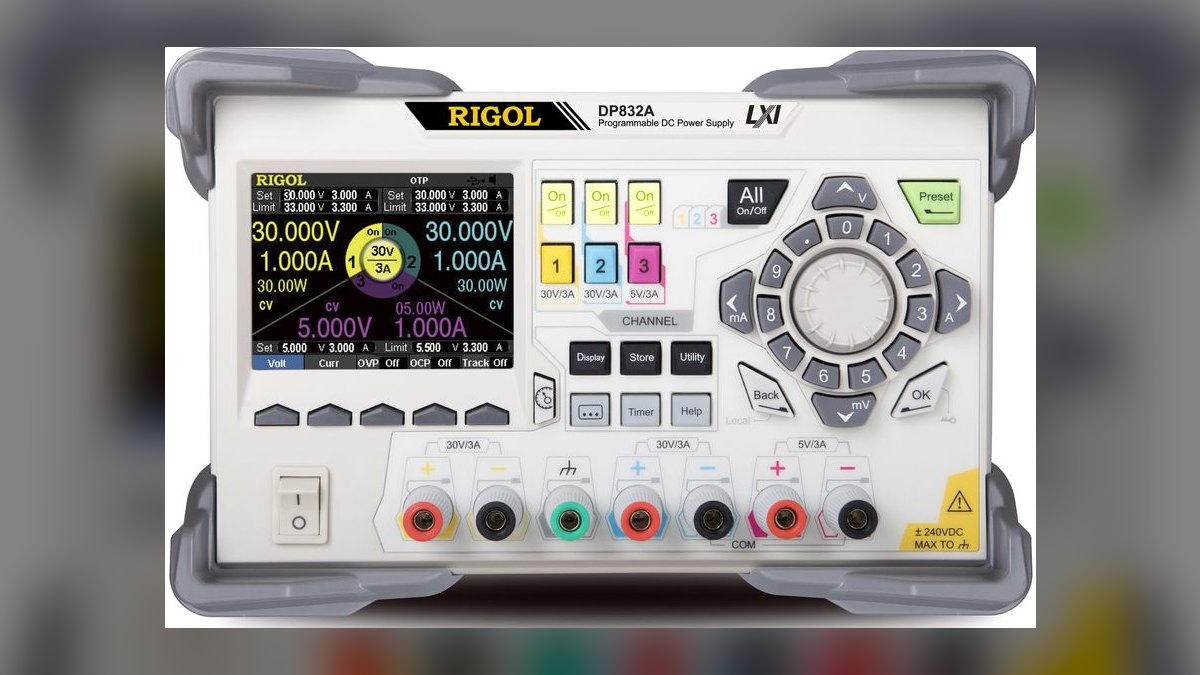
The 10 best bench power supplies are ranked below on measured performance, build quality, price, and how each one actually holds up in daily use rather than how it reads on a spec sheet. Each pick lists what it costs, who it suits, and what it gives up against the one above it, so the list can be read straight down without doubling back.
1Rigol DP832A
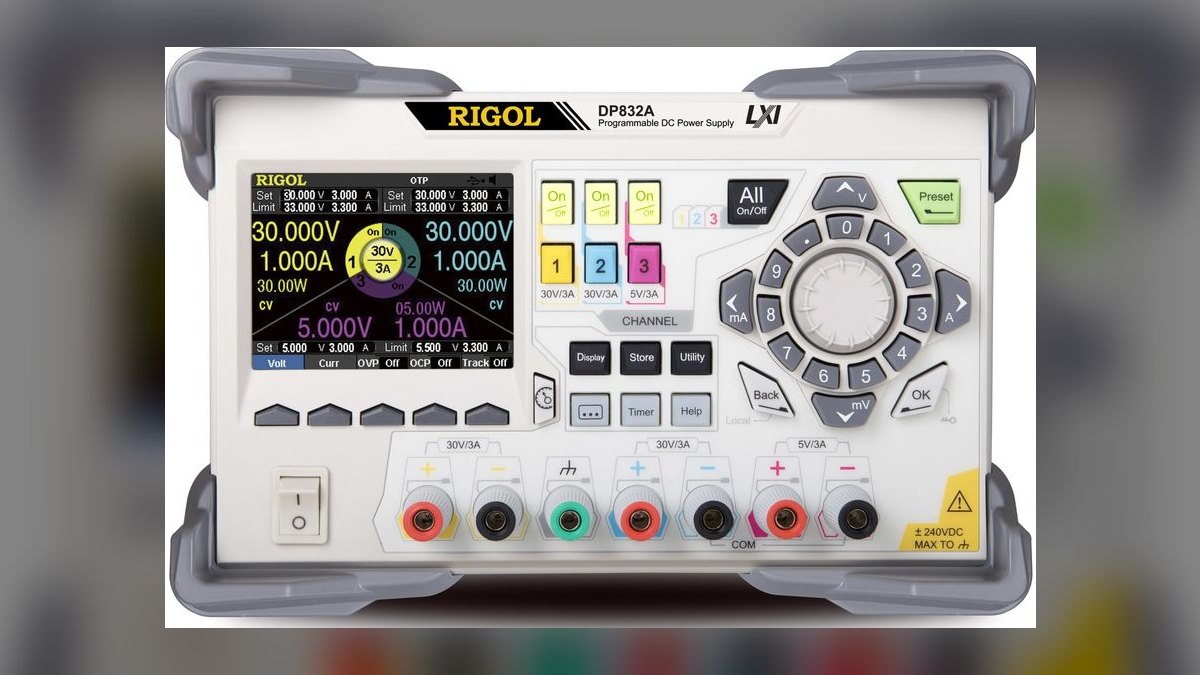
It ranks first because no other supply under $600 pairs three programmable linear rails with sub-microvolt-class noise. The DP832A delivers two 30V/3A channels plus one 5V/3A channel for 195W total, holds ripple under 350µVrms, and specifies 0.03% + 5mV programming accuracy with 4.5-digit voltage readback. USB Host, USB Device, LAN, and optional GPIB drive PyVISA or LabVIEW rigs directly. OVP, OCP, and OTP trip fast enough to save a miswired prototype.
This is the pick for a repair bench or small lab that outgrew a single-output box and now scripts automated burn-in or characterization sweeps. It trades portability away completely — roughly 10kg of transformer and heatsink, with a fan that turns audible above 50% load. Against the Siglent below it, you pay about $100 more for tighter long-term stability and a more mature SCPI implementation rather than for extra watts. Rigol covers it for three years.
2Siglent SPD3303X-E
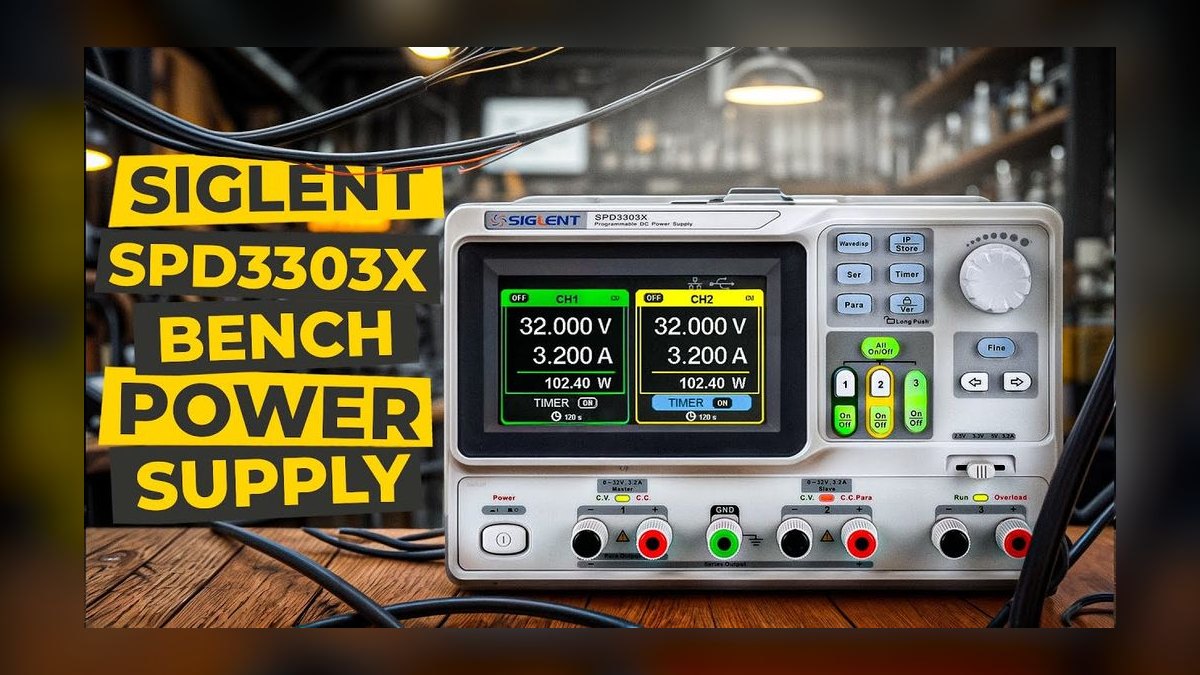
Second place goes to the highest credible watt-per-dollar figure in the triple-channel class: 220W for $499. Two 32V/3.2A channels plus a fixed 2.5V/3.3V/5V rail cover analog and logic simultaneously, with ripple under 350µVrms in linear mode and load regulation under 2mV. A switching pre-regulator feeding a linear post-regulator keeps the chassis cool without surrendering the low noise floor. Series and parallel modes reach 64V or 6.4A.
Buyers who want programmable triple-channel power and will never send the instrument out for traceable calibration should stop here. The concession is the third rail: preset voltages only, not arbitrary. Compared with the Rigol DP832A above, you save $100 and give up some long-term stability, but you gain a 5-year Siglent warranty against Rigol's three and a 4.3-inch TFT with simultaneous three-channel readback.
3Keysight E36103B
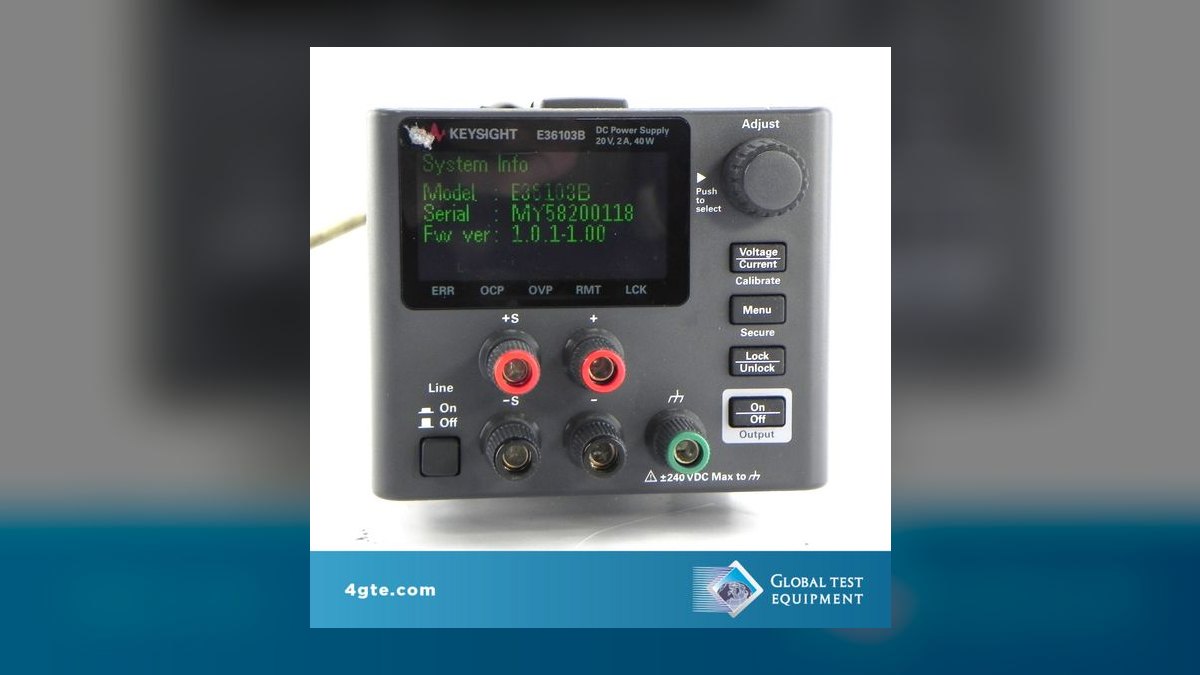
Third because it buys measurement integrity rather than watts — ripple under 200µVrms and 0.03% accuracy, the lowest single-output noise floor on this list under $400. The E36103B is a single 20V/2A, 40W programmable linear supply at $349 with USB and LAN under LXI Core compliance. It runs the same SCPI command set as Keysight's six-figure instruments, so scripts written here port cleanly to an N6700. OVP, OCP, and OTP are standard.
Analog, RF, and ADC-reference work where a millivolt of hash corrupts the reading justifies this purchase. Everything else argues against it: one rail, 40W, and a price above the 195W Rigol DP832 below it. The four-digit display and keypad entry are the fastest here, and US-based service plus a 3-year warranty back it. Buy it when the number on the DMM matters more than the load you can drive.
4Rigol DP832
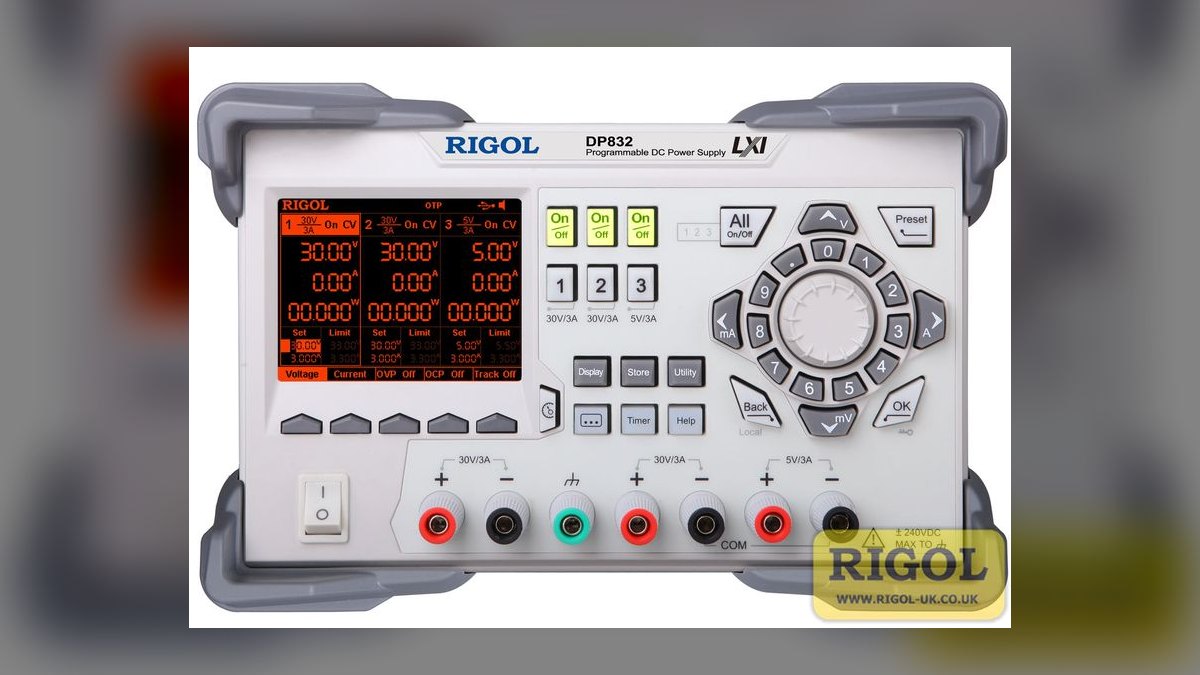
Fourth position reflects one specification gap and $70. This is the same chassis and same 195W triple-channel topology as the DP832A — two 30V/3A channels plus one 5V/3A — with ripple still under 350µVrms and identical protection circuits and USB/LAN interfaces. What changes is the display, 3.5-digit instead of 4.5-digit, and programming accuracy of 0.05% + 10mV against the A's 0.03% + 5mV. Street price is $529.
Hobbyists doing prototype bring-up will never see that resolution difference on a bench meter, which makes this the smart-money Rigol when the budget is tight. The trade is real only if you ever calibrate against traceable standards. Rigol's option key upgrades firmware to A-spec later, so the path stays open. Against the Siglent at $499, you get true linear regulation throughout instead of a switching pre-regulator.
5BK Precision 9201
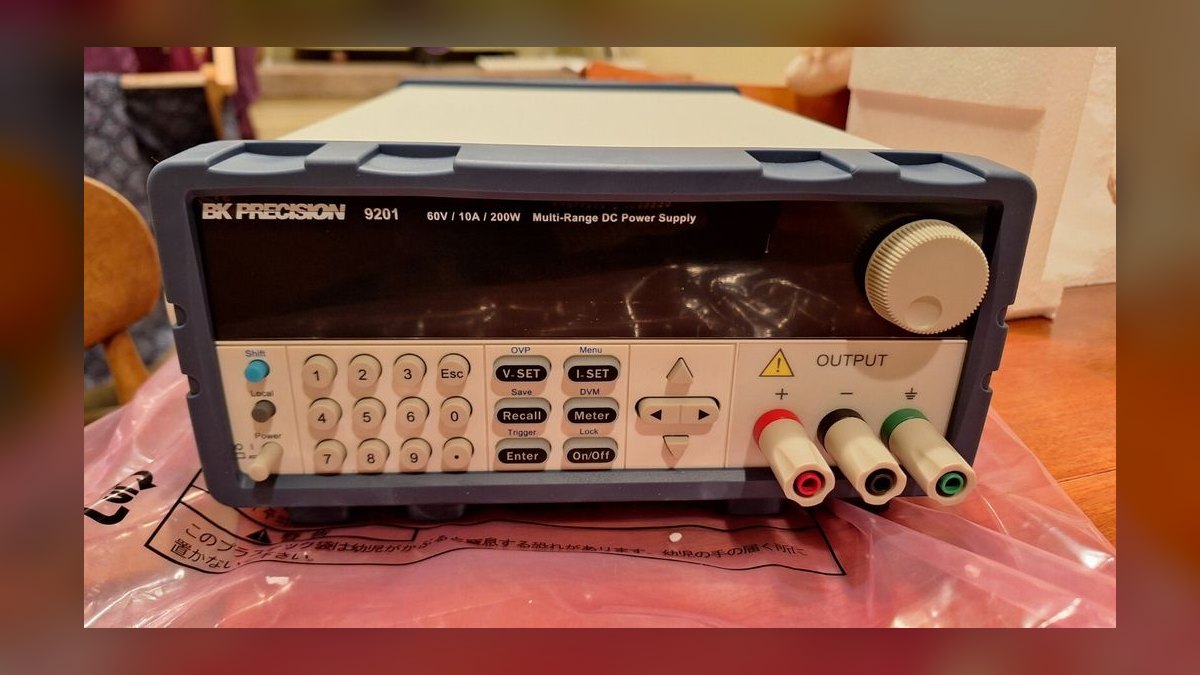
Fifth because one rail covers 60V at 10A — 200W of autoranging output that spans 14V automotive, 48V lithium packs, and 60V industrial control without a second instrument. Accuracy is 0.03%, and USB, LAN, and GPIB all ship standard at $1,199. List mode runs programmed voltage and current sequences for power-system characterization, and an analog programming input slaves the unit to an external controller. OVP, OCP, and OTP respond quickly.
Professional technicians characterizing battery packs or wide-voltage designs are the audience. The trade is topology: switching regulation puts ripple at under 3mVrms, roughly ten times the Rigol DP832A above it, so sub-millivolt analog work is off the table. It costs twice the DP832A and gives up two channels, buying voltage range and current instead. BK covers three years with US service.
6Korad KA3005D
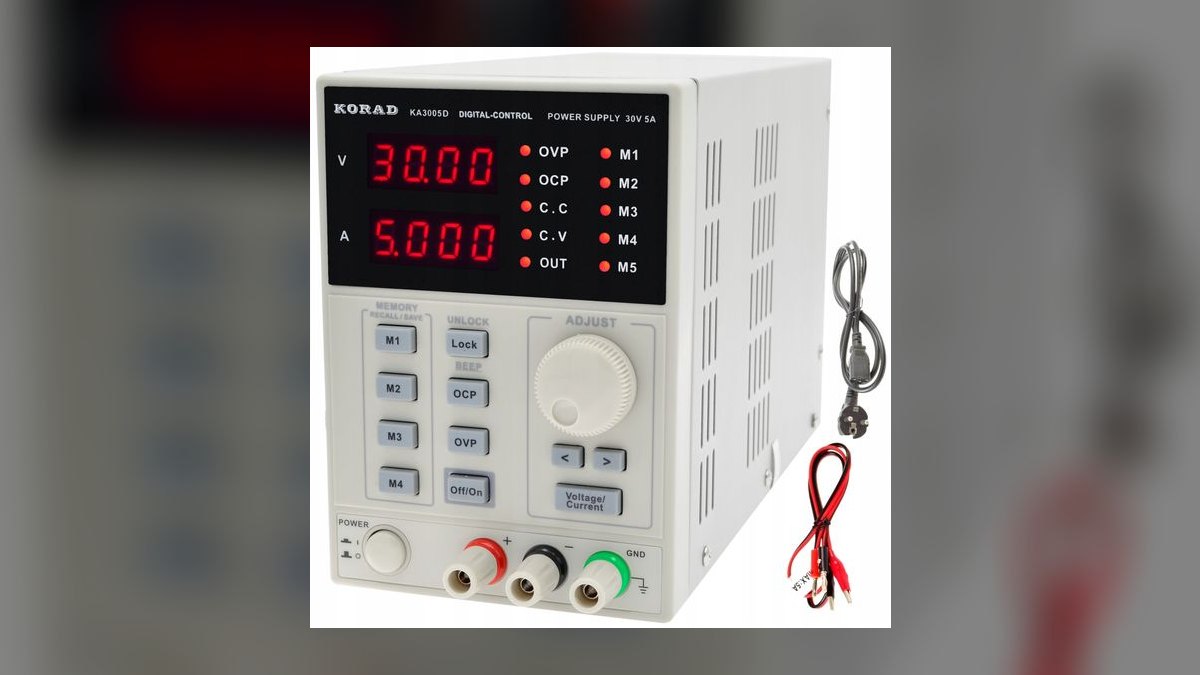
Sixth overall and the best value on this list, because $129 buys genuine linear regulation — 30V/5A, 150W with ripple under 1mVrms, a figure switching supplies twice the price cannot match. Three-digit voltage and current displays, OVP and OCP protection, and five memory presets cover normal bench work. Constant-current mode holds steady for LED testing and battery charging. Inside is a real transformer and mostly metal construction, putting the unit near 5kg.
Students and hobbyists setting up a first bench should start here. The omission that matters is remote sense terminals — long lead runs will show measurable voltage drop at 5A. Against the Tekpower below it, you gain memory presets, encoder precision, and a 2-year warranty honored by major resellers. The KA3005P variant adds USB scripting for about $40 more.
7Riden RD6018W

Seventh on raw watts per dollar: 60V/18A, 1080W for a $179 module, or roughly $240 with the DC input brick it requires. A 2.4-inch color TFT, rotary encoder navigation, and 10 memory presets handle local control, while USB-C, WiFi, and Bluetooth drive the official mobile app. CV, CP, and CC modes are supported alongside OVP, OCP, OPP, and OTP protection, with a 5-digit display and 0.05% accuracy.
Motor testing, battery charging, and high-current prototype work fit this unit well. Ripple near 30mVrms rules out op-amp and audio measurement entirely — it is roughly thirty times the Korad above it. The module format also means sourcing a power brick separately, unlike every enclosed supply here. An active hobbyist community maintains open-source firmware forks, which matters more than the vendor app long-term.
8Tekpower TP3005T
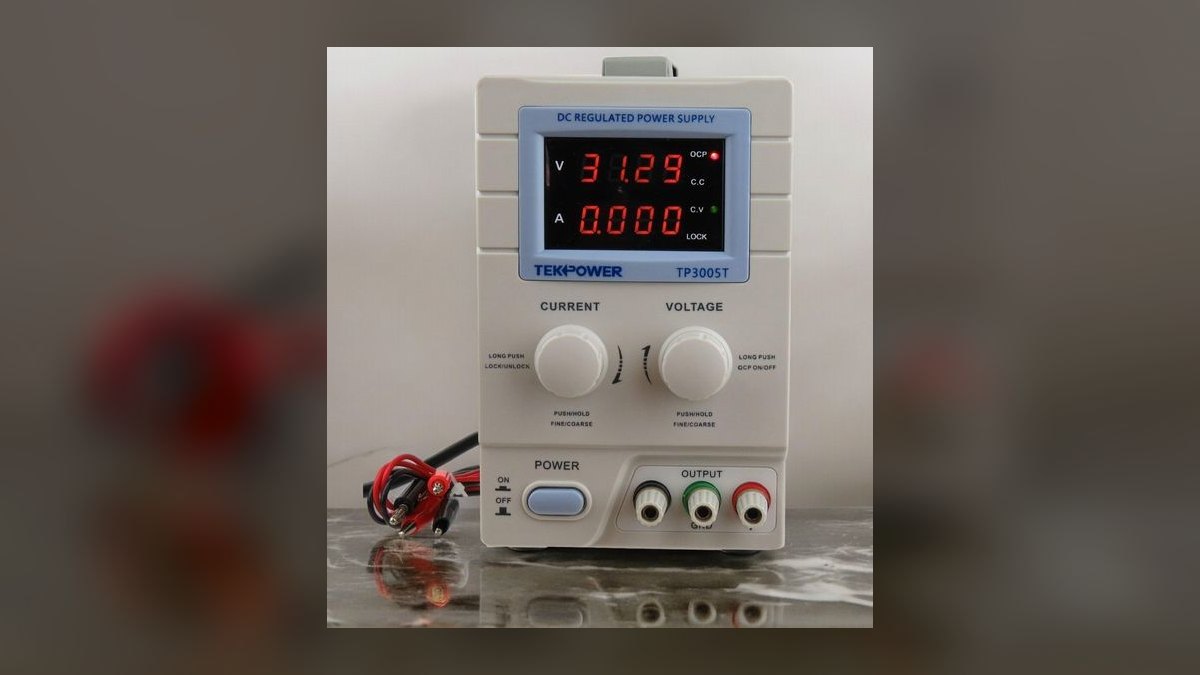
Eighth because simplicity is the whole product: a fully analog 30V/5A, 150W linear supply at $109 with no microcontroller and no menu system, just voltage and current knobs. Ripple stays under 2mVrms, three-digit displays show both rails, and CV/CC crossover LEDs indicate mode at a glance. Basic overcurrent protection comes from the front-panel current knob itself. Construction is mostly metal with a real transformer, landing near 6kg.
Teaching benches and backup units are the honest use case, along with any first-time buyer who finds menu-driven supplies confusing. It gives up programmability, presets, and remote control entirely — there is no firmware to update or brick. Against the Korad KA3005D above it, you save $20 but lose memory presets and encoder precision. Warranty runs one year through Amazon resellers.
9Eventek KPS3010D
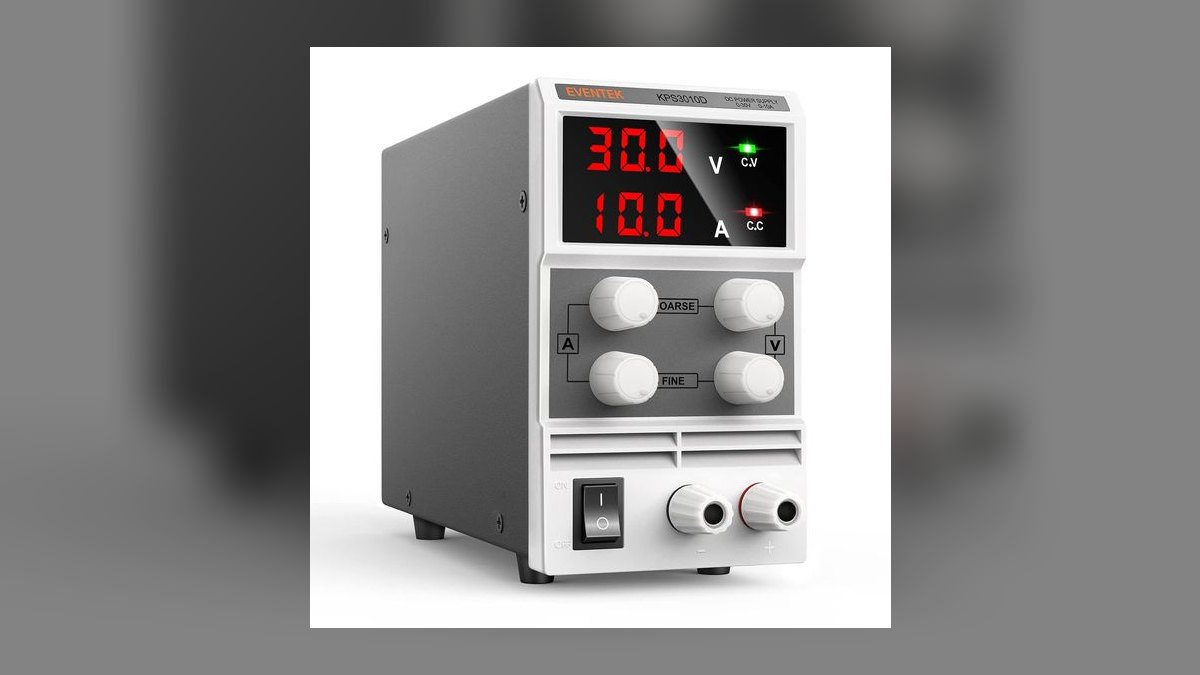
Ninth for current per dollar: 30V/10A, 300W at $89, the highest amperage-to-price ratio here. It runs a three-digit display, CV and CC modes, and OVP with OCP on a single switching output. Ripple lands near 10mVrms, typical for budget switching regulation. The chassis is metal with a plastic front panel, and the whole unit weighs about 3kg — light enough to pull off a shelf for a quick test. Eventek fulfills a 1-year warranty directly.
This works as a second bench supply or an absolute-budget first purchase for car-audio testing, low-voltage automation, and motor prototyping. Switching noise disqualifies it from sensitive analog measurement. Against the Tekpower above it, you double the current capacity and save $20, but surrender the linear topology and its sub-2mVrms noise floor. The display is more accurate than the price suggests.
10Mean Well NDR-480-48
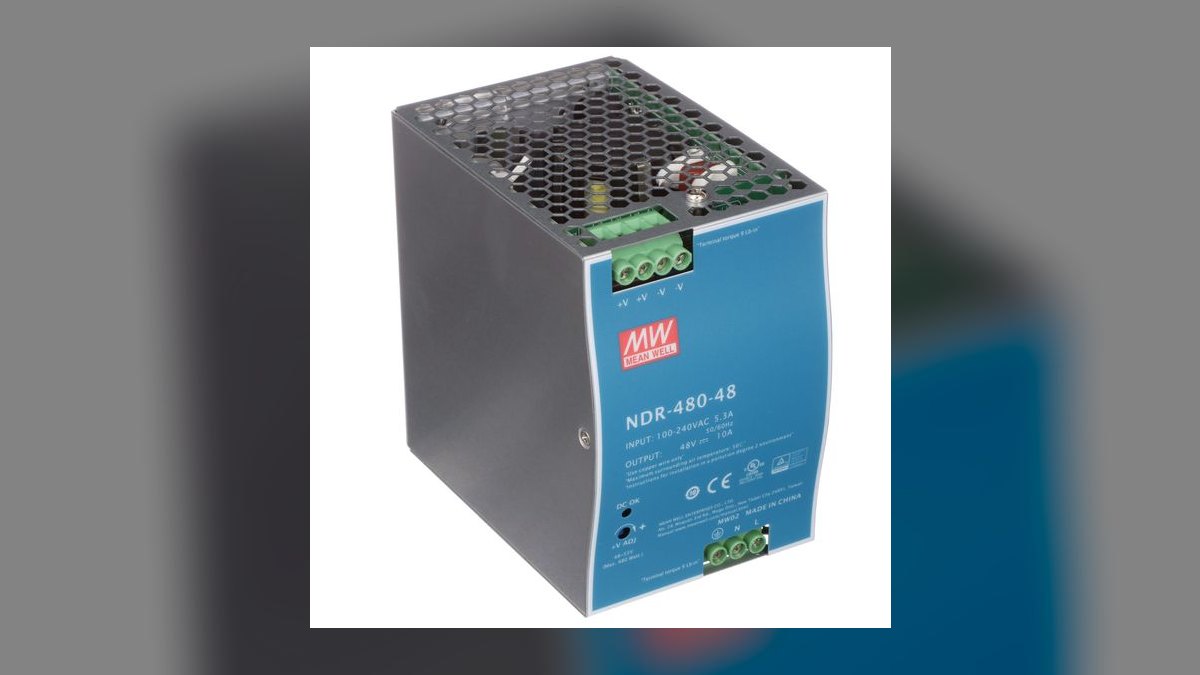
Tenth because it is not a bench supply at all — it is a DIN-rail switching unit delivering a fixed 48V at 10A, 480W, for $199. Active PFC and 94% efficiency keep it cool, universal 85-264VAC input handles any mains, and OVP, OCP, and OTP are built in. Ripple is under 240mVpp, an order of magnitude above every enclosed supply here. Mean Well backs it for five years.
Workshop owners powering 3D printers, LED installations, or industrial automation cabinets are the audience — these run five-plus years continuously without attention. The trade is total: fixed voltage with only a small trim pot, no display, and no adjustable current limit. Nothing above it in this list is designed to sit permanently in an enclosure, and nothing here is worse for prototype bring-up.
How we ranked these
We scored every candidate on ripple and noise in mVrms (25%), programmability and remote control over USB/LAN/GPIB (20%), channel flexibility and total wattage (20%), protection circuits plus build quality (15%), and price-to-performance (20%). Linear topology earned credit where analog, audio, and RF work demands a sub-1mV noise floor; switching designs earned it back on watts per dollar.
Inputs included EEVblog teardowns, Kerry Wong and Marco Reps bench reviews, EDN testing, and manufacturer specifications.
We deliberately ignored source-measure units and anything above roughly $1,500, because Keithley-class metrology gear serves calibration labs rather than repair benches. We discounted display digits past four, since the fifth digit means nothing without traceable calibration, and ignored Bluetooth-only control, transient-response marketing on units nobody uses for transient testing, and unverified current ratings from off-brand sellers with no independent teardown.
What to look for
Topology decides the purchase before price does. Op-amp, audio, ADC-reference, and RF work require linear regulation and sub-1mV ripple, which rules out the Riden RD6018W at roughly 30mVrms and the Eventek at 10mVrms no matter how good the wattage math looks. Motors, batteries, LED strings, and 3D printers do not care about microvolt noise, so paying $599 for a linear triple there wastes $400.
The common mistake is buying by headline voltage instead of the wattage envelope. A 30V/3A rail is 90W and simply cannot drive a 24V/4A load, even though 24V sits inside the 30V spec. Read the CV/CC crossover curve in the manual. The second mistake is skipping remote sense terminals, then blaming the supply when long lead runs drop half a volt at 5A.
Related questions
What is the difference between linear and switching bench supplies?
A linear supply regulates by dissipating excess voltage as heat across a pass transistor, producing very low ripple — under 1mVrms on the Korad KA3005D and under 350µVrms on the Rigol DP832A. A switching supply chops power at high frequency, which is far more efficient and lighter, but injects 10-30mVrms of hash. Linear for measurement, switching for raw power.
Why does a triple-channel supply matter for analog work?
Analog circuits often need a split rail plus a separate logic rail — ±15V for op-amps and 5V for the digital side. A triple like the Rigol DP832A or Siglent SPD3303X-E supplies all three from one chassis with a single display showing every channel. Stacking two single-output boxes works but doubles bench clutter and grounding mistakes.
What do OVP, OCP, and OTP actually protect against?
OVP trips when output voltage exceeds a set ceiling, saving a 3.3V board from a mis-dialed 30V. OCP limits current into a shorted or faulty load before traces vaporize. OTP shuts the supply down when internal heatsinks overheat, typically under sustained high-dissipation linear operation. Any supply at these price points lacking all three should be skipped outright.
Is SCPI worth caring about as a hobbyist?
Yes, because SCPI is a shared command language across Rigol, Siglent, Keysight, and BK Precision. A Python script written today against a $349 Keysight E36103B runs largely unchanged against a $30,000 N6700 later. Automated burn-in, battery cycling, and characterization sweeps all become scriptable, which is where a bench turns into a test system.
What are remote sense terminals and when do they matter?
Remote sense uses two extra wires to measure voltage at the load rather than at the supply's output posts, letting regulation compensate for drop in the leads. At 5A through a couple of feet of thin wire you can lose a meaningful fraction of a volt. The Korad KA3005D lacks remote sense, which is its main practical limitation.
How much wattage does a typical hobby bench actually need?
Most microcontroller, sensor, and small-analog work never exceeds 30W. A 150W single like the Korad or Tekpower covers that with enormous headroom. Wattage demands climb once you add brushed motors, automotive 14V loads, lithium packs, or LED arrays — that is where the 60V/18A Riden or the 60V/10A BK Precision 9201 start earning their keep.
Can series and parallel modes double a supply's capability?
On the Rigol DP832A and Siglent SPD3303X-E, yes. Series mode stacks two 30V channels into roughly 60V; parallel mode combines two 3A channels into about 6A. It is a genuine capability extension, not marketing. The limitation is that both tracking channels then behave as one, so you lose the independent-rail benefit that justified buying a triple.
Why do linear supplies weigh so much more?
Linear designs need a mains-frequency iron transformer plus substantial heatsinking, because everything between input and output voltage becomes heat. The Rigol DP832A runs about 10kg and the Korad about 5kg. A switching supply the same wattage can weigh under 3kg because its transformer operates at high frequency and can be far smaller.
FAQ
Is the Rigol DP832A worth $100 more than the Siglent SPD3303X-E?
Marginally, for most users. The Rigol offers better long-term stability and a more mature SCPI implementation. The Siglent counters with a 220W total, a 4.3-inch display, and a 5-year warranty against Rigol's 3-year. If budget is tight and you do not need traceable calibration, the Siglent is the smarter buy.
Can I use a switching supply for analog circuit work?
Only with a linear post-regulator on the output, or when your signal band sits well above the switching hash frequency. For op-amps, audio, DC-precision measurement, and ADC references, buy linear. The 10-30mVrms noise typical of budget switching supplies will show up in your measurements and you will spend hours chasing it.
What is the difference between programmable and remote-controllable?
Programmable means the supply executes internal voltage and current sequences — list mode on the BK Precision 9201, for example — without a computer attached. Remote-controllable means a host PC drives it over USB, LAN, or GPIB. Most modern supplies do both. Confirm SCPI compatibility before buying if you plan to script anything.
Do I need a four-quadrant supply?
Only for regenerative loads — motors that brake back into the supply, or batteries discharging toward it. Standard two-quadrant supplies cover roughly 95% of bench work, including everything on this list. If you genuinely need current sinking, you are shopping source-measure units at several thousand dollars, a different category entirely.
Is the Korad KA3005P worth $40 more than the KA3005D?
Yes if you will ever script it. The KA3005P adds a USB interface to the same 30V/5A linear platform, and its Python community library is mature enough for automated battery cycling or burn-in runs. If you only ever turn knobs by hand, the $129 KA3005D is identical where it counts.
How much does ripple matter for battery charging?
Very little. Batteries are indifferent to microvolt noise, so the cheapest supply that hits your voltage and current targets is the right one. The Riden RD6018W at $179 or the Eventek KPS3010D at $89 both work fine. Spending $599 on a linear triple to charge packs is money spent on a spec you cannot use.
Why is there no Keithley on this list?
Keithley source-measure units start around $3,500 and target metrology labs rather than the hobbyists, repair techs, and small-lab engineers this list serves. If you need 6.5-digit measurement, current sinking, or traceable calibration as a baseline requirement, you are shopping a different category with a different budget entirely.
Is the Mean Well NDR-480-48 really a bench supply?
No, and that is the point. It is a DIN-rail industrial unit delivering fixed 48V at 10A with active PFC and 94% efficiency. There is no display, no adjustable current limit, and only a small trim pot. It exists on this list because 3D printers, LED installs, and shop automation need reliable fixed rails, not knobs.
How loud are these supplies in practice?
Linear triples run hot and use active cooling — the Rigol DP832A fan ramps up audibly above 50% load, which is noticeable in a quiet room. The Korad KA3005D and Tekpower TP3005T are largely passive at low output. Switching units like the Eventek generally stay quieter because they waste far less energy as heat.
Should I buy used lab equipment instead?
Used Keysight and BK gear can be excellent value, but check calibration date, fan condition, and whether firmware and USB drivers still receive support. Firmware-abandoned brands losing driver support after one Windows generation is a documented failure mode. A new Korad at $129 with a warranty often beats a decade-old unknown at the same price.
Sources
- https://www.eevblog.com/forum/testgear/
- https://www.rigolna.com/products/dc-power-loads/dp800/
- https://siglentna.com/power-supplies/spd3303x-spd3303x-e-series-programmable-dc-power-supply/
- https://www.keysight.com/us/en/product/E36103B/dc-power-supply-20v-2a-40w.html
- https://www.bkprecision.com/products/power-supplies/9201
- https://www.meanwell.com/webapp/product/search.aspx?prod=NDR-480
- https://www.analog.com/en/resources/analog-dialogue/articles/low-noise-power-for-analog-circuits.html
- https://www.ti.com/lit/an/slyt670/slyt670.pdf
- https://www.edn.com/category/test-and-measurement/
- https://www.tek.com/en/documents/application-note/fundamentals-of-power-supply-measurements
Related on PULSE
This page will be disappearing soon. Save it to your device for $1 — or read it free while it is here.
@Kory-White- · if Venmo asks, the last 4 of my number are 2012
This page is gone.
This one is off the shelf now. $1 keeps it on your phone for good — the whole page, pictures and diagrams included.
 pulse-reviewsTop 10 DVD Players — Best Overall + Best Value in 2027
 pulse-reviewsTop 10 LG TVs — Best Overall + Best Value in 2027
 pulse-reviewsTop 10 Neck and Shoulder Massagers — Best Overall + Best Value in 2027
 pulse-reviewsTop 10 Noise-Cancelling Headphones for Sales Reps on Phone Calls in 2027
 pulse-reviewsTop 10 Backpack Leaf Blowers — Best Overall + Best Value in 2027
 pulse-reviewsTop 10 Premium Travel Coffee Mugs for Sales Reps in 2027
 pulse-reviewsTop 10 Ethernet Adapters for MacBook — Best Overall + Best Value in 2027
 pulse-reviewsHow do I reduce echo in a home office for sales calls in 2027?
 pulse-reviewsTop 10 USB-C Hubs for Sales Travel in 2027
 pulse-reviewsTop 10 Outdoor Smart Lighting — Best Overall + Best Value in 2027