


How do you build a population health platforms (Arcadia / Innovaccer) go-to-market motion in 2027?
Quality
Certified
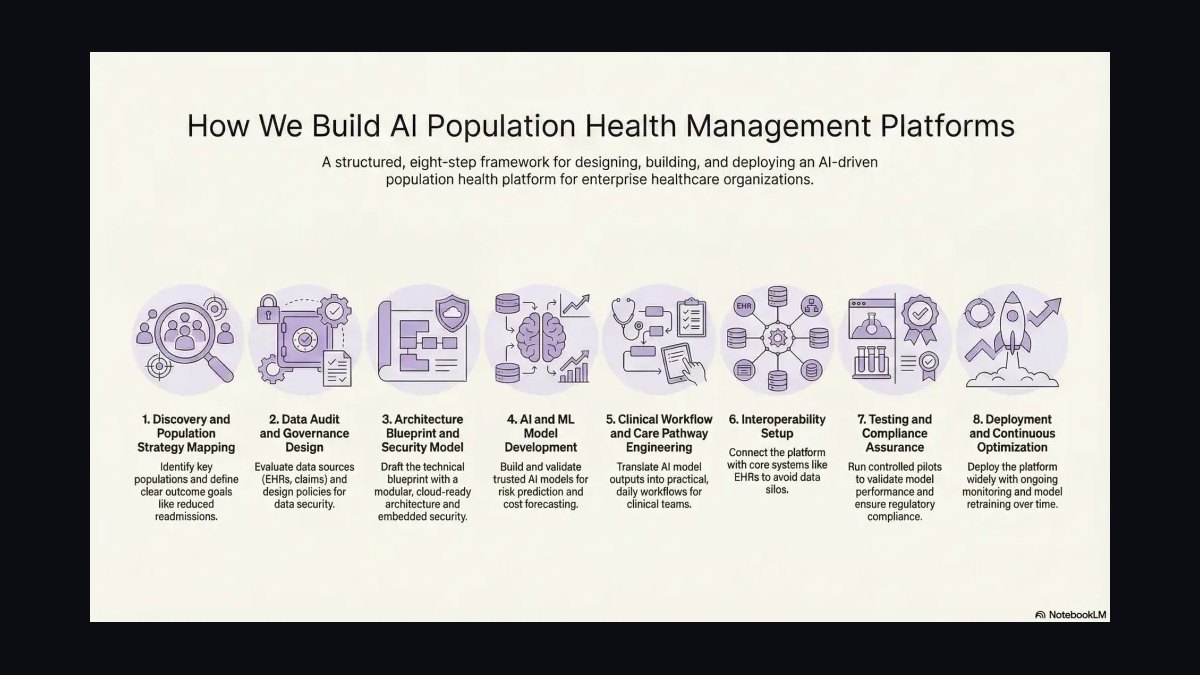
Sell population health platforms in 2027 through a Chief Population Health Officer-led committee, price per-member-per-month, and prove value with a 90-day pilot on one risk-bearing panel. Motion shape changes by company stage: founder-led niche wedge early, partner-led EHR co-sell at scale, enterprise field coverage last.
What changes by company stage
The single biggest mistake in this category is copying Arcadia's or Innovaccer's go-to-market when you have eleven customers. Those companies sell top-down into integrated delivery networks and national payers because they have a decade of reference logos, EHR certifications, and the balance sheet to survive an eighteen-month enterprise cycle. A seed-stage company that opens with "we're the data platform for value-based care" is competing on exactly the axis where the incumbent's install base is the product. The stage variable that matters is not headcount or funding — it's whether you can survive a sales cycle longer than your runway divided by your burn.
At the earliest stage, the constraint is proof. You have no attributable savings history, no HEDIS lift you can point to across a cohort, and no CIO who will vouch that your FHIR ingestion didn't break their interface engine. Everything about the motion has to be organized around manufacturing that proof as fast as possible on the smallest population that still generates statistically meaningful signal. That usually means a single independent physician association, a small ACO, or one line of business inside a regional plan — a panel measured in tens of thousands of attributed lives, not hundreds of thousands. The deal is small. The reference is the actual product you're building.

At the middle stage — call it the point where you have somewhere between fifteen and sixty customers and a repeatable implementation — the constraint flips from proof to distribution. You can prove the thing works. You cannot find enough buyers fast enough, because population health buying is concentrated: a few hundred health systems, a few dozen national and regional payers, and a long tail of ACO participants who mostly buy through an enabler rather than directly. This is the stage where partner-led motion stops being a nice-to-have and becomes the majority of your pipeline. The ACO enablers, the EHR marketplaces, the regional Blues plans pushing tooling down to their contracted provider groups — these are the distribution channels that exist in this market, and they are not optional.
At the late stage, the constraint becomes displacement. Every account worth having already has something: a homegrown data warehouse built on a cloud data platform, an incumbent population health vendor on a three-year renewal, an EHR vendor's native registry module bundled at effectively zero marginal cost, or a payer-supplied portal the health system tolerates because the payer pays for it. You are no longer selling into whitespace. You're selling a switch, and the switching cost is measured in data migration, retraining care management staff, and re-validating quality measure logic against submitted-and-accepted results. Late-stage motion is about de-risking that switch, not about explaining what population health analytics does.
There's an adjacent pattern worth naming here because it shows up in almost every healthcare data category — risk adjustment vendors, care management platforms, interoperability layers, SDOH referral networks, clinical trial site-matching tools. The stage progression is the same: prove on a narrow panel, distribute through whoever already touches the buyer, then displace. What differs is where the money sits. In population health specifically the money sits in contract performance — shared savings, risk-adjusted revenue, quality bonus — which means your buyer can, in principle, pay you out of the upside you create. That's an unusual and underused structural advantage, and stage determines whether you can credibly ask for it.
Stage-by-stage playbook

Stage one: the wedge, roughly zero to fifteen customers. Pick one contract type and one data problem. Not "population health" — something like "HCC recapture for Medicare Advantage panels under twenty thousand lives" or "post-acute leakage visibility for bundled-payment episodes." Founder sells every deal. There is no SDR, no marketing hire, no partner manager. The founder's job in this stage is not closing revenue; it's producing three referenceable customers who will get on a call with a prospect and describe a specific number that moved.
Structure those first deals to survive scrutiny. Price them low enough that they clear without a formal RFP — in most health systems and provider groups there is a signature threshold below which a service line leader or medical director can approve without procurement, finance committee, and legal all weighing in simultaneously. Find that threshold and price under it deliberately for the first cohort. A smaller first contract that closes in six weeks is worth more than a larger one that dies in committee in month nine, because the smaller one starts generating the proof asset you actually need.

Instrument the pilot before it starts. This is where most early teams lose. They run a ninety-day pilot, the customer says "yeah, it's been useful," and there is no baseline, no control comparison, no agreed measurement definition, so nothing quotable comes out the other side. Before day one, get written agreement on: the exact population and attribution logic, the baseline period, the two or three metrics that constitute success, who calculates them, and what happens at day ninety in each outcome. Put it in the order form.
Stage two: repeatability, roughly fifteen to sixty customers. Now you hire, and the hiring order matters more than the hiring count. First hire is not an AE — it's an implementation lead who can own data onboarding, because in this category time-to-first-value is the single strongest predictor of both close rate on the next deal and retention on the current one. If your ingestion of claims files, ADT feeds, and EHR extracts takes five months, no amount of sales talent fixes the funnel. Second hire is a solutions architect or clinical informaticist who can sit in a room with a CMO and argue about measure specifications without needing a founder in the chair.
Then the first two field reps, hired regionally rather than by vertical, because healthcare buying is regional — the same three health systems, the same dominant plan, the same referral patterns, the same conference circuit. A rep who knows one metro's provider landscape outperforms a generalist covering four time zones. Only after those four hires do you add a partner manager, and their first year is spent on one or two relationships done properly rather than twelve logos on a slide.

Stage three: scale and displacement, sixty-plus customers. Enterprise field execs with prior category credibility, a formal security and compliance function that can answer a health system's assessment without a two-week scramble, a customer success organization structured around contract-performance reviews rather than product-usage reviews, and a partner ecosystem that generates a real share of pipeline. Marketing shifts from category education to competitive displacement content and analyst relations, because at this stage you are appearing in evaluations you didn't source and need to be positioned before you're in the room.
Numbers that matter at each stage
Per-member-per-month is the dominant pricing unit in this category and it behaves very differently by stage. Early, PMPM is a trap: a twenty-thousand-life pilot at a low PMPM produces a contract too small to fund the implementation cost, and you will lose money on your first ten customers regardless. Accept that. The early-stage number to watch is not gross margin on the deal — it's time-to-first-value in weeks and whether the customer will reference. Track those two obsessively and let unit economics be bad on purpose for the first cohort.
At mid-stage, the numbers that determine whether you have a business are implementation cost as a percentage of first-year contract value, and the ratio of expansion revenue to new revenue. If implementation eats more than roughly a third of year-one contract value you have a productization problem, not a sales problem, and adding reps will make it worse by generating deals your delivery organization can't absorb. The expansion ratio matters because this category expands naturally — a customer who starts with one ACO contract adds lines of business, adds modules, adds attributed lives — and if you're not seeing that pull, your product isn't embedded in the workflow the way you think it is.

Sales cycle length is the number most often misforecast. Provider-side deals of meaningful size run long because they touch clinical, IT, finance, and compliance, and because the budget frequently sits inside a value-based contract's administrative allowance rather than in an IT line item, which means the buying window is tied to contract cycles and CMS program year timing rather than to your quarter. Payer-side deals run longer still. Plan for cycles measured in quarters, not weeks, and build a pipeline coverage ratio that assumes slippage rather than one that assumes your stated close dates.
Net revenue retention is where population health platforms should structurally outperform generic software, and where a weak product gets exposed fast. Once your analytics are wired into a care management team's daily worklist and your risk scores feed submitted encounters, ripping you out is genuinely painful. But if you're only delivering a reporting layer that a director opens monthly, you're a discretionary line item and you churn at the first budget cycle. The diagnostic question: does someone's job get harder tomorrow if we turn this off? Early stage, the honest answer is usually no. Getting to yes is the mid-stage product mandate.
Payback period stretches long in healthcare relative to horizontal software, driven by long cycles, heavy implementation, and security review overhead. Assume it's long, and correspondingly assume that burning cash on field sales headcount before you have repeatable implementation is the fastest way to run out of money in this category. Two adjacent categories illustrate the contrast: point-solution digital health tools sold to employers close faster and churn faster; revenue cycle software sold to the same health system closes on a similar timeline but attaches to an existing operating budget line, which makes the budget question easier even though the committee looks nearly identical.
One more number that gets ignored: the security and compliance assessment cycle itself. A health system's third-party risk review is a real, schedulable, resource-consuming phase of the deal, and a startup without documented controls, penetration test results, and a completed assessment package will add months. Treating compliance readiness as a sales asset rather than a legal chore is one of the cheapest cycle-time reductions available at mid-stage.
Decision framework

Use this to pick the motion rather than defaulting to whatever the last company you worked at did. The first question is whether you can demonstrate value on a population small enough that one organization can hand it to you without a formal procurement process. If yes, you run a direct, founder-led, pilot-first motion regardless of how big your ambitions are. If no — if your product only demonstrates value across hundreds of thousands of lives or requires enterprise-wide data integration to show anything — you don't have a startup motion available to you and you need either a partner who already has the data relationship or considerably more capital than a normal seed round.
Second question: where does the buyer's budget come from? If it comes out of shared savings or risk-adjusted revenue, you can price against outcomes and shorten the cycle by aligning to their contract performance. If it comes from an IT capital budget, you're in a queue behind the EHR upgrade and you should plan the cycle around their budget calendar. If it comes from a payer's delegated funding — the plan paying for tooling used by its contracted providers — then the payer is your real customer and the provider is your user, which changes everything about who you sell to and what you measure.
Third question: is there an existing channel that already reaches your buyer with an established commercial relationship? EHR marketplaces, ACO enablers, regional plans, group purchasing organizations, and consulting firms with healthcare practices all fit. If one of them exists and your product complements rather than competes with what they sell, partner-led is not a supplementary channel — it should be your primary one, and you should structure comp, product roadmap, and support model around it from the beginning rather than bolting it on at series B.

Fourth: can you win a head-to-head against the incumbent on a dimension the buyer already cares about, or do you need to change what they care about? Changing the evaluation criteria is a legitimate strategy and sometimes the only one available, but it adds significant time and requires marketing investment most early companies don't have. If you're changing criteria, you need content, analyst engagement, and a customer willing to publicly articulate the new frame. If you're winning on existing criteria, you need a clean bake-off and nothing else.
Where the adjacent motions diverge
It's worth mapping the neighbors, because population health sits in the middle of a cluster of categories that share buyers but not motions, and teams routinely borrow the wrong playbook.
Risk adjustment tooling — HCC capture, chart review, coding accuracy — sells faster than platform population health because the ROI arithmetic is direct and the buyer can model it before signing. The committee is smaller, often centered on a VP of risk adjustment or a coding operations leader, and the pilot can run retrospectively on historical charts without any live integration. If you have a risk adjustment capability inside a broader platform, leading with it is frequently the correct wedge even if it isn't the strategic center of your product, precisely because it closes.
Care management and utilization management software sells into a different seat — nursing leadership, medical management, the operational side of a plan — and the evaluation is workflow-centric rather than analytics-centric. Demos matter enormously; data architecture matters less. The buying cycle is closer to a clinical workflow tool purchase than to a data platform purchase, and the competitive set is different vendors entirely.

Interoperability and data exchange infrastructure sells to the CIO and the integration team almost exclusively, gets evaluated on standards conformance and reliability, and is largely insulated from clinical-outcome arguments. It's the plumbing beneath population health, which is why platform vendors keep acquiring in that space — but selling it requires a technical field motion that looks more like developer infrastructure sales than healthcare sales.
SDOH and community referral networks share the population health buyer and often ride along in the same conversation, but the economics are thinner and the budget frequently comes from grant funding or community benefit dollars rather than operating budget. Attaching to a population health deal is usually a better commercial path than selling standalone.
The practical takeaway: your motion should be selected by where the budget sits and how the value is proven, not by which category label your product carries. Two products described identically on a website can require completely different go-to-market structures, and the fastest way to diagnose which one you have is to trace a single dollar backward from your invoice to the source of funds.
Related questions
When should a population health startup hire its first partner manager?
After implementation is repeatable — typically once you can onboard a new customer without founder involvement. Hiring a partner manager before that produces partner-sourced deals your delivery team can't absorb, which damages the partnership more than having no partner at all.
Is outcome-based pricing realistic for a small vendor?

Partially. Full risk-sharing requires balance sheet and attribution rigor most startups lack. A workable middle path is a base fee plus a performance component capped at a modest multiple, which signals confidence without betting the company on measurement disputes.
How do you handle an EHR vendor's bundled native module?
Don't argue it's worse across the board — it usually isn't for basic registry functions. Compete on the specific gap: multi-payer claims integration, cross-EHR aggregation, or contract-specific financial modeling that a single-vendor module structurally can't cover.
What kills population health deals late in the cycle?
Security review, data-use agreements, and the discovery that the customer's data is worse than they described. Front-load a data readiness assessment during the pilot scoping conversation so surprises land in week two rather than month seven.
FAQ
How long should a population health pilot run?
Ninety days is the standard, and it's usually the right length for provider engagement and workflow adoption signals. But quality measure and cost-of-care outcomes genuinely take longer to move. Structure the pilot so the ninety-day gate measures leading indicators — data completeness, care gap closure rate, workflow adoption — with a longer measurement window contractually committed for financial outcomes.
Should we sell to providers or payers first?

Providers, in most cases, because the cycle is shorter and the reference is more portable. Payer deals are larger and stickier but the procurement process, security review, and legal negotiation will consume a small company's bandwidth entirely. Once you have provider references and operational maturity, payer becomes a viable second motion rather than a company-betting first one.
How much does regional density actually matter?
More than most founders expect. Healthcare referral patterns, plan concentration, health information exchange membership, and executive networks are all regional. A cluster of five customers in one metro generates warm introductions, shared conference presence, and credible local reference — five customers scattered nationally generate none of that.
What's the right way to handle a competitive bake-off?
Insist on your own data. Bake-offs run on a sanitized sample the incumbent has already optimized against will not go your way. Push for a live panel with real claims and real ADT feeds, agree on measurement definitions before anyone runs anything, and be willing to walk from a rigged evaluation rather than losing slowly.
Does the buying committee really need all five seats?
Not to start. You need one seat with budget authority and one clinical champion to run a pilot. The full committee assembles at contract stage. Trying to align five executives before you've demonstrated anything is how eight-month cycles become eighteen-month cycles.
When is it right to walk away from an enterprise deal?
When the champion can't name the budget source, when the data readiness assessment reveals problems the customer won't fund fixing, or when the timeline extends past your ability to fund it. Enterprise pipeline that never closes is more dangerous than an empty pipeline because it prevents honest forecasting.
Sources
- https://www.cms.gov/priorities/innovation/innovation-models/aco-reach
- https://www.cms.gov/medicare/payment/fee-for-service-providers/shared-savings-program-ssp-acos
- https://www.ncqa.org/hedis/
- https://www.healthit.gov/topic/interoperability
- https://www.himss.org/
- https://www.naacos.com/
- https://www.hfma.org/
- https://www.kff.org/medicare/
- https://hitrustalliance.net/
- https://www.hl7.org/fhir/
Related on PULSE
- How do you build a mental health and behavioral health platforms (Lyra / Spring Health) go-to-market motion in 2027?
- How do you build a caregiving and home health software (CareAcademy / WellSky) go-to-market motion in 2027?
- GTM Playbook for Home Health Care Agencies in 2027
- How do you build a biotech research platforms (Benchling / Schrödinger) go-to-market motion in 2027?
- How do you build an EHS (environment health safety) software go-to-market motion in 2027?
This page will be disappearing soon. Save it to your device for $1 — or read it free while it is here.
@Kory-White- · if Venmo asks, the last 4 of my number are 2012
This page is gone.
This one is off the shelf now. $1 keeps it on your phone for good — the whole page, pictures and diagrams included.
 gtm-playbookWhat is the go-to-market playbook for launching a new product line in 2027?
 gtm-playbookGTM Playbook for Property Management Companies in 2027
 gtm-playbookGTM Playbook for Plumbing Services in 2027
 gtm-playbookHow do you build the GTM playbook for a driving school in 2027?
 gtm-playbookWhat do top-performing SDR teams do differently in their outreach sequencing in 2027?
 gtm-playbookHow do you build a payroll and benefits administration go-to-market motion in 2027?
 gtm-playbookHow do you build a climate risk analytics (Jupiter Intelligence / Cervest) go-to-market motion in 2027?
 gtm-playbookHow do you build an HR Tech and HRIS go-to-market motion in 2027?
 gtm-playbookGTM Playbook for Optometry Practices in 2027
 gtm-playbookWhat is the go-to-market playbook for category creation in 2027?