


“FOR THE 6TH TIME” — Sales Meme
Quality
Certified
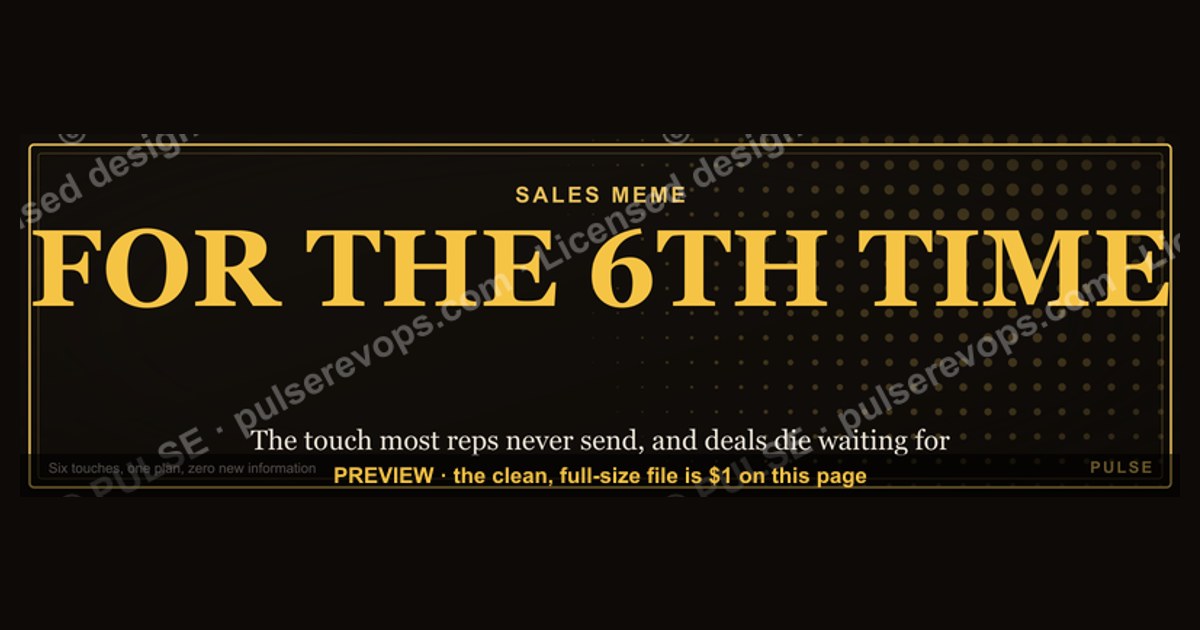
"FOR THE 6TH TIME" is a sales meme joking about the sixth follow-up to a silent prospect. It lands because most deals genuinely need five to eight touches, yet many reps quit after two. The humor is recognition: everyone has sent that email, and everyone knows the sixth one usually says nothing new.
The outcome you should expect
Treat this meme as a diagnostic rather than a punchline and the outcome is fairly predictable: you stop losing deals to premature abandonment, and you stop burning domain reputation on touches that carry zero new information. Those are two different problems, and the joke sits precisely at the seam between them.
The first outcome is reach. Widely cited sales research — the kind summarized by HubSpot, Brevet, and the old InsideSales/XANT studies — consistently points to the same shape: a large majority of closed deals require five or more follow-up attempts, while a large share of reps stop at one or two. Whatever the exact percentages in any given study (and they vary), the directional finding has been stable for years. Teams that formalize a six-to-eight-touch cadence rather than leaving persistence to individual grit typically see connect rates rise, because they are simply present for more of the prospect's buying window. Nothing clever happens. They just show up on the day the prospect's priority changed.

The second outcome is quality control. Once you name "the sixth touch" as an object — something with a plan, an owner, and a content requirement — you can audit it. A rep who cannot describe what their sixth touch will contain does not have a cadence; they have a reminder task. The practical result of enforcing that requirement is fewer sends and better ones. In most teams that do this exercise honestly, touch volume per account goes *down* while reply rate goes *up*, because the four near-identical "just checking in" emails collapse into one substantive message.
The third outcome is cultural, and it is the one the meme actually delivers on its own. Humor lowers the shame around a stalled deal. A rep who can laugh at the sixth email is a rep who will tell their manager the deal is stuck, which is the precondition for coaching it. A rep who treats every non-response as personal failure hides the pipeline until forecast day. Sales floors that share this kind of Meme in a channel tend to surface bad news earlier, and earlier bad news is cheaper bad news.
What you should *not* expect is a number that transfers. Six is a joke, not a benchmark. Your real optimal touch count is a function of deal size, buying committee width, channel mix, and how urgent the underlying problem is. The meme's value is that it makes people ask the question at all.
What drives that outcome

Three mechanisms sit underneath the "sixth time" phenomenon, and they pull in opposite directions.
Timing luck. Most non-responses are not rejections. They are mistimed arrivals. A prospect who ignores you in March may be actively shopping in June because a system broke, a competitor raised prices, a new VP arrived, or budget freed up. Every additional touch is another lottery ticket against the calendar. This is why persistence works at all — not because you wore anyone down, but because you were in the inbox on the week the pain became urgent. It also explains why long, low-frequency nurture often outperforms short, high-frequency blitzes for considered purchases.
Familiarity. The mere-exposure effect is a real and well-replicated finding in psychology: repeated exposure to a stimulus tends to increase liking for it, within limits. Applied to sales, the sixth message from a name the buyer half-recognizes reads differently than a first message from a stranger. This is the same mechanism brand advertising rents. It is also why consistency of sender, signature, and framing matters more than people assume — six touches from three different reps on the same account buy less familiarity than six from one.
Habituation and irritation. The counter-force. Repetition without new information stops being noticed and starts being filtered — by the human first, then by the mail system. Once a recipient marks a sender as unwanted, the damage is not confined to that account; sustained spam complaints degrade sending-domain reputation for everyone on it. This is the mechanism that turns the meme from funny to expensive.
The net result of these three forces is a curve, not a line. Value rises with touches while timing luck and familiarity dominate, then flattens and eventually inverts once habituation and irritation take over. Where the peak sits depends almost entirely on whether each touch carries new information.
mermaid flowchart TD A[Week 1: Measure current cadence] --> B[Median touches to closed-lost] A --> C[Touch position of positive replies] A --> D[Unsubscribe and complaint rate by position] B --> E[Week 2: Audit touches four to six] C --> E D --> E E --> F{New information in each touch?} F -->|No| G[Week 3: Rewrite with a defined job per touch] F -->|Yes| H[Keep and document the pattern] G --> I[Add multi-thread branch at touch four] H --> I I --> J[Week 4: Instrument guardrails] J --> K[Hard stop on opt-out] J --> L[Per-account touch cap across reps] J --> M[Weekly complaint and reply review]
K --> N[Re-measure after 30 days] L --> N M --> N </invoke>
After thirty days, re-measure the same four numbers from week one. The pattern you want to see is total sends flat or down, positive replies up, complaints flat. If sends went up and positive replies went up proportionally, you did not improve the cadence — you just did more of it, and the deliverability bill arrives later.
Two adjacent workflows worth wiring in while you're here. First, closed-lost recycling: accounts that exhausted six touches and went quiet are not dead, they are early. A quarterly re-entry with a genuinely new hook — a product capability that didn't exist last time, a trigger event at their company — routinely outperforms net-new cold lists, because you have familiarity banked. Second, the handoff from marketing: if an account is simultaneously receiving nurture email from marketing and a six-touch outbound cadence from sales, the prospect experiences one combined stream and judges it as one. Shared suppression lists and a single view of total contact frequency prevent the accidental twelfth touch that nobody planned.
Coaching angle for managers. The most useful question to ask a rep about a stalled deal is not "have you followed up?" It is "what does your sixth touch say?" If the answer is specific, the deal has a plan. If the answer is a shrug, you have found the coaching moment — and you have found it without making the rep feel like the punchline of a Meme.
Related questions
How many follow-ups is too many?
There is no universal ceiling, but a useful stop rule is: no engagement signal — no opens, clicks, replies, or site visits — after six substantive touches means move the account to long-cycle nurture. Any explicit "stop" ends contact immediately, regardless of touch count.
Does sending a meme to a prospect ever work?
Occasionally, and only with warm, informal relationships where rapport is already established. With strangers, senior executives, or formal procurement processes it reads as unserious. A single self-aware sentence carries the same disarming effect with far less downside than an image.
Why do reps give up after two touches when deals need more?
Because non-response feels like rejection and rejection is unpleasant, while a fresh list feels like progress. It is an emotional-economics problem, not an information problem. Fixing it requires cadence automation and manager visibility, not another statistic on a slide.
Is the "sixth time" about attempts or about people?
Both, and the second reading matters more in enterprise. Buying committees frequently run to six or more stakeholders, so repeating your pitch is coverage of a group rather than nagging one person. Tailor each retelling to that stakeholder's actual concern.
What metric proves a longer cadence is working?

Positive replies sourced from touch four and later, tracked against unsubscribe and spam-complaint rates over the same window. Rising later-touch replies with flat complaints means the cadence earns its sends. Rising complaints means you added frequency, not value.
FAQ
What exactly is the "FOR THE 6TH TIME" sales meme?
It is an internet-native joke — usually a caption over a weary-looking image, often paired with a phrase like "just circling back" — about a salesperson sending yet another follow-up to a prospect who has clearly stopped reading. There is no single canonical original; it circulates in endless remixed forms across LinkedIn, sales Slack channels, and meme generators. Its staying power comes from being simultaneously self-deprecating and true.
Is there an actual six-touch rule in sales?
No formal rule exists, but the number sits inside a real and widely cited planning range. Sales research over many years has converged on the observation that most B2B deals require roughly five or more follow-up attempts while a large fraction of reps stop well short of that. Six is a joke perched on the edge of that finding, which is precisely why it reads as funny rather than arbitrary.
Does persistence actually improve close rates, or is that a myth?
Persistence with new information improves outcomes; persistence without it does not. The mechanism is timing — most silence is a mismatch between your outreach and the buyer's current priorities, and additional touches increase the odds of arriving during a window when the priority has shifted. Repeating identical messaging does not create that window; it just trains the recipient's filter.
Can this meme be used internally to make a point about process?
Yes, and it is arguably better suited to that than to prospecting. Managers use it to open honest conversations about CRM hygiene, cadence discipline, or a rule that has been explained repeatedly without sticking. Used well, it signals "this is a shared frustration, not an accusation." Used badly — aimed at one named person — it becomes public criticism wearing a joke as cover.
What is the real risk of over-following-up?
Three compounding costs. Recipients mark you as spam, which degrades sending-domain reputation for your entire team and quietly suppresses deliverability for everyone. Buyers remember and tell peers, which shows up later as weaker inbound. And your own team habituates to ignoring disinterest signals, which is the behavior that eventually produces a compliance complaint. The cost of one extra touch is small; the cost of a house style of them is not.
Where do teams usually get the highest return when fixing their cadence?
Almost always in the content of the later touches rather than in the touch count. Rewriting touches four through six so each carries a distinct new hook — a comparable customer story, a named objection addressed directly, a clean close-the-loop message — typically lifts reply rate while holding or reducing total sends. Tightening who enters the sequence in the first place is the close second.
Sources
- https://blog.hubspot.com/sales — HubSpot Sales Blog: follow-up cadence research, outreach benchmarks, and prospecting data
- https://hbr.org/topic/subject/sales — Harvard Business Review: sales strategy, buyer behavior, and B2B selling research
- https://www.gartner.com/en/sales/insights/b2b-buying-journey — Gartner: B2B buying journey and buying-group size research
- https://www.ftc.gov/business-guidance/resources/can-spam-act-compliance-guide-business — U.S. Federal Trade Commission: CAN-SPAM Act compliance guide
- https://gdpr.eu/ — GDPR overview and compliance guidance for handling EU personal data
- https://support.google.com/a/answer/81126 — Google Workspace: email sender guidelines and spam-complaint thresholds
- https://www.fcc.gov/general/telemarketing-and-robocalls — FCC: telemarketing, robocall, and do-not-call rules
- https://www.bls.gov/ooh/sales/ — U.S. Bureau of Labor Statistics: Occupational Outlook Handbook, sales occupations
- https://www.gallup.com/workplace/ — Gallup Workplace: employee engagement and team effectiveness research
- https://imgflip.com/ — Imgflip: meme creation and circulation platform
Related on PULSE
This page will be disappearing soon. Save it to your device for $1 — or read it free while it is here.
@Kory-White- · if Venmo asks, the last 4 of my number are 2012
This page is gone.
This one is off the shelf now. $1 keeps it on your phone for good — the whole page, pictures and diagrams included.
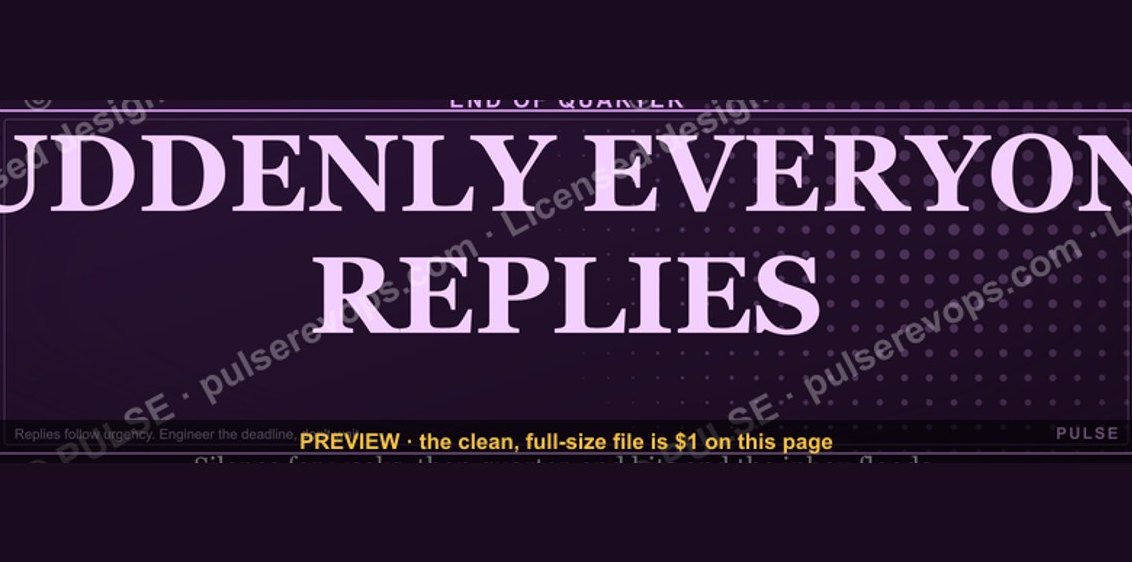 graphic“SUDDENLY EVERYONE REPLIES” — Sales Meme
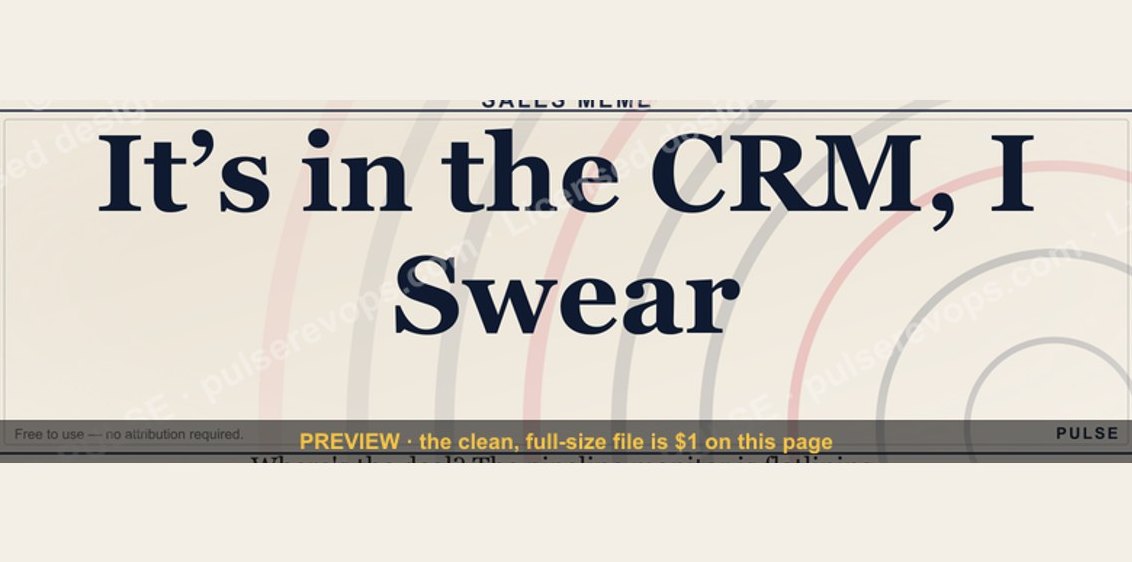 graphic“It’s in the CRM, I Swear” — Sales Meme
 graphic“PANIC SUNDAY NIGHT” — Sales Meme
 graphic“12 TIMES. NO REPLY.” — Sales Meme
 graphic“IT'S A NOT YET” — Sales Meme
 graphic“TIME TO DO IT AGAIN” — Sales Meme
 graphic“...AFTER THE DEAL CLOSES” — Sales Meme
 graphic“SHOULD DO IT” — Sales Meme
 graphic“DEAL SLIPS TO NEXT QUARTER” — Sales Meme
 graphic“FINANCE: NOT YET” — Sales Meme