


“TIME TO DO IT AGAIN” — Sales Meme
Quality
Certified
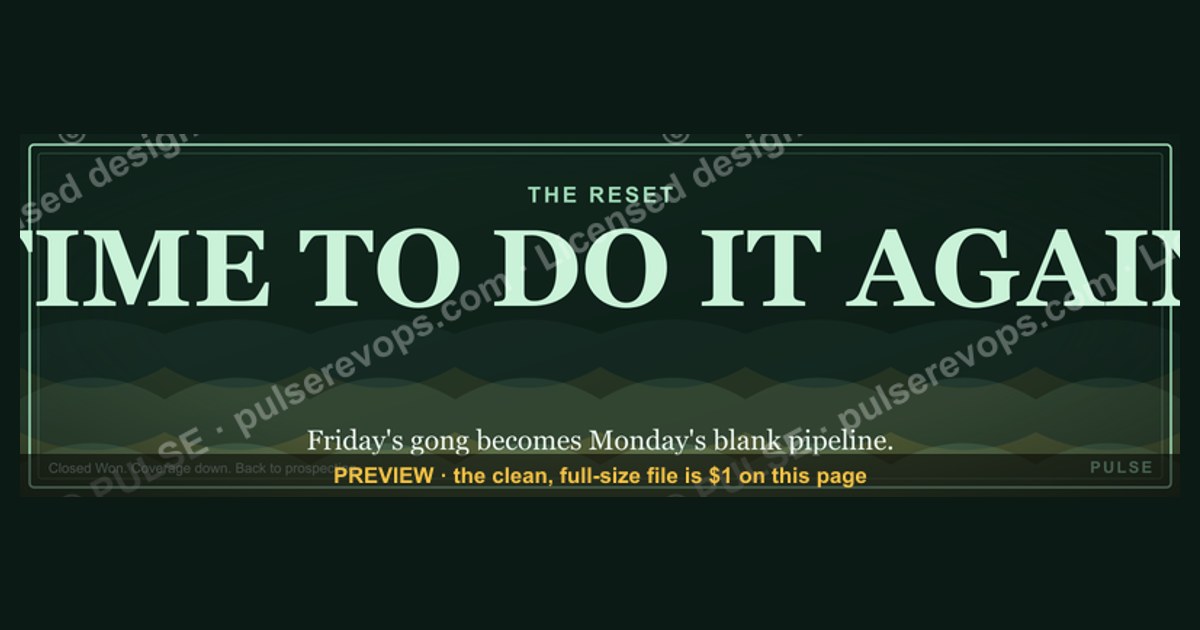
"TIME TO DO IT AGAIN" is a sales meme about the reset — the moment a deal closes or a quarter ends and the number snaps back to zero. It names the whiplash between celebration and the fresh pipeline waiting behind it. Reps share it in Slack as joke, vent, and solidarity all at once.
The Friday close that becomes Monday's blank slate
Picture a Thursday afternoon in a mid-market SaaS org. A rep who has been working a 90-day cycle finally gets countersignature on a six-figure deal. The gong hits Slack. Fourteen people react with fire emojis. The VP of Sales posts a paragraph. For roughly forty minutes, that rep is the most celebrated person in the company.
Friday morning, the CRM has already rolled the opportunity to Closed Won and moved it out of the open-pipeline view. The forecast call at 9 a.m. does not discuss the deal that closed — it discusses coverage for the *next* period, and the rep's coverage ratio just dropped because their biggest open opportunity is no longer open. By Friday afternoon they are prospecting again. Monday they post the meme.
That sequence is the whole joke. It is not that anyone did anything wrong; it is that the operating system of a quota-carrying role is designed to reset. Most functions in a company measure output on long arcs — an engineer ships a feature and it stays shipped, a finance analyst closes the books and the close stands. Sales measures on a short, public clock, and the scoreboard resets while the emotional residue of the last cycle is still warm.

The scenario broadens easily. Customer Success sees the same shape on renewal dates. Recruiters see it when a placement starts and the req list refills. Agency account managers see it every time a campaign wraps. Anyone whose contribution is denominated in *recurring closed units* rather than *accumulated artifacts* recognizes the reset. That is why the meme travels well outside pure B2B software: the underlying structure — public number, short period, hard reset — exists in real estate, in fundraising, in retail floor targets, and in med-device territory quotas.
The variants matter too. The meme fires hardest at five specific moments: the end-of-month scramble where the 25th arrives and coverage is thin; the post-demo silence where a prospect said "this is exactly what we need" and then vanished for ten days; the resurrected loss where a deal you already lost re-enters pipeline because the competitor failed and you must re-prove everything while carrying the memory of losing once; the quarterly reset where you blow out the number and leadership responds by raising the next one; and CRM cleanup day, where the reward for closing is a queue of stale leads, bad contact data, and opportunities that should have been marked closed-lost months ago. Each variant is a different flavor of the same structural fact.
Why the reset lands emotionally — the mechanism underneath the joke

Two things are happening at once, and separating them explains why the meme is funny rather than merely bleak.
The first is adaptation. Psychologists describe a well-documented tendency for people to drift back toward a baseline level of satisfaction after both good and bad events — the "hedonic treadmill." A closed deal produces a real spike, and that spike decays regardless of what anyone does. Sales does not cause this; sales *accelerates* it, because the system asks for the next number before the decay has finished naturally. The meme captures the gap between how large the win felt and how quickly the organization moved on from it.
The second is the difference between "again" and "the same." The reflex after a win is to run the identical motion, because it just worked. But the next opportunity is a different account with a different buying committee, a different compelling event, and a different competitive frame. Repeating the last playbook on a weaker deal feels productive — activity looks the same on a dashboard — while the outcome distribution is completely different. The healthiest version of "do it again" contains a short beat of reflection: what actually moved that deal, and does this one look anything like it?

There is a third, structural layer worth naming, because it is where revenue operations can actually intervene. The reset is not purely psychological — it is instrumented. Pipeline coverage ratios recompute nightly. Forecast categories roll. Compensation accelerators reset at period boundaries. Territory books get rebalanced. The rep experiences these as one undifferentiated wave of "start over," but they are separate systems with separate cadences, and some of them can be desynchronized deliberately so that everything does not snap to zero on the same morning.
The diagram above is the loop the meme compresses into six words. The branch in the middle is the only place a team has leverage. Everything upstream is fixed by the calendar and the comp plan; everything downstream is a consequence of which branch got taken.
The rhythms and ranges that shape how often it fires
Precise universal statistics on meme-sharing behavior do not exist in any form worth citing, so it is more useful to look at the operating rhythms that create the feeling — those are observable in any CRM.
Period length drives frequency. Monthly-quota teams experience twelve resets a year; quarterly teams experience four. The monthly cadence produces a sharper, more frequent version of the joke, and it tends to arrive in a predictable window — the last five to seven business days of the month, when coverage math becomes visible to everyone. Teams on annual quotas with quarterly checkpoints report the feeling less often but more intensely, concentrated at fiscal year end.

Cycle length determines how exposed the reset feels. A transactional team with a two-to-four-week sales cycle refills pipeline continuously; the reset is shallow because there is always something mid-funnel. An enterprise team running six-to-twelve-month cycles feels the reset far more acutely, because closing the one big deal in the book genuinely empties a meaningful share of open pipeline. The ratio that matters is cycle length divided by quota period: when that ratio exceeds roughly 1.0 — the cycle is longer than the period you are measured on — the reset is structurally guaranteed to feel brutal, because you can never close within the window you are being judged on.
Coverage ratios make the reset visible. Most revenue teams run somewhere in the 3x-to-5x pipeline-coverage range depending on historical win rate; a team converting at 25% needs roughly 4x. The uncomfortable arithmetic is that closing a deal *reduces* coverage, because the closed amount leaves the open-pipeline numerator while the next period's quota resets the denominator. A rep can win and watch their coverage health indicator turn from green to yellow in the same twenty-four hours. That specific dashboard behavior is the single most literal expression of the meme anywhere in the tech stack.
Ramp and tenure change the emotional weight. Common ramp assumptions run three to six months for mid-market and six to nine for enterprise. Reps inside ramp experience the reset differently — they are still accumulating firsts, so the loop feels like progress. The meme lands hardest in years two and three, once the novelty is gone and the pattern is legible.

Attrition context matters without needing invented numbers. Sales roles are widely understood to carry higher voluntary turnover than most corporate functions, and the reset cycle is one commonly cited contributor among several — comp changes, territory changes, and management churn being others. The honest framing is that the meme is a symptom worth watching, not a diagnosis on its own.
What you can actually change, and what you deliberately should not
There is a strong temptation, once a leader notices the pattern, to "fix" it. Most of the available fixes trade one problem for another.
Lengthen the measurement period. Moving from monthly to quarterly quotas cuts reset frequency by two-thirds and gives longer cycles room to land. The trade-off is real: monthly cadence surfaces problems early, and quarterly cadence lets a rep hide a bad six weeks until it is too late to coach. Teams with long cycles and experienced reps generally do better on quarterly; teams with short cycles and heavy ramp generally need the monthly signal.
Add a rolling metric alongside the period metric. Reporting trailing-twelve-month or trailing-90-day production next to the current-period number gives the reset something to sit against. The rep who just closed still sees their cumulative contribution even as the period counter zeroes. This is cheap to build in most BI layers and does not require touching the comp plan. The trade-off is dashboard clutter and the risk that reps optimize toward whichever number flatters them.

Desynchronize the resets. If quota period, territory review, comp accelerator tiers, and pipeline-review cadence all reset on the same date, the rep experiences one giant cliff. Staggering them — accelerators on a rolling basis, territory reviews mid-quarter — softens the edge without changing any individual policy.
Do not sand off the edge entirely. The reset has a function. It is what makes the number credible and what keeps a strong quarter from becoming a coasting quarter. A team that never feels the reset is usually a team whose quota is not binding. The goal is a survivable rhythm, not a flat one.
Do not corporatize the meme. This is the cultural trade-off and the one most often botched. The meme's power is that it comes from below. Putting it on an all-hands slide, printing it on mugs, or building a "Time To Do It Again" recognition program converts honest gallows humor into sanctioned messaging, and reps stop using it — which also removes a useful signal.
The middle branch is the expensive mistake. Once the joke is owned by leadership it stops being reported, and the early-warning value goes with it.
Pitfalls when a team leans on the meme

Treating frequency as noise. A rep who posts some version of "time to do it again" three weeks running is communicating something. Not a crisis, necessarily — but a low-key private check-in ("saw you post that a few times, how's the book feeling?") costs nothing and occasionally catches a resignation six weeks early.
Mistaking humor for consent. A team joking about the grind is not the same as a team endorsing the grind. Leaders sometimes read the meme as evidence of a healthy, self-aware culture and use that as a reason to leave a structural problem — bad territories, unrealistic coverage math, a comp plan that punishes long cycles — unaddressed.
Letting "again" mean "identical." The most concrete operational pitfall. After a win, the discipline is a two-line post-close note: one thing that worked, one thing to change. Teams that attach this to the meme itself — post the meme, add the line — convert a vent into a transferable insight that newer reps read in the channel. It takes ninety seconds and is the only ritual here that reliably survives contact with a busy quarter.
Using it externally without thinking. In sales-native spaces — a LinkedIn post to an audience of AEs and revenue leaders — it humanizes a brand. Pointed at buyers who do not live the cycle, it reads as either confusing or as evidence that the vendor's team is exhausted. Keep it internal or in-community.
Skipping the reset entirely. The opposite failure: reps who never pause and simply roll straight from close into the next call every time. Short-term this looks like elite work ethic. Over several quarters it produces reps who cannot articulate why they win, which makes them impossible to coach and fragile when the market shifts.

Forgetting the meme is a symptom, not the subject. If forecasts keep breaking and resetting, that is an operating problem with real revenue consequences — coverage math, stage definitions, exit criteria — and no amount of cultural handling fixes it. The joke is the smoke.
Related questions
Where did the "TIME TO DO IT AGAIN" meme come from?
There is no single documented origin, owner, or canonical first post. Like most workplace formats, it emerged from repeated independent use across sales Slack channels and LinkedIn until the phrasing stabilized. That anonymity is part of why it feels honest rather than branded.
Is this only a B2B software thing?
No. It fits anywhere performance is measured in recurring, publicly visible goals — real estate, recruiting, fundraising, retail floor targets, insurance. SaaS just has the tightest reset cadence and the most Slack channels, so the format shows up there most visibly.
Does the meme mock sales culture or celebrate it?
Both simultaneously, which is why it works. It ridicules the absurdity of an infinite target while signaling that the person posting it is still in the fight. That double meaning is what separates it from straightforward complaining.
Should a manager respond when a rep posts it?

React, do not orate. A quick acknowledgment reads as "I get it." A speech about resilience reads as co-option. If the frequency climbs, move it to a direct message rather than the channel.
What is the one habit worth attaching to it?
A two-line post-close note: what moved the deal, what you would change. Posted alongside the meme, it turns a vent into something the rest of the team can actually use, and it forces the reflection that prevents blind repetition.
FAQ
What does the "TIME TO DO IT AGAIN" meme mean in sales? It captures the loop of hitting a target, celebrating briefly, and immediately facing a fresh — often higher — number. The humor comes from the shared recognition that the celebration window is far shorter than the effort that earned it, and that the system moves on before you do.
Why does the meme resurface year after year? Because the structure it depicts has not changed. Tooling, methodology, and buyer behavior all shift, but the combination of a public scoreboard, a short measurement period, and a hard reset at the boundary is a permanent feature of quota-carrying work. New reps rediscover the joke independently every cycle.

Can it be used in external marketing? Carefully. To a sales-native audience it builds credibility and reads as insider fluency. To buyers outside that world it lands as confusing or slightly alarming. The safe default is internal channels and sales-specific social communities.
Does joking about the reset make burnout worse? Generally the opposite — naming a shared experience tends to relieve pressure rather than amplify it. The risk is not the joke; it is treating the joke as a substitute for fixing the underlying coverage math, territory design, or forecast discipline that made the cycle punishing.
How do I tell healthy gallows humor from a warning sign? Frequency and tone. Occasional posting across a whole team is normal culture. One person reaching for it repeatedly, especially paired with dropping activity or withdrawal from channels, is worth a private conversation. It is an early read, not a diagnosis.
What is the operational fix if the loop feels unsustainable? Look at the ratio of sales cycle length to quota period, at pipeline coverage against actual win rate, and at whether every reset — quota, territory, comp accelerators, review cadence — lands on the same date. Desynchronizing those and adding a rolling trailing metric usually does more than any morale initiative.
Sources
- https://knowyourmeme.com/
- https://hbr.org/topic/subject/sales
- https://www.gartner.com/en/sales
- https://www.pewresearch.org/internet/
- https://www.apa.org/
- https://time.com/
- https://www.theatlantic.com/technology/
- https://www.adweek.com/
Related on PULSE
This page will be disappearing soon. Save it to your device for $1 — or read it free while it is here.
@Kory-White- · if Venmo asks, the last 4 of my number are 2012
This page is gone.
This one is off the shelf now. $1 keeps it on your phone for good — the whole page, pictures and diagrams included.
 graphic“DEAL SLIPS TO NEXT QUARTER” — Sales Meme
 graphic“SUDDENLY EVERYONE REPLIES” — Sales Meme
 graphic“...AFTER THE DEAL CLOSES” — Sales Meme
 graphic“GHOSTED BY MONDAY” — Sales Meme
 graphic“IT'S A NOT YET” — Sales Meme
 graphic“FINANCE: NOT YET” — Sales Meme
 graphic“FREE CONSULTING SESSION” — Sales Meme
 graphic“SHOULD DO IT” — Sales Meme
 graphic“FOR THE 6TH TIME” — Sales Meme
 graphic“EVERY. SINGLE. MONTH.” — Sales Meme