


“BOUGHT THE COMPETITOR” — Sales Meme
Quality
Certified
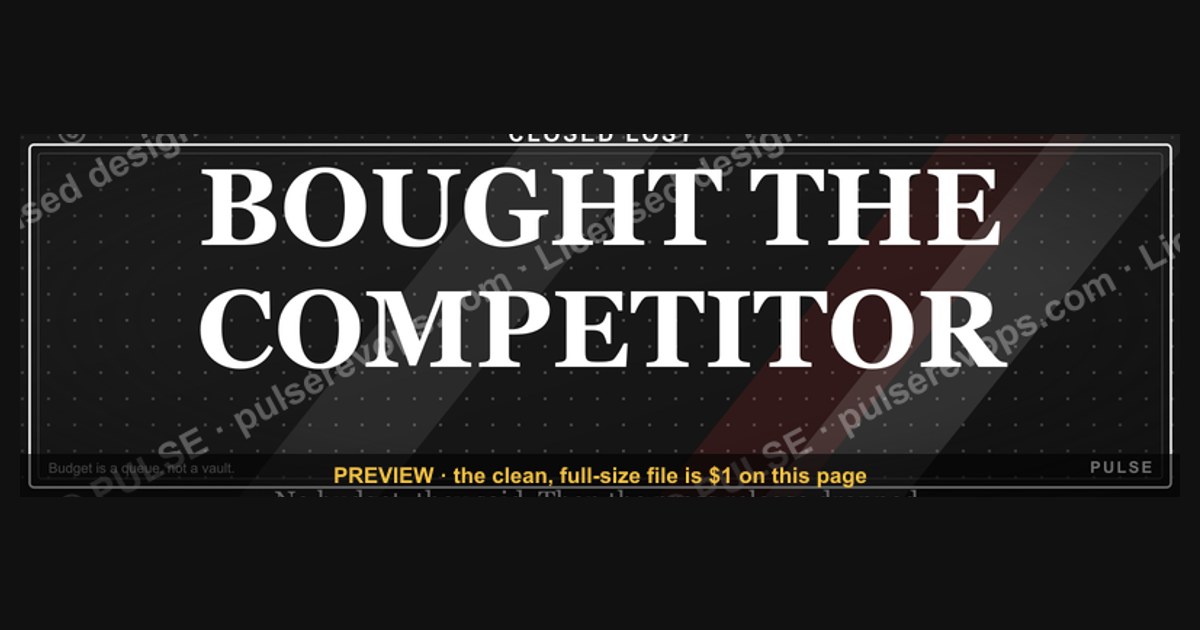
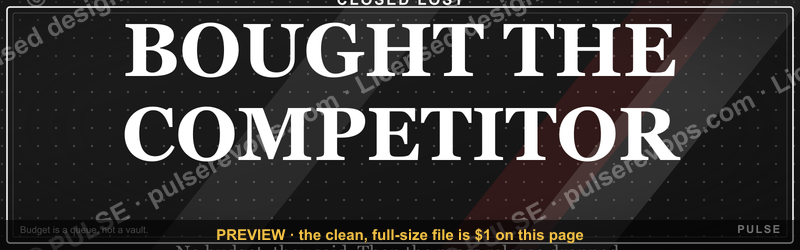
This is a free downloadable 1600x500 PNG banner titled “BOUGHT THE COMPETITOR” — a Sales Meme graphic you can drop into LinkedIn posts, Slack channels, or internal decks. It reads as a deadpan trophy-style announcement, the kind a rep posts after a prospect who was already using a rival tool signs with you instead. Use it to celebrate a competitive displacement win without gloating at the named vendor.
The scenario this banner was built for
Picture the Tuesday morning after a deal closes. A prospect you have been chasing for five months — one who was already three years deep into a rival platform, with contracts, seat licenses, and an admin who knew the old system cold — finally signs. The rep who closed it opens LinkedIn, types “BOUGHT THE COMPETITOR” in all caps, attaches the banner, and hits post. Within an hour it has forty reactions from teammates and two awkward silence-dots from the account executive at the rival vendor who happens to follow them. That is the exact moment this banner exists to serve.
Competitive displacement is the hardest category of enterprise deal to win, and it is also the one most likely to go uncelebrated because the win looks like an ordinary logo add in the CRM. Nobody outside the deal team knows that the customer had to rip out an incumbent, migrate data, retrain users, and absorb switching costs. The banner is a shorthand that says: this was not a greenfield win, this was a fight, and we took ground.
The scenario repeats across industries. A cybersecurity vendor displaces an endpoint incumbent after a breach scare. A payroll platform wins a mid-market account off a legacy provider during a renewal window. A CRM challenger takes an account from a category leader because the admin got tired of paying for seats nobody used. In each case, the rep wants a low-effort way to signal the win to their network, their leadership, and — quietly — the competitor’s sales team. A text-only post gets scrolled past. A banner gets screenshotted.
There is also a less flattering version of the scenario, and it is worth naming early. Sometimes a rep posts the banner after a deal that was not really a displacement — the customer had already churned from the competitor six months earlier, or was never really using the tool, or was on a free tier. Posting “BOUGHT THE COMPETITOR” when you did not actually buy anything out from under anyone is the fastest way to look like you are performing a win rather than reporting one. The banner works because the claim behind it is usually true. When it is not, the audience notices.

How the graphic actually works, element by element
The banner is a horizontal 1600x500 pixel image, which is the standard LinkedIn link-preview and post-image aspect ratio (roughly 3.2:1). That ratio matters: LinkedIn crops square and 4:5 images aggressively in feed, so a wide banner survives the crop and reads at a glance on mobile, where more than half of feed impressions happen. The layout is deliberately simple so it stays legible when LinkedIn compresses it down to a thumbnail.
What is on it, in order from left to right:
- A trophy or plaque motif. The visual anchor is a generic award shape — not a specific vendor’s logo, not a real trophy, just the silhouette of one. This is what makes the banner read as a joke rather than a brag. The trophy is the punchline: you are accepting an award for something that is, at bottom, just a sales deal.
- The headline text, “BOUGHT THE COMPETITOR,” set in all caps. All caps is doing real work here. It is the same register as a tabloid headline or a wrestling promo. Lowercase would read as a status update; caps read as an announcement.
- A subtitle line that carries the deadpan framing — something in the spirit of “and all I got was this lousy quota attainment” or “the customer was already using them.” The subtitle is where you can localize the joke for your team.
- A small footer strip with room for a company name, a team name, or a date. This is the customization slot. Leaving it blank is fine; filling it in makes the banner feel like an internal artifact rather than a stock meme.
- A muted background — dark or neutral, low contrast behind the text — so the headline pops in a compressed feed thumbnail.
The whole thing is intentionally low-fidelity. A polished, on-brand, gradient-heavy banner reads as corporate marketing. A slightly crude banner reads as a meme, which is what makes it shareable. If you are tempted to add your logo, your brand colors, and a call to action, you are fighting the format.
The mechanism by which it spreads is worth understanding, because it explains why the format is so durable. Sales memes travel through three overlapping networks: the rep’s own LinkedIn following, the internal Slack or Teams channel where the deal was announced, and the competitor’s own team, who monitor each other’s social feeds for exactly this kind of post. The first network gives the rep social capital. The second gives the manager a reason to screenshot it into the weekly all-hands. The third is the one nobody admits to, and it is the one that makes the meme sting.
The loop that matters is the one on the right side of that diagram. A single banner post does not win deals, but it does two things that compound: it gives your own team a visible signal that displacement wins are possible, and it puts a small amount of psychological pressure on the rival’s team. Neither effect is measurable in a dashboard, and both are real.
Where and how to use it, and the specs
The banner is a PNG, 1600x500 pixels, designed to be dropped into a LinkedIn post as an image attachment. That is the primary use case and the one the dimensions were chosen for. But the same file works in several adjacent places, and each has its own placement rules.
LinkedIn feed post. Attach the PNG directly to a text post. Do not put it in the link preview — LinkedIn will crop and shrink it. Write two or three lines of text above it: the customer’s industry, the incumbent you displaced, and one sentence on why they switched. Keep the text short; the banner is the payload. Best posting window for B2B sales content is Tuesday through Thursday, 7–9am in your audience’s primary time zone. Expect the post to peak in the first 90 minutes and then flatten.
Internal Slack or Teams channel. Drop the PNG into the deal-desk or wins channel with a one-line caption and a link to the closed-won opportunity. This is where the banner does its most useful work, because it turns a CRM record into a moment the team can react to. Some teams pin a running “displacement wall” of these banners for the quarter.
Sales kickoff and QBR decks. The banner scales down cleanly to a slide header at 1600x500. Use it as the title slide for a displacement-win case study. Pair it with three numbers: contract value, incumbent displaced, and days in cycle. Do not stretch it — if your slide is 16:9, place the banner centered with white space above and below rather than distorting the aspect ratio.
Email signature or internal newsletter header. At 1600x500 the banner is too wide for an email signature, but it can be cropped to a 600x200 strip for a newsletter header. Cropping from the center keeps the headline legible; cropping from the edges cuts the trophy and the footer.
Download and swap-in. The file downloads as a PNG from this page. To swap it into a post: save the PNG to your device, open LinkedIn, start a post, click the image icon, select the file, and confirm the crop preview shows the full headline. If LinkedIn offers a crop, choose “original” or the widest option. To customize the wording, open the PNG in any image editor — Canva, Figma, Photoshop, or even Preview on Mac — and edit the text layer if you have the source, or place a text box over the subtitle and footer if you only have the flat PNG. Keep the headline in a heavy sans-serif at roughly 90–110px on the 1600px canvas so it survives compression.
Real numbers, ranges, and benchmarks
There is no single published statistic for “how often a sales meme post generates pipeline,” and anyone who quotes one is making it up. What can be said with confidence is drawn from how competitive displacement deals behave in aggregate, and those numbers are worth knowing because they tell you when the banner is celebrating something real.
Competitive displacement deals typically take longer than greenfield deals. A greenfield mid-market SaaS deal might run 60–90 days from first touch to close. A displacement deal against an entrenched incumbent commonly runs 120–180 days, and in enterprise segments 9–18 months is normal. The extra time comes from three places: the customer has to justify the switch internally, the incumbent gets a renewal-window counter-offer, and the migration has to be scoped.
Win rates tell a similar story. In most competitive SaaS categories, win rates against a named incumbent run somewhere between 20% and 40%, compared with 30% to 50% in deals where no incumbent is present. The variance is enormous and depends on category maturity, but the pattern — displacement is harder — holds across CRM, HRIS, security, and data tooling.
Discounting is the hidden cost. Displacement deals close at steeper discounts than greenfield deals, often 10–20 percentage points deeper, because the buyer is using the incumbent’s renewal quote as leverage and because switching costs give them a credible reason to demand concessions. A rep who posts “BOUGHT THE COMPETITOR” after a 40% discount has won a deal, but the margin tells a different story than the banner does.
Migration effort is the number most often underestimated. A mid-market customer moving off a three-year-old platform typically needs 4–12 weeks of parallel running, data export and import, admin retraining, and end-user change management. Enterprise migrations run 3–9 months. If your implementation team is not resourced for that, the win becomes a churn risk inside two quarters.
The social numbers are softer but real. A well-timed sales meme post from an account executive with 2,000–5,000 LinkedIn connections typically lands 30–80 reactions, 5–15 comments, and 2–6 reshares. That is not viral by consumer standards. It is high engagement for B2B sales content, where a typical post gets 10–20 reactions. The banner format reliably outperforms a text-only win announcement by a wide margin, mostly because it gives people something to react to visually.
The benchmark that matters most is internal: how many displacement wins your team closes per quarter, and how many of them get posted. Teams that post them see more of them, because visibility changes what reps believe is possible. That is the entire mechanism. There is no study behind it; it is just how sales floors work.
Trade-offs, alternatives, and when the banner backfires

The banner is a tool with a narrow sweet spot. Used well, it is a morale and employer-brand asset. Used badly, it is a liability. The trade-offs are worth walking through before you post.
Trade-off 1: celebration versus gloating. The line between “we won a competitive deal” and “we are mocking a rival” is thin and audience-dependent. If the incumbent is a much larger, much better-known company, the banner reads as an underdog win and lands well. If you are the larger company punching down at a smaller rival, the same banner reads as bullying. Rule of thumb: post it when you are the challenger, think twice when you are the incumbent.
Trade-off 2: reach versus risk. A public post reaches your network, your prospects, and your competitors. That is the point. But it also reaches the customer you just won, who may not want their vendor switch broadcast, and it reaches the incumbent’s sales team, who will use your post as a slide in their next competitive deal. Some teams solve this by posting the banner internally only, or by posting it without naming the customer.
Trade-off 3: speed versus substance. The banner is fast. A case study is slow. The banner gets attention; the case study gets referenced in a prospect’s internal business case. The best teams do both — banner for the moment, case study for the quarter.
Alternatives worth considering, depending on the situation:
- A written win post with no image. Lower reach, lower risk, better for sensitive accounts.
- An anonymized case study. Slower to produce, far more useful in late-stage deals.
- An internal “displacement wall.” A running visual of banners in the sales channel. Keeps the energy internal and avoids public gloating.
- A customer-quoted testimonial. The highest-trust asset, and the hardest to get. If the customer will go on record, skip the meme and use the quote.
The decision tree is simple: name the customer only with permission, post publicly only when you are the underdog, and always follow the banner with something substantive. A banner with no follow-up is a sugar high.
Common pitfalls and how to avoid them
Pitfall: posting before the contract is countersigned. A verbal yes is not a closed deal. Posting the banner on a handshake and then losing the deal to a renewal-window counter-offer is a specific and memorable kind of humiliation. Wait for signature.
Pitfall: claiming a displacement that was not one. If the customer had already churned from the competitor, or was on a trial, or was using a free tier, you did not buy the competitor out. Posting the banner anyway is the fastest way to lose credibility with the people who know the account. Check the CRM’s competitor field against reality before you post.
Pitfall: naming the customer without permission. Enterprise contracts often include publicity clauses. A banner post that names a customer who did not consent is a legal and relationship problem, not just a social one. Default to naming the industry, not the logo.
Pitfall: naming the competitor in a way that invites a response. Some competitors will reply publicly, and some will screenshot your post into their own deal cycles. If you are going to name them, be ready for the reply. If you are not, describe them generically.
Pitfall: over-polishing the banner. Adding brand gradients, a logo lockup, and a CTA turns a meme into an ad and kills the share rate. Keep it crude.
Pitfall: posting the same banner every week. The format has a half-life. One or two displacement wins a quarter is a moment; one a week is noise. If your team is closing that many, rotate formats or move to case studies.
Pitfall: letting the banner substitute for pipeline. The post is a celebration, not a strategy. Teams that over-invest in win announcements and under-invest in competitive battlecards, win-loss analysis, and displacement playbooks are optimizing the scoreboard instead of the game.
Pitfall: ignoring the discount. A banner that celebrates a heavily discounted displacement win teaches the team that any competitive win is a good win. Some are not. Build a rule: post the banner only when the deal closed at or above your target discount threshold.
Pitfall: forgetting the implementation handoff. The rep posts the banner and moves on. The customer then spends three months migrating and hits friction the sales team never warned them about. The banner is the start of the relationship, not the end of the deal. Loop in implementation before you celebrate.
Pitfall: using the banner in a public channel where the customer is present. If the customer’s team follows your company page, a public “BOUGHT THE COMPETITOR” post can read as triumphalism at their expense. Some buyers love it; some do not. Know your buyer.
Related questions
Is “BOUGHT THE COMPETITOR” a real sales meme or just a LinkedIn trend?
It is a real, recurring format in sales communities, not a single campaign. The phrase circulates as a caption for trophy-style banners and text posts whenever a rep displaces an incumbent. It has no single origin and no owner.
Can I use this banner if I did not actually displace anyone?
You can, but you should not. The format’s credibility depends on the claim being true. If the customer was never really using the competitor, post a normal win announcement instead — the banner will read as performance.
What size should the banner be for LinkedIn?
1600x500 pixels is the safe wide format for LinkedIn feed images. It survives the mobile crop and stays legible as a thumbnail. Square and 4:5 images get more vertical real estate but lose the banner feel.
Should I name the competitor in the post?
Only if you are prepared for a public reply and a legal review. Most teams describe the incumbent generically (“a legacy provider,” “the category leader”) and let the audience fill in the blank. Naming is higher-risk and rarely higher-reward.
How often should a team post displacement wins?
Once or twice a quarter per team is a moment. Weekly is noise. If your team closes more than that, rotate formats — case studies, customer quotes, internal walls — so the banner stays special.
FAQ
What exactly is the “BOUGHT THE COMPETITOR” Sales Meme?
It is a deadpan banner graphic — 1600x500 PNG — that a Sales rep posts after closing a deal against an incumbent vendor. The phrase is intentionally blunt and trophy-themed, treating a competitive displacement win like a prize. It circulates on LinkedIn and in internal Sales channels as a low-effort, high-signal way to announce that a customer switched from a rival tool.
Why does the meme work better than a plain win announcement?

Because it gives the audience something to react to. A text post saying “closed a deal” gets scrolled past. A banner with a trophy and all-caps text gets screenshotted, reshared, and dropped into Slack. The visual format also signals the category of win — displacement, not greenfield — which is the part that matters to other reps.
Is it unprofessional to post a meme about beating a competitor?
It depends on who you are and who is watching. As a challenger brand, it reads as confident. As a category leader, it reads as punching down. The safe move is to post it internally, or publicly without naming the customer or the competitor. If your legal or PR team has rules about competitive claims, follow them.
Can I customize the banner for my team?
Yes. The headline is the fixed element; the subtitle and footer strip are the customization slots. Teams change the subtitle to an internal joke, add a team name or quarter to the footer, or swap the background color to match a sales kickoff theme. Keep the headline in all caps and keep the layout crude — polish kills the format.
Does posting the banner actually help win more deals?
Not directly. It does not generate pipeline on its own. What it does is make displacement wins visible inside the team, which changes what reps believe is achievable, and it puts light social pressure on the rival’s team. Those effects are real but indirect, and they compound over a quarter.
What should I do after posting it?
Follow it with substance. Write up the win as a short case study within two to four weeks, capture the customer’s reason for switching, and add it to your competitive battlecard. The banner is the announcement; the case study is the asset that actually helps the next rep close a similar deal.
Sources
- LinkedIn Marketing Solutions — image and video ad specs: https://business.linkedin.com/marketing-solutions/ads
- Harvard Business Review — research and articles on competitive strategy and sales: https://hbr.org
- Gartner — B2B buying and sales research: https://www.gartner.com/en/sales
- Forrester — B2B revenue and sales research: https://www.forrester.com
- HubSpot Blog — sales enablement and competitive selling guides: https://blog.hubspot.com/sales
- Salesforce — State of Sales report and resources: https://www.salesforce.com/resources/research-reports/state-of-sales/
- Canva — design tool for resizing and editing banner graphics: https://www.canva.com
- Figma — collaborative design tool for editing PNG assets: https://www.figma.com
Related on PULSE
- Competitive displacement playbook: how to win deals against an entrenched incumbent
- Win-loss analysis: what to ask after a competitive deal closes
- Battlecard basics: what belongs on a one-page competitive sheet
- Sales memes and internal culture: when celebration helps and when it backfires
- Discount discipline in competitive deals: protecting margin when the buyer has leverage
This page will be disappearing soon. Save it to your device for $1 — or read it free while it is here.
@Kory-White- · if Venmo asks, the last 4 of my number are 2012
This page is gone.
This one is off the shelf now. $1 keeps it on your phone for good — the whole page, pictures and diagrams included.
 graphic“SHOULD DO IT” — Sales Meme
 graphic“FINANCE: NOT YET” — Sales Meme
 graphic“FREE CONSULTING SESSION” — Sales Meme
 graphic“IT'S A NOT YET” — Sales Meme
 graphic“TIME TO DO IT AGAIN” — Sales Meme
 graphic“GHOSTED BY MONDAY” — Sales Meme
 graphic“...AFTER THE DEAL CLOSES” — Sales Meme
 graphic“It’s in the CRM, I Swear” — Sales Meme
 graphic“THE KISS OF DEATH” — Sales Meme
 graphic“SUDDENLY EVERYONE REPLIES” — Sales Meme