


“Hire slow. Ramp fast.” — LinkedIn Banner
Quality
Certified
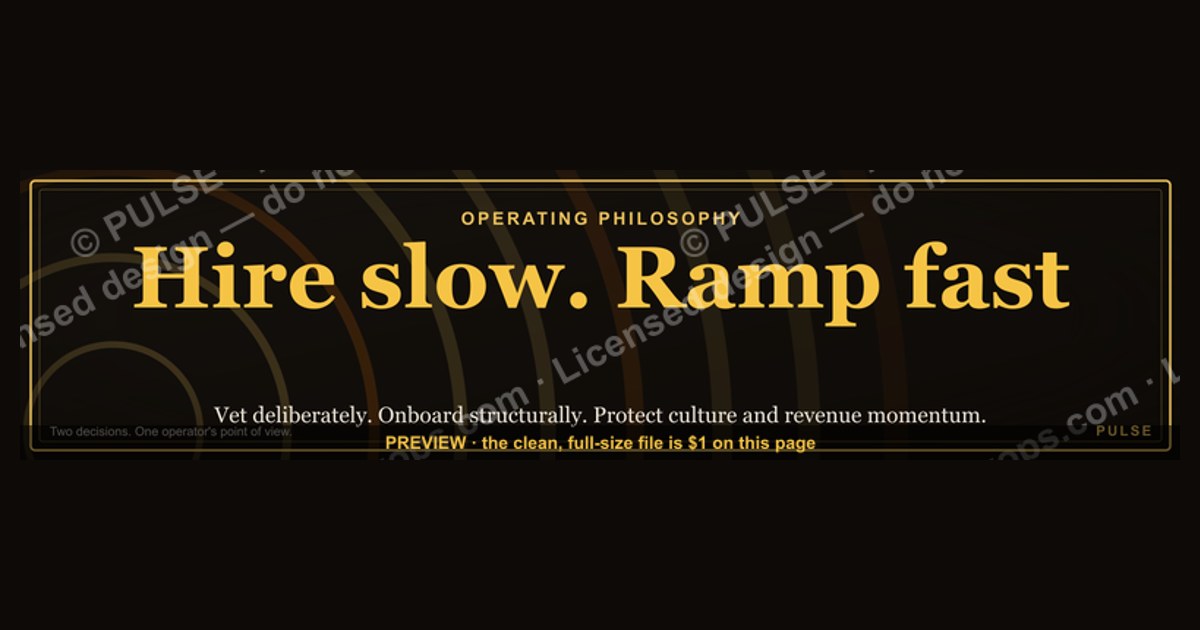
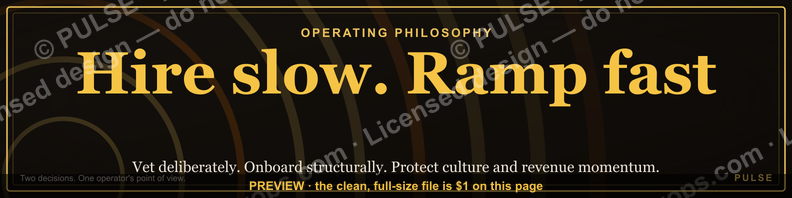
This is a downloadable LinkedIn profile banner, 1584x396 px, that reads “Hire slow. Ramp fast.” in bold type on a dark background. It states a hiring philosophy in five words: choose deliberately, then onboard with urgency. Use it on a recruiter, hiring manager, or talent-brand profile to signal that your team treats selection and ramp as two separate disciplines.
The outcome you should expect
The realistic outcome of putting this banner on a profile is not a flood of applicants. It is a positioning signal that changes the *quality* of conversations you have with the people who already care about hiring craft — candidates who read carefully, peers who run talent teams, and hiring managers who have been burned by a warm body hired in a panic.
Expect three measurable-ish shifts over the first 60 to 90 days. First, inbound messages from senior candidates tend to get more specific: instead of “are you hiring?”, you get “I saw your banner — how do you run your loop?” That is a warmer starting point and shortens the trust-building phase of a screen. Second, referral quality improves when your own employees share the banner or the phrase internally, because it gives them language to explain why your process takes longer than a competitor’s. Third, and least obvious, it pre-frames rejections. A candidate who has already read “Hire slow” is less likely to take a slow decision as a personal slight.
What you should *not* expect: a banner is not a sourcing channel. It does not generate pipeline on its own, it does not rank in search, and it does not substitute for a careers page that explains your process. Treat it as a one-line manifesto that earns you the right to explain the process later. If your actual hiring behavior contradicts the phrase — if you make offers in 24 hours and then leave new hires without a plan for a month — the banner becomes a liability, because the gap between the promise and the reality is visible to exactly the audience you were trying to impress.

The clearest early indicator that it is working is when someone quotes the phrase back to you in an interview. When a candidate says “I read your banner, so I assume this loop will take a few weeks — that’s fine,” the banner has done its job: it has set expectations before you had to.
What drives that outcome
Three forces determine whether this banner helps or hurts.
The first is audience fit. A LinkedIn profile gets visited by a mix of recruiters, candidates, clients, and former colleagues. The phrase “Hire slow. Ramp fast.” reads as insider language — it lands hardest with people who have owned a req or a team. For a sales-led profile where most visitors are prospects, the banner may read as an unexplained slogan and consume cover-image real estate that could carry a value proposition instead.

The second is behavioral consistency. A banner is a claim. Claims are cheap. What gives the claim weight is that your calendar, your job postings, and your interview loop all reflect it. If your job posts say “fast-paced, we move quickly” while the banner says “hire slow,” the contradiction is legible and it costs you credibility with exactly the careful readers you wanted.
The third is repetition across surfaces. One banner on one profile is a small signal. The same phrase appearing in your LinkedIn headline, your team’s shared profile frames, your job descriptions, and your interview prep doc becomes an operating principle. The banner is the anchor; the rest of the system is the proof.
The takeaway from that flow: the banner is a filter, not a megaphone. It sorts the audience rather than broadcasting to all of it, and the sorting only pays off if the process behind it is real.
Benchmarks and realistic ranges
You will not find a credible benchmark that says “this banner increases applications by X percent.” Anyone quoting a precise number for a cover-image phrase is guessing. What you *can* reason about are the ranges that govern the two halves of the slogan, because those are well-documented operational realities.
The “hire slow” half. For professional and managerial roles, a healthy requisition-to-offer cycle commonly runs somewhere in the range of 30 to 60 days, with senior or specialized roles routinely stretching past 90. Interview loops of three to five stages are typical; loops that exceed six stages tend to lose candidates to faster competitors rather than surface better hires. The practical tension is that “slow” does not mean “unlimited.” A loop that drags past roughly six weeks without clear communication converts a deliberate process into a candidate-experience problem. The discipline is slow *decision-making*, not slow *responsiveness* — you can reply within 24 hours and still take three weeks to decide.
The “ramp fast” half. Time-to-productivity varies enormously by role and by how well the onboarding is built. Common planning assumptions for knowledge-work roles land in the range of 60 to 90 days to basic proficiency and three to six months to full contribution, with quota-carrying sales roles often modeled on a 90-day ramp and engineering roles frequently taking longer to reach full velocity on a complex codebase. The number that matters is not the industry average — it is the delta between your ramp and your competitor’s. Shaving two or three weeks off a 90-day ramp across a handful of hires a year is a meaningful amount of recovered capacity.

The combined math. If a role costs roughly a month of unproductive time during ramp, and you hire several people a year, the compounding effect of tightening ramp by even a few weeks dwarfs the cost of adding one extra interview stage to the loop. That asymmetry is the entire argument for the slogan: the cost of a bad hire is large and hard to unwind, while the cost of one more careful conversation is small and bounded. Adding a structured work-sample stage might add three to five hours of team time; replacing a mis-hire can consume months of management attention and recruiting spend.
Cover-image specs. LinkedIn profile cover images render at 1584x396 px on desktop, with the safe area for text sitting well inside the edges because the profile photo overlaps the lower-left region on both desktop and mobile. Keep critical words in the upper-right two-thirds. A PNG under a few megabytes uploads cleanly; the platform will re-crop on mobile, so any text that would be clipped should be checked at a narrow aspect ratio before you publish.
Risks, edge cases, and failure modes
The most common failure mode is the slogan outrunning the process. A leader changes their banner, then keeps running a chaotic loop with no defined scorecard, and candidates arrive expecting rigor they do not receive. The banner now amplifies the problem instead of the philosophy.
The second is using “hire slow” as cover for indecision. There is a real difference between a deliberate loop with a defined decision date and a loop that stalls because nobody owns the hire. If your “slow” is actually “unowned,” candidates will read it as disorganization. Set an explicit target decision date for every candidate and communicate it.
The third is tone risk. On a personal profile, a five-word imperative can read as a lecture if the rest of the profile is thin. Pair it with a headline that says what you actually do, so the banner reads as a point of view rather than a scold.
The fourth is role mismatch. “Hire slow” is a poor fit for high-volume, high-turnover hiring — retail, support tiers, seasonal work — where speed-to-fill genuinely dominates and a long loop destroys the funnel. In those contexts the honest banner is the opposite: hire fast, ramp fast, and accept a higher failure rate as a designed trade-off.
The fifth is legal and compliance edge cases. If your “slow” loop includes unstructured, off-script interviews, you have not improved hiring quality — you have added latency and legal exposure. Structured interviews with defined competencies and consistent scoring are what make a longer loop defensible and predictive. A longer unstructured loop is strictly worse than a short structured one.
The sixth is the internal-optics trap. If you display the banner but your own team has watched three hires land without a plan, the phrase reads as marketing. Internal credibility is the first place a slogan like this is tested, and it is tested long before a candidate ever sees it.
A practical rollout plan

Rolling this out well takes about two weeks and costs almost nothing, because the work is in the process, not the graphic.
Days 1–2: audit the reality first. Before you publish anything, write down your actual loop: number of stages, who interviews, what each stage assesses, and your median days-to-offer for the last five hires. If those numbers embarrass you, fix the process before you make a claim about it.
Days 3–4: define your ramp. Write a one-page ramp plan template for each role family: what the new hire should be able to do at 30, 60, and 90 days, who owns each milestone, and what “on track” looks like. This is the half of the slogan most teams skip, and it is the half that pays.
Days 5–7: install the graphic. Download the PNG, open your LinkedIn profile, and upload it as the cover image. Check the crop on both desktop and mobile. Rewrite your headline so it says what you do — “Recruiting leader building deliberate hiring loops” — rather than leaving the banner to carry the message alone.
Days 8–10: align the surfaces. Update your job postings so they describe the loop honestly, including its length. Brief your interviewers on the structured scorecard. Tell your own team what the phrase means so they can repeat it accurately.

Days 11–14: instrument it. Track three things for the next two quarters: candidate drop-off by stage, days-to-offer, and time-to-first-contribution for new hires. Those three numbers tell you whether the philosophy is real.
Customization notes. The wording can be adapted without losing the idea: “Select slow. Onboard fast.” for a team that dislikes the word hire; “Hire deliberately. Ramp relentlessly.” if you want a softer register. Colors should match your employer brand — the dark background with high-contrast text is chosen for legibility at small sizes, but a light background with dark type works equally well if that matches your palette. If you are rolling it out to a whole team, keep the typeface and layout identical across profiles so the shared frame reads as an intentional campaign rather than a coincidence.
Download and swap. The file is a PNG at the standard LinkedIn cover dimensions, so it drops into the cover-image slot without resizing. If you need a variant, change the text in your design tool at the same canvas size rather than scaling an exported image, which keeps the type crisp. Keep the source file so you can produce a matching version for a teammate without rebuilding the layout.
Related questions
What size should a LinkedIn profile banner be?
LinkedIn profile cover images are designed for 1584x396 px. Keep text inside the central and upper-right area, because the profile photo overlaps the lower-left on desktop and the image is cropped more aggressively on mobile. Export as PNG and check the mobile crop before publishing.
Does a banner like this actually help recruiting?
It helps indirectly. It does not generate applicant volume, but it sets expectations for the candidates and peers who already read hiring content closely. Its value shows up in warmer first conversations and better-qualified referrals, not in raw application counts.
What does “hire slow, ramp fast” mean in practice?
It means spending more time on structured evaluation before an offer — defined stages, consistent scorecards, deliberate decisions — and then compressing onboarding with a written 30/60/90 plan, clear ownership, and early measurable milestones. Selection gets more rigor; onboarding gets more urgency.
When is this message a bad fit?
It backfires in high-volume or seasonal hiring where speed-to-fill dominates, and it backfires anywhere the real process contradicts the claim. If your loop is slow because nobody owns the decision, the banner advertises a weakness rather than a philosophy.
Can I put this on my whole team’s profiles?
Yes, and it works better that way. Identical layout and typeface across profiles reads as a shared operating principle. Just make sure the process behind it is genuinely consistent across the team, or the variation between profiles becomes the story.
FAQ
Is “Hire slow. Ramp fast.” a known hiring framework or a slogan?
It circulates as a hiring philosophy rather than a formal, trademarked framework. The underlying idea — that selection and onboarding are separate disciplines with different optimal speeds — is well established in recruiting practice. The five-word version is a compressed expression of that idea, which is exactly what makes it work on a banner.
Will this banner make candidates think my process is slow?
Some will, and that is partly the point — but you must distinguish slow decision-making from slow communication. Reply within a day, give every candidate a target decision date, and explain the loop up front. Candidates tolerate a rigorous process; they do not tolerate silence.
What should go in my LinkedIn headline if I use this banner?
State what you do, not the slogan again. Something like “Recruiting leader | deliberate hiring, fast onboarding” gives a visitor the role context the banner does not carry. The banner supplies the philosophy; the headline supplies the job.
Can I use this on a company page instead of a personal profile?
Company pages use different cover-image dimensions, so the same file will not drop in cleanly. You would rebuild the layout at the company-page canvas size. The message also reads differently from a company page — it becomes an employer-brand claim rather than a personal point of view, which raises the bar on living up to it.
How do I know if it is working?
Watch three numbers: candidate drop-off by interview stage, median days-to-offer, and time-to-first-contribution for new hires. If drop-off falls and time-to-contribution shortens while days-to-offer stays stable, the philosophy is real. If days-to-offer balloons with no quality gain, your “slow” has become indecision.
Do I need permission to adapt the wording?
The phrase itself is a short, widely used expression and not something you need a license for. If you are adapting a specific designed graphic from someone else, check its terms. If you are designing your own banner from scratch, you are free to change the wording, colors, and typeface to fit your brand.
Sources
- LinkedIn Help — Profile cover image and photo guidelines: https://www.linkedin.com/help/linkedin/answer/a563419
- LinkedIn Help — Edit your profile cover image: https://www.linkedin.com/help/linkedin/answer/a507508
- Society for Human Resource Management (SHRM) — Talent acquisition resources: https://www.shrm.org/topics-tools/topics/talent-acquisition
- Harvard Business Review — Hiring and onboarding articles: https://hbr.org/topic/subject/hiring
- U.S. Bureau of Labor Statistics — Job Openings and Labor Turnover Survey (JOLTS): https://www.bls.gov/jlt/
- Gallup — Workplace and onboarding research: https://www.gallup.com/workplace/
- Indeed Hiring Lab — Labor market research: https://www.hiringlab.org/
- Harvard Business Review — Onboarding and new-hire productivity: https://hbr.org/topic/subject/onboarding
Related on PULSE
- “Hire slow. Ramp fast.” — What the phrase means for a hiring loop
- LinkedIn Banner specs: sizing, safe areas, and mobile crops
- Building a 30/60/90 ramp plan that a new hire can actually follow
- Structured interviews vs. unstructured loops: what changes quality
- Employer-brand slogans that backfire when the process does not match
- Time-to-productivity: the metric most teams forget to track
This page will be disappearing soon. Save it to your device for $1 — or read it free while it is here.
@Kory-White- · if Venmo asks, the last 4 of my number are 2012
This page is gone.
This one is off the shelf now. $1 keeps it on your phone for good — the whole page, pictures and diagrams included.
 graphicOne team. One number. — LinkedIn Wallpaper
 graphicPredictable revenue, by design. — LinkedIn Wallpaper
 graphic“Bring the energy every call.” — LinkedIn Banner
 graphicVector Database CTO — LinkedIn Banner
 graphic“Revenue for marketing tech.” — LinkedIn Banner
 graphicTrust compounds. — LinkedIn Wallpaper
 graphicRegional Sales Director — LinkedIn Banner
 graphicHow to build a champion champion plan in 2027?
 graphicStartup Founder — LinkedIn Banner
 graphic“Great reps are coached, not born.” — LinkedIn Banner