


LOVED by Martina Lauchengco — Cliff Notes Summary
Quality
Certified

*LOVED: How to Rethink Marketing for Tech Products* (Wiley, 2022) by Martina Lauchengco argues that product marketing is tech's most misunderstood function. Her remedy is four fundamentals — Ambassador, Strategist, Storyteller, Evangelist — and the claim that loved products are won by a PMM-engineering-sales triangle, never by collateral factories.
The company that had the better product and lost anyway
Start where Lauchengco starts, because the scenario frames everything that follows. Netscape owned the browser market in 1995 in the way that felt permanent at the time — the technology was ahead, the brand was the internet, and the engineers were the best in the industry. By 1998 the market was gone. Not because Microsoft shipped a better rendering engine, but because Microsoft told a different story about what a browser was: an inevitable, bundled, enterprise-safe piece of the operating system rather than a product you chose. Netscape kept marketing features. Microsoft marketed a decision that had already been made for you.
Lauchengco was inside that. She worked product marketing at Netscape and later at Microsoft, which gives the anecdote a weight it would not have coming from a consultant. And it gives her the diagnostic question the rest of the book answers: when a technically superior product loses, what exactly failed?
Translate that scenario forward and it looks depressingly familiar in any modern RevOps org. A company ships a genuinely differentiated platform. Sales asks for a competitive one-pager. Product marketing produces the one-pager. Sales asks for a vertical deck. PMM produces the vertical deck. Six months later there are ninety-one assets in a shared drive, three of which anyone opens, and nobody in the building can answer in one sentence which segment the product is actually for or why it costs what it costs. The pricing hasn't been reviewed since launch. The category the company competes in was named by an engineer in a Jira ticket in 2023. Win/loss is a spreadsheet somebody's intern maintains.

That is the failure state the book is written against, and Lauchengco names it precisely: the sales enablement trap. It is not that enablement is unimportant. It is that enablement is the only PMM output with an obvious internal customer who complains loudly when it is late, so it crowds out everything with a slower feedback loop — segmentation, pricing, positioning, launch tiering. The strategic work has no Slack channel yelling at you. So it does not get done.
The scenario generalizes beyond software. A medical device company loses to a competitor with worse specs because the competitor got the reimbursement narrative right. A fintech loses a category to a startup that named the problem before anyone named a product. The mechanism is identical: the market's understanding of what you sell is a distinct artifact from the thing you built, and somebody has to own it deliberately. Lauchengco's argument is that the somebody is a product marketer, and that most companies have quietly reassigned that person to making slides.
How the four fundamentals actually divide the work
The book's core framework decomposes every product marketing job — startup or enterprise, B2B or consumer — into four irreducible responsibilities. The framework's usefulness is not that it is clever; it is that it is exhaustive and it makes imbalance visible.

Ambassador is the input function. The PMM is accountable for the company never losing contact with market reality. That means win/loss analysis run as a discipline rather than a quarterly panic, competitive intelligence that is synthesized rather than dumped, market research, and analyst relations. Lauchengco prescribes something specific here that most teams skip: a weekly voice-of-customer digest that the PMM personally writes. Not a dashboard link. A narrative synthesis, in prose, with a point of view about what changed this week. The distinction matters because a dashboard transmits data and a narrative transmits judgment, and judgment is what executives actually act on.
Strategist is the fundamental Lauchengco cares most about and the one that atrophies first. It owns four levers: segmentation (which customers, which use cases, in what order), positioning (what category, against which alternatives, with what unique value), pricing and packaging (what unit, what tiers, what willingness to pay), and launch strategy (what tier of launch, what channels, what cadence). Her line — PMMs are strategists, not sales-collateral factories — is the thesis of the chapter. At healthy companies these four decisions have a clear owner in partnership with product and sales. At struggling companies they float: owned by nobody, contested by everybody, and resolved in practice by whoever is loudest in the room or most senior on the call.
Storyteller shapes how the market thinks. It owns the narrative, the messaging architecture, and the category. Lauchengco explicitly defers to April Dunford's *Obviously Awesome* as the canonical positioning reference and then adds the piece Dunford's book doesn't cover: operationalization. Positioning is not a document that gets approved and filed. It is a running narrative that has to be present in every deck, demo, analyst briefing, onboarding email, and job posting. She introduces a practical ladder for this — one line, one paragraph, one page, one deck — where PMM owns the canonical version at each length and is accountable for keeping every team synchronized against them. When the ladder drifts, the field invents its own positioning, and you learn about it a year later in a lost-deal debrief.
Evangelist is how the narrative scales through other people: sales enablement, partner programs, community, analyst relations. It is genuinely necessary. It is also where PMM capacity goes to die, which is why Lauchengco pairs it with an explicit budget rather than a warning.
The loop is the point. Evangelism feeds win/loss, win/loss feeds the Ambassador, the Ambassador feeds the Strategist. Break any link and the next cycle's strategy is built on last year's understanding of the market. Most companies break it at the same place: the win/loss data exists, but nobody synthesizes it into a positioning change, so the loop runs open.
The numbers, tiers, and cadences worth stealing
Lauchengco is unusually willing to put ranges on things, which is what makes the book operationally useful rather than merely correct.
The enablement cap. Cap sales-enablement work at roughly a quarter to a third of PMM capacity, with a published intake process and an explicit agreement with sales leadership about what PMM is for. This is the single most-cited number from the book, and it functions less as a scientific finding than as a negotiating position — a leader defending PMM strategic time needs a figure to point at. The practical test: audit a PMM's calendar and ticket queue for two weeks. If enablement is past a third, the Strategist function is starving whether or not anyone has noticed yet.

Launch tiering. Not every release deserves a launch, and treating them uniformly fails in both directions. Tier 1 is a company-defining moment — CEO keynote, press, customer event — and most companies can sustain one or two a year before the market stops believing them. Tier 2 is a significant feature or market expansion, handled with a webinar, a substantial blog post, a sales kickoff moment; a healthy company runs several of these annually. Tier 3 is incremental: release notes, in-product announcement, a line in the customer email. Continuous, unglamorous, and where most of the volume lives. Companies fail by declaring everything Tier 1, which trains the audience to ignore them, or by declaring everything Tier 3, which means the product never accumulates narrative momentum and the analysts never notice you shipped anything.
Pricing cadence. Review pricing and packaging on a recurring cycle measured in months, not "at launch and never again." Do willingness-to-pay research before any major release rather than after the pricing page is designed. Tie packaging tiers to identifiable personas rather than arbitrary feature bundles — the tier should answer "who are you" before it answers "what do you get." And give sales explicit discount guardrails owned by PMM, so that discounting is a policy rather than a per-deal negotiation with the CRO.
Hiring signal. Lauchengco's rubric scores candidates against the four fundamentals plus three qualities she treats as non-negotiable: strategic thinking, written communication, and cross-functional influence without formal authority. That third one is the job. A PMM has no direct reports in engineering or sales and has to change both of their behavior anyway. She flags two failure hires explicitly — the marketing MBA with no technical grounding, who cannot hold a credible conversation with engineering, and the product manager who couldn't quite PM, who has no marketing instinct and treats messaging as a formatting exercise. The strongest PMMs, in her experience, come from founding-team roles, technical product management, or analyst-firm research.
The interface with adjacent functions. The PM/PMM split is the cleanest articulation in print: product management owns *what we build and why* — problem definition, roadmap, prioritization. Product marketing owns *who we build it for and how we win* — segmentation, positioning, GTM strategy. They co-own the launch and the win/loss loop. The relationship breaks in two predictable ways: PMs who treat PMMs as marketing helpers, and PMMs who treat PMs as feature-request takers. The structural fix is that PMM and PM sit at the same level and share a launch scorecard, so neither can grade themselves.
The sales interface gets its own prescription: a standing weekly PMM-sales cadence with three fixed agenda items — pipeline review (Strategist input), win/loss debrief (Ambassador input), and message reinforcement (Storyteller output). Battle cards and collateral get produced on a release cycle, not on demand. The cadence is what converts sales from a requester into a partner, because it gives their requests a scheduled place to land.
Trade-offs: what this model costs you
No operating model is free, and the honest read of LOVED requires naming what you give up by adopting it.
Seniority over headcount. The triangle model — engineering builds something people want to use, product marketing decides segment, positioning, pricing and narrative, and sales or self-serve revenue closes and expands — only works with unusually senior PMMs. A junior PMM cannot credibly own pricing against a CFO or reposition a category against a CEO's preference. This means the model resists scaling by hiring cheaply. Companies that try to run the triangle with three coordinators get the org chart without the outcome, and then conclude the framework doesn't work.

Slower response to sales. If you cap enablement, some sales requests will wait. That is the trade, stated plainly. A rep who needed a competitive card yesterday will not be consoled by an explanation of the Strategist fundamental. The mitigation is a real intake process with published SLAs and a self-serve library for the recurring eighty percent, so the cap bites on bespoke work rather than on basics.
Coordination overhead. Three co-equal corners means three-way decisions, and three-way decisions are slower than one-way ones. A founder-led company where the founder simply decides positioning will move faster in the first two years. The triangle earns its overhead at the point where the founder can no longer be in every deal and every roadmap review — usually somewhere in the transition from a single motion to multiple segments.
The alternatives, honestly. Demand-gen-led marketing optimizes for pipeline volume and is easier to measure, which is why boards like it; it degrades when the positioning is wrong, because you scale a message that doesn't land. Brand-led marketing builds durable preference and is nearly impossible to attribute quarter to quarter. Founder-led narrative is the fastest and highest-quality option available to an early company and does not survive the founder's calendar. Sales-led positioning — letting the field decide the story — adapts fastest to individual deals and produces the least coherent market understanding, because every rep optimizes locally.
The closing chapter extends the trade-off upward: Lauchengco argues the tech CMO role should be filled by product marketers rather than brand or demand-gen leaders, because the PMM path is the only one that produces fluency in strategy, product, customer, and narrative simultaneously. That is a claim about career design as much as org design, and it is contestable — a company whose bottleneck is genuinely pipeline volume may be better served by a demand-gen CMO. The argument holds most strongly where the bottleneck is that nobody understands what you sell.
Where teams get this wrong, and what has aged

The most common implementation failure is adopting the vocabulary without the budget. A team renames itself around the four fundamentals, puts Ambassador and Strategist on a slide, and continues spending its entire week on decks. Nothing changes because the constraint was never conceptual. The fix is boring and structural: instrument where the time actually goes, publish it, and make the reallocation an explicit decision with sales leadership present rather than a private aspiration.
The second failure is treating positioning as a project. A workshop happens, a document is produced, everyone agrees, and within two quarters the field has drifted back to feature-listing because nothing enforced the ladder. Positioning without a maintenance cadence decays at roughly the speed of sales hiring. If you onboard ten reps a quarter and the canonical one-paragraph version lives in a document nobody reads during onboarding, you have chosen the drift.
The third is confusing the Ambassador function with a tooling purchase. Buying conversation intelligence does not give you voice of customer; it gives you searchable transcripts. The synthesis — the judgment about what the pattern means and what should change because of it — is human work that the tooling accelerates rather than replaces. This is where the 2022 text is most visibly dated in a useful way: AI now genuinely compresses the Ambassador and Storyteller mechanics. Drafting positioning variants, clustering win/loss themes across hundreds of calls, pre-processing competitive intel — all of that is faster than it was when the book was written. The strategic judgment Lauchengco is arguing for is exactly the part that doesn't compress, which arguably strengthens her case rather than dating it.

Two other areas have aged. The book underweights community-led growth as an evangelism channel distinct from analyst relations — Discord and Slack communities, creator ecosystems, and developer advocacy now carry narrative weight that traditional AR does not. And the analyst-relations emphasis reflects a buying journey that has partially shifted toward peer review sites, social, and AI-assisted research, where the unit of influence is a review corpus rather than a Magic Quadrant placement. Neither invalidates the framework; both change which Evangelist channels deserve the budget.
What holds up well is the diagnostic core. The four fundamentals map cleanly onto how senior PMM roles are actually scoped today. The triangle describes how product-led companies genuinely operate, where a small and senior product marketing team sits alongside engineering and revenue leadership rather than downstream of them. Launch tiering has become close to default practice. And the enablement trap is more acute now than in 2022, not less: as content generation got cheap, the volume of plausible collateral requests went up, which means the pressure on strategic time intensified precisely as the excuse for it weakened.
The Monday-morning move the book implies is small and uncomfortable. Audit how the product marketing team spent last week. If more than about a third went to sales enablement, you have a Strategist deficit, and the market is being defined for you by someone else — a competitor, an analyst, or your own field organization improvising. Fixing it starts with a calendar, not a framework.
Related questions
How does LOVED relate to Inspired and Empowered?
It completes a Silicon Valley Product Group lineage: Cagan's *Inspired* (2008) on product discovery, *Empowered* (2020) on product teams, and *LOVED* (2022) on product marketing. Lauchengco is a partner at SVPG, so the books share vocabulary and assume each other's operating model.
Should I read this or Obviously Awesome first?

Read Dunford first if your immediate problem is that nobody understands what you sell — *Obviously Awesome* is the tighter, more tactical positioning manual. Read Lauchengco if your problem is that the product marketing function itself is misdefined. They complement rather than compete.
Is the framework useful outside B2B SaaS?
The examples lean B2B tech, but the four fundamentals apply to any product with a complex buying process. Hardware, medical devices, and fintech all face the same problem: the market's understanding of the product is a separate artifact requiring an owner.
What is the smallest version of this a startup can run?
One senior generalist doing all four fundamentals badly is better than a coordinator doing one well. Cap enablement early, write the weekly customer digest yourself, and make segmentation and pricing explicit decisions with owners before headcount exists.
How do I measure product marketing if not by collateral produced?
Use launch outcomes against tier expectations, win-rate movement in targeted segments, message adoption in field calls, and pricing realization. All are slower than asset counts, which is precisely why asset counts win by default.
FAQ
What is the main argument of LOVED?
That product marketing is the most misunderstood and under-leveraged function in technology companies, and that the remedy is a clear four-part definition of the role — Ambassador, Strategist, Storyteller, Evangelist — combined with an operating model in which product marketing sits co-equal with engineering and revenue rather than downstream of sales.
Who is Martina Lauchengco?
A partner at Silicon Valley Product Group alongside Marty Cagan, a lecturer at UC Berkeley's Haas School of Business, and a former product marketing leader at Netscape and Microsoft. That combination of startup and large-enterprise experience is what grounds the book's examples in practice rather than theory.
What is the sales enablement trap?
The failure mode where product marketing becomes a collateral factory — decks, datasheets, battle cards on demand — because enablement requests have loud internal customers while strategic work has slow feedback. The trap starves segmentation, pricing, and positioning without anyone deciding to defund them.
Does the book give templates or just theory?
It is written as an operating manual. You get the four fundamentals as a job definition, launch tiering, the positioning ladder from one line to one deck, hiring criteria, and cadence prescriptions for the PMM-sales and PMM-product interfaces. It is lighter on fill-in-the-blank worksheets than on operating structures.
Who should actually read it?
Founders, heads of product, heads of sales, and product marketers at technology companies — particularly anyone who has watched an inferior competitor win and could not explain why. It is also useful for CMOs deciding how to structure a marketing organization around product rather than campaigns.
Is this a good first product marketing book?
Yes, if you need to understand the function. Pair it with Dunford for positioning craft and Cagan for the product-team context it assumes. Reading LOVED alone gives you the role definition without the tactical depth on messaging that Dunford supplies.
Sources
- LOVED: How to Rethink Marketing for Tech Products — Wiley
- Silicon Valley Product Group — articles and team
- Martina Lauchengco — SVPG partner profile
- UC Berkeley Haas School of Business
- April Dunford — Obviously Awesome
- Product Marketing Alliance
- Marty Cagan — Inspired (Wiley)
- Marty Cagan — Empowered (Wiley)
- Lenny's Newsletter — product and go-to-market interviews
- Harvard Business Review — marketing
Related on PULSE
- Obviously Awesome by April Dunford — Cliff Notes Summary for Sellers
- Sales Pitch by April Dunford — Cliff Notes Summary for Sellers
- The Advantage by Patrick Lencioni — Cliff Notes Summary for Sales Leaders
- Contagious by Jonah Berger — Cliff Notes Summary for Sellers
- The 12 Week Year by Brian Moran and Michael Lennington — Cliff Notes Summary for Sellers
This page will be disappearing soon. Save it to your device for $1 — or read it free while it is here.
@Kory-White- · if Venmo asks, the last 4 of my number are 2012
This page is gone.
This one is off the shelf now. $1 keeps it on your phone for good — the whole page, pictures and diagrams included.
 pulse-recentInsight Selling by Mike Schultz and John Doerr — Top 10 Key Takeaways for Sales Leaders in 2027
 pulse-recentSPIN Selling by Neil Rackham — Top 10 Key Takeaways for Sales Leaders in 2027
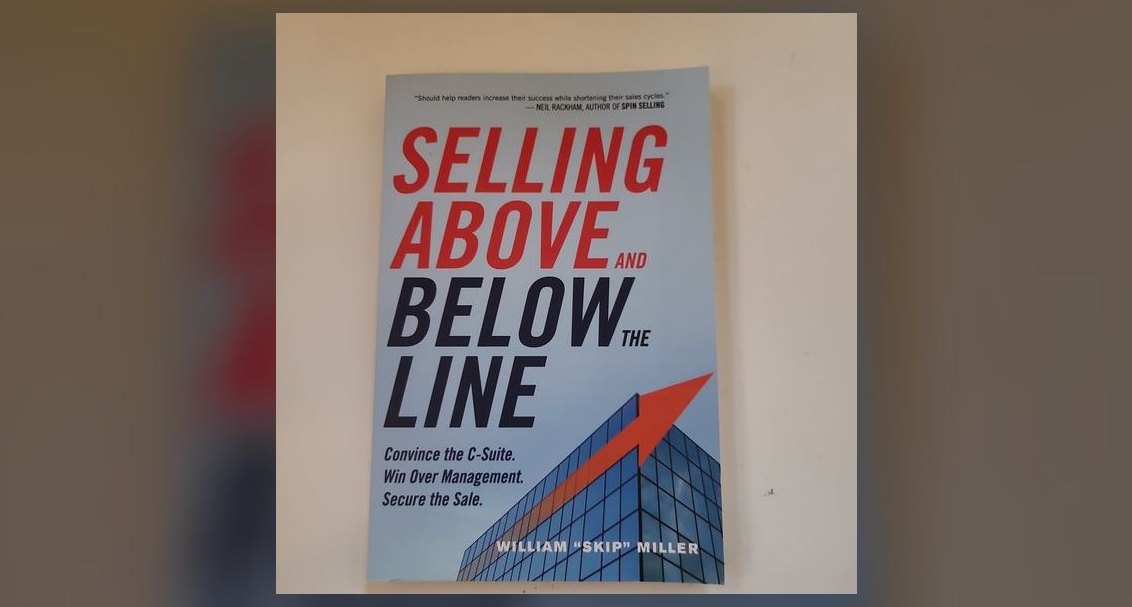 pulse-recentSelling Above and Below the Line by Skip Miller — Top 10 Key Takeaways for Sales Leaders in 2027
 pulse-booksRework by Jason Fried and David Heinemeier Hansson — Cliff Notes Summary
 pulse-recentThe Sales Acceleration Formula by Mark Roberge — Top 10 Key Takeaways for Sales Leaders in 2027
 pulse-recentWhat is the first concrete step in Sandler Rule #4 for a sales leader to implement in 2027?
 pulse-recentSnap Selling by Jill Konrath — Top 10 Key Takeaways for Sales Leaders in 2027
 pulse-recentWhat is the first concrete step in SPIN Selling by Neil Rackham for structuring a discovery call in 2027?
 pulse-recentHow I Raised Myself from Failure to Success in Selling by Frank Bettger — Top 10 Key Takeaways for Sales Leaders in 2027
 pulse-recentNever Split the Difference by Chris Voss — Top 10 Key Takeaways for Sales Leaders in 2027