


Never Split the Difference by Chris Voss — Top 10 Key Takeaways for Sales Leaders in 2027
Quality
Certified
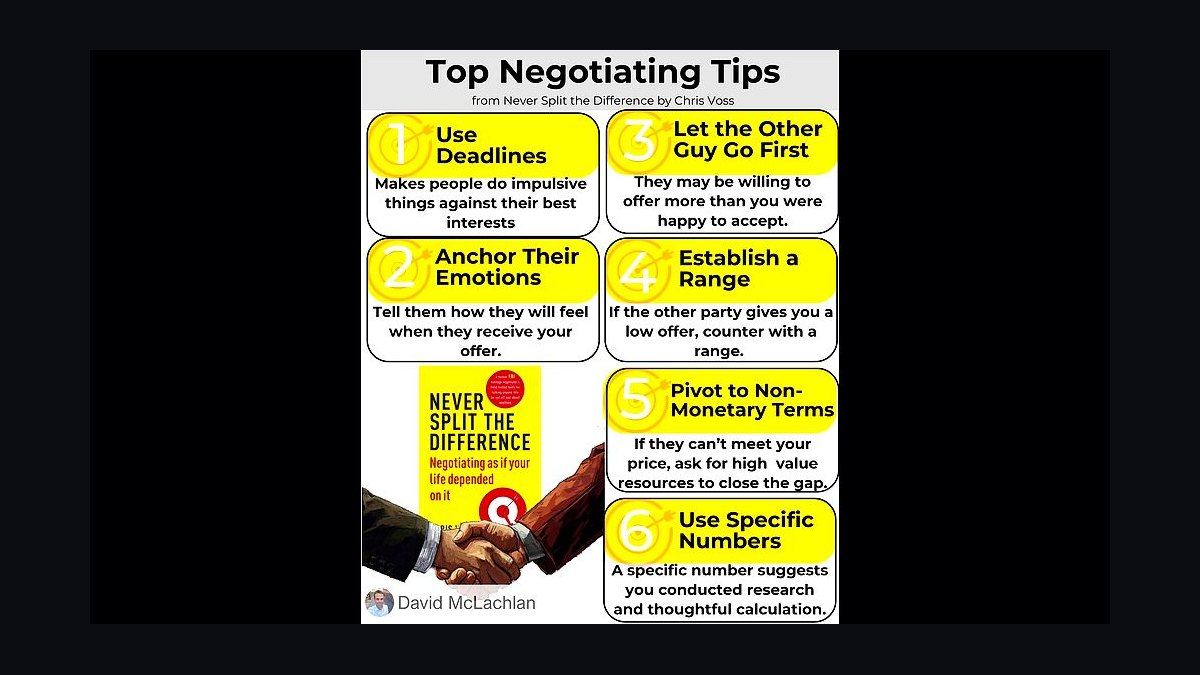
Chris Voss's *Never Split the Difference* teaches sales leaders that negotiation is emotional intelligence under pressure, not haggling. The top takeaways — tactical empathy, labeling, mirroring, calibrated questions, "no"-oriented framing, the Ackerman ladder, and hunting Black Swans — replace splitting the difference with disciplined discovery that protects margin and surfaces the real decision criteria.
The outcome you should expect when a sales org actually adopts Voss
Most sales leaders read *Never Split the Difference* and come away with a vocabulary — "labeling," "mirroring," "that's right" — without changing a single thing about how deals close. The book's own premise is that compromise is a failure mode: splitting the difference gets you one black shoe and one brown shoe, an outcome nobody wanted. So the honest question for a 2027 revenue org isn't "did the team enjoy the book," it's "did the discount curve change, and did we learn things in discovery we were not learning before."
The realistic outcome is narrower and more useful than the hype suggests. Voss's techniques are strongest in the middle of a deal — discovery, multi-threading, objection surfacing, and the final concession sequence. They are weakest as a substitute for pipeline. No amount of tactical empathy fixes a rep who is negotiating with someone who cannot sign, and Voss himself is explicit that identifying the true decision-maker (and the hidden "Black Swan" information that changes the whole frame) matters more than any single verbal move.
What you should expect to see, in order: first, longer and more revealing discovery calls, because calibrated questions invite the buyer to talk and reps stop pitching over silence. Second, fewer surprise losses in late stage, because labeling surfaces objections while there's still time to address them. Third — and only third, usually a quarter or two later — better realized pricing, because reps stop offering the reflexive 10% and start trading concessions for terms. Leaders who invert this order and measure discount rate in week two conclude the book "doesn't work."
Set the expectation with your team plainly: this is a communication discipline, not a script. Voss's own framing is that the goal is to get the counterpart to say "that's right" — genuine agreement that you understand their world — rather than "you're right," which is the polite brush-off that precedes ghosting. That distinction is the single most useful diagnostic a manager can listen for on a recorded call, and it costs nothing to start listening for it Monday morning.

There's also an adjacent benefit leaders underrate: these techniques travel. The same labeling and calibrated-question discipline that works on a procurement lead works on an internal deal desk, on a churn-risk QBR, on a partner co-sell dispute, and on a candidate negotiating comp. Teams that adopt this well tend to see the vocabulary migrate into CS renewals and partner management within a couple of quarters, which is usually where the compounding return actually shows up.
What drives that outcome — the ten takeaways that matter for revenue leaders
Voss's core argument is that negotiation runs on emotion and information, and that the person asking the questions controls the conversation. Here are the takeaways that translate most directly into a sales motion.
Tactical empathy. Not sympathy, not agreement — the deliberate demonstration that you understand the other side's perspective and the emotions driving it. Voss's position is that you cannot move someone you haven't first made feel heard. In a sales context this means the rep can articulate the buyer's constraints better than the buyer can, including the ones that make your product inconvenient.
Mirroring. Repeating the last one to three words the counterpart said, with an upward inflection, then shutting up. It is almost absurdly simple and it reliably produces elaboration. On a discovery call, the buyer says "the rollout timeline is complicated," the rep says "complicated?" and gets thirty seconds of unprompted context about an internal reorg nobody was going to volunteer.

Labeling. Naming the emotion or dynamic you observe: "it seems like this budget cycle is a real constraint," "it sounds like you've been burned by an implementation before." Voss's guidance is to use "it seems like / it sounds like / it looks like" rather than "I'm hearing that," because the first-person phrasing pulls attention back to you. Labels defuse negative emotion by making it explicit; unlabeled fear runs the deal from the shadows.
The accusation audit. Preemptively listing every bad thing the counterpart might be thinking about you before they say it. "You're probably thinking we're the expensive option, that switching costs will eat the first year, and that our team is going to disappear after signature." Saying it first drains its charge. For a sales leader this is the highest-leverage thing to install in a pricing conversation, because it converts unspoken objections into a shared agenda item.
"No" is the start, not the end. Voss argues that "yes" is often counterfeit — people say it to get you off the phone — while "no" makes people feel safe and in control. So you engineer for it: "Is it a ridiculous idea to loop in your security team this week?" "Have you given up on solving this?" No-oriented questions get honest answers, and honest answers are what forecasting is made of.
"That's right" is the breakthrough. The moment the buyer says "that's right" after your summary, you have earned the right to propose. "You're right" means you've lost them. Voss's tool for producing "that's right" is the summary: a paraphrase plus a label that reflects the counterpart's whole world back at them.
Calibrated questions. Open-ended "how" and "what" questions that give the counterpart the illusion of control while making them solve your problem. "How am I supposed to do that?" is the flagship — it forces the other side to confront your constraints without you making a demand. Voss's advice to avoid "why" is practical: "why" reads as accusatory in nearly every language.
Bend their reality — anchor, frame, and use loss aversion. People are more motivated to avoid a loss than to secure an equivalent gain. Voss recommends anchoring extremes, using odd, precise numbers because they read as calculated rather than arbitrary, and framing terms in the counterpart's frame of reference. In practice: a proposal at $37,450 signals analysis; $40,000 signals a round number you'll obviously discount.
The Ackerman bargaining model. Voss's structured concession ladder: set your target, open at 65% of it, then step to 85%, 95%, and 100% with decreasing increments. Use lots of empathy and no-oriented questions between offers, never counter until they've responded, and on the final number add a non-monetary item to show you're at your limit. The decreasing increments telegraph that you're converging on a true ceiling.
Find the Black Swans. The three to five pieces of unknown information that, once surfaced, change the entire negotiation. Voss's claim is that every negotiation has them, and they only appear in unguarded, in-person, off-agenda moments. For a sales org this is an argument for multi-threading and for the "what's the thing nobody outside your company knows about this project?" question.
Benchmarks and realistic ranges for a 2027 rollout
Be careful here, because this is where sales-enablement claims usually get invented. Voss does not publish controlled trial data on B2B win rates, and neither should you pretend to. What you *can* do is set internal baselines and watch them move.
The metrics worth instrumenting, in rough order of how fast they respond:

Talk-to-listen ratio. Most conversation-intelligence platforms report this out of the box. Reps trained on mirroring and calibrated questions should talk less on discovery calls, not more. Pick your current team median as the baseline and set a directional target — if your top performers already sit meaningfully lower than the team median, that gap is your target, not a number from a blog post.
Question count and question type. Count open "how/what" questions per discovery call versus closed and "why" questions. This is the cleanest leading indicator that training stuck, because it's behavioral rather than emotional and a manager can score it from a transcript in two minutes.
Objections surfaced before the proposal stage. If labeling and accusation audits are working, objections migrate earlier in the funnel. Track the share of closed-lost deals where the stated loss reason was never logged before the proposal was sent. That number should fall. High values there mean your reps are getting "you're right" and mistaking it for progress.
Realized discount versus list. The slowest and most meaningful. Ackerman only pays off when reps actually hold the ladder, which requires a deal desk that will not undercut them. Expect no movement at all in the first quarter and only modest movement in the second — and expect a subset of reps to get worse before they get better, because a half-learned concession ladder is worse than an honest single number.
Multi-threading depth. Contacts engaged per opportunity. The Black Swan takeaway is functionally an argument for breadth of contact, and this is the easiest metric to move deliberately.
On timelines: treat a Voss rollout like any behavior change, not like a tool rollout. A single workshop produces a two-week vocabulary bump and then decays. Sustained change generally requires weekly call review with specific coaching on one technique at a time, over at least a quarter. Trying to install all ten takeaways at once is the most common failure and produces reps who sound like they're running a script — which buyers detect immediately and resent.
A reasonable sequencing for a team of ten to thirty reps: weeks one to three, mirroring and labeling only. Weeks four to six, calibrated questions and the accusation audit. Weeks seven to nine, no-oriented framing and the summary-to-"that's right" drill. Weeks ten onward, the Ackerman ladder, and only with reps who have already demonstrated the earlier skills on recorded calls. Rolling out the concession ladder first — which is what most leaders instinctively want, because it touches price — inverts the dependency and is why so many teams report the book "didn't take."
Risks, edge cases, and failure modes
The biggest risk is that the techniques get used as manipulation, and buyers can tell. Voss's own framing is that tactical empathy is about understanding, not tricking — but a rep who has read the summary and not the book will mirror mechanically, label inaccurately, and produce a conversation that feels like being handled. Inaccurate labels are worse than no labels: "it seems like cost is your main concern" said to someone whose actual concern is implementation risk tells the buyer you weren't listening. The repair is straightforward and Voss recommends it explicitly — when a label misses, say so and ask, rather than defending it.
Cultural and contextual fit is a real constraint. Voss's material comes out of high-stakes kidnapping negotiation and American business contexts. Direct labeling of emotion lands differently across cultures and across buyer roles; a procurement professional running a formal RFP with scoring rubrics is not going to be moved by "it sounds like this has been frustrating." In heavily proceduralized enterprise buying — public sector, regulated industries, formal tenders — the negotiation surface is genuinely narrow and the leverage lives in the requirements document written months earlier. Deploying Voss techniques there is not wrong, but expecting them to override a scoring matrix is.
Ackerman has a specific failure mode worth naming. The model assumes you have room to open at 65% of target and a counterpart willing to trade. If you sell at transparent published pricing, or your deal desk publishes a floor everyone knows, the ladder is theater. Worse, opening at 65% of a number you actually need can destroy credibility with a sophisticated buyer who benchmarks your pricing against peers. Use the ladder where there's genuine negotiation latitude — enterprise, multi-year, bundled — and skip it in transactional motions where a clean, well-anchored single number closes faster.
There's a forecasting edge case leaders should watch. "No"-oriented questions produce more honest answers, which means the forecast should get *more accurate*, not more optimistic. If your team adopts these techniques and the forecast simultaneously improves in both accuracy and optimism, someone is coaching to the metric. Early in a rollout it's normal and healthy for stage-two pipeline to shrink as reps disqualify faster.
Another failure mode: the summary that never lands. Reps chase "that's right" so hard that calls balloon and momentum dies. Voss's technique is a *concise* summary — paraphrase plus label — not a fifteen-minute recitation. If your discovery calls are running long without a corresponding rise in qualified opportunities, the summary discipline has degraded into stalling.
Finally, there's an internal risk. Once a team learns these tools, they'll use them upward — on their manager, on deal desk, on the comp plan. That's mostly fine and arguably a sign the training worked, but leaders should be honest that a rep who runs an accusation audit on you before asking for a territory change is doing exactly what you taught them. Reward it rather than punishing it, or the skill quietly gets shelved as something reps only do to outsiders.
One more caution about the book itself: it's a memoir as much as a manual, and the hostage-negotiation stories are the reason it's memorable and also the reason it's easy to over-apply. Very few B2B deals have the asymmetry of a hostage situation. Your buyer can walk, has alternatives, and will still be in your market next year. Techniques calibrated for a counterpart with no exit need adjusting for a counterpart with plenty.
A practical rollout plan for a sales organization
Start with evidence, not enthusiasm. Before any training, pull twenty recorded calls — ten from top performers, ten from the middle of the distribution — and score them on the behavioral markers: open questions asked, labels used, accusation audits attempted, "that's right" moments, and the shape of the concession sequence. You will almost always discover that your best reps already do several of these instinctively. Naming what they already do is far more persuasive to a skeptical team than a book club.
Then pick one technique. Mirroring, first, because it's the cheapest to learn, the hardest to do badly, and produces visible results on the first call. Run a thirty-minute session, have reps practice on each other, and then require every rep to bring one recorded mirror to the next team meeting. Manager coaching should be specific to that one behavior for the full two to three weeks — no drifting into the rest of the book.
Layer the next technique only after the first shows up unprompted in recorded calls. This is the whole discipline: sequenced, single-skill installation with call-level evidence at each gate. It is slower than a one-day workshop and it is the only version that survives past the quarter.
Build the supporting infrastructure at the same time. That means a shared accusation-audit library — the eight or ten objections your buyers actually carry, written out as preemptive statements reps can adapt. It means a calibrated-question bank organized by deal stage. It means a deal-desk policy that explicitly supports the Ackerman ladder rather than undercutting it, because nothing kills a concession strategy faster than a rep holding at 85% while an SE promises a 20% discount on a parallel thread.
Extend it past new business. Renewals and expansion conversations are the highest-yield adjacent use case: a CSM running an accusation audit before a price increase ("you're probably thinking this increase came with no warning, that support has been slower this year, and that we're counting on switching costs") converts a hostile call into a working one. Partner managers negotiating co-sell splits and recruiters closing candidates benefit from the same toolkit. If you're going to invest in the training, the marginal cost of including CS and partnerships is near zero and the return is often higher than in new business, because those conversations are relationship-dense and less scripted.
Measure honestly and publicly. Publish the behavioral metrics — question counts, objections surfaced early, multi-threading depth — weekly, and the outcome metrics quarterly. Resist reporting a win-rate lift in month one; it will be noise, and claiming it destroys credibility for the real result later.
Finally, decide what "done" means before you start. A reasonable definition: every rep can run a discovery call where the buyer talks more than they do, can produce a summary that earns "that's right" on a recorded call, and can walk a concession ladder without volunteering a discount. That's a concrete bar a manager can certify against, and it's a far better goal than "the team read the book."
Related questions
Is splitting the difference ever the right move?
Yes — when the gap is small, the relationship matters more than the increment, and the cost of another round exceeds what's contested. Voss's argument is against reflexive compromise as a default strategy, not against ever meeting in the middle when the math genuinely favors it.
How is this different from SPIN Selling or MEDDIC?
MEDDIC is a qualification framework and SPIN is a question sequence for building need. Voss is about the emotional and informational dynamics of the conversation itself. They stack rather than compete: MEDDIC tells you what to learn, Voss gives you the technique for getting someone to tell you.
Can these techniques work over email and chat?
Partially. Labels and accusation audits translate to writing reasonably well. Mirroring and the pursuit of "that's right" depend on tone, timing, and silence, which text strips out. Use written channels for accusation audits and summaries; save the rest for voice or video.
What's the single highest-return technique to start with?
The accusation audit before a pricing conversation. It takes one prepared paragraph, requires no improvisation skill, and converts the objections your buyer was going to raise privately into a shared agenda you control the framing of.
Does this apply to inbound, product-led motions?
Less directly, since much of the negotiation is displaced into pricing pages and self-serve limits. It applies at the upgrade and enterprise-conversion boundary, and in churn-save conversations, where a real human negotiation reappears.
FAQ
What does "never split the difference" actually mean?
It means refusing reflexive compromise as a negotiating default. Voss's illustration is that meeting in the middle can produce an outcome neither side wanted — the mismatched shoes. His alternative is to keep working the conversation with empathy and questions until you find a solution that addresses the real underlying interests, rather than mechanically halving the gap.
What is tactical empathy?
The deliberate practice of understanding and articulating the counterpart's perspective and emotional state, without necessarily agreeing with it. It's a working tool, not a feeling. In sales, it shows up as the rep being able to state the buyer's constraints, risks, and internal politics accurately enough that the buyer confirms it — which is what earns the right to propose.
Why does Voss say to avoid "why" questions?
Because "why" reads as accusatory in most contexts and languages, putting the counterpart on the defensive. "What made this a priority now?" gets the same information as "why is this a priority?" without the implied challenge. Voss's calibrated questions lean almost entirely on "how" and "what" for this reason.
How does the Ackerman model work in practice?
Set your target price. Open at 65% of it. Then move to 85%, 95%, and finally 100% of target, using empathy and calibrated questions between each step and never countering yourself before the other side responds. The shrinking increments signal you're approaching a real limit, and adding a non-monetary item on the last offer reinforces it.
Does this work with professional procurement teams?
It works, but with reduced leverage. Procurement professionals are trained to recognize and neutralize negotiation tactics, and formal RFP processes deliberately limit the conversational surface. The takeaways that hold up best there are calibrated questions and the accusation audit; the ones that hold up least are anchoring games against a published scoring rubric.
How long before a sales team sees results?
Behavioral metrics like question mix and talk ratio move within weeks. Pipeline-quality effects — objections surfacing earlier, cleaner disqualification — typically show over a quarter. Pricing outcomes are the slowest and depend heavily on whether your deal desk and leadership actually hold the line behind the reps.
Sources
- Never Split the Difference — publisher page (HarperCollins)
- The Black Swan Group — Chris Voss's negotiation firm
- Harvard Program on Negotiation — negotiation skills and research
- HBR: How to Negotiate with a Liar
- Kahneman & Tversky, "Prospect Theory: An Analysis of Decision under Risk" (JSTOR)
- Wikipedia — Never Split the Difference
- Harvard Business Review — negotiation topic hub
- Chris Voss — MasterClass on the art of negotiation
Related on PULSE
- How to run a discovery call that surfaces objections before the proposal
- MEDDIC vs. MEDDPICC: which qualification framework fits your motion
- Building a deal desk that protects discount discipline
- Multi-threading enterprise deals: how many contacts is enough
- Renewal conversations: pricing increases without churn spikes
- Sales call coaching: what to score on a recorded call
This page will be disappearing soon. Save it to your device for $1 — or read it free while it is here.
@Kory-White- · if Venmo asks, the last 4 of my number are 2012
This page is gone.
This one is off the shelf now. $1 keeps it on your phone for good — the whole page, pictures and diagrams included.
 pulse-recentCrossing the Chasm by Geoffrey Moore — Top 10 Key Takeaways for Sales Leaders in 2027
 book-summaryMajor Account Sales Strategy by Neil Rackham: Summary, Key Lessons, and RevOps Takeaways
 pulse-recentWhat are the concrete steps in Sandler Rule #7 for handling a prospect's budget objection in 2027?
 pulse-recentWhat are the concrete steps to implement the Sandler Rules for Sales Leaders by David Mattson in 2027?
 pulse-recentSPIN Selling by Neil Rackham — Top 10 Key Takeaways for Sales Leaders in 2027
 pulse-recentHyper Sales Growth by Jack Daly — Top 10 Key Takeaways for Sales Leaders in 2027
 pulse-recentWhat is the first concrete step in SPIN Selling by Neil Rackham for structuring a discovery call in 2027?
 pulse-recentSell or Be Sold by Grant Cardone — Top 10 Key Takeaways for Sales Leaders in 2027
 pulse-recentHigh-Profit Prospecting by Mark Hunter — Top 10 Key Takeaways for Sales Leaders in 2027
 pulse-recentSnap Selling by Jill Konrath — Top 10 Key Takeaways for Sales Leaders in 2027