
Gap Selling — Cliff Notes Summary
 Curated byKory White · Fractional CRO · Maryland
 PULSEKNOWLEDGE LIBRARY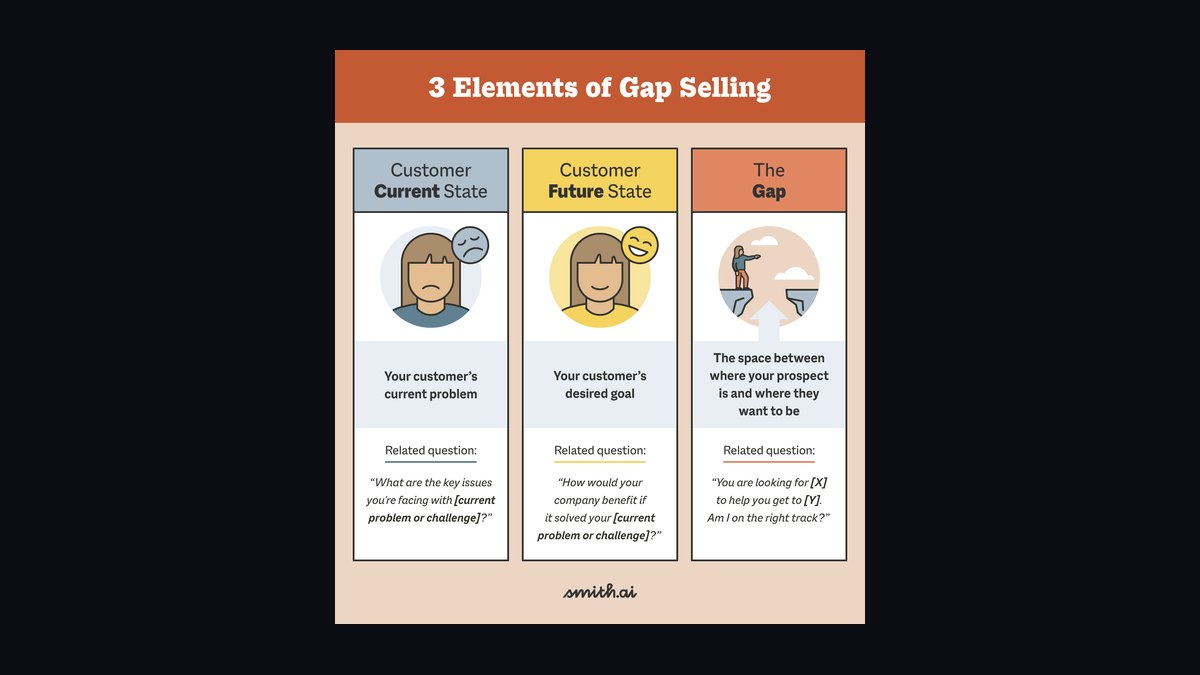
Gap Selling by Keenan argues no sale exists without a problem, and every problem is a measurable gap between a buyer's current state and their future state. Value equals gap size. Sellers diagnose first — mapping literal, business, and emotional reality — then position the product as the bridge. Objections, pricing pushback, and stalls are symptoms of an undersized gap.
What changes when a team actually adopts this
The honest outcome of reading Gap Selling is not a bigger pipeline. It is usually a *smaller* one — and that is the point. Teams that adopt the framework properly start disqualifying deals that never had a problem attached, which means the top of the funnel contracts before the bottom improves. Managers who expect Week 2 lift are the ones who abandon the method in Week 3.
What you should expect instead, in rough order of arrival:
Weeks 1–3: discovery calls get longer and more uncomfortable. Reps who used to run a 22-minute call with four questions and a demo request now run 40-minute calls where they ask a buyer why a problem has persisted for three years. Call recordings get harder to listen to, because reps are new at asking hard questions and they flinch. This is a skill-acquisition dip, not a failure signal. Anyone reviewing Gong or Avoma transcripts during this window should be grading question *type*, not outcome.
Weeks 4–8: stage-2 conversion drops, stage-4 conversion climbs. This is the clearest early tell. When a rep is required to articulate a quantified gap before a deal advances, a meaningful slice of "interested" prospects fail the test and get pushed back or killed. Pipeline value on the board goes down. But the deals that survive convert at a materially higher rate, because they were never going to be no-decision losses in the first place.

Months 3–6: "no decision" starts falling as a loss reason. This is the outcome most worth tracking, because it is the single failure mode Gap Selling was designed to attack. Matthew Dixon's later work in The JOLT Effect quantified indecision as a huge share of closed-lost in complex B2B — a finding that arrived four years after Keenan's book and independently validated its central premise. If your CRM's top loss reason is still "no decision" after two full quarters of practice, the gap work is happening on paper but not in the buyer's head.
Months 6–12: forecast accuracy improves more than win rate does. This surprises people. A sized gap is a much better predictor of close than a rep's gut confidence, so forecasts tighten before win rates move. RevOps leaders often get the strongest ROI here — not from selling more, but from knowing sooner what will and won't land.
A caution on expectations: the framework is a diagnostic stance, not a script. Teams that turn it into a checklist ("did you ask the four question types? tick the box") get compliance without comprehension. The reps who improve most are the ones who genuinely become curious about the buyer's business, and curiosity is not a field in Salesforce.

The mechanics underneath the outcome
The reason the framework works is structural, not motivational. It reorders the sale so that the expensive, low-yield activities happen *after* the cheap, high-yield one.
Current state is the foundation, and it has four layers. Keenan demands you map the buyer's literal environment (tools, headcount, tech stack, process), their business environment (revenue, growth, market position), their problems, and — the layer nearly everyone skips — their emotional state. What does the VP of Sales feel walking into a Monday forecast call when the number is short? Embarrassed, defensive, quietly worried about their job? Urgency is emotional. A perfectly quantified gap that carries no emotional weight produces a polite "let's revisit next quarter."
Future state has to be numeric or it is useless. "We want to grow" is not a future state. "We want to hit a specific ARR number by a specific quarter, at a specific net revenue retention, with a specific LTV/CAC ratio" is. Without specificity on both ends, the gap has no dimensions and cannot be sized. Most sellers ask "what are your goals?" and accept the first vague answer they hear. That single lazy moment is what makes the rest of the deal a grind.
The gap is the distance, and value equals the size of it. This is the load-bearing idea of the entire book. If a buyer will not pay your price, the near-universal cause is that they do not perceive a gap large enough to justify it. Discounting treats the symptom. Re-quantifying impact treats the cause.

Problem and impact are different things, and impact is where urgency lives. The problem is "forecast accuracy is 62 percent." The impact is "the CFO has stopped trusting the sales number, a finance hire now sits in revenue reviews, and the CRO's bonus is exposed." Problems get acknowledged. Impacts get funded.
Root cause is what stops you from selling the wrong thing. Keenan pushes sellers to diagnose *why* the problem exists, not just that it does. If a buyer's win rate is low because discovery is shallow, a tool that automates proposals will not help — and a seller who sells it anyway earns a churn event in eleven months.
The adjacent workflows matter too. Marketing that writes content against problems rather than features feeds this motion; marketing that writes feature comparison pages fights it. Customer success inherits the gap document at handoff and can measure whether the promised bridge was actually crossed — which is the cleanest renewal argument that exists. And product teams that see aggregated gap data across a hundred deals get a roadmap signal far better than a win/loss survey.
Benchmarks, ranges, and where the numbers actually sit
Be careful with benchmarks here, because the sales-methodology space is full of vendor-published lift figures that will not survive scrutiny. What follows are directional ranges practitioners commonly work with, not guarantees.

Win rate. Keenan's framing is aimed squarely at teams whose win rates sit in the low twenties. If your team is below roughly 25 percent on qualified opportunities and "no decision" is your top loss reason, the diagnosis in this book is almost certainly describing you. Teams already running mature MEDDPICC or command-of-the-message motions with win rates north of 35 percent will find much of the content familiar.
Deal size and fit. The framework earns its keep in complex B2B where discovery is genuinely load-bearing — roughly the $25K to $500K-plus ACV band, multi-stakeholder, three-to-nine-month cycles. Below about $5K ACV in self-serve or product-led motions, the economics invert: a 40-minute diagnostic call costs more than the deal is worth, and product-qualified-lead scoring does more for you than any discovery framework. This is not a criticism of the book; it is a scope boundary the book itself was written before PLG existed to address.
Ramp time. Expect a full quarter before habits set and two quarters before pipeline metrics reflect it. Reps with prior consultative training move faster. Reps coming from transactional or heavily scripted environments take longest, because the method requires improvisation under uncertainty — you cannot pre-write the follow-up to an answer you have not heard yet.

Discovery call length. Practitioners running problem-centric discovery typically land in the 35–50 minute range for first calls in the mid-market band, versus 20–30 for feature-led calls. If your calls are not getting longer, you probably have not changed anything.
Pipeline coverage. Teams often see raw coverage ratios fall by a fifth to a third in the first two quarters as non-problems get purged. If your CRO tracks coverage without tracking coverage *quality*, brief them before you start, or the initiative dies on a board slide.
The pricing math. Keenan's approach to price is to express it as a fraction of the gap. If annual loss from the problem is a large multiple of the annual cost of the solution, the ROI argument closes the deal on its own. The discipline is in doing arithmetic the buyer agrees with — numbers you computed alone are marketing; numbers the buyer supplied and confirmed are leverage. When a buyer says the price is too high, the correct next question is almost never about price.
What not to benchmark. Do not set a target for "gaps identified per rep per week." Activity metrics on diagnostic work produce theater — reps will fill in the field to clear the gate. Measure the downstream effects (stage conversion, loss reasons, forecast accuracy) instead.

Where it breaks, and who it does not fit
An honest Cliff Notes summary has to include the failure modes, because most of them are predictable.
Checkbox adoption. The most common failure by a wide margin. A RevOps team adds a required "gap size" field to the opportunity record, reps type a number to advance the stage, and nothing else changes. The field is now populated and meaningless. If you add the field, pair it with call review — the field is evidence of a conversation, not a substitute for one.
Interrogation instead of discovery. Reps new to the method sometimes weaponize the hard questions. "Why has this problem persisted for three years?" is a great question delivered with genuine curiosity and a hostile one delivered as a gotcha. The book's tone is combative by design; the calls should not be. Coach the delivery, not just the question list.

Manufacturing a gap that isn't there. If a buyer genuinely does not have a problem, the correct move is to leave. Sellers under quota pressure will instead inflate a minor annoyance into a crisis, and buyers detect this instantly. The credibility loss extends to the whole vendor relationship.
Thin coverage of buying groups. Keenan is light on multi-threading and buying-committee dynamics. A perfectly built gap owned by one champion still dies when four other stakeholders each have a different problem. Pair the framework with MEDDPICC for stakeholder mapping, or with the buyer-group work in The Challenger Customer, if your deals routinely involve five-plus people.
Product-led and self-serve motions. As noted, sub-$5K ACV transactional SaaS gets little from this. So does anything with a genuine free-tier-to-paid conversion path where the product does the discovery.
The champion who leaves. A gap document lives in one person's head unless you write it down and share it. When your champion takes another job, an unrecorded gap evaporates. Put the current state, future state, and quantified impact in the CRM and in a shared doc the buyer has seen — a mutual action plan is the natural home for it.

Emotional mapping done badly. There is a version of "map the emotional current state" that reads as manipulative — probing someone's job insecurity to create leverage. The defensible version is understanding what the buyer cares about so you can help them get it. The line is real, and reps who cross it burn accounts.
Manager bandwidth. This method dies without call coaching. If your frontline managers carry a quota, run fourteen direct reports, and review two calls a month, the rollout will not take. That is an org design problem, not a methodology problem, and it needs solving first.
A rollout plan that survives contact with a real team
Here is a practical sequence for a manager or RevOps lead putting this into production, built to produce evidence early enough that leadership does not kill it during the pipeline dip.
Before week one: read the book yourself, cover to cover. Do not roll out a framework from a summary — including this one. Then build a Problem Identification Chart for your top three personas: a three-column artifact listing the problems your product solves, the likely root causes behind each, and the probable impacts if left unsolved. This is the single most-copied artifact in the book and the cheapest thing to build. Keenan's firm publishes a problem identification worksheet you can start from.

Week one: rewrite the discovery template around current state, future state, and gap. Kill every question that exists to make the rep feel productive ("what's your timeline?" asked before you know the problem is theater). Introduce the four question types — probing, process, provoking, validating — and have each rep write three of each for their own patch.
Week two: run calls and record them. Do not change the CRM yet. Let reps practice in a low-stakes environment where the only consequence is a coaching conversation. Managers grade on whether an impact was surfaced, not on whether the meeting advanced.
Week three: review as a group. Pick two calls — one where the gap got built and one where it did not — and walk the team through the difference. Peer review does more here than manager review, because reps discount their manager and believe their peers.

Week four: add the CRM requirement. A quantified gap before stage three, with the number sourced from the buyer, not the rep. Now the practice has teeth.
Week five onward: enforce it in the forecast call. Any deal without a sized gap gets pulled from commit. This is the moment the initiative either becomes real or becomes decoration, and it depends entirely on whether leadership holds the line on the first uncomfortable Friday.
Ongoing: feed the gap data back. Aggregate the problems and root causes across closed-won and closed-lost, and hand them to marketing and product quarterly. This is where the framework stops being a sales technique and becomes an operating strategy — the same diagnostic vocabulary running through content, roadmap, and renewal conversations.
One note on tooling. Conversation intelligence platforms now extract current state, future state, and problem language from transcripts automatically, which means the book's vocabulary is quietly becoming a default schema for AI sales coaching. That is a real tailwind — but the tool can tell you a question was asked, not whether the buyer actually felt the gap. Judgment still lives with the human.
Related questions
Is Gap Selling still relevant given AI-assisted selling?
Yes, arguably more so. AI tools now auto-extract current state, future state, and gap language from call recordings, which makes the framework's vocabulary a useful schema for coaching at scale. The diagnosis still requires human judgment; the transcription and tagging no longer do.
How does it compare to SPIN Selling?
SPIN is a question-sequencing framework — situation, problem, implication, need-payoff — with strong research behind it. Gap Selling is narrower and blunter: it makes quantified problem diagnosis the entire job. They overlap heavily. SPIN teaches the questions; Gap Selling teaches the stance and the arithmetic.
Do I need MEDDPICC too?
They solve different problems and pair well. Gap Selling builds the case for change; MEDDPICC maps the people, paper, and process required to get it signed. Teams with strong discovery and weak stakeholder coverage should add MEDDPICC. Teams with the reverse problem should start here.
What is the Problem Identification Chart?
A pre-call worksheet with three columns: problems your product solves, the likely root causes behind each, and the probable impact if unresolved. Built per persona, before the call. It converts a rep's improvisation into preparation and is the fastest single thing to implement from the book.
Should RevOps own the rollout?
Partly. RevOps should own the stage-gate definitions, CRM fields, and reporting on loss reasons and forecast accuracy. Frontline managers must own the call coaching. Rollouts where RevOps owns both tend to produce populated fields and unchanged conversations.
FAQ
What exactly is Gap Selling?
Gap Selling is a problem-centric methodology built on the premise that no sale exists without a problem, and that every problem is a measurable gap between a buyer's current state and their desired future state. The seller's job is to diagnose that gap in dollars, time, risk, and emotion, then position their solution as the bridge across it. Keenan published it in 2018 through A Sales Guy Publishing.
Is this book only for experienced sellers?
No. The core concepts are accessible to a first-year rep, and in some ways new sellers adopt it faster because they have no product-pitch habits to unlearn. The difficulty is not comprehension, it is discipline — consistently doing thorough problem diagnosis under quota pressure takes months of deliberate practice regardless of tenure.
Does it work outside of software sales?
The framework is product- and industry-agnostic because it operates on problems rather than features. It fits any sale where the buyer has a real, measurable, expensive problem and a genuine choice about whether to act. It fits worst where the purchase is transactional, low-consideration, or where the product is genuinely a nice-to-have.
Do I have to stop talking about my product?
Not permanently, only until the buyer understands and feels their own gap. The book's target is product-centric selling — leading with features before the problem is established. Once the gap is built and sized, product conversation becomes relevant and easy, because you are describing a bridge someone already wants to cross.
How do I handle a price objection under this framework?
Treat it as evidence that the gap is undersized in the buyer's mind, not as a request for a discount. Return to impact: what does the problem cost annually, what breaks if it persists, who feels it. If the arithmetic the buyer agreed to makes the price look small, the objection usually dissolves. If it does not, the deal may genuinely not be worth their money — which is useful information.
What is the fastest thing I can implement from the book?
The Problem Identification Chart. Pick your top persona, list the problems you solve, the root cause behind each, and the impact of leaving each unsolved. It takes an afternoon, and it changes the quality of the next call you run more than any other single change described here.
Sources
- Gap Selling on Amazon — Keenan, A Sales Guy Publishing, 2018
- A Sales Growth Company — Gap Selling methodology
- Gong — operator guide to Gap Selling
- Avoma — Gap Selling applied to modern discovery
- Yesware — Gap Selling review and breakdown
- Built In — Gap Selling explained
- Goodreads — Gap Selling reader reviews and ratings
- 30MPC Tactics — uncovering problems with Gap Selling
- Salesman.com — podcast interview with Keenan
Related on PULSE
- [SPIN Selling by Neil Rackham: Summary, Key Lessons, and RevOps Takeaways](/knowledge/bs296)
- [Secrets of Question-Based Selling by Thomas Freese: Summary, Key Lessons, and RevOps Takeaways](/knowledge/bs301)
- [Selling the Invisible by Harry Beckwith — Cliff Notes Summary](/knowledge/bs0315)
- [Gap Selling by Keenan: Summary, Key Lessons, and RevOps Takeaways](/knowledge/bs295)
- [Gap Selling by Keenan — Cliff Notes Summary & Key Takeaways](/knowledge/bs0010)
This page will be disappearing soon. Save it to your device for $1 — or read it free while it is here.
@Kory-White- · if Venmo asks, the last 4 of my number are 2012
 pulse-recentVirtual Selling by Jeb Blount — Top 10 Key Takeaways for Sales Leaders in 2027
 pulse-recentMade to Stick by Chip Heath and Dan Heath — Top 10 Key Takeaways for Sales Leaders in 2027
 pulse-recentTraction by Gabriel Weinberg and Justin Mares — Top 10 Key Takeaways for Sales Leaders in 2027
 book-summaryWhat Great Salespeople Do by Michael Bosworth and Ben Zoldan — Cliff Notes Summary
 book-summarySPIN Selling by Neil Rackham: Summary, Key Lessons, and RevOps Takeaways
 book-summaryGrit by Angela Duckworth — Cliff Notes Summary for Sales Leaders
 pulse-recentThe Effortless Experience by Matthew Dixon — Top 10 Key Takeaways for Sales Leaders in 2027
 pulse-recentThe Customer Success Professional’s Handbook by Ashvin Vaidyanathan — Top 10 Key Takeaways for Sales Leaders in 2027
 book-summaryTalking to Humans by Giff Constable — Cliff Notes Summary
 book-summaryThe Trusted Advisor by Maister, Green & Galford — Cliff Notes Summary