
Made to Stick by Chip Heath and Dan Heath — Top 10 Key Takeaways for Sales Leaders in 2027
 Curated byKory White · Fractional CRO · Maryland
 PULSEKNOWLEDGE LIBRARY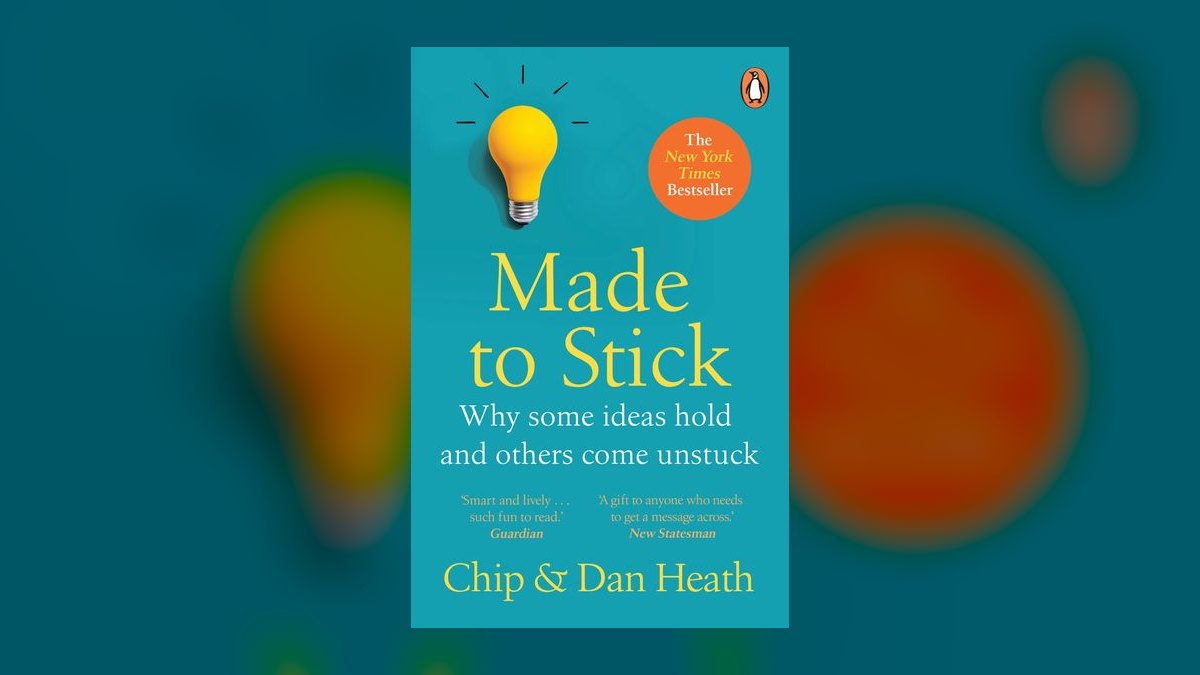
Made to Stick by Chip Heath and Dan Heath distills six principles — Simple, Unexpected, Concrete, Credible, Emotional, Stories — that make ideas memorable and actionable. For sales Leaders in 2027, these Takeaways matter because buying committees forget generic pitches fast. Applying the SUCCESs framework to messaging, onboarding, and deal strategy helps reps Stick in memory, shorten cycles, and win more consistently against competitors.
A stalled enterprise deal shows why sticky messaging wins
Consider a concrete 2027 scenario that many revenue organizations will recognize. A B2B software company sells a compliance automation platform into mid-market financial services. Its average contract value sits near $48,000, its sales cycle runs roughly 95 to 120 days, and its win rate hovers around 22 percent on qualified opportunities. A rep named Dana has been working a 340-employee credit union for four months. She has run six discovery and demo calls, sent a 42-slide deck, and delivered a 28-page security questionnaire. The economic buyer, a chief risk officer, has gone quiet for three weeks.
Dana's manager reviews the deal and finds the problem is not effort. It is memory. When the champion is asked by the CFO what the platform does, the champion says something vague like "it automates some compliance workflows." Nothing survives the internal replay. The CFO cannot repeat it, cannot defend it, and cannot justify a $48,000 line item against four other competing priorities. The deal stalls not because the product is weak but because the message evaporates the moment Dana leaves the room.
This is the exact problem Chip Heath and Dan Heath wrote about in Made to Stick. Their core insight is that ideas do not spread because they are true or important. They spread because they are constructed to survive the journey from one brain to another. For sales Leaders, this reframes the job. It is no longer enough to train reps on features, objection handling, and MEDDPICC. Leaders must also engineer the message itself so it survives the internal replay that happens when the buyer is not in the room.
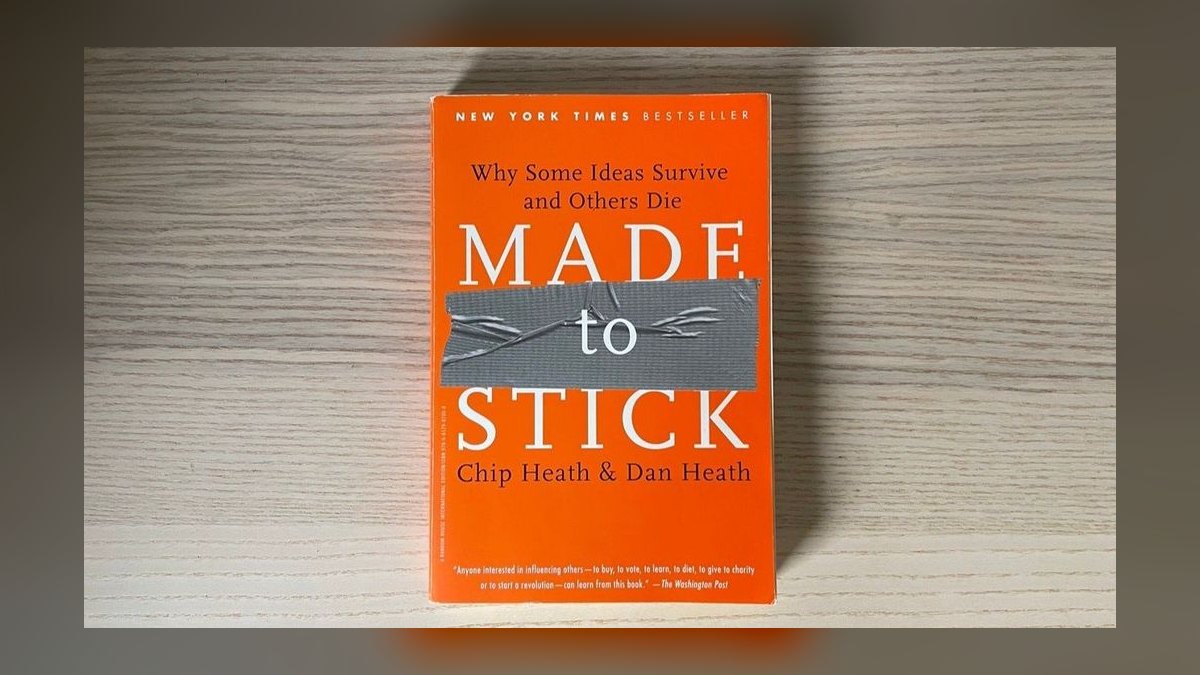
Now imagine the same deal with a sticky message. Dana's champion tells the CFO: "Right now, three people spend eleven hours a week pulling evidence for audits. This tool cuts that to ninety minutes by pulling the same evidence automatically." That sentence is simple, concrete, and emotional. It survives. The CFO can repeat it to the board. That is the difference the Heath brothers describe, and it is measurable in cycle time and win rate.
The rest of this page translates the book into operating practice for sales Leaders in 2027. It covers how the mechanism actually works, real numbers and benchmarks you can sanity-check against, the trade-offs of over-indexing on stickiness, and the pitfalls that quietly erode adoption. The goal is not to summarize a bestseller. It is to give a revenue Leader a usable operating model.

How the mechanism actually works
The Heath brothers built their framework from a study of naturally sticky ideas — urban legends, conspiracy theories, memorable ads, and enduring proverbs. They asked what these ideas share that forgettable ones lack. The answer became the SUCCESs checklist: Simple, Unexpected, Concrete, Credible, Emotional, and Stories. The book's central argument is that these six traits are not stylistic flourishes. They are the load-bearing structure that determines whether an idea survives transmission.
Here is the mechanism in plain terms. Human working memory holds only a few chunks of information at once, and it discards anything that cannot be compressed. A message that requires the listener to hold eight abstractions simultaneously will be dropped. A message that compresses to one concrete image will be retained. This is why "three people spend eleven hours a week" beats "streamlined compliance operations." The first is a chunk the brain can carry. The second is noise.
Each of the six principles does a specific job. Simple finds the core and forces a choice about what to leave out. Unexpected breaks the prediction loop so attention is captured. Concrete converts abstraction into something the senses can verify. Credible supplies the internal or external proof that stops the listener from discounting the claim. Emotional makes the listener care enough to act. Stories provide a mental simulation the listener can run and retell. Remove any one and the idea weakens. Remove Simple and the idea is too heavy to carry. Remove Emotional and nobody bothers to carry it.

For sales Leaders, the operational implication is that messaging must be designed, not discovered. Most organizations let each rep improvise the pitch. That produces variance, and variance produces forgettable messaging. A better model is to treat the core narrative the way a product team treats a feature: define it, test it, version it, and measure whether it survives the buyer's internal replay. The test is simple. Ask the champion to explain your product to a colleague in one sentence. If they cannot, the message has not stuck.
The diagram above is the practical sequence. Notice that it is a loop of questions, not a checklist you complete once. In practice, a sales Leader runs this sequence on the three to five core messages that carry the majority of deals, then trains reps to deliver those messages consistently. Everything else — the 42-slide deck, the security questionnaire, the feature matrix — is supporting material. The sticky core is what the buyer repeats.
There is a second mechanism worth naming. The Heath brothers emphasize that sticky ideas are often generated, not found. Their research on "the curse of knowledge" shows that experts systematically overestimate how much their audience understands. A sales Leader who has lived inside the product for five years cannot easily hear the pitch as a first-time buyer does. This is why sticky messaging usually requires an outsider's eye — a rep who just joined, a customer who just bought, or a fresh transcript review. The curse of knowledge is the single biggest reason internal messaging feels clear to the team and confusing to the market.

Real numbers, ranges, and benchmarks
The book itself is qualitative, so a careful reader should be skeptical of anyone who attaches precise statistics to it. What follows are ranges that revenue Leaders in 2027 can use as sanity checks, drawn from general patterns in B2B sales rather than from the book. Treat them as directional, not as published findings from the Heath brothers.
Start with memory decay. Without reinforcement, buyers forget the majority of a vendor's specific claims within days of a demo. In practice, teams that measure "message recall" — asking a champion to restate the value proposition a week after the call — often find that fewer than one in three can do so accurately. That single metric is a leading indicator of deal health. If your champion cannot restate your value proposition, your forecast is probably optimistic.

Next, consider cycle time. Mid-market B2B sales cycles commonly run 60 to 120 days, and enterprise cycles run 120 to 270 days. A sticky core message does not eliminate the cycle, but it reduces the number of touches required to re-explain the value. Teams that tighten their messaging often report a 10 to 20 percent reduction in the number of calls needed to reach a decision, which compounds into shorter cycles. These are operational estimates, not guarantees.
Then look at win rates. On qualified opportunities, healthy B2B win rates typically fall between 20 and 35 percent, with top-quartile teams exceeding 40 percent in well-defined segments. The gap between average and top performers is rarely explained by product alone. It is frequently explained by message consistency — the degree to which every rep tells the same story in the same way. Consistency is a measurable variable, and it is one of the few levers a sales Leader can control directly.
Finally, consider onboarding and ramp. New rep ramp time in B2B sales commonly runs three to nine months to full productivity. If your onboarding teaches product features but not sticky messaging, ramp will be slower because reps must invent their own narrative. Organizations that ship a defined core narrative as part of onboarding often compress ramp by several weeks. Again, this is a directional pattern, not a cited study.

The honest summary is this: Made to Stick does not provide benchmarks. It provides a framework. The benchmarks above are the operating ranges a Leader should use to judge whether the framework is producing results. If message recall is low, cycle time is long, and win rates are average, the messaging is probably not sticking regardless of how good the product is.
Trade-offs and alternatives
Stickiness is not free, and a serious Leader should understand what it costs. The first trade-off is between simplicity and completeness. A message compressed to one core idea is memorable but omits nuance. In complex, regulated, or highly technical sales, omitting nuance can create compliance risk or set false expectations that surface during implementation. The resolution is not to abandon simplicity. It is to separate the sticky core from the detailed appendix. The core travels; the appendix supports.

The second trade-off is between consistency and relevance. A single core narrative delivered identically to every buyer is memorable but may feel generic to a specific segment. The resolution is a stable core with variable framing. Keep the core claim fixed and adjust the concrete example to the buyer's world. A credit union hears about audit evidence hours. A hospital system hears about the same mechanism applied to clinical compliance. The structure is identical; the surface adapts.
The third trade-off is between emotional resonance and credibility. Emotional messages spread, but in risk-averse buying committees, emotion without proof reads as hype. The Heath brothers pair Emotional with Credible for exactly this reason. A sales Leader should require that every emotional claim is anchored to a verifiable number, a named reference, or a documented outcome. Emotion opens the door; credibility keeps it open.
An alternative framework worth considering is the classic problem-solution-proof structure used in many sales methodologies. It overlaps heavily with SUCCESs but organizes around the buyer's problem rather than the message's stickiness. A second alternative is the "jobs to be done" lens, which focuses on the buyer's functional and emotional progress. Both are useful. Neither replaces the stickiness question, which is specifically about whether the message survives transmission. The Heath framework answers a question the others largely ignore.

The diagram captures the operating discipline. The core message stays fixed, the depth varies by audience, and the test is always the same: can the buyer restate it? If not, the answer is to simplify, not to add more detail. This is counterintuitive for many sales Leaders, who instinctively respond to a confused buyer by sending more information. The Heath framework says the opposite. Confusion is a signal that the core is too heavy, not that the appendix is too thin.
Common pitfalls and how to avoid them
The first pitfall is confusing stickiness with cleverness. A slogan or a gimmick may be memorable without being useful. The Heath brothers are explicit that sticky ideas serve understanding, not entertainment. Avoid this by testing whether the message helps a buyer make a decision, not whether it makes them smile. If a rep's memorable line does not move the deal forward, it is decoration.
The second pitfall is over-compressing. Leaders who discover the framework sometimes reduce every message to a three-word tagline and strip out the substance that made it credible. The fix is to keep the core short but attach the proof. Simple is about finding the core, not about being vague. A three-word tagline with no supporting number will not survive a procurement review.

The third pitfall is the curse of knowledge, mentioned earlier. Internal teams consistently believe their messaging is clearer than it is. The fix is external testing. Record a champion restating your value proposition, or run a message test with people outside the sales team. Their confusion is data, not an insult.
The fourth pitfall is inconsistency across the team. If ten reps tell ten different stories, none of them accumulates the repetition needed to stick. The fix is a defined core narrative with a small number of approved variations. This is a leadership decision, not a rep-level one. Sales Leaders who delegate messaging entirely to individual reps forfeit the compounding effect of repetition.

The fifth pitfall is treating the framework as a one-time project. Messaging decays as the market, the product, and the competition change. A core narrative that worked in early 2026 may be stale by 2027. Build a quarterly review into your revenue operating cadence. Revisit the sticky core the way you revisit pricing and territory design.
The sixth pitfall is measurement avoidance. Most teams never test whether their messaging sticks, so they cannot tell whether their enablement investment is working. Adopt a simple message-recall check. Ask champions to restate the value proposition, score it, and track the score over time. This single habit separates teams that improve from teams that guess.
Each of these pitfalls shares a root cause: treating messaging as an art rather than an operating discipline. The Heath brothers' contribution to sales Leaders in 2027 is not a slogan. It is permission to manage messaging with the same rigor as pipeline and forecast. The Takeaways are durable precisely because they describe how human memory works, and human memory has not changed. What has changed is the volume of noise competing for buyer attention. That makes Stick more valuable, not less.
Related questions
What is the SUCCESs framework in Made to Stick?
SUCCESs is an acronym for Simple, Unexpected, Concrete, Credible, Emotional, and Stories. The Heath brothers identified these six traits in naturally memorable ideas and proposed them as a checklist for crafting messages that survive transmission. Each trait addresses a specific failure mode in how people remember and retell information.
Why does Made to Stick matter for sales Leaders specifically?
Sales depends on a buyer retelling your value proposition when you are not in the room. If the message does not Stick, the deal stalls. Leaders who apply the framework reduce message variance, shorten cycles, and improve win rates by making the core narrative easy to repeat and defend.
How do you test whether a sales message is sticky?
Ask a champion to restate your value proposition a week after a call. If they can reproduce the core claim accurately, it is sticky. If they produce a vague summary, it is not. Track this recall score across deals and treat it as a leading indicator of forecast quality.
Does Made to Stick apply to internal sales enablement?
Yes. The same principles govern how reps remember training. Onboarding that uses concrete examples, surprising contrasts, and customer Stories produces better retention than feature lists. Leaders should apply SUCCESs to internal messaging before applying it externally.
What is the biggest mistake when applying Made to Stick?
Over-compressing. Leaders sometimes reduce messaging to a clever tagline and strip the proof. Stickiness requires both a memorable core and credible support. Simple without substance fails in procurement and security reviews, where buyers demand evidence.
FAQ
Is Made to Stick still relevant in 2027? Yes. The book describes how human memory works, and that has not changed. What has changed is the volume of competing messages. Buyers in 2027 face more noise than ever, which makes the principles more valuable, not less. The framework is durable because it is grounded in cognitive science rather than trends.
How many core messages should a sales team maintain? Most teams can sustain three to five core messages tied to their primary buyer personas and use cases. More than that dilutes repetition, which is what makes messages Stick. Fewer than three usually means the messaging is too generic to be Concrete. Start with three and expand only when you have evidence.
Does Made to Stick conflict with MEDDPICC or other sales methodologies? No. Methodologies govern deal execution and qualification. Made to Stick governs message construction. They operate at different layers. A rep can run perfect MEDDPICC discipline and still lose because the value proposition does not survive the buyer's internal replay. The frameworks complement each other.
How do sales Leaders roll out the framework without overwhelming reps? Start with one deal stage and one message. Rewrite the core narrative using SUCCESs, test recall with champions, and iterate. Then expand to other stages. A phased rollout respects rep capacity and produces evidence you can use to justify broader adoption. Avoid launching a company-wide initiative before you have proof.
What role does storytelling play in enterprise sales? Stories provide a mental simulation the buyer can run and retell. In enterprise sales, a well-told customer story compresses complex value into a repeatable narrative. The Heath brothers emphasize that Stories are not decoration; they are the delivery vehicle for the other five principles. A story without a Concrete core is just entertainment.
Can stickiness be measured quantitatively? Yes, through message-recall scores, win-rate variance across reps, cycle-time changes, and champion restatement accuracy. None of these are perfect, but together they indicate whether messaging is working. Track them alongside pipeline metrics so you can correlate messaging changes with revenue outcomes.
Sources
- https://heathbrothers.com/books/made-to-stick/
- https://en.wikipedia.org/wiki/Made_to_Stick
- https://hbr.org/2006/01/the-curse-of-knowledge
- https://www.goodreads.com/book/show/69242.Made_to_Stick
- https://www.amazon.com/Made-Stick-Ideas-Survive-Others/dp/1400064287
- https://www.forbes.com/sites/forbescoachescouncil/
- https://www.mckinsey.com/capabilities/growth-marketing-and-sales/our-insights
- https://www.gartner.com/en/sales/insights
Related on PULSE
- Sales messaging frameworks that survive the buying committee
- How to reduce sales cycle time with tighter value propositions
- Building a message-recall metric into revenue operations
- Onboarding new reps with sticky narratives instead of feature dumps
- Applying behavioral science to B2B sales enablement
- Win-rate variance: diagnosing message inconsistency across teams
 pulse-recentThis Is Marketing by Seth Godin — Top 10 Key Takeaways for Sales Leaders in 2027
 pulse-recentContagious by Jonah Berger — Top 10 Key Takeaways for Sales Leaders in 2027
 pulse-recentBlue Ocean Strategy by W. Chan Kim and Renee Mauborgne — Top 10 Key Takeaways for Sales Leaders in 2027
 pulse-recentPlay Bigger by Al Ramadan — Top 10 Key Takeaways for Sales Leaders in 2027
 pulse-recentThe 22 Immutable Laws of Marketing by Al Ries and Jack Trout — Top 10 Key Takeaways for Sales Leaders in 2027
 pulse-recent$100M Leads by Alex Hormozi — Top 10 Key Takeaways for Sales Leaders in 2027
 pulse-recent$100M Offers by Alex Hormozi — Top 10 Key Takeaways for Sales Leaders in 2027
 pulse-recentTraction by Gabriel Weinberg and Justin Mares — Top 10 Key Takeaways for Sales Leaders in 2027
 pulse-recentHacking Growth by Sean Ellis and Morgan Brown — Top 10 Key Takeaways for Sales Leaders in 2027
 pulse-recentBuilding a StoryBrand by Donald Miller — Top 10 Key Takeaways for Sales Leaders in 2027