

Which chapter of *Influence: The Psychology of Persuasion* is most useful for marketers in 2027?
 Curated byKory White · Fractional CRO · Maryland
Quality
Certified
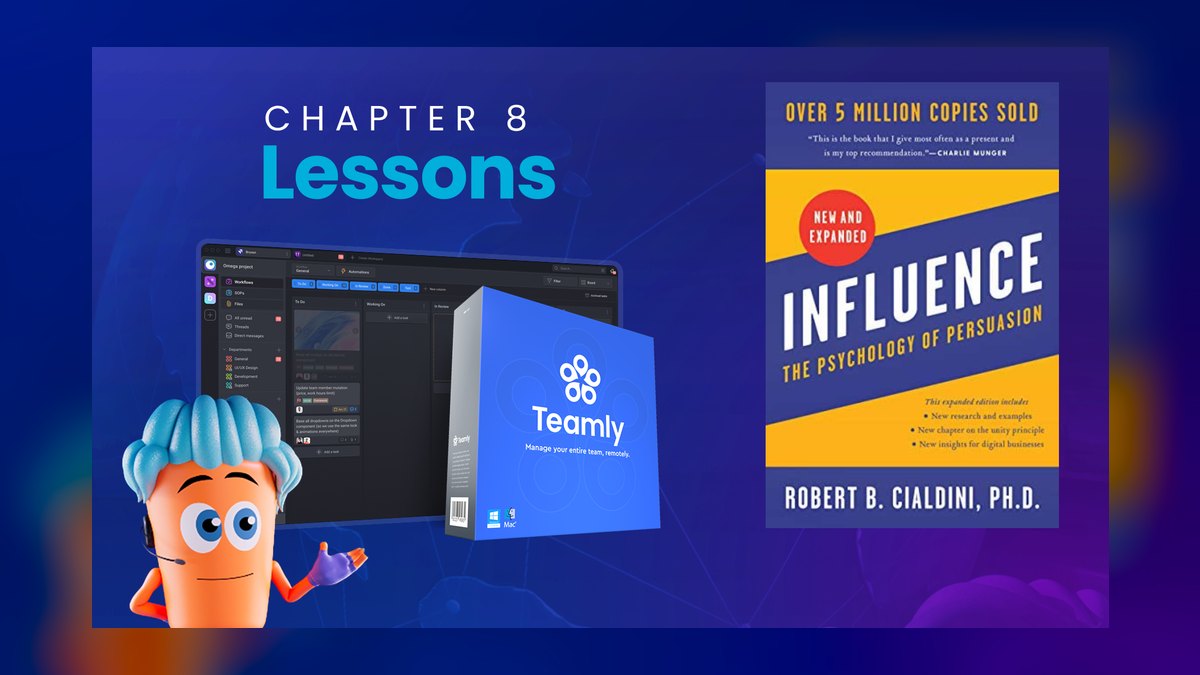
Chapter 5, "Liking," is the most useful chapter for marketers in 2027. Authority is undercut by synthetic media, social proof is gamed by bots, and scarcity is cheapened by fake countdown timers. Liking — built on genuine similarity, real compliments, and cooperative contact — is the one principle that still survives contact with a skeptical audience.
The Tuesday morning that forces the question
Picture a mid-market software marketer on a Tuesday in early 2027. Pipeline is down quarter over quarter. Paid social CPMs are up, email open rates have gone unreliable since Apple and Google both broke pixel-based tracking, and the last three "limited time" campaigns produced a spike in unsubscribes rather than a spike in demos. The CMO wants a diagnosis, not another channel test. Somebody on the team pulls a copy of *Influence: The Psychology of Persuasion* off the shelf and asks the practical question: if we only had bandwidth to operationalize one chapter this year, which one actually earns its keep?
That framing matters because it forces a ranking rather than a survey. Cialdini's six weapons — reciprocity, commitment and consistency, social proof, authority, liking, and scarcity — are not equally exposed to 2027's conditions. Three of them have been systematically degraded by the environment marketers now operate in, and the degradation is not subtle.
Authority went first. The authority principle works because we outsource judgment to credentialed signals: titles, uniforms, trappings of expertise. Every one of those signals is now cheap to fabricate. A synthetic video of a plausible-looking expert costs almost nothing to produce, and audiences know it. The result is not that people stopped trusting experts — it's that they stopped trusting *unverified* expert signals, which is what most marketing authority plays actually are. A byline claiming "20 years in the industry" no longer moves anyone who has spent five minutes on the modern internet.

Social proof degraded next, and for a mechanically similar reason. The principle depends on the observed behavior of others being an honest signal of their private beliefs. Review farms, engagement pods, and generated testimonials break that link. Consumers have adapted: a rising share of people now read the *negative* reviews first, precisely because negative reviews are less likely to be purchased. When your audience has developed a counter-heuristic against your persuasion mechanism, the mechanism is no longer a lever — it's a liability.
Scarcity has been worn out by its own success. Perpetual "ends tonight" banners that never actually end, evergreen countdown timers that reset on page reload, "only 3 left" inventory counters on infinite digital goods — these taught a generation of buyers that urgency claims are decorative. Scarcity still works when it's real and verifiable, which in practice means it works for a narrow band of genuinely constrained offers and nowhere else.
Reciprocity and consistency held up better, but both have narrower operating ranges than they used to. Reciprocity requires a gift with real perceived value, and the content-marketing gold rush turned "free ebook" into a synonym for "form gate." Consistency plays — micro-commitments, small-yes ladders — still work well, but they operate downstream of interest. They help you convert someone who already engaged. They don't get you the first engagement.
Which leaves liking. And liking's mechanism is peculiarly resistant to the exact forces that damaged the others: it is grounded in *observable, verifiable relationship* rather than in a claimed attribute. You can fake a credential in an afternoon. Faking a two-year track record of showing up in a community, answering questions with no ask attached, and being visibly the same person across contexts is a far harder forgery. The cost asymmetry is the whole point — liking is expensive to fake, which is exactly why it still carries information.
How the liking mechanism actually works
Cialdini's chapter breaks liking into components that behave differently, and the practical value comes from treating them separately rather than as a vague mandate to "be likable."
Similarity. People say yes more readily to people like themselves — in attitudes, background, lifestyle, and, in the studies Cialdini cites, even trivial correspondences like a shared first name or hometown. The finding that surprises marketers is how little the similarity has to matter for it to work. But the operational lesson for 2027 is the inverse: because *manufactured* similarity is now cheap and detectable, the only similarity worth building a strategy on is the kind that survives inspection. A brand that claims to care about supply-chain transparency and publishes its actual supplier list has built similarity with a values-aligned buyer. A brand that only says it in ad copy has built a liability.
Compliments. Cialdini reports that praise increases liking even when the recipient has reason to suspect it's instrumental — flattery is remarkably robust. Marketers should be careful with this one, because the studies concern person-to-person praise, and the generalization to brand-to-consumer messaging at scale is a stretch. What clearly transfers is *specific acknowledgment*: noticing what somebody actually did. "You've read every post in this series" is acknowledgment. "You're one of our valued customers" is noise, and the difference is whether the statement could have been generated without knowing anything about the recipient.
Contact and cooperation. Repeated exposure under positive conditions increases liking; repeated exposure under adversarial conditions does the opposite. This is the component most marketers get backwards. Familiarity from being pursued across the web by a retargeting pixel is contact without cooperation — the exposure accumulates, but the affect attached to it is negative. Familiarity from a brand that keeps showing up as a genuinely useful participant in a space you care about is contact *with* cooperation, and it compounds.
Conditioning and association. Liking transfers by proximity. Cialdini's weather-forecaster example — audiences dislike the messenger for the message — is the negative case. The positive case is why sponsorship works at all, and why the choice of what you associate with is a higher-leverage decision than the creative you run inside it.
The Tupperware party is Cialdini's central case, and it remains the most useful mental model in the book for 2027. The company's insight was that the request should come not from the company but from a friend sitting in the room. The friendship does the persuading; the product just has to be adequate. Every creator partnership, ambassador program, and community-led growth motion is a re-implementation of that same structure — and the ones that fail usually fail because the brand tried to shortcut the friendship half of the equation.
What the numbers and ranges actually look like
Cialdini's book is a synthesis of academic findings, and a marketer using it should be honest about which numbers come from the research and which come from their own instrumentation. The chapter's own evidence is qualitative and experimental — the classic studies concern jury simulations, sales-training outcomes, and small-group compliance, not conversion rates. Anyone citing a hard percentage lift "from Cialdini" is extrapolating. So build your own baselines.
The measurements worth standing up before you invest in a liking strategy are these.
Source-attributed conversion split. Instrument every conversion by who made the request: the brand, an employee with a visible identity, a partner creator, or another customer. Most organizations cannot answer this question at all, which is the first finding. Once you can answer it, you have the only benchmark that matters — the delta between brand-originated and peer-originated conversion for the same offer. Track it monthly. If the peer-originated path doesn't outperform after two quarters, your liking strategy isn't working and no amount of Cialdini quotation will fix it.
Frequency and wear-out curves. Mere exposure has a nonmonotonic shape: liking rises with repetition, plateaus, then reverses. The turn happens sooner for high-interruption formats than for ambient ones, and sooner for narrow creative pools than wide ones. The practical move is to run a frequency-versus-sentiment analysis on your own data rather than adopting a rule of thumb from a blog post. Cap frequency where your own negative-response rate — unsubscribes, mutes, hides, blocks — starts to bend upward, and rotate creative before that inflection rather than after it.
Time-to-trust in communities. If you're building the Tupperware structure, the honest planning number is that meaningful standing in a community takes quarters, not weeks. A useful proxy metric: the ratio of your posts that are answers to other people's questions versus posts that are your own announcements. Communities read that ratio, even if nobody states it. Track your own; if announcements outnumber contributions, you're extracting, not participating, and the community will price you accordingly.
Cohort retention by acquisition source. This is the one that usually settles internal arguments. Segment retention curves by whether the customer arrived through a peer, a creator, a community, or paid acquisition. Liking-sourced cohorts tend to retain differently than urgency-sourced cohorts because the reason for buying was different. Measure it in your own data; the direction of the effect will tell you where budget belongs far more credibly than any framework will.
Cost structure. Liking strategies front-load cost. A community manager, a creator program, or a genuine transparency initiative all cost real money before they return anything, and the return arrives as a slope rather than a spike. Budget them like brand investments with a multi-quarter horizon, not like performance channels with a monthly ROAS gate — evaluating them on a monthly ROAS gate is the single most common way these programs get killed one quarter before they would have worked.
One measurement warning: liking effects are notoriously hard to isolate with last-click attribution, because their whole mechanism is upstream of the click. A creator mention that makes someone trust you doesn't show up as the conversion source when they search your brand name three weeks later. If your measurement stack is last-click only, a liking strategy will look like it does nothing while quietly improving everything downstream of it. Incrementality testing, geo holdouts, or at minimum a self-reported-attribution question in your signup flow will keep you from defunding the thing that's working.
Trade-offs, and when a different chapter wins
Chapter 5 is the best single bet for 2027, but "best on average" is not "best always." A marketer who applies it universally will misallocate.
Liking is slow. Its returns compound but they start near zero. If you are a marketer with a two-month runway and a hard number to hit, a liking strategy is the wrong instrument — you will spend the runway building relationships that mature after the company has run out of time. In that situation, the consistency chapter is more useful: micro-commitment ladders, trials that convert on accumulated small yeses, and reactivation of people who already engaged. Those work on a weeks-scale.
Liking scales awkwardly. The mechanism is inherently person-shaped. It runs through individuals — a creator, a founder, a community manager, a support rep with a name. That means it carries key-person risk and it does not linearly accept more budget. Doubling spend on a paid channel roughly doubles impressions; doubling spend on a liking strategy mostly produces more of the fake version, which is worse than nothing. Scaling liking means increasing the *number of genuine relationships*, which is a hiring and culture problem more than a media-buying one.
Category matters. In commodity purchases with low consideration, liking has less room to operate — nobody builds an affinity relationship with a road-salt supplier, and the reciprocity and scarcity levers do more work there. In high-consideration B2B, where a buying committee is choosing a multi-year partner, liking is arguably the dominant factor and everything else is post-hoc justification. Between those poles, the honest answer is to test.
Regulated industries constrain it. Financial services, healthcare, and pharma face disclosure regimes that limit how creator and peer advocacy can be structured. The chapter still applies, but the implementation surface narrows to things like clinician communities, transparent methodology publishing, and named-expert content with real credentials — closer to an authority-liking hybrid than to pure liking.
The adjacent chapters don't disappear. Cialdini's principles interact, and the practical strategy is usually a stack rather than a single lever. Liking makes reciprocity land — a gift from someone you like reads as generous; the same gift from a stranger reads as a hook. Liking makes authority credible — expertise from a person you already trust doesn't need the credential armor. And liking makes social proof legible again, because proof from a specific named peer routes around the bot problem that broke aggregate proof. Chapter 5 is the best *entry point*, not the whole book.
The pitfalls that turn Chapter 5 into a liability
Every failure mode of the liking principle has the same root: treating a relationship as a channel.
Manufactured similarity. The most common error. A brand adopts the vocabulary, aesthetics, and stated values of a community it has no actual connection to. This works until somebody checks — and in 2027 somebody always checks, because employee reviews, supply-chain data, political donation records, and old posts are all a search away. The exposure cost exceeds the gain, because a discovered fake doesn't just neutralize liking, it converts it to active dislike. The avoidance rule is simple: only claim similarity you would be comfortable having audited. If the answer is "we'd rather they didn't look too closely," don't claim it.
Compliments that reveal the database. Personalization that names something the recipient never told you reads as surveillance rather than attention. There's a line between "we noticed you finished the onboarding series" — a thing that happened inside your product — and inferences drawn from cross-site tracking about someone's life circumstances. The first is acknowledgment; the second is creepy, and the creepy version damages liking in the same motion it was meant to build it. Keep acknowledgment inside the boundary of the relationship the person knowingly has with you.
Confusing frequency with familiarity. Retargeting a person eighty times does not make them like you. Mere exposure requires that the exposure be neutral-to-positive; an ad that interrupts something they wanted to do is not neutral. Marketers who read Chapter 5 as "run more impressions" get the wear-out side of the curve and conclude the principle doesn't work.
Treating creators as media inventory. The Tupperware structure works because the host genuinely likes both the guests and the product. A creator program that briefs talent on exact copy, forbids criticism, and optimizes purely for reach reconstructs the ad it was supposed to replace, at a higher price. The programs that work give creators latitude to be honest — including negative honesty — because the latitude is what makes the endorsement worth anything. If a creator can't say anything critical, the audience knows the positive statements are unpriced.
Astroturfing the community. Manufactured engagement in a space you don't belong to is the most expensive failure available, because communities have long memories and public archives. The recoverable version is slower and duller: show up, answer things, sponsor without controlling, and accept that standing accrues over quarters.
Letting the person outgrow the brand. A liking strategy that runs entirely through one charismatic founder or one star creator creates a dependency. When they leave, the affinity leaves with them. The mitigation is deliberate distribution — multiple named humans, a visible team, community leaders who aren't employees — so the relationship attaches to more than one node.
Measuring it like a performance channel. Covered above, but it belongs on the pitfall list because it's the most common way good programs die. A liking strategy evaluated on a 30-day last-click window will always look like it's losing to a discount code.
Ethics as a practical constraint, not a footnote. Cialdini himself distinguishes smugglers of influence from detectives of it — using the principles to point at real merit versus fabricating the signal. The commercial case for the ethical version is straightforward: fabricated liking has a discovery risk that compounds with reach, and the penalty on discovery is worse than never having tried. That's not a moral appeal, it's a risk calculation, and it happens to point the same direction the moral appeal does.
Related questions
Which chapter should a solo founder start with instead?
Same answer, different implementation. A solo founder *is* the liking asset — a named human with a visible point of view. Skip the creator budget, spend the time in two or three communities where your buyers already are, and let the founder's own account carry the relationship.
Does Chapter 5 apply to paid media at all?
Yes, mostly through association and casting. The liking principle governs *who* appears in the creative and *what context* it runs beside more than it governs the copy. Choosing partners and placements your audience already likes transfers affect; the ad unit itself is a weak liking instrument.
How does this square with Cialdini's seventh principle, unity?
Unity — shared identity rather than mere similarity — is arguably where the liking chapter was heading. In practice they stack: similarity gets attention, unity ("one of us") sustains it. Marketers can treat unity as the deep end of the same pool Chapter 5 describes.
Is there a chapter that has gotten *more* dangerous to use?
Scarcity. Its mechanism is intact, but the tactical vocabulary has been so abused that deploying standard urgency language now signals low quality regardless of whether the constraint is real. If your scarcity is genuine, say the specific reason, or the claim gets filed with all the fake ones.
What about applying this outside marketing?
The same structure works in recruiting, partner ecosystems, and internal change management — anywhere a request lands better coming from a peer than from an institution. Recruiting in particular is nearly a direct port of the Tupperware model.
FAQ
Is the Liking chapter still relevant for B2B, or is it a consumer idea?
It is arguably more relevant in B2B. Committee purchases with long cycles and high switching costs run on trust between individuals, and the vendor a champion is willing to stake internal credibility on is usually one they personally like. The mechanism just runs through peer references, community standing, and named practitioners rather than through consumer creators.
How is liking different from social proof in practice?
Social proof aggregates: many people did this, so it must be right. Liking is specific: this particular person, whom I have a relationship with, is making the request. That distinction matters in 2027 because aggregation is what bots can forge cheaply. A named peer whose track record you can inspect is much harder to fake than a five-star average.
Can you build liking with AI-generated content?
You can build volume with it, and volume is not liking. AI is useful for the operational layer — drafting, summarizing, finding the conversations worth joining, keeping response times short. What it cannot do is be the person the audience forms a relationship with. Use it to free up human time for the parts that require a human, and disclose where disclosure is expected.
Why not lead with authority instead?
Because authority's signals are now cheap to counterfeit and audiences have adjusted their priors accordingly. Authority still works, but it now needs verification attached — published methodology, real names, checkable track records — and that verification is itself a liking play. In effect, authority in 2027 routes through liking rather than around it.
How long before a liking strategy shows results?
Plan in quarters. Community standing, creator relationships, and a reputation for genuine transparency all accrue slowly and then hold. The most common failure is a program killed at month three by a performance-marketing evaluation framework that was never designed to see the effect it was measuring.
Does this differ across cultures?
The principle holds broadly, but its expression varies considerably. In more collectivist contexts, group affiliation and the endorsement of a respected in-group figure carry more weight than individual likability does. Marketers running multi-region programs should localize the *unit* of liking — person, family, professional guild, community — rather than translating the same tactic.
Sources
- https://www.influenceatwork.com/
- https://en.wikipedia.org/wiki/Influence:_The_Psychology_of_Persuasion
- https://hbr.org/2001/10/harnessing-the-science-of-persuasion
- https://www.annualreviews.org/journal/psych
- https://www.apa.org/
- https://www.ftc.gov/business-guidance/resources/ftcs-endorsement-guides-what-people-are-asking
- https://www.nngroup.com/articles/persuasion/
- https://www.thinkwithgoogle.com/
Related on PULSE
- What's the most persuasive principle from *Influence: The Psychology of Persuasion* for social media in 2027?
- Influence: The Psychology of Persuasion by Robert Cialdini — Cliff Notes & Chapter-by-Chapter Summary
- What's the most actionable chapter in *How to Win Friends and Influence People* for cold calling in 2027?
- How does *Influence: The Psychology of Persuasion* explain why "free" offers actually work in B2B sales?
- What's the most underrated chapter in *How to Win Friends and Influence People* for building executive relationships?
- How do you use *Influence: The Psychology of Persuasion* to prevent buyer's remorse after a big sale in 2027?
This page will be disappearing soon. Save it to your device for $1 — or read it free while it is here.
@Kory-White- · if Venmo asks, the last 4 of my number are 2012
This page is gone.
This one is off the shelf now. $1 keeps it on your phone for good — the whole page, pictures and diagrams included.
 bsWhat’s the most persuasive principle from *Influence: The Psychology of Persuasion* for social media in 2027?
 bsHow do you build a sales team's resilience after a major market downturn in 2027?
 bsWhat’s the best chapter in *How to Win Friends and Influence People* for leading a team in 2027?
 bsHow can *Predictable Revenue* help a startup build a repeatable sales process from scratch in 2027?
 bsHow do you build a sales pipeline when your entire market is brand new and no one is searching for your category in 2027?
 bsWhat’s the key difference between a situational and a problem question in *SPIN Selling* for discovery calls in 2027?
 pulse-booksTop 10 best Book Summaries options in 2027
 bsWhat’s the single most effective questioning technique from *SPIN Selling* for enterprise discovery calls?
 pulse-booksHow much do Book Summaries cost in 2027?
 bsWhat’s the most actionable chapter in *How to Win Friends and Influence People* for networking in 2027?