

What is the first concrete step in Strategic Selling by Miller Heiman for building a sales plan in 2027?

The first concrete step is building the Blue Sheet's Buying Influences list: name every Economic Buyer, User Buyer, Technical Buyer, and Coach on the single opportunity in front of you. Miller Heiman's Strategic Selling starts at the account-position level, not the pipeline level — you inventory who decides before you plan anything else.
A deal that looked closed and wasn't
A mid-market RevOps team walks into Q1 2027 with a $340K renewal-plus-expansion opportunity that has been in "Verbal" for six weeks. The rep has a champion — a director of field operations who loves the product, uses it daily, and has said out loud, "This is happening." Forecast category: Commit. Close date: pushed twice.
Then procurement introduces a new VP of Finance who joined in November, and the deal dies in nine days.
This is the exact failure Strategic Selling was written to prevent, and the reason the methodology's first concrete step is what it is. The rep had a plan — a sequence of demos, a business case deck, a pricing sheet, a mutual action plan. What the rep did not have was a complete list of the people whose approval the deal actually required. The director of field operations was a User Buyer with genuine enthusiasm and zero signing authority. Nobody had ever met the Economic Buyer. The rep's "sales plan" was a plan for one relationship, executed as if it were a plan for an account.

Miller Heiman's core insight, published in 1985 and durable enough that the framework still ships inside Korn Ferry's sales methodology practice today, is that complex B2B sales fail on *coverage*, not on persuasion. The rep who loses rarely loses because the champion stopped liking them. They lose because a person they never identified said no, or because a person they identified but never contacted said nothing at all and the deal starved.
So the first concrete step is not research, not qualification scoring, not a discovery call script, and not a territory plan. It is: pick one specific opportunity, open a Blue Sheet, and write down every human being who can affect the outcome, sorted into the four Buying Influence roles. That list is the foundation everything else in the strategy sits on. You cannot assess degree of influence, you cannot rate each person's response mode, you cannot find your Red Flags, and you cannot write a single valid action item until the roster exists.
A useful way to think about it in 2027 terms: your CRM has an Opportunity object with a dollar amount and a stage. Strategic Selling says that object is nearly meaningless until it has a populated, role-typed contact roster attached to it. The dollar amount is a claim. The roster is evidence.
Notice what the step does *not* require. It does not require the buyer's cooperation. It does not require a call. It does not require budget, timeline, or a signed NDA. You can complete the first concrete step alone at a desk with your notes, your email history, your CRM activity log, and thirty minutes. That accessibility is the point — Strategic Selling is a discipline you can start applying to your worst deal today, not a transformation program you roll out next fiscal year.

The immediate output is uncomfortable, which is how you know it's working. Most reps who complete this step honestly on a live opportunity discover two or three named roles they cannot fill in. An Economic Buyer slot reading "unknown — probably someone in Finance" is not a failure of the exercise. It *is* the exercise. You have just converted an invisible risk into a written one, and written risks generate action items.
How the four Buying Influences actually work
Strategic Selling defines four roles, and the roles are functions in a decision, not job titles on an org chart. One person can hold two roles. One role can be held by six people. A role held by nobody you know is the single most reliable predictor of a slipped close date.
Economic Buyer. Gives final approval to spend. There is exactly one per opportunity — this is a hard constraint in the methodology, and it's the constraint reps most often get wrong. The Economic Buyer controls discretionary funds, can release money, and has veto power that nobody above them will overturn on this specific purchase. Critically, the Economic Buyer changes by deal size and deal type inside the same company. A $15K seat expansion might have a director as Economic Buyer; a $400K platform replacement at the same account might route to the CFO. When a rep says "our Economic Buyer is the CRO," ask whether the CRO has ever personally approved a purchase at this dollar amount, or whether they sign what Finance hands them. Those are different people playing different roles.

User Buyers. Judge the impact on their own job performance. They will use the thing, or supervise people who use it. There are usually several, and they are the loudest and most accessible voices in any deal — which is precisely why reps over-index on them. User Buyers can't approve, but they can kill. A User Buyer who believes the rollout will make their team's quarter worse becomes a quiet, effective blocker who never has to say no out loud.
Technical Buyers. Screen out. They evaluate against measurable specifications and their job is to say no to things that fail the spec. Security review, IT architecture, legal, procurement, compliance, data governance, and increasingly in 2027, whoever owns AI-usage policy and model-data-handling review. Technical Buyers cannot say yes to the purchase. They can only say no to it, and their no is usually final. The number of Technical Buyer gates in enterprise software has grown substantially over the last decade; a deal that cleared security and legal in 2018 may now also clear a data-residency reviewer, a third-party risk committee, and an AI governance owner. Every one of those is a Technical Buyer, and every one of them needs a row.
Coach. Develops for you, guides you in this specific sale, and is credible to the other Buying Influences. The Coach is the only role you create rather than discover. Three tests: does this person want your solution to win, are they credible inside the account, and will they give you information about the other Buying Influences? A friendly contact who likes you but can't tell you who signs is not a Coach. A Coach can be internal (a services lead who worked the account last year), external (a consultant), or inside the customer. Deals routinely close without a formally identified Coach, but the ones that close *predictably* have one.

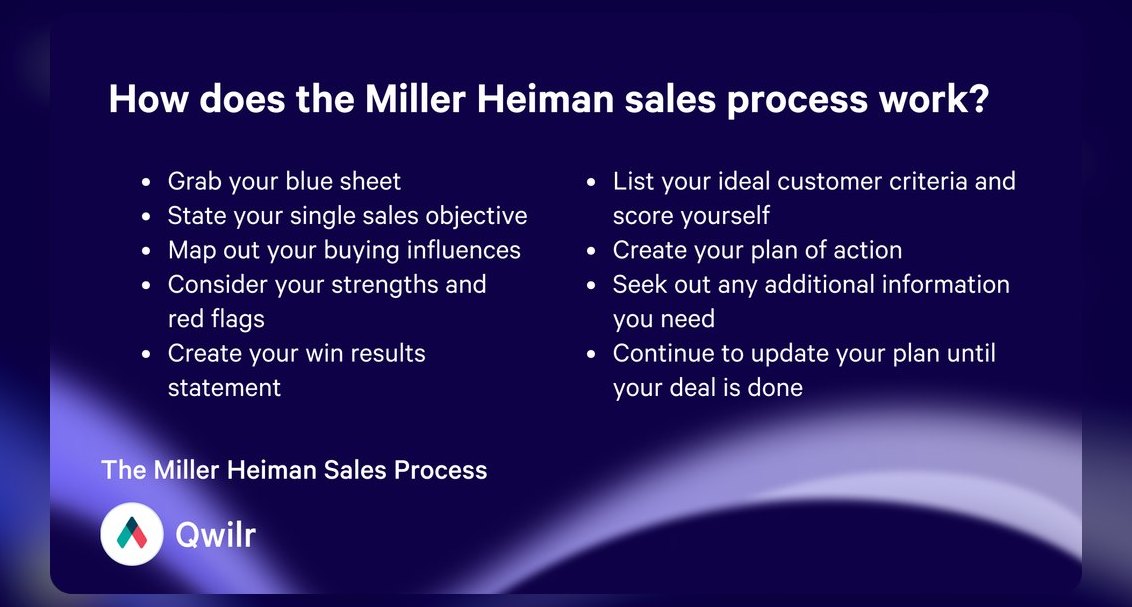
The sequence in that diagram is not decorative. Strategic Selling is explicit that the Blue Sheet moves in order: Buying Influences, then Red Flags, then Response Modes and Win-Results, then Strengths, then the Action Plan. Reps who jump straight to the Action Plan write tasks that address the wrong people. The roster is the gate.
One practical note on filling the roster: your CRM contact list is a starting point, not the answer. Contacts get created because someone downloaded a whitepaper or attended a webinar. Buying Influences get identified because someone told you they have a say. The overlap is partial. Pull the CRM list, then walk your email threads, calendar invites, and call recordings for names in cc lines and on the attendee list who never became contacts. Those people are often exactly the Technical Buyers you're missing.
What the roster typically reveals, in numbers
Buying committee size is the number that makes this step non-optional. Gartner's widely cited B2B buying research puts the typical complex solution purchase at roughly six to ten decision makers, each arriving with four or five independently gathered pieces of information. Other buyer-behavior research from vendors like 6sense and Forrester has reported committee sizes trending higher over the last several years, particularly on deals above six figures. Treat the specific figures as directional rather than precise — methodologies and sample definitions differ — but the direction is consistent across every credible source: the number of people who must be satisfied has grown, not shrunk.

Set that against what reps typically have on the sheet. A common pattern when teams run their first honest Blue Sheet exercise is a roster of two or three named contacts against a committee that the same team, on reflection, agrees is seven or eight people. That gap — call it four to five unidentified Buying Influences — is where slipped deals live.
A few working ranges practitioners find useful, offered as planning heuristics rather than published statistics:
- Roster completeness before first Blue Sheet: frequently under 50% of the real committee. If you can name every person and their role on the first pass, either the deal is genuinely small or you're guessing.
- Time to complete the first step on one deal: 20-40 minutes solo, 45-60 minutes in a deal review with a manager. It is not a half-day workshop. Teams that budget four hours per opportunity abandon the practice inside a quarter.
- Deals per rep worth Blue Sheeting: the top 3-5 opportunities by value or strategic weight, refreshed weekly. Blue Sheeting all 30 open opportunities is how the discipline dies. Strategic Selling is deliberately per-opportunity and deliberately expensive per unit — you spend the effort where the dollars are.
- Red Flags per sheet on first pass: three to six is normal and healthy. Zero means the rep filled it in defensively. Twelve means the deal probably shouldn't be in Commit.
- Cycle length correlation: longer cycles correlate with larger committees and more Technical Buyer gates. If your average enterprise cycle stretched from four months to seven over the last few years, look first at how many new screening functions were added to the buyer's side, not at rep activity levels.
There's a measurement trap worth naming. Teams love to instrument this step as "contacts per opportunity" and set a target — say, six contacts on every deal above $100K. Within two quarters, every deal has six contacts and none of them are role-typed, because reps will hit any number you put in a dashboard. The metric that survives contact with incentives is roles filled with a named person and a last-touch date, not raw contact count. Economic Buyer: named, last contacted 34 days ago. That row tells you something. "8 contacts" tells you nothing.

The second-order number that matters more than any of these is forecast accuracy. The business case for Strategic Selling's first step is rarely "we win more" in the short run — it's "we stop calling things Commit that were never Commit." A deal with an unidentified Economic Buyer sitting in Commit is a forecasting defect. Teams that enforce a simple rule — no opportunity enters Commit with an empty Economic Buyer field — typically see near-term forecast dollars *drop* and forecast accuracy improve, which is an awkward conversation with a board and the right trade.
Trade-offs, and where other frameworks fit
Strategic Selling's first step is deliberately narrow, and that narrowness has costs.
It's opportunity-scoped, not account-scoped. The Blue Sheet plans one sale. If your question is "how do I grow this account over three years," that's the Gold Sheet (Large Account Management Process / LAMP), a different Miller Heiman instrument with a different first step — situation appraisal across the whole account. Reps who try to make a Blue Sheet do account planning end up with a bloated sheet that plans nothing well. Pick the instrument that matches the question.

It says nothing about whether the deal should exist. Buying Influence mapping assumes you have a real opportunity. It won't tell you the prospect has no budget or no compelling reason to act. That's Conceptual Selling's territory on the buyer side, or a qualification framework like MEDDIC/MEDDPICC on the seller side. In practice, many teams in 2027 run MEDDPICC as the qualification and forecast-hygiene layer and Strategic Selling as the multi-threading and strategy layer on the deals that survive qualification. They overlap — MEDDPICC's "Economic Buyer" and "Champion" are close cousins of Miller Heiman's Economic Buyer and Coach — and that overlap is fine. Running both means the same facts get checked twice from two angles.
It's manual, and manual things decay. The Blue Sheet is a snapshot. Committees churn — a reorg, a departure, a new VP of Finance in November — and a sheet built in January and never touched is worse than no sheet, because it produces false confidence. The practical fix is cadence, not tooling: the sheet gets reviewed in the weekly deal review or it rots.
It can become theater. The most common failure mode is not that teams reject the framework; it's that they adopt the artifact and skip the thinking. A Blue Sheet filled out to satisfy a manager, with every role populated by whoever was handy, is a compliance document. The tell is that no action items change as a result of filling it in.

On adjacent tooling: most modern CRMs and revenue platforms now ship relationship-mapping or org-chart features, and several will auto-suggest committee members from email and calendar metadata. Used well, these accelerate the first step — they surface the cc-line names you'd otherwise miss. Used badly, they replace judgment with a graph. A tool can tell you a person exists and appears on threads. It cannot tell you whether that person can release funds. Role assignment stays human, and the honest ones on your team will mark a role "unknown" rather than let software guess.
There's a genuine argument that the four-role model is under-specified for 2027 buying. Some practitioners add explicit rows for procurement-as-adversary, for the AI-governance reviewer, or for the "ratifier" who doesn't evaluate but must not object. Miller Heiman would file all of those under Technical Buyer or a second Economic Buyer influence. Whether you extend the taxonomy or keep it at four matters less than whether every human with a veto has a row with a name in it.
Pitfalls that quietly wreck the first step
Naming a title instead of a person. "Economic Buyer: VP Finance" is not a completed row. Titles don't sign things; people do. If you can't produce a first and last name, the row is a Red Flag, and writing a title in the box hides that.

Assuming your champion is your Coach. Enthusiasm is not the test. Credibility with the other Buying Influences and willingness to tell you about them is the test. Ask directly: "Who else needs to be comfortable with this before it moves?" A Coach answers. A friendly User Buyer deflects, usually because they genuinely don't know.
Two Economic Buyers. If your sheet has two, you have either misidentified one of them or you're actually running two opportunities that should be split. The single-Economic-Buyer rule is a forcing function — it makes you resolve ambiguity rather than paper over it.
Filling in unknowns to look competent. The pressure in a deal review to have a complete sheet is real, and it's exactly backward. A sheet with three honest "unknown" entries generates three action items and moves the deal. A fully populated fictional sheet generates confidence and moves nothing. Managers set this tone: if the first rep who admits they've never met the Economic Buyer gets grilled, nobody else will admit it either.
Confusing access with coverage. Reps often have wide access — six contacts, lots of meetings — concentrated entirely among User Buyers. Coverage means every *role* is touched, not that the contact count is high. Sort your roster by role and look for the empty column.

Doing it once. Committees change. Set a trigger, not a date: re-run the roster whenever the close date slips, whenever a new name appears on a thread, whenever the account reorganizes, and whenever the deal size changes materially, because a bigger deal often means a different Economic Buyer.
Treating it as a rep-only activity. Solution engineers, customer success, and executive sponsors all hold information the rep doesn't. A ten-minute round-robin in a deal review — "who have you talked to that isn't on this sheet?" — routinely surfaces two or three names. The first concrete step is faster and more accurate as a team exercise, even though it's structured as an individual artifact.
Skipping straight to the action plan. The most seductive pitfall, because action plans feel productive. Building a plan before the roster exists means you're scheduling activity against the people you already know — which is, definitionally, the people who weren't going to kill the deal. The whole strategy depends on doing the boring inventory first.
Related questions
Is the Blue Sheet the same thing as the Strategic Selling framework?
No. The Blue Sheet is the worksheet that operationalizes the framework for a single opportunity. The framework includes the concepts — Buying Influences, Red Flags, Win-Results, Ideal Customer Profile. The Blue Sheet is where you apply them to one deal.
How is this different from MEDDPICC?
MEDDPICC is primarily a qualification and forecast-hygiene checklist; Strategic Selling is a multi-threading and deal-strategy method. They overlap on Economic Buyer and Champion. Many teams run both — MEDDPICC to decide whether to invest, Strategic Selling to decide how.
Can one person hold more than one Buying Influence role?
Yes, frequently. A CTO can be Economic Buyer and Technical Buyer on an infrastructure purchase. Note both roles on the sheet, because the person will evaluate through both lenses and needs to hear two different arguments.
What if I genuinely cannot identify the Economic Buyer?
Write "unknown," flag it red, and make identifying them the top action item. Ask your Coach directly, or ask any contact who approved the last purchase of similar size. Never forecast a deal to Commit with that field empty.
Does Strategic Selling still apply to product-led or self-serve motions?
Partially. Self-serve purchases below a few thousand dollars rarely have four distinct roles. Once a PLG account moves to an enterprise agreement — security review, procurement, a finance approver — the roles reappear and the framework applies again.
FAQ
Who wrote Strategic Selling and when?
Robert B. Miller and Stephen E. Heiman, with Tad Tuleja, published *Strategic Selling* in 1985; *The New Strategic Selling* followed as a revised edition. The methodology is now part of Korn Ferry's sales training portfolio after a chain of acquisitions from Miller Heiman Group and Sales Performance International.
Why is the first step identifying people rather than qualifying the deal?
Because Strategic Selling assumes qualification happens elsewhere and focuses on the failure mode it was built for: complex deals lost to people the seller never met. In a single-decision-maker sale the step is trivial; in a seven-person committee it's the whole game.
How long should the first step take on a real opportunity?
Twenty to forty minutes alone, longer with a team. If it's taking half a day you're planning the whole deal instead of building the roster. Do the roster, find the gaps, stop, and let the gaps generate your next actions.
What is a Red Flag in Strategic Selling terms?
Anything that signals incomplete or negative information: a missing Buying Influence, a role you've never contacted, a recent reorganization, a person whose response mode you can't read. Red Flags aren't reasons to abandon a deal — they're the inputs that make the action plan specific.
Should the Blue Sheet live in the CRM or on paper?
Wherever it gets updated. The historical artifact is a physical sheet, and many teams still use a document per deal. CRM-native versions win on visibility and reporting and lose on candor — reps write more honestly in a document their VP isn't watching in real time. Pick the trade deliberately.
Does this replace a territory or account plan?
No. Strategic Selling plans one opportunity. Territory planning and account growth are separate instruments — LAMP's Gold Sheet handles the multi-year account view. Using the Blue Sheet for account strategy produces a sheet that's too broad to drive weekly action.
Sources
- https://www.kornferry.com/capabilities/sell/sales-methodology — Korn Ferry's sales methodology practice, current home of Miller Heiman methodologies
- https://www.gartner.com/en/sales/insights/b2b-buying-journey — Gartner research on B2B buying committee size and buyer behavior
- https://www.forrester.com/blogs/category/b2b-sales/ — Forrester B2B sales research and buying group analysis
- https://hbr.org/2017/03/the-new-sales-imperative — Harvard Business Review on buying committee complexity and decision friction
- https://www.mheducation.com/ — McGraw Hill, publisher of *The New Strategic Selling*
- https://www.salesforce.com/resources/research-reports/state-of-sales/ — Salesforce State of Sales, recurring data on sales cycles and deal complexity
- https://www.rainsalestraining.com/blog — RAIN Group research and commentary on complex B2B sales
- https://www.challengerinc.com/blog/ — Challenger research on buyer consensus and group decision dynamics
Related on PULSE
- What is MEDDPICC and how does it compare to Strategic Selling?
- How do you identify the Economic Buyer in an enterprise deal?
- What is the Miller Heiman Blue Sheet and how do you fill one out?
- How many decision makers are in a typical B2B buying committee?
- What is LAMP (Large Account Management Process) and when do you use it?
- How do you multi-thread a deal without going around your champion?
 pulse-recentHow to Apply Strategic Selling — Step-by-Step Playbook in 2027
 book-summaryThe Art of the Start 2.0 by Guy Kawasaki — Cliff Notes Summary
 pulse-recentWhat is the step-by-step process for Strategic Selling by Miller Heiman in 2027?
 pulse-booksHow does Daring Greatly by Brené Brown change how you handle criticism at work in 2027?
 book-summaryProActive Selling by William Miller — Cliff Notes Summary
 book-summaryEmpowered by Marty Cagan — Cliff Notes Summary for Sellers
 book-summaryNever Split the Difference by Chris Voss: Summary, Key Lessons, and RevOps Takeaways
 book-summaryPositioning: The Battle for Your Mind by Al Ries and Jack Trout: Summary, Key Lessons, and RevOps Takeaways
 book-summaryThe 22 Immutable Laws of Marketing by Ries and Trout — Cliff Notes Summary
 book-summaryHow to Become a Rainmaker by Jeffrey Fox — Cliff Notes Summary