
Do I Need a Fractional CRO for My HVAC Company in 2026?
 Curated byKory White · Fractional CRO · Maryland
 PULSEKNOWLEDGE LIBRARY
Quality
Certified

You likely need a fractional CRO if your HVAC company clears roughly $2M in revenue, the owner is still the closer, and booked-call rate swings with the weather. A fractional CRO gives you senior revenue leadership a few days a month — typically $5,000–$15,000 monthly — instead of a $300K–$500K full-time executive.
The Tuesday in October that tells you everything
Picture a $6M residential HVAC company in a four-season market. July was enormous — 41 replacement systems, techs running twelve-hour days, dispatch triaging no-cool calls like an ER. The owner felt like a genius. Then October arrives. The phones drop to a third of summer volume, and now the same crew that was drowning is looking for hours. The owner walks into the office on a Tuesday and asks the dispatcher how many calls are booked. She says nine. He asks how many were offered a maintenance agreement. She doesn't know — nobody tracks that. He asks the comfort advisor how the two replacement quotes from last week landed. One's a "thinking about it," the other never got a follow-up call because the advisor was pulled onto an emergency service run.
That Tuesday is the diagnostic. Not the revenue number, not the profit margin — the fact that four separate questions about the revenue engine produced four shrugs. Nobody in that building owns the path from marketing dollar to booked call to presented option to signed agreement as one connected system. The service manager owns dispatch. The office manager owns the phones. The owner owns closing. Marketing is a vendor sending a monthly PDF. Each piece works in isolation and the handoffs leak.
Here's the specific shape of the leak. In most HVAC companies at this size, somewhere between 15% and 35% of inbound calls never convert to a booked appointment — abandoned rings, callbacks that go out ninety minutes later, a CSR who quotes a diagnostic fee to a price shopper and lets them hang up. That's demand you already paid for, evaporating at the front door. Then, of the calls that do get booked, only a fraction ever get presented a full-system replacement option even when the equipment is eighteen years old and the tech is standing three feet from the data plate. The tech patches it, collects $480, and drives away from a $9,000 opportunity because his comp pays the same either way and nobody trained him on the handoff to a comfort advisor.
Now stack the seasonal layer on top. That October softness isn't weather — it's the absence of a proactive replacement and maintenance engine to fill the gap. A company with 1,200 active maintenance agreements has a scheduling department with an October problem solved: precision tune-ups, filter changes, IAQ conversations, and the pre-qualified replacement leads those visits produce. A company with 180 agreements has a crew standing around. The difference isn't luck. It's whether someone senior owned agreement growth as a number with a name attached to it.
This is the moment the fractional CRO question becomes real, and it's worth being precise about the trigger. It isn't "revenue is flat." It's "the operational capacity to do more work exists, but the commercial system to reliably book that work does not." Your install crews could do six more changeouts a month. Your techs have open capacity in shoulder season. The constraint has moved from the truck to the phone, the presentation, and the follow-up — and those are revenue-system problems, not operations problems. Adding another tech won't fix it. Buying more Google Ads won't fix it, because you'll pour more leads into the same leaky front door.
Adjacent industries hit this same wall on the same schedule. Plumbing, electrical, roofing, and pest control all run the identical structure: paid demand generation, a phone-booking gate, an in-home diagnostic, a high-ticket recommendation, a financing decision, and a recurring-service base underneath it. If you've read a case study about a plumbing company doubling its membership base or a roofer fixing its lead-response time, the mechanics transfer almost cleanly. What doesn't transfer is the seasonality curve — HVAC's demand is more violently bimodal than plumbing's, which changes how aggressively you have to build the off-season engine.
How the mechanism actually works
A fractional CRO isn't a part-time salesperson and isn't a consultant who hands you a deck. The role is architectural: they own the revenue operating system end to end, install it, staff it, instrument it, and then transfer it to your internal leadership. The engagement is typically a few days a month — call it sixteen to thirty-two hours monthly — concentrated into working sessions rather than spread thin as daily availability.
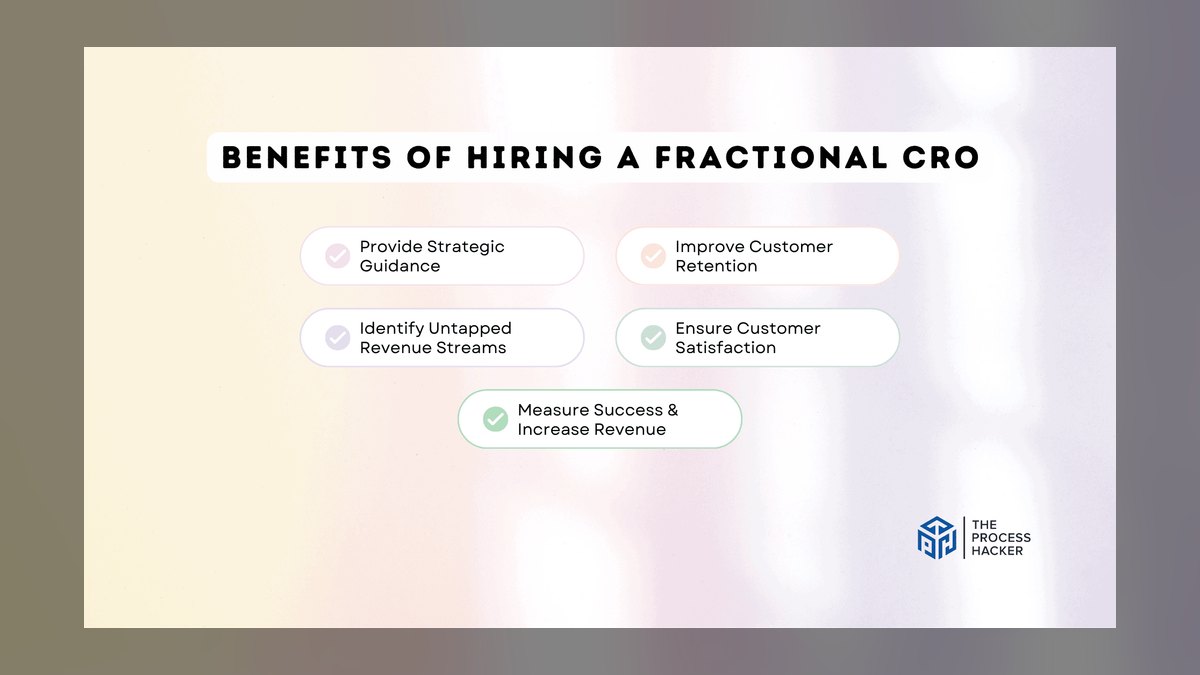
The work moves in a fixed sequence, and the sequence matters more than any individual tactic.
Phase one is forensic, not strategic. Before touching a comp plan or a script, the operator pulls the actual numbers: cost per lead by source, cost per *booked* call by source (a very different and much more useful number), booked-call rate by CSR, service-to-replacement conversion rate, average ticket split between repair and install, financing attach rate, maintenance-agreement count and true renewal rate, revenue per technician per day, and gross profit per crew and per lead source. Most owners have never seen these side by side. The typical finding in the first two weeks is that one or two lead sources are quietly unprofitable at the gross-margin line while a cheap source — existing customer base, agreement holders, referrals — is carrying the company and being under-invested.
Phase two is installation. This is where the system gets built: a booking standard with a target answer time and a live-answer rate, a documented handoff from technician to comfort advisor, a presentation format with tiered options and financing presented every time rather than only when the customer looks affluent, a maintenance-agreement offer scripted into every service call, and a comp plan that pays on the behaviors you want instead of on whatever closed. Then the cadence: a weekly number review, a monthly forecast, and a scorecard that every role can see themselves in.
Phase three is handoff. A fractional engagement that never ends is a failed engagement. The service manager, the lead CSR, and the sales manager get trained to run the meetings, read the scorecard, and coach to the standard. The operator's presence tapers.

The thing that diagram makes obvious, and that no single department head can see from inside their own box, is that the loop closes. Agreement growth feeds off-season demand, which feeds booked calls, which feeds replacement opportunities, which feed agreement growth. Break any link and the flywheel becomes a funnel that you have to refill with ad spend every single month. That systemic view — owning the whole loop rather than optimizing one segment — is the entire justification for the role.
There's an upstream effect worth naming too. Once the revenue system is instrumented, your operational decisions get better almost as a side effect. You stop hiring techs on gut feel because you can see revenue per tech per day and know exactly what capacity you're short. You stop guessing at truck stock because the replacement mix is visible. You stop renewing a marketing contract out of inertia because the cost-per-booked-call by source is on a report. The revenue system becomes the company's instrument panel.
Real numbers, ranges, and benchmarks
Costs first, because this is where the decision usually gets made.

A fractional CRO generally runs $5,000–$15,000 per month, with the range driven by engagement depth, market size, and the operator's track record. Annualized, that's $60,000–$180,000, and the number is all-in — no benefits, no payroll taxes, no truck or vehicle allowance, no relocation, no equity, and no severance exposure. You can end or restructure the arrangement on roughly thirty days' notice.
A full-time VP of Sales in home services typically carries a base of $150,000–$250,000, with variable comp pushing total cash past $300,000. Add benefits, payroll tax, and a vehicle allowance (near-universal in this industry) and the loaded cost climbs further. A full-time CRO — the genuine article, owning marketing, sales, and revenue operations for a multi-location company — is $300,000–$500,000 all-in.
Now the cost nobody models: ramp. A new full-time executive needs six to twelve months to learn your service area, your dispatch quirks, your pricing book, your equipment mix, and — hardest of all — to earn credibility with technicians who have been there a decade. During that ramp you are paying full freight for partial output. If the hire doesn't work, you've spent well north of $200,000 including severance, plus the opportunity cost of a year of stalled growth, plus the morale damage of a failed leadership experiment. A fractional operator can be replaced in a month.
Operationally, here are the levers with the most reliable payback, roughly in order of speed:

Lead response time. Most HVAC companies take thirty to sixty minutes to return a web lead or missed call. Speed-to-lead research across industries consistently shows conversion falling off a cliff after the first few minutes. The fix is unglamorous: a live-answer standard during business hours, an after-hours answering service with an actual booking script rather than a message-taker, instant SMS acknowledgment on web forms, and a named owner for the callback queue. This is a process change with essentially no marginal cost, and it recovers demand you have already purchased.
Maintenance-agreement attach and retention. Every repair customer who leaves without being offered an agreement is a one-night stand instead of a subscription. A disciplined offer on every service call plus a structured thirty-day follow-up — text, call from the technician who did the work, or a mailed card — converts a meaningful share of one-time repair customers into recurring members. The compounding matters more than the monthly fee: agreement holders call you first, buy their replacement from you, and give you off-season work. They also materially raise your enterprise value, because a buyer pays a real multiple for a recurring base and almost nothing for last summer's heat wave.
Revenue per technician per day. This is the metric most owners never compute. Take total revenue produced by field technicians, divide by tech-days worked. Then ask where the day goes: paperwork at the truck, inefficient routing, unbilled diagnostic time, waiting on parts, a second trip that should have been one. Tightening routing, pre-loading truck stock against the most common repair SKUs, and giving techs a clean script for the agreement offer moves this number without adding a single new customer.
Financing attach rate. On a $9,000–$16,000 changeout, whether financing is presented — every time, to every homeowner, before price is discussed — is frequently the difference between a sold job and a "let me think about it." Companies that present financing as a standard part of every option sheet close more full-system replacements at higher tickets than companies that offer it reactively when someone flinches.
Where the fit breaks by company size. Under roughly $2M, a fractional CRO is usually premature — the constraint is more often owner time, basic pricing discipline, or a single missing salesperson, and a sales coach or part-time consultant is the better spend. From about $2M to $20M is the sweet spot: enough revenue to fund senior leadership, enough complexity to need a system, not enough scale to justify $400,000 of fixed executive cost against a seasonal P&L. Past $15M–$20M with multiple locations, a real marketing budget, and layered management, a full-time CRO usually becomes the right call — and a good fractional operator will tell you that and help you hire your replacement.
Reasonable expectations on timeline. Don't expect revenue to move in thirty days. Expect *measurement* to move in thirty days, process compliance in sixty, and outcome metrics — booked-call rate, agreement count, replacement close rate — to show real movement in ninety. Anyone promising a revenue transformation in the first month is selling you something.
Weighing it against the alternatives
The fractional CRO is one option in a set, and it is genuinely wrong for some companies. Here's the honest comparison.

A sales manager — internal, full-time, $70,000–$120,000 plus variable — runs and motivates the team. They coach ride-alongs, hold the weekly meeting, and push the number. What a sales manager almost never does is architect the comp plan, evaluate lead-source economics, design the maintenance-base strategy, or build the forecast model. That's not a knock on the role; it's a different job requiring different reps. If your problem is "we have a good system and nobody is driving it," hire a sales manager and skip the CRO conversation entirely.
A marketing agency owns demand generation and nothing downstream. If your problem is genuinely that the phone doesn't ring enough, an agency is the cheaper, more direct fix. But agencies have a structural incentive to report on leads delivered rather than booked calls converted, and most HVAC companies at $3M–$10M do not have a lead-volume problem. They have a lead-conversion problem being misdiagnosed as a lead-volume problem, and the tell is that spending more never seems to move revenue proportionally.
A business coach or peer group — the industry best-practice networks, consulting programs, and owner masterminds — provides frameworks, benchmarks, and accountability at a much lower price point. What they generally don't do is get inside your specific numbers, rebuild your comp plan, or sit in your Monday meeting. For an owner who is coachable and has time to implement, this is real value and often the right first step before a fractional engagement.

An operations-side hire deserves mention because it's the alternative owners most often overlook. If your close rate is fine but you can't schedule the work, can't get installs done in under two weeks, or are losing sold jobs to cancellation, your bottleneck is service management, not revenue leadership. Fixing dispatch and install throughput will produce more revenue than any commercial intervention. Diagnose honestly before you buy.
The trade-off that matters most is depth versus continuity. A full-time executive is in the building every day, absorbs culture, catches the small things, and builds relationships with technicians over months. A fractional operator brings a finished playbook and pattern recognition across many companies but is not there Wednesday afternoon when a comfort advisor quits. You buy expertise and pay in presence. That trade works when your internal management bench is strong enough to execute daily and weak only in architecture. It works badly when there's nobody capable of running the system between visits — in that case, hire the manager first and the architect second.
One structural advantage worth naming: a fractional operator has no career stake in your org chart. They will tell you a lead source is unprofitable, that your top producer is a culture problem, or that your pricing is too low — conversations a full-time employee angling for a permanent seat tends to soften. The absence of internal politics is a genuine, underrated part of what you're buying.
Common pitfalls and how to avoid them
Hiring a generalist who has never worked a high-ticket in-home sale. A CRO whose reps come from SaaS or e-commerce will reach for funnel stages and CRM automations and will be baffled by why your close rate craters in July. The answer — your techs are buried and your advisors are running service calls — is obvious to anyone who has lived it and invisible to anyone who hasn't. Screen for it directly. In the first conversation, a real HVAC operator asks about your average ticket, service-to-install conversion, lead-to-dispatch time, technician utilization, and agreement count. If the first twenty minutes are about funnels and nobody has asked about your dispatch board or truck stock, you're interviewing the wrong person.

Expecting the operator to be the closer. Some owners hire a fractional CRO hoping they'll personally run the big replacement calls. That's a very expensive salesperson and it reproduces the exact dependency you're trying to escape. The deliverable is a system your people can run, not a temporary star.
Not defining what "done" looks like. Open-ended retainers drift into expensive advisory relationships. Set a ninety-day plan with named, measurable milestones — booked-call rate target, agreement attach rate, financing attach rate, lead response time, forecast accuracy within a stated band — and a defined handoff. A good operator will propose those metrics before you ask. One who deflects from measurement is telling you something.
Skipping the comp-plan change. This is the single most common reason engagements underdeliver. You can install perfect scripts, a beautiful scorecard, and a weekly cadence, and if the technician still earns the same on a $480 patch as on the referral that becomes a $12,000 changeout, behavior will not move. Comp is the operating system underneath the operating system. Changing it is politically hard, requires modeling so nobody's take-home drops unfairly during transition, and needs an owner willing to hold the line through the first uncomfortable month.

Letting the owner stay the escape valve. If the team knows that a stalled deal eventually routes to the owner's kitchen-table close, they will route it there and the process will never be load-bearing. The owner has to visibly stop rescuing — which means tolerating a few lost jobs in month two so the system gets real reps.
Ignoring the CSR seat. Owners obsess over closers and under-invest in the person answering the phone, despite that seat governing whether any of the downstream process ever runs. Book-rate coaching, call recording review, and a real script for price shoppers routinely produce a bigger revenue lift than anything you do at the kitchen table, at a fraction of the cost.
Starting in peak season. Launching a system rebuild in mid-July guarantees failure — everyone is drowning and nobody has bandwidth to learn anything. Start the diagnostic in shoulder season so installation lands before the next surge, and the surge becomes the proof rather than the obstacle.
Buying leadership when the problem is capacity. If your install schedule is booked four weeks out and you're turning away work, more sales leadership makes the pain worse. Fix throughput first.
Related questions
Can a fractional CRO work for a company under $2M?
Usually not efficiently. Below that line the constraint is typically owner bandwidth, pricing discipline, or a single hire. A sales coach, an industry peer group, or a part-time consultant delivers more per dollar. Revisit the CRO question once revenue is consistently above the threshold.
How long should a fractional CRO engagement last?
Six to twelve months is common: roughly thirty days of diagnosis, thirty of installation, thirty of handoff, then a taper into lighter advisory. Anything past a year without a defined exit usually means the system never transferred to internal leadership — which is a failure, not a renewal.
Does a fractional CRO replace my marketing agency?
No. They govern it. The CRO defines what a qualified lead is, holds the agency to cost per *booked call* rather than cost per lead, and kills unprofitable sources. Many engagements keep the agency and simply make its reporting honest.
What should I ask for before signing?
A written thirty-day audit plan naming your specific bottlenecks, references from companies with a comparable revenue model, the exact KPIs they'll be measured on, and a defined handoff milestone. Generic growth decks and vague scope are the reddest flags available.
Will this help when I eventually sell the business?
Substantially. Buyers pay for transferable, recurring revenue — a large maintenance base, documented process, and a forecast that holds. Owner-dependent revenue gets discounted hard. Building the system two or three years before a sale changes the multiple, not just the story.
FAQ
What exactly does a fractional CRO do for an HVAC company?
They own the full revenue engine — lead generation, call booking, in-home presentation, financing, and the recurring maintenance base — as one connected system rather than five disconnected departments. Practically, that means auditing your real numbers, installing process and comp changes, setting a management cadence, building a forecast you can hand a lender, and then training your internal leaders to run all of it without them.
How is a fractional CRO different from a sales manager or a marketing agency?
A sales manager drives daily team performance. An agency drives demand. A fractional CRO architects the system both of them operate inside — the comp plan, lead-source economics, the handoff from technician to comfort advisor, the agreement strategy, and the measurement layer. It's a design-and-install job, not a day-to-day management job, which is exactly why it works at a few days a month.
What size HVAC company benefits most?
Roughly $2M to $20M in annual revenue. Below that, the money is better spent on coaching or a first real salesperson. Above roughly $15M–$20M with multiple locations, the complexity typically justifies a full-time CRO. Inside that band you have enough revenue to fund senior thinking and enough disorder to need it.
How much does a fractional CRO cost?
Typically $5,000–$15,000 per month depending on scope, market, and the operator's track record — no benefits, payroll taxes, vehicle allowance, or severance exposure. Compare it against a full-time VP of Sales at $150,000–$250,000 base plus variable, and a full-time CRO at $300,000–$500,000 all-in.
How fast should I expect results?
Measurement improves in thirty days, process compliance in sixty, and outcome metrics like booked-call rate, agreement count, and replacement close rate in about ninety. Be skeptical of anyone promising a revenue transformation in month one — in a seasonal business, that claim usually just means they caught a hot July.
What's the most common reason these engagements fail?
The comp plan doesn't change. Scripts, scorecards, and meetings all get installed, but technicians and advisors still earn the same regardless of whether they patch a dying unit or route a full-system opportunity properly. Behavior follows compensation. If the owner won't rework pay, the rest of the system stays decorative.
Sources
- https://www.acca.org/ — Air Conditioning Contractors of America: standards, business resources, and contractor benchmarks
- https://www.bls.gov/ooh/installation-maintenance-and-repair/heating-air-conditioning-and-refrigeration-mechanics-and-installers.htm — U.S. Bureau of Labor Statistics: HVAC employment and wage data
- https://hbr.org/ — Harvard Business Review: research on executive roles, incentives, and organizational design
- https://www.ahrinet.org/ — Air-Conditioning, Heating, and Refrigeration Institute: equipment shipment and industry data
- https://www.nahb.org/ — National Association of Home Builders: residential construction and remodeling trends
- https://www.contractingbusiness.com/ — Contracting Business: HVAC contractor management and operations coverage
- https://www.achrnews.com/ — The ACHR NEWS: HVACR industry news and contractor business reporting
- https://www.energy.gov/energysaver/heat-pump-systems — U.S. Department of Energy: equipment efficiency and system replacement guidance
- https://www.sba.gov/ — U.S. Small Business Administration: small business financing and growth resources
- https://www.forbes.com/ — Forbes: coverage of fractional leadership models and small business growth
Related on PULSE
- What Service Fees Should an HVAC Company Charge?
- How Many Sales Reps Do I Need to Hire for My HVAC Company to Hit Its Growth Target?
- How Do I Get My HVAC Techs to Sell Maintenance Agreements?
- Should I Hire a Fractional CRO If I Am Taking the Company to Market in a Year?
- Should I Hire a Fractional CRO If I Am a PE Operating Partner Standardizing a Portfolio Company?
- Should I Hire a Fractional CRO If I Want to Test Enterprise Without Betting the Company?
This page will be disappearing soon. Save it to your device for $1 — or read it free while it is here.
@Kory-White- · if Venmo asks, the last 4 of my number are 2012
This page is gone.
This one is off the shelf now. $1 keeps it on your phone for good — the whole page, pictures and diagrams included.
 pulse-qShould I Hire a Fractional CRO If I Am Preparing for a Series B in Six Months in 2026?
 pulse-qHow Do I Get My Optical Staff to Sell Premium Lenses and Coatings in 2026?
 pulse-qHow Many Sales Reps Do I Need to Hire for My Home Security and Alarm Company in 2026?
 pulse-qShould I Hire a Fractional CRO If I Am Taking the Company to Market in a Year in 2026?
 pulse-qDo I Need a Fractional CRO for My Multi-Unit Retail Business in 2026?
 pulse-qHow Do I Calculate the Right Service Fee to Charge in 2026?
 pulse-qIs a Fractional CRO Worth It for a Small Business in 2026?
 pulse-qHow Many Sales Reps Do I Need to Hire for My Window Blinds Company in 2027?
 pulse-qHow Many Sales Reps Do I Need to Hire for My Smart Home Integration Company in 2027?
 pulse-qHow Many Sales Reps Do I Need to Hire for My Dental Equipment Company in 2026?