
Sales Kickoff — Title Slide
 Curated byKory White · Fractional CRO · Maryland
 PULSEKNOWLEDGE LIBRARY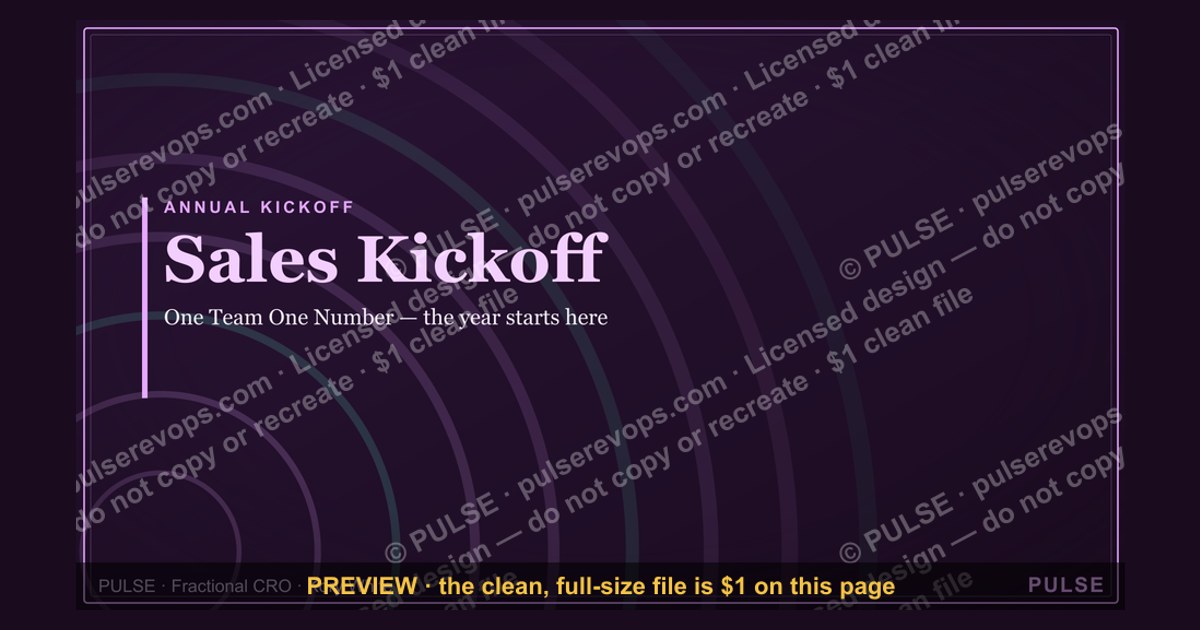
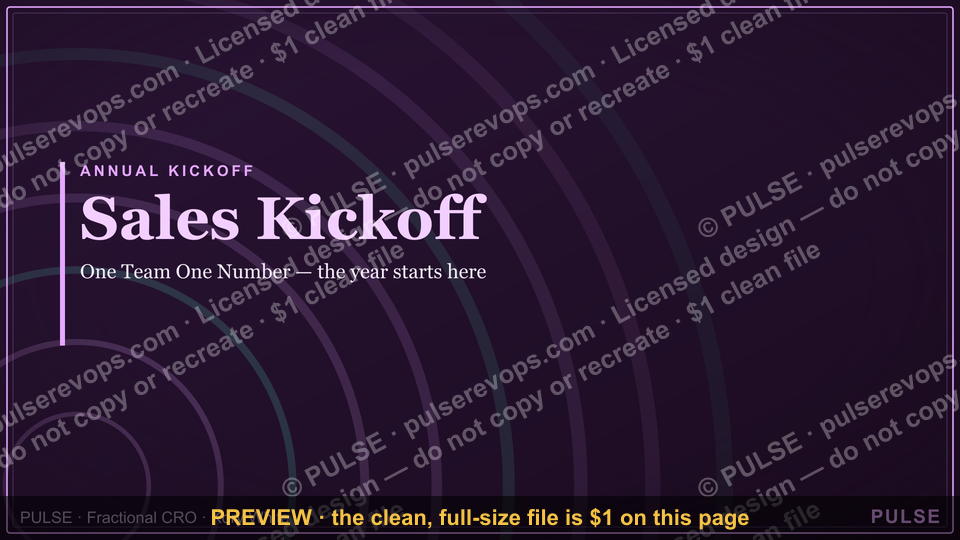
A Sales Kickoff title slide is the opening visual of a kickoff meeting, typically displaying the event name, date, and company branding. Its purpose is to set the tone, establish the theme, and welcome attendees. The slide often includes a compelling tagline or key message that aligns with the organization's annual sales goals.
Sales Kickoff — Title Slide

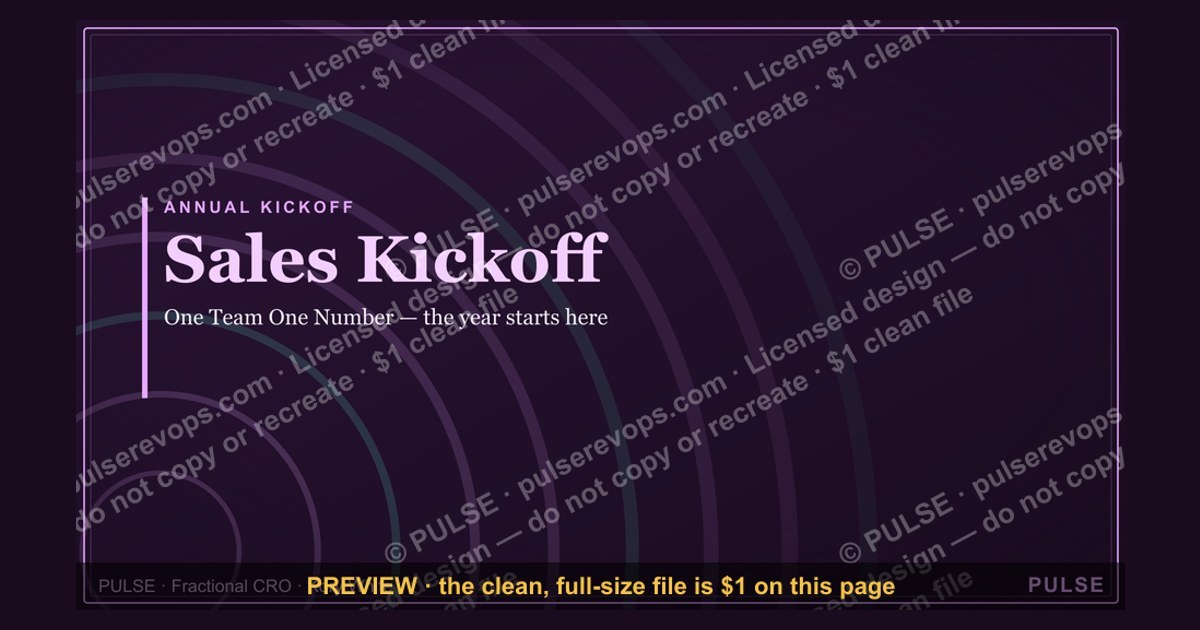
A clean 16:9 title slide — "Sales Kickoff" with a "One Team One Number" sub-line and pulse accent. Open your sales kickoff on a polished, on-brand note.
Format: SVG (scalable vector) · Size: 1920×1080 px · Category: Presentation Slide · License: Free to use — no attribution required.
[⬇ Download this graphic](/graphics/assets/gb0062.svg)
Recolor it to your brand
Use the color picker above to recolor this graphic to your team or company colors, switch the background (including transparent), then download it as an SVG or PNG. No sign-up, no watermark.
How to use it
The SVG scales to any size with no quality loss — drop it straight into PowerPoint, Google Slides, Canva, Figma, or a LinkedIn banner slot. The PNG export is ready to upload anywhere that wants a raster image.
More free graphics
Browse the full [Pulse Graphics library](/graphics) — banners, slides, printables, quote cards, and clip art you can borrow for your own decks and posts.
Related on PULSE
- [Sales Kickoff 2027 — Title Slide](/knowledge/gb0007)
- [Sales Training — Title Slide](/knowledge/gb0078)
- [Sales Onboarding — Title Slide](/knowledge/gb0070)
- [Annual Sales Planning — Title Slide](/knowledge/gb0067)
- [Quarterly Business Review — Title Slide](/knowledge/gb0005)
- [RevOps Review — Title Slide](/knowledge/gb0080)
Anatomy of a High-Impact Sales Kickoff Title Slide
A title slide isn’t just a placeholder—it’s the first impression that sets the emotional and strategic tone for your entire SKO. The “Sales Kickoff — Title Slide” design, with its clean 16:9 format and “One Team One Number” sub-line, works because it balances clarity with energy. But to maximize its impact, you need to understand the psychology behind each element and how to adapt it for your specific audience.
The 5-Second Rule: Your title slide has roughly 5 seconds to convey three things: what the event is, who it’s for, and why it matters. The “Sales Kickoff” headline is obvious, but the “One Team One Number” sub-line does the heavy lifting—it signals unity and a shared metric. This is critical because sales teams often operate in silos (SDRs, AEs, CSMs). A sub-line like this reminds everyone they’re rowing in the same direction. If your company has a specific revenue target (e.g., “$50M ARR”), consider swapping the generic “One Number” for that actual figure. For example: “One Team — $50M ARR.” This turns an abstract concept into a tangible goal.
Color Psychology and Pulse Accent: The pulse accent (likely a red or orange line or dot) isn’t decorative—it’s a visual cue for urgency and heartbeat. Red tones increase heart rate and attention, making them ideal for a sales kickoff where you want energy, not relaxation. If your brand uses blue or green, you can still create urgency with a contrasting accent (e.g., a bright yellow pulse on a navy background). The pulse itself suggests movement, rhythm, and forward momentum—perfect for a team that needs to hit the ground running.
Typography Hierarchy: The title slide uses a bold, sans-serif font for “Sales Kickoff” (likely 60-80pt) and a lighter weight for the sub-line (20-30pt). This hierarchy guides the eye: headline first, then the unifying message. Avoid using more than two font families. A common mistake is adding a third element (like a date or location) that competes for attention. If you must include logistics, place them in the bottom third in a small, neutral font (12-14pt). The top two-thirds should remain focused on the emotional hook.
Real-World Adaptation: A SaaS company scaling from 50 to 100 reps might use this slide with a sub-line like “From 50 to 100 — Same Mission.” A manufacturing firm with regional teams could say “One Supply Chain, One Revenue Line.” The key is to keep it short—no more than 5-7 words for the sub-line. Anything longer dilutes the impact. Also, consider adding a subtle background element (like a faint world map or industry icon) that reinforces your vertical without distracting from the text.
Technical Considerations for SVG: The SVG format is ideal because it scales without loss and can be edited in tools like Figma, Illustrator, or even code. But SVG files can have hidden issues: check that the pulse accent is on a separate layer (so you can animate it later), that the text is not outlined (so you can edit it), and that the color hex codes match your brand guidelines. A common pitfall is an SVG that looks great on a white background but disappears on a projector screen. Always test your title slide against a dark room projection—high contrast (white text on dark background or vice versa) is non-negotiable.
The “Before and After” Test: Before your SKO, show the title slide to three people who don’t know the agenda. Ask them: “What is this event about, and how does it make you feel?” If they say “excited” or “focused,” you’ve nailed it. If they say “confused” or “generic,” iterate. A title slide that fails this test will lose the room before the first speaker even stands up.
Strategic Messaging: Crafting the Sub-Line and Visual Narrative
The sub-line “One Team One Number” is a classic sales rallying cry, but its effectiveness depends on how well it aligns with your company’s current reality. A generic sub-line can feel hollow if the team doesn’t believe in the “one number” or if there’s internal friction between departments. Here’s how to refine it for maximum buy-in.
The “One Number” Trap: Many companies use a single revenue target (e.g., “$100M by Q4”). But if your team is split between new business and expansion revenue, a single number can create unhealthy competition. Consider a dual sub-line: “One Team — Two Numbers, One Mission.” For example, “$60M New Business + $40M Expansion = $100M Total.” This acknowledges different roles while maintaining unity. Alternatively, use a non-revenue metric that everyone influences, like “One Team — 95% Customer Retention” or “One Team — 500 Qualified Meetings.” The goal is to pick a number that every rep can directly impact.
Temporal Urgency: The “Sales Kickoff” is typically held in Q1, but the sub-line can create urgency for the year ahead. Instead of “One Number,” try “This Year’s Number: $X.” The word “this year” anchors the goal in the present, making it feel more immediate. You can also add a countdown element: “One Team — One Number — 365 Days to Hit It.” This works especially well if your SKO is in January, as it frames the entire year as a finite sprint.
Visualizing the Sub-Line: The SVG title slide likely has room for a small icon or graphic next to the sub-line. A simple upward arrow, a target crosshair, or a linked chain icon can reinforce the message. Avoid cliché images like handshakes or dollar signs—they feel corporate and uninspired. Instead, use abstract shapes that suggest connection (circles overlapping, lines converging) or momentum (a diagonal line, a wave). If your company uses a mascot or symbol, place it subtly in the corner (10-15% opacity) so it doesn’t compete with the text.
The “One Team” Reality Check: If your sales team is remote or hybrid, “one team” might feel aspirational rather than real. To bridge this gap, consider adding a secondary line that acknowledges the challenge: “One Team — One Number — Anywhere in the World.” This validates the remote reality while reinforcing unity. Alternatively, use a visual cue like a world map with dots representing team locations—this turns the “one team” concept into a visual truth.
A/B Testing the Sub-Line: Before finalizing, run a quick poll among your sales leadership and a few top reps. Offer three options: (1) “One Team One Number,” (2) “Our Year: $X,” (3) “Together We Hit $X.” Option 1 is classic, option 2 is direct, option 3 is inclusive. The winner often depends on your company culture. A startup with a competitive culture might prefer option 1, while a collaborative enterprise might lean toward option 3. The key is to test, not assume.
The Title Slide as a Promise: Remember, your title slide is a promise to the audience. If you say “One Team One Number,” every subsequent slide must reinforce that unity. Avoid slides that pit teams against each other (e.g., “SDRs vs. AEs” or “Region A vs. Region B”). Instead, frame competition as external (e.g., “Our Competitors vs. Us”) or as a shared challenge (e.g., “The Market vs. Our Team”). A title slide that promises unity but delivers division will breed cynicism faster than any bad speaker.
Production and Delivery: Making the Title Slide Work in the Room
A title slide that looks perfect on your laptop can fall flat in a live setting. Lighting, screen calibration, and room acoustics all affect how the slide is perceived. Here’s how to ensure your “Sales Kickoff — Title Slide” lands with impact.
Projector Calibration: Most office projectors have lower contrast and brightness than your monitor. An SVG with subtle gradients or light text on a white background will wash out. Before the event, test the slide on the actual projector in the room. Adjust the SVG’s background to a dark color (e.g., navy, charcoal, or deep red) with white or bright text. If your brand uses light colors, add a 20-30% black overlay to the background to boost contrast. The pulse accent should be at least 3-4 pixels thick on screen (roughly 8-12pt stroke) to remain visible from the back row.
Sound and Motion: A static title slide is fine, but adding a subtle animation can increase engagement. The SVG format supports CSS animations, so consider a gentle pulse effect on the accent line (e.g., a 2-second opacity fade from 100% to 70% and back). Avoid spinning, bouncing, or sliding text—it looks unprofessional. If you have audio, a short intro track (15-20 seconds of instrumental music that fades as the first speaker begins) can set the mood. Choose music with a steady beat (120-130 BPM) to create energy without distraction. Test the volume in the room—background music should be audible but not overpowering.
The “Dark Room” Test: Sales kickoffs often have dimmed lights to focus on the screen. In a dark room, a bright white title slide can be blinding and create eye strain. Use a dark background (e.g., #1A1A2E or #2D2D2D) with light text (#FFFFFF or #E0E0E0). The pulse accent can be a bright color (#FF3366 or #00D4AA) that pops against the dark backdrop. This also helps the slide transition smoothly into the next (usually a darker agenda slide or speaker intro).
Speaker Introduction Timing: The title slide should remain on screen for at least 10-15 seconds before the first speaker speaks. This gives the audience time to read, absorb, and settle. If the slide disappears too quickly, the message is lost. Have the slide up as attendees enter the room (pre-event) and as the first speaker walks to the stage. The speaker should wait until the slide has been visible for at least 5
Sources
- Harvard Business Review — sales strategy and team performance insights
- Salesforce — official product documentation and best practices for sales kickoffs
- Gartner — research on sales enablement and meeting effectiveness
- McKinsey & Company — reports on sales transformation and organizational alignment
- American Marketing Association (AMA) — resources on sales and marketing collaboration
- Forrester — analysis of sales kickoff trends and ROI measurement
FAQ
How long does a typical sales kickoff meeting last? Most sales kickoff meetings run between one and three days, depending on company size and agenda depth. Some organizations extend to a full week for global teams or product launches.
Who should attend the sales kickoff? Core attendees include the entire sales team, sales leadership, marketing leads, and product managers. Customer success and executive sponsors often join for key sessions, especially strategy and Q&A.
What is the main goal of a sales kickoff? The primary goal is to align the team on annual targets, product updates, and sales strategies. It also serves to energize and motivate the team for the coming year.
How far in advance should we plan a sales kickoff? Planning typically begins three to six months before the event. Venue booking, speaker coordination, and content development are the longest lead-time items.
What is a realistic budget for a sales kickoff? Budgets vary widely from tens of thousands to several hundred thousand dollars, depending on location, travel, venue, and production quality. A modest regional event might cost $20,000–$50,000, while a large-scale global kickoff can exceed $500,000.
How do we measure the success of a sales kickoff? Success is often measured through post-event surveys, pre- and post-event knowledge assessments, and tracking sales performance in the following quarter. Qualitative feedback on team morale and alignment is also key.
This page will be disappearing soon. Save it to your device for $1 — or read it free while it is here.
@Kory-White- · if Venmo asks, the last 4 of my number are 2012
 graphicForecast — Section Divider Slide
 graphicDemand Gen Review — Title Slide
 graphicThank you. — Closing Slide
 graphicProduct Launch (GTM) — Title Slide
 graphicMonthly Business Review — Title Slide
 graphicQuestions? — Closing Slide
 graphicComp Plan Rollout — Title Slide
 graphicGo win. — Closing Slide
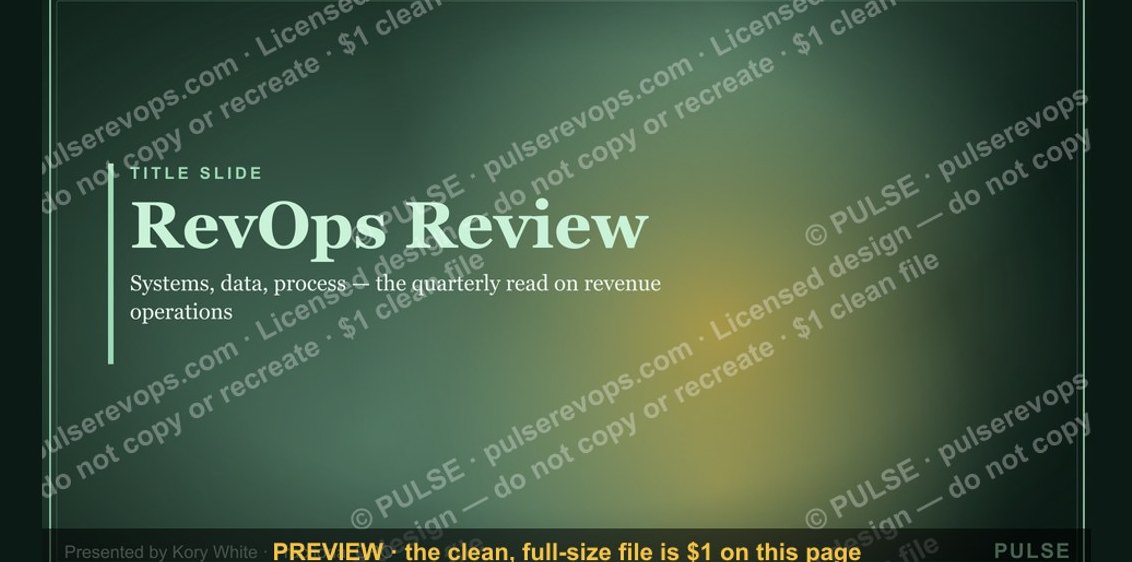 graphicRevOps Review — Title Slide
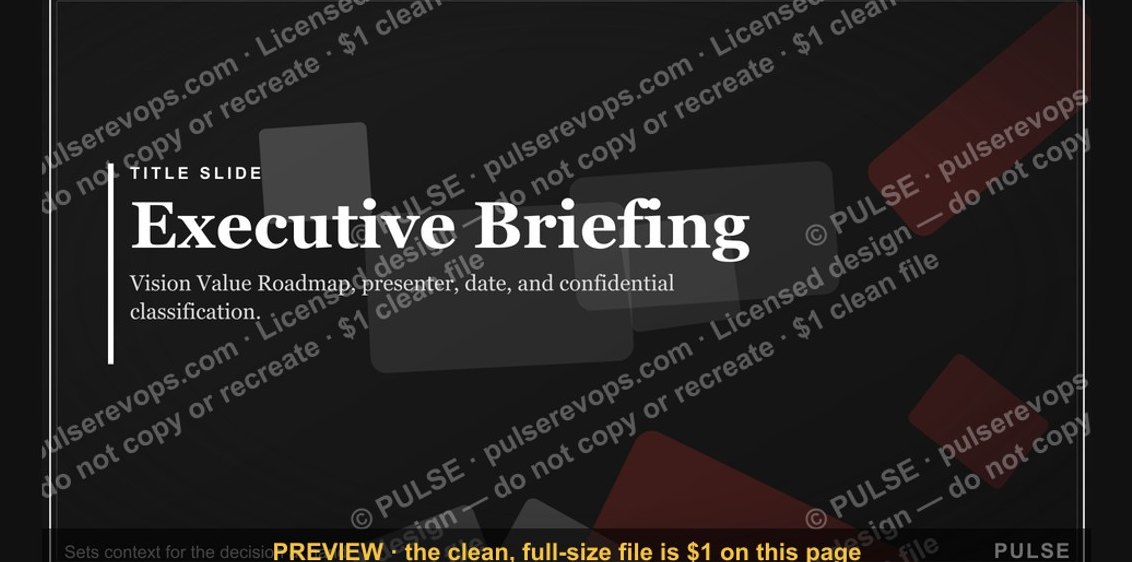 graphicExecutive Briefing — Title Slide