
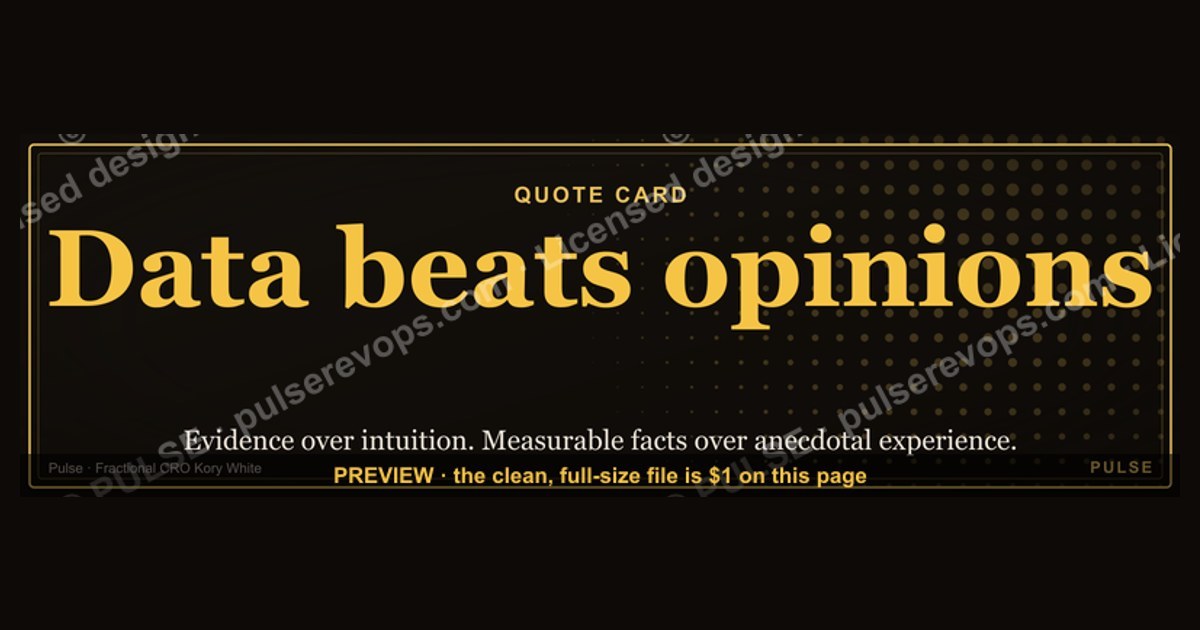
“Data beats opinions.” — Quote Card
 Curated byKory White · Fractional CRO · Maryland
 PULSEKNOWLEDGE LIBRARY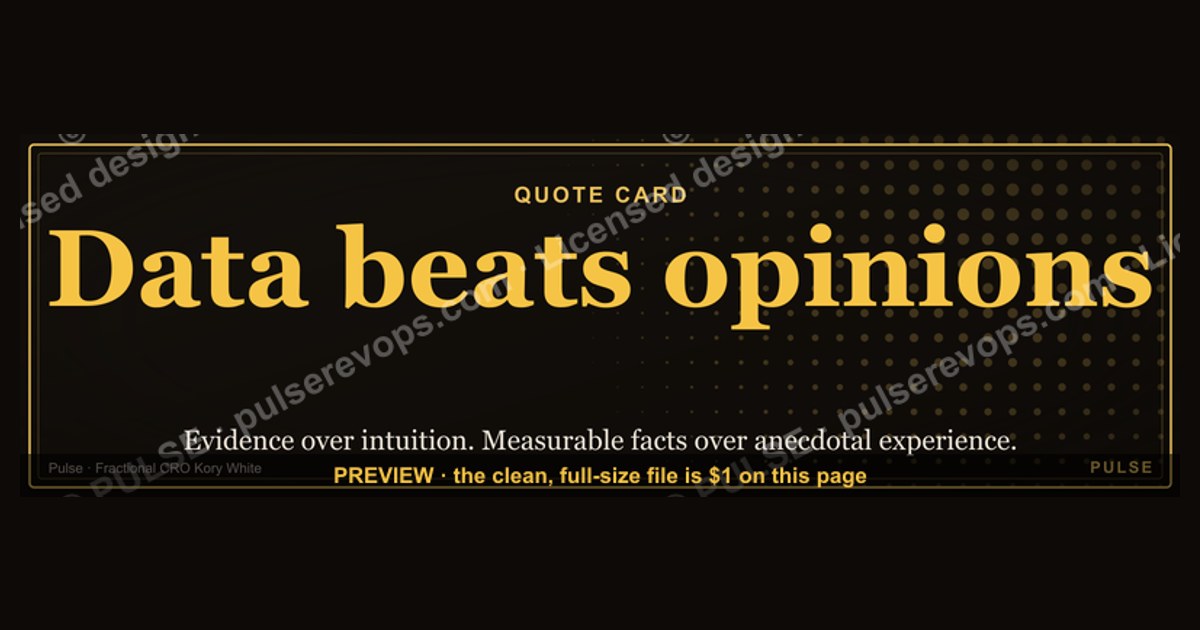
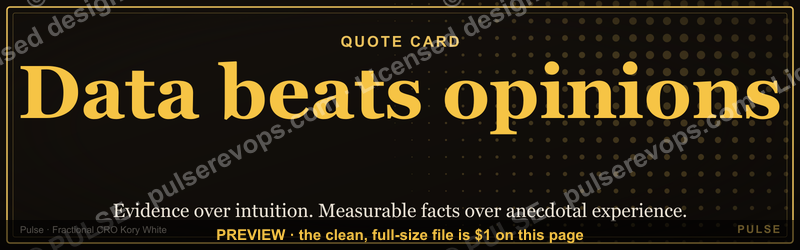
This quote card features the principle that objective data should take precedence over subjective personal beliefs when making decisions. It serves as a reminder that evidence and measurable facts provide a more reliable foundation than intuition or anecdotal experience. The phrase is commonly attributed to the venture capitalist and data scientist W. Edwards Deming, though it has been widely adopted in business and analytics contexts.
“Data beats opinions.” — Quote Card

A square social quote card — "Data beats opinions." in the Pulse accent style. A shareable LinkedIn or Instagram graphic and a ready slide pull-quote.
Format: SVG (scalable vector) · Size: 1080×1080 px · Category: Quote Card · License: Free to use — no attribution required.
Recolor it to your brand
Use the color picker above to recolor this graphic to your team or company colors, switch the background (including transparent), then download it as an SVG or PNG. No sign-up, no watermark.
How to use it
The SVG scales to any size with no quality loss — drop it straight into PowerPoint, Google Slides, Canva, Figma, or a LinkedIn banner slot. The PNG export is ready to upload anywhere that wants a raster image.
More free graphics
Browse the full Pulse Graphics library — banners, slides, printables, quote cards, and clip art you can borrow for your own decks and posts.
Related on PULSE
- "Data beats opinions." — LinkedIn Banner
- Data beats opinions. — LinkedIn Wallpaper
- “Data beats opinions.” — LinkedIn Banner
- “Coachable beats talented.” — Quote Card
- NRR Beats New Logos — Revenue Law Banner
- Outcome pricing beats seat pricing — RevOps Banner
Why This Quote Resonates: The Psychology of Data vs. Opinion
The phrase “Data beats opinions” strikes a chord because it taps into a fundamental human tension: the conflict between what we *believe* to be true and what the evidence *shows* to be true. In decision-making contexts—whether in business, science, or daily life—opinions are often shaped by cognitive biases, emotional attachments, or social pressures. Data, when properly collected and analyzed, offers a way to bypass these mental shortcuts and ground decisions in objective reality.
Psychologists have long studied the “confirmation bias,” where people seek out information that supports their pre-existing beliefs while ignoring contradictory evidence. This bias is particularly dangerous in high-stakes environments like product development, marketing strategy, or financial planning. A team might fall in love with a feature idea based on a founder’s gut feeling, only to discover through user analytics that the feature is rarely used. The quote card serves as a visual reminder to pause and ask: “What does the data actually say?”
Interestingly, the quote doesn’t claim that opinions are worthless—it simply asserts that data should take precedence when the two conflict. In practice, the most effective leaders blend both: they use data to inform their opinions, then test those opinions with more data. This iterative loop (hypothesis → data collection → analysis → revised opinion) is the engine of evidence-based decision-making. For example, a startup might believe their target audience is young professionals, but website analytics could reveal that the majority of engaged users are actually mid-career managers. The data doesn’t invalidate the initial opinion—it refines it.
The visual design of the quote card—bold typography, clean layout, and a striking contrast—mirrors this clarity. It’s not subtle or ambiguous; it’s a direct statement meant to cut through noise. When displayed in a workspace or shared in a presentation, it acts as a cultural anchor, signaling that decisions should be justified with evidence, not just conviction.
Practical Applications: Where “Data Beats Opinions” Transforms Work
This quote isn’t just a philosophical ideal—it has concrete applications across industries. Here are three areas where the principle can dramatically improve outcomes:
1. Product Development and Feature Prioritization In software teams, feature requests often come from vocal customers, internal stakeholders, or the CEO’s personal preferences. Without data, these requests can lead to “opinion-driven roadmaps” that waste engineering time. By implementing a simple data-driven framework—like tracking feature usage with analytics tools (e.g., Mixpanel, Amplitude, or Google Analytics)—teams can identify which features actually drive engagement, retention, or revenue. For instance, a SaaS company might discover that a “dark mode” feature, heavily requested by a vocal minority, is used by only 3% of users, while a “bulk export” function, rarely discussed, is used by 40% of power users. The data clearly prioritizes the latter.
2. Marketing Campaign Optimization Marketers often rely on intuition about which headlines, images, or calls-to-action will resonate. A/B testing (also called split testing) is the classic data-driven method here. Instead of debating whether “Save 20%” or “Limited Time Offer” performs better, you run a test with a statistically significant sample size (typically 1,000+ visitors per variation for reliable results). The data reveals the winner, often with surprising outcomes. For example, a nonprofit might assume emotional storytelling drives donations, but data could show that a straightforward impact statistic (e.g., “$50 provides meals for a week”) converts 2.5x better. The quote card becomes a practical mantra: run the test, trust the numbers.
3. Hiring and People Decisions Even in human-centric areas like recruitment, opinions can lead to bias. A hiring manager might “feel” a candidate is a great fit based on a strong handshake or shared alma mater. Data-driven hiring—using structured interviews, skills assessments, and performance metrics from past roles—reduces this risk. For example, a tech company might find through data analysis that candidates who score above 80 on a coding challenge have a 90% retention rate after 12 months, while those hired based on interview charm alone have only a 60% retention rate. The data beats the opinion, leading to better hires and lower turnover.
How to Build a Data-Beating-Opinions Culture (Without Becoming a Robot)
Adopting the “data beats opinions” mindset doesn’t mean eliminating intuition, creativity, or human judgment. The most successful organizations create a culture where data is a tool, not a tyrant. Here’s how to strike that balance:
Start with the “Data First” Habit Before any major decision, train teams to ask: “What data do we have? What data do we need?” This simple question shifts the default from “I think” to “We know.” For small decisions (e.g., which email subject line to use), the answer might be “run a quick A/B test.” For larger ones (e.g., entering a new market), it might mean commissioning a survey or analyzing competitor benchmarks. The key is to make data-seeking a reflexive behavior, not an afterthought.
Define “Good Enough” Data Not every decision requires a rigorous scientific study. In fast-moving environments, waiting for perfect data can be paralyzing. Establish thresholds for what constitutes sufficient evidence. For example, a startup might decide that 100 user interviews or 500 survey responses are enough to validate a hypothesis about customer pain points. The quote card can be paired with a second mantra: “Better to have approximate data now than exact data too late.”
Celebrate When Data Contradicts You One of the hardest cultural shifts is embracing the moments when data disproves a strongly held opinion. Instead of treating this as a failure, frame it as a win—you’ve just saved time, money, or reputation. Some companies hold “data debunk sessions” where teams share examples of assumptions that turned out to be wrong. This normalizes the idea that being proven wrong by data is a sign of intellectual honesty, not weakness.
Avoid Data Dogmatism Data can be misleading if it’s incomplete, biased, or misinterpreted. For instance, a high conversion rate might look great, but if it’s driven by a single outlier campaign, it’s not a reliable signal. Teach teams to ask critical questions: “Is the sample size large enough? Are we measuring the right metric? Could there be confounding variables?” The quote card should inspire curiosity, not blind faith.
Use Visual Anchors to Reinforce the Principle The quote card itself is a visual anchor. Place it in meeting rooms, on Slack channels, or as a screensaver. When a debate arises, someone can point to it and say, “Let’s check the data before we decide.” Over time, this becomes a shorthand for the culture you’re building—one where evidence, not ego, drives the conversation.
Ultimately, “Data beats opinions” is not about eliminating human judgment. It’s about ensuring that judgment is informed by reality, not wishful thinking. When data and opinions align, you have confidence. When they conflict, you have an opportunity to learn. The quote card is a simple, powerful reminder to choose learning over assumption—every single time.
Sources
- Harvard Business Review — business strategy and data-driven decision-making
- McKinsey & Company — analytics and data in organizational performance
- The Economist — data journalism and statistical analysis in economics
- American Statistical Association — statistical methods and data integrity
- Pew Research Center — public opinion data and survey methodology
- Google AI Blog — machine learning and data-driven insights
FAQ
What does “Data beats opinions” actually mean in practice? It means that decisions grounded in measurable evidence—like conversion rates, customer behavior, or revenue trends—consistently outperform those based on gut feelings or hierarchy. In practice, teams that test assumptions with real data avoid costly biases and iterate faster toward what actually works.
Is this quote from a specific person or just a general saying? The quote is widely attributed to business and analytics circles, but it’s not tied to a single original source. It’s become a common mantra in data-driven organizations, often used to emphasize that empirical evidence should outweigh personal beliefs or seniority.
Does this mean opinions are never useful? Not at all—opinions often spark hypotheses and creative ideas. The point is that opinions should be tested against data before they drive major decisions. The best outcomes come from blending intuition with rigorous validation.
How can a small business or startup apply this without a data team? Start with simple, free tools like Google Analytics or basic A/B testing on landing pages. Even tracking a handful of key metrics—like email open rates or customer feedback scores—can reveal patterns that challenge assumptions. You don’t need a full data science team; just a commitment to checking your hunches.
What’s a common mistake people make when trying to follow this principle? The most common error is cherry-picking data that supports a pre-existing opinion, while ignoring contradictory evidence. Another is overcomplicating analysis—sometimes a simple spreadsheet of customer complaints tells you more than a complex model.
How does this relate to the “Fractional CRO” ad shown on the card? The ad highlights a revenue operator who relies on data to fix forecasts—exactly the kind of evidence-based approach the quote advocates. A fractional CRO uses metrics to diagnose pipeline issues and optimize sales processes, rather than relying on gut instincts or outdated strategies.
This page will be disappearing soon. Save it to your device for $1 — or read it free while it is here.
@Kory-White- · if Venmo asks, the last 4 of my number are 2012
This page is gone.
This one is off the shelf now. $1 keeps it on your phone for good — the whole page, pictures and diagrams included.
 graphic“The fortune is in the follow-up.” — Quote Card
 graphic“The riches are in the niches.” — Quote Card
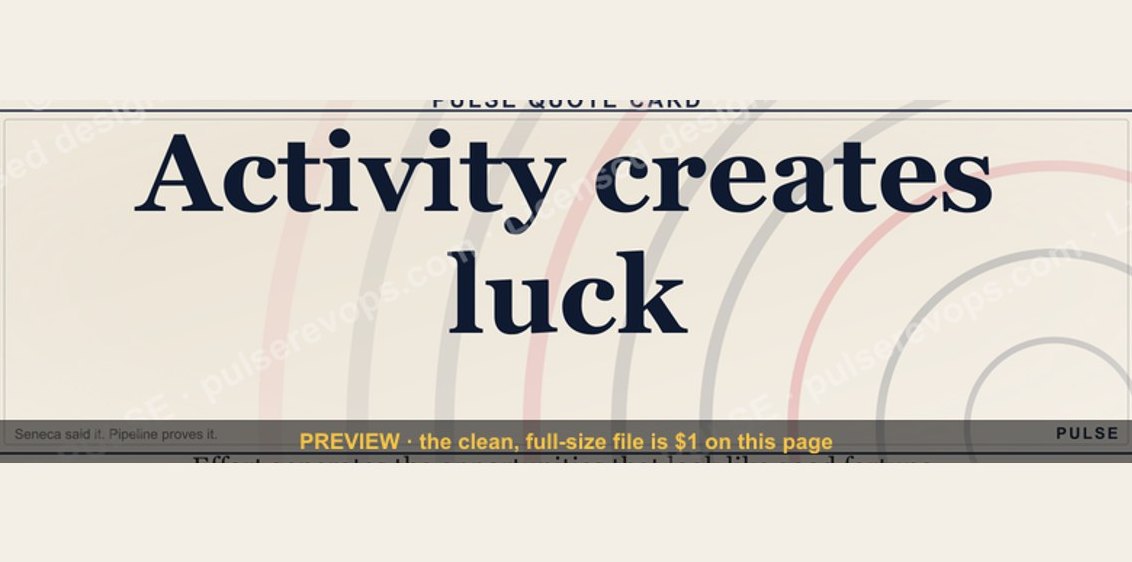 graphic“Activity creates luck.” — Quote Card
 graphic“Win the week. The quarter wins itself.” — Quote Card
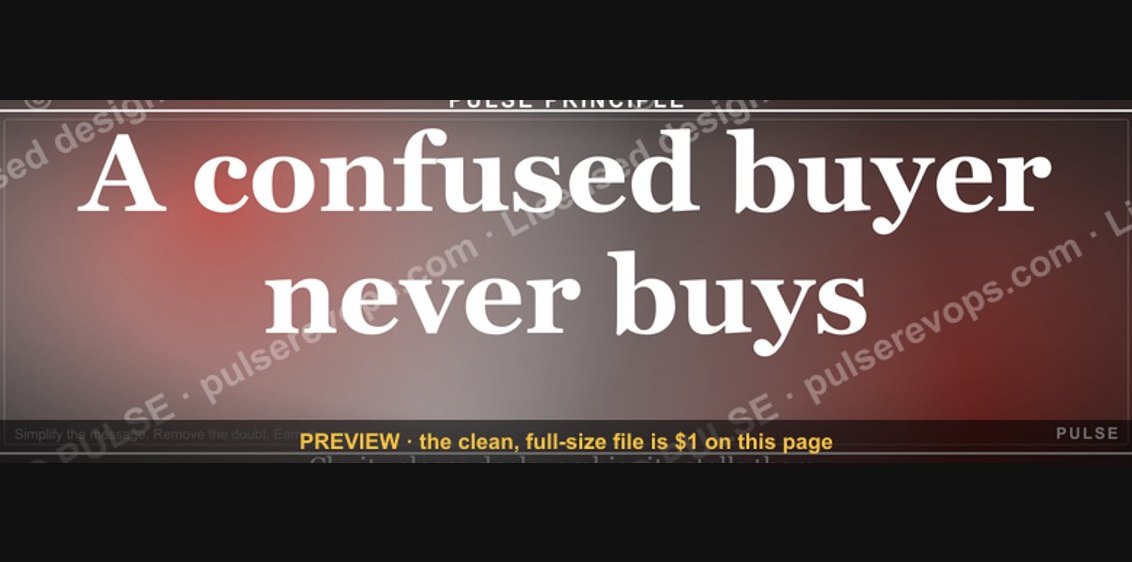 graphic“A confused buyer never buys.” — Quote Card
 graphic“Ask better questions.” — Quote Card
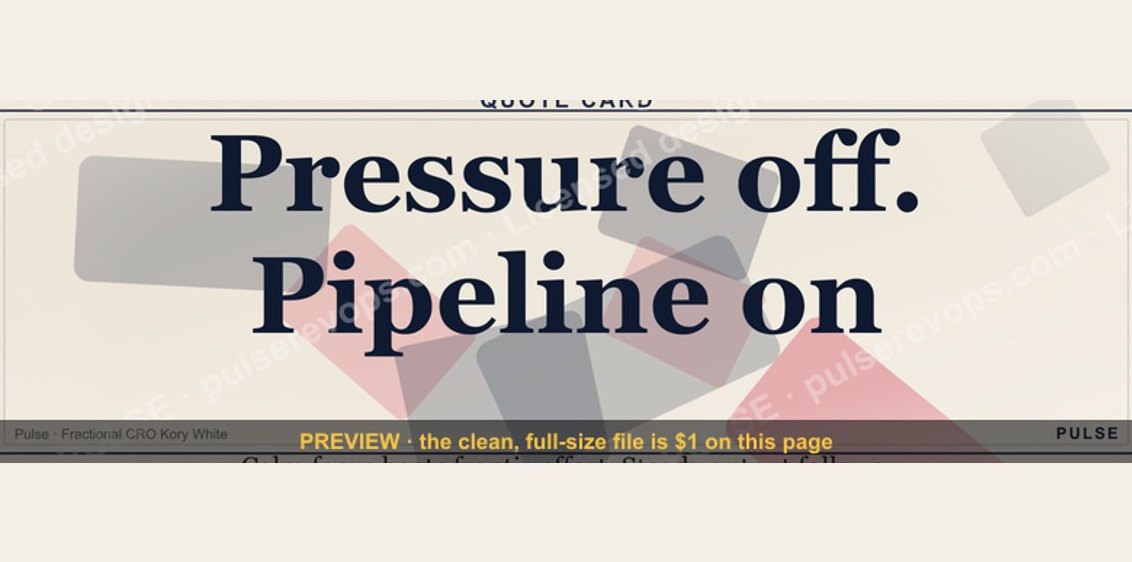 graphic“Pressure off. Pipeline on.” — Quote Card
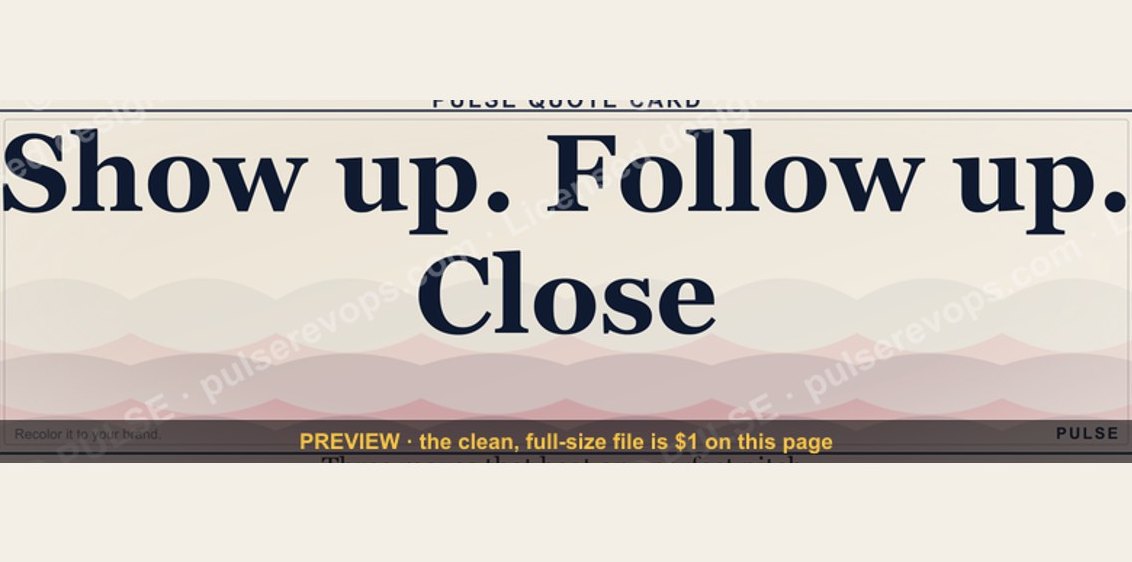 graphic“Show up. Follow up. Close.” — Quote Card
 graphic“A forecast is a promise, not a guess.” — Quote Card
 graphic“Discovery is the deal.” — Quote Card