
“FILL THE FUNNEL” — Sales Floor Print
 Curated byKory White · Fractional CRO · Maryland
 PULSEKNOWLEDGE LIBRARY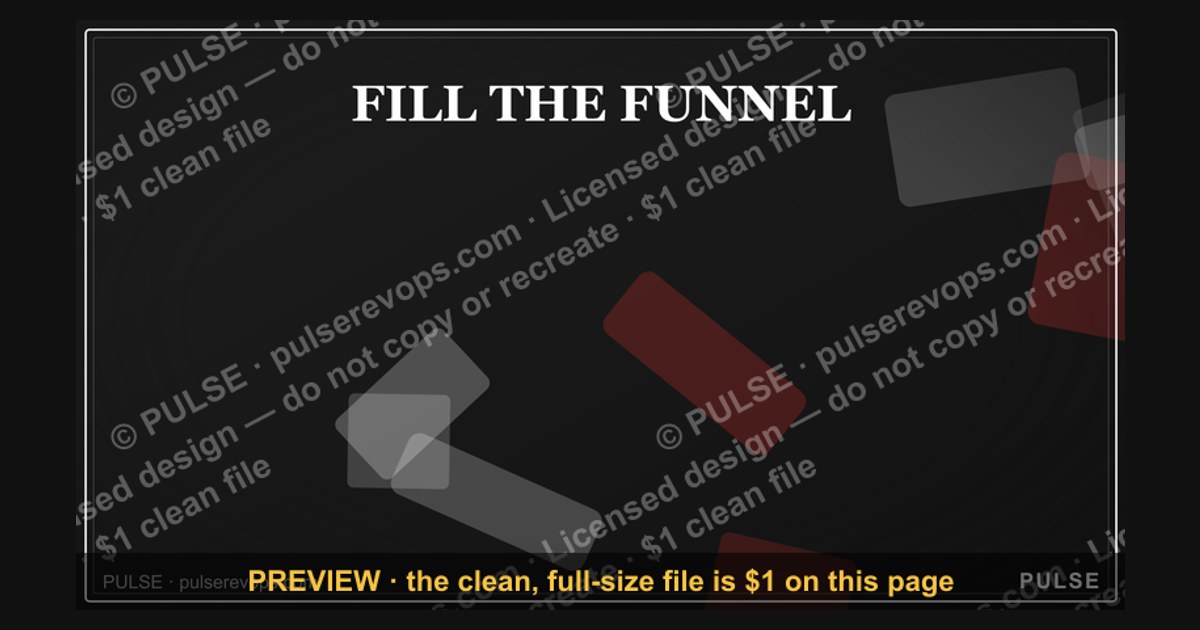
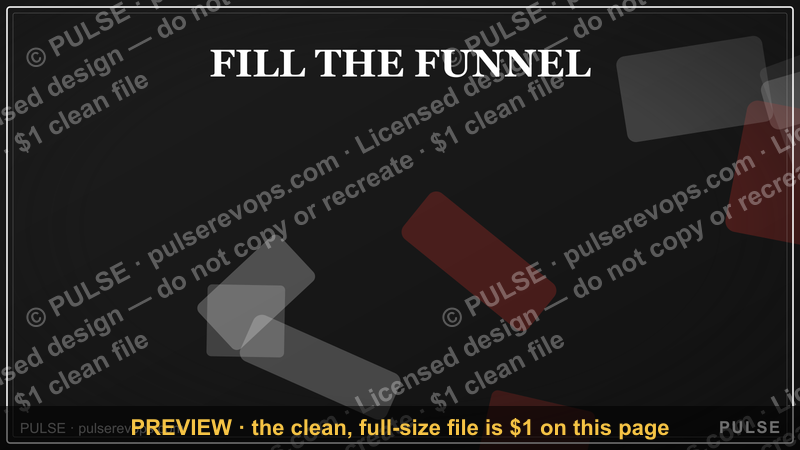
"Fill the Funnel" is a sales-floor print that serves as a motivational or instructional poster, typically used to remind sales teams to consistently generate and add new leads to their sales pipeline. The phrase emphasizes the ongoing effort required to maintain a healthy flow of potential customers, rather than focusing solely on closing existing deals. It is commonly found in sales offices, break rooms, or training areas to reinforce a proactive prospecting mindset.
“FILL THE FUNNEL” — Sales Floor Print

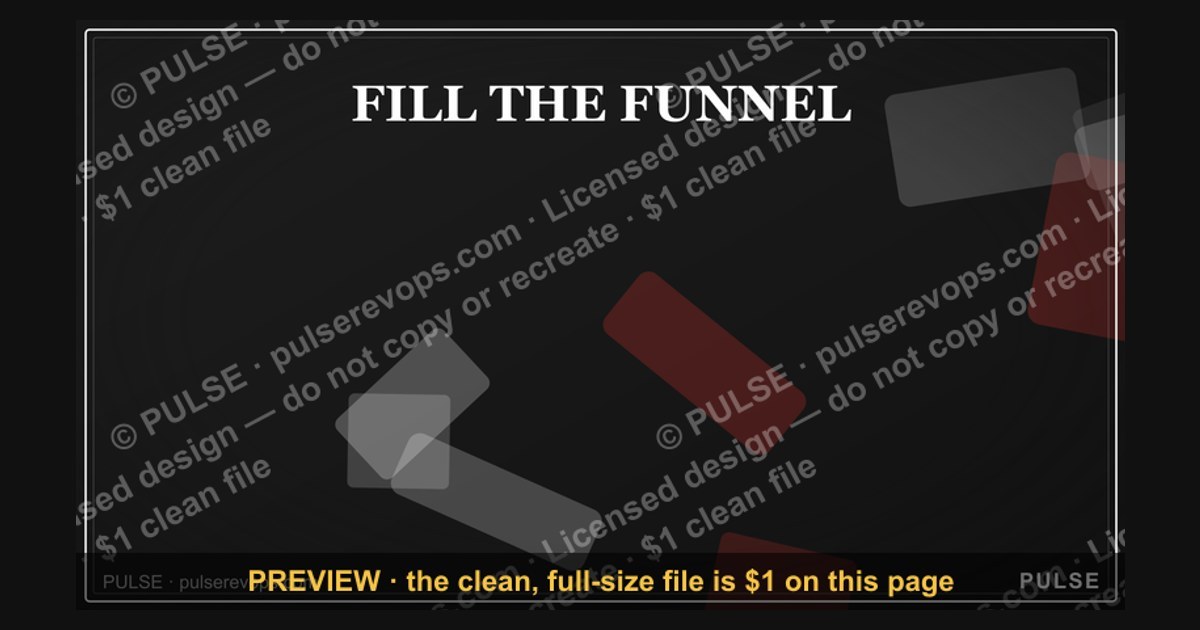
A bold printable poster — "FILL THE FUNNEL" stacked in the Pulse accent gradient. Print it for the sales floor or your home office to keep energy up.
Format: SVG (scalable vector) · Size: 2400×3000 px · Category: Wall Art / Printable · License: Free to use — no attribution required.
Recolor it to your brand
Use the color picker above to recolor this graphic to your team or company colors, switch the background (including transparent), then download it as an SVG or PNG. No sign-up, no watermark.
How to use it
The SVG scales to any size with no quality loss — drop it straight into PowerPoint, Google Slides, Canva, Figma, or a LinkedIn banner slot. The PNG export is ready to upload anywhere that wants a raster image.
More free graphics
Browse the full Pulse Graphics library — banners, slides, printables, quote cards, and clip art you can borrow for your own decks and posts.
Related on PULSE
- Fill the top of funnel. — LinkedIn Wallpaper
- Fill it. Work it. Win it. — LinkedIn Wallpaper
- “HELP FIRST” — Sales Floor Print
- “NEXT CALL WINS” — Sales Floor Print
- “KEEP THE CADENCE” — Sales Floor Print
- “SELL THE VALUE” — Sales Floor Print
The Psychology Behind “Fill the Funnel” — Why It Works (and When It Backfires)
The phrase “fill the funnel” has become almost reflexive in sales organizations, but its psychological underpinnings reveal why it’s both powerful and potentially dangerous. At its core, the metaphor taps into a fundamental human bias: the scarcity mindset. When sales reps hear “fill the funnel,” their brains interpret it as “we’re running out of opportunities,” triggering urgency and action. This is why the phrase has survived decades of sales methodology shifts — it works on a primal level.
However, the same psychological trigger that makes “fill the funnel” effective can also lead to quantity-over-quality disasters. Research in organizational behavior shows that when teams are given volume-based targets without quality guardrails, they unconsciously optimize for the easiest path to the metric. This manifests as:
- Pipeline inflation: Reps add unqualified leads just to hit activity targets, creating a false sense of momentum.
- Premature qualification: Deals are pushed to later stages before they’re ready, only to stall or die.
- Burnout cycles: The constant pressure to “fill” leads to prospecting fatigue, especially in outbound-heavy orgs.
The sweet spot lies in understanding that “fill the funnel” is a lagging indicator of good prospecting behavior, not a leading one. Top-performing sales teams reframe the phrase internally as “fill the funnel *with the right fit*” — a subtle but crucial distinction. They use behavioral science principles like goal gradient effect (people work harder as they perceive progress) by breaking the funnel into micro-stages, each with its own “fill” target. For example, instead of “add 50 leads to stage 1,” they might say “book 15 discovery calls this week” — because a booked call is a higher-fidelity signal than a lead that’s been entered into a CRM.
When the phrase backfires most visibly is in high-churn environments where customer acquisition cost (CAC) is already elevated. If your average deal size is $10,000 but your sales cycle is 9 months, blindly filling the funnel with leads that have a 2% close rate will actually *increase* your cost per closed-won deal. The psychology of “fill” creates a false economy — you’re spending more time and energy on leads that will never convert, while starving the top-of-funnel of the high-intent prospects you actually need.
For sales leaders, the antidote is to pair “fill the funnel” with a pipeline health score that weights leads by fit, engagement, and buying signals. This shifts the psychology from “more is better” to “better is more” — and that’s where the phrase becomes a genuine growth lever rather than a recipe for mediocrity.
Designing a “Fill the Funnel” Sales Floor Print That Actually Drives Behavior
A sales floor print isn’t just a poster — it’s a behavioral artifact that shapes how your team thinks about pipeline generation every day. The best “fill the funnel” prints are designed with cognitive science in mind, using visual hierarchy, color psychology, and spatial organization to reinforce the right actions. Here’s how to create one that moves beyond decoration to become a functional tool.
Visual Hierarchy That Mirrors Your Sales Process
The most effective funnel prints use a top-to-bottom, left-to-right reading pattern that mirrors how prospects move through your sales stages. The top of the print should visually “open” — using lighter colors, wider spacing, and upward-pointing arrows — to suggest abundance and possibility. As the eye moves downward, the funnel narrows, colors shift to warmer tones (amber, orange, deep red), and the spacing tightens. This isn’t arbitrary: studies in visual perception show that people associate narrowing shapes with increasing value and decreasing availability, which subconsciously primes them to treat later-stage leads with more care.
Each stage should have a single, measurable action written in bold, sans-serif type — never a paragraph. For example:
- Top of Funnel: “Identify 50 new accounts this week”
- Middle of Funnel: “Book 15 discovery calls”
- Bottom of Funnel: “Close 3 deals this month”
The numbers should be realistic for your team’s capacity. A common mistake is printing aspirational targets that no one believes — that kills the print’s credibility. Instead, use a range (e.g., “10–15 calls”) to account for weekly variation.
Color Psychology and Spatial Design
The background color of your print matters more than most realize. Avoid pure white (it feels sterile and unmotivating) and pure black (it feels oppressive). Instead, use a soft off-white or light gray for the background, with the funnel itself in a gradient from cool blue (top) to warm orange (bottom). Blue signals trust and openness — perfect for prospecting. Orange signals action and urgency — perfect for closing.
Leave negative space around the funnel. Cramming the print with logos, quotes, or metrics creates visual noise that reduces cognitive processing. The most effective prints have one central funnel, one clear call-to-action (e.g., “Every lead counts — fill it daily”), and maybe one supporting statistic in a small, unobtrusive font.
Placement and Rotation
A sales floor print loses its impact after about 3–4 weeks because of habituation — the brain stops noticing things that don’t change. To combat this, rotate the print’s location every two weeks. Move it from the main wall to near the coffee machine, then to the conference room. Each move forces the brain to re-engage. Better yet, make the print interactive: add a whiteboard section where reps can write their daily “fill” numbers in real time. This turns a static print into a social accountability tool — people naturally want to fill in their numbers when they see others doing it.
For remote or hybrid teams, create a digital version that lives on your CRM dashboard or Slack channel. The same design principles apply, but add a live counter that updates as leads are added. The visual of the funnel “filling up” in real time triggers the endowment effect — people value what they feel ownership over, so they’re more likely to nurture the leads they’ve personally added.
Measuring What “Fill the Funnel” Actually Means — Metrics That Matter
The phrase “fill the funnel” is dangerously vague without a clear measurement framework. Most sales teams track volume (number of leads added) and velocity (time to move between stages), but these are surface-level metrics that can mask deeper problems. To truly understand whether your funnel-filling efforts are working, you need a three-dimensional measurement system that accounts for quality, conversion, and cost.
1. Pipeline Coverage Ratio (PCR)
This is the single most important metric for evaluating funnel health. PCR compares your total pipeline value (weighted by stage probability) to your revenue target. A healthy B2B SaaS company typically targets a 3x to 5x coverage ratio — meaning your weighted pipeline should be 3 to 5 times your quarterly target. If your PCR is below 3x, you’re not filling the funnel enough. If it’s above 7x, you’re likely filling it with low-quality leads that will waste your team’s time.
To calculate PCR:
- Take your total pipeline value
- Multiply each deal by its stage probability (e.g., 10% for lead, 30% for discovery, 60% for proposal, 90% for negotiation)
- Sum the weighted values
- Divide by your revenue target
A “fill the funnel” print should display your current PCR prominently, with a visual indicator (green/yellow/red) so the team can see at a glance whether they’re in a healthy zone.
2. Lead-to-Opportunity Conversion Rate (L2O)
This metric reveals whether your “fill” efforts are generating actual opportunities or just noise. L2O measures the percentage of leads that move from stage 1 to stage 2 (e.g., from “lead” to “qualified opportunity”). Industry benchmarks vary wildly, but for most B2B organizations, a healthy L2O is between 15% and 30%. If yours is below 10%, you’re either targeting the wrong accounts or your qualification criteria are too loose.
Track L2O by source (inbound, outbound, referrals, events) to see which channels are actually filling the funnel with viable leads. A common mistake is celebrating a high volume of inbound leads without checking their L2O — if inbound L2O is 5% but outbound L2O is 25%, you’re better off redirecting prospecting energy to outbound.
3. Time-to-Fill (TTF) and Pipeline Aging
TTF measures how quickly your team can move a lead from “identified” to “in the funnel” (stage 1). For outbound-heavy teams, a good TTF is under 48 hours from initial contact to CRM entry. Longer than that, and the lead goes cold. For inbound, TTF should be under 4 hours — research from Harvard Business Review shows that responding to an inbound lead within an hour increases qualification rates by 7x.
Pipeline aging is equally important. If leads are sitting in stage 1 for more than 30 days without progressing, they’re likely dead. Set a pipeline freshness threshold: any lead that hasn’t moved in 45 days should be automatically disqualified or recycled to top-of-funnel. This prevents your funnel from becoming a graveyard of old, stale opportunities that inflate your PCR but never close.
4. Cost per Filled Lead (CPFL)
This is the metric most sales teams ignore — and it’s the one that separates profitable growth from vanity metrics. CPFL calculates the total cost of your prospecting efforts (salaries, tools, ads, events) divided by the number of leads added to the funnel. If your CPFL is higher than your average deal size multiplied by your close rate, you’re losing money on every lead you add.
For example:
- Monthly prospecting cost: $20,000
- Leads added: 200
- CPFL: $100 per lead
- Average deal size: $5,000
- Close rate: 10%
- Revenue per lead:
Sources
- Harvard Business Review — sales funnel theory and B2B sales strategies
- Salesforce — CRM best practices and sales pipeline management
- HubSpot — inbound marketing and lead generation frameworks
- American Marketing Association — definitions and research on sales funnels
- Forrester Research — B2B buying behavior and funnel analytics
- Gartner — sales process optimization and technology trends
FAQ
What is a sales funnel? A sales funnel is a visual model that shows the customer journey from first awareness to purchase, typically broken into stages like awareness, interest, decision, and action. It helps businesses understand where prospects drop off and where to focus improvements.
How does the "Fill the Funnel" print help my sales team? The print serves as a constant visual reminder of the funnel stages, encouraging reps to consistently add leads at the top and nurture them through each step. It can be used as a coaching tool during team meetings or as a daily motivator on the sales floor.
What size or format does the print come in? Most sales floor prints are available in standard sizes like 24x36 inches or 18x24 inches, often as a high-resolution digital file for local printing or a physical poster. Check the product listing for exact dimensions and material options.
Can I customize the funnel stages on this print? Some versions allow for minor customization, such as changing the stage labels or adding your company logo, but many are pre-designed with generic marketing terms. Contact the seller to confirm if edits are available before purchasing.
Is this print suitable for a remote or hybrid sales team? Yes, the digital file can be shared as a virtual background for video calls or printed at home for a home office. However, its primary design is for a physical sales floor to create a shared visual focus.
How long does it take to ship the physical print? Shipping times vary by seller and location, but typical ranges are 5–10 business days for standard delivery within the US and 10–20 business days internationally. Expedited options may be available at an additional cost.
This page will be disappearing soon. Save it to your device for $1 — or read it free while it is here.
@Kory-White- · if Venmo asks, the last 4 of my number are 2012
This page is gone.
This one is off the shelf now. $1 keeps it on your phone for good — the whole page, pictures and diagrams included.
 graphic“QUOTA IS A FLOOR” — Sales Floor Print
 graphic“ACTIVITY PIPELINE REVENUE” — Sales Floor Print
 graphicActivity to Revenue — Motivational Print
 graphic“MAKE THE CALLS” — Sales Floor Print
 graphic“OWN THE NUMBER” — Sales Floor Print
 graphic“BRING THE ENERGY” — Sales Floor Print
 graphic“Always Be Closing” — Sales Floor Poster
 graphic“EARN THE RIGHT” — Sales Floor Print
 graphic“NEXT CALL WINS” — Sales Floor Print
 graphic“ONE TEAM ONE NUMBER” — Sales Floor Print