
“EARN THE RIGHT” — Sales Floor Print
 Curated byKory White · Fractional CRO · Maryland
 PULSEKNOWLEDGE LIBRARY
Quality
Certified
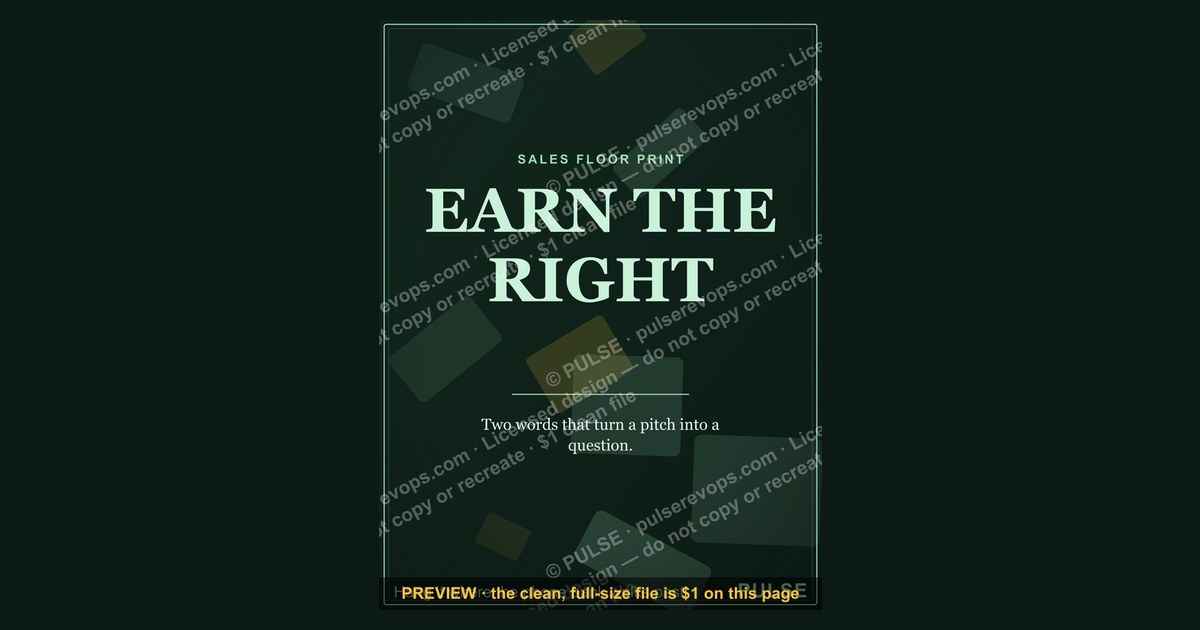

“EARN THE RIGHT” is a sales floor print: a bold wall poster or printable graphic that reminds reps to build trust, deliver value, and demonstrate credibility before asking for a meeting, a demo, or a close. It is commonly displayed in sales offices, training rooms, and home offices, and is typically free to download or priced roughly $10–$30 when printed and framed.
What the print looks like on a real sales floor
Picture a 40-person inside sales team in a software company. The floor is open-plan: rows of desks, headsets, dual monitors, a whiteboard at the far end, and a wall near the phone bank that everybody walks past on the way to coffee. Management has tried a dozen motivational posters over the years. Most of them fade into the background within two weeks — the brain stops registering static stimuli it sees every day.
Then someone hangs a single print: “EARN THE RIGHT,” set in a heavy stacked typeface with a gradient accent. It is not a slogan about hustle, quota, or grinding harder. It is a two-word question disguised as a poster. Within a month, managers report a subtle but measurable shift. Reps start asking each other “Did you earn it?” before a big call. New hires ask what it means during onboarding. A team lead uses it as shorthand in a coaching session: “You jumped to the demo in minute three — did you earn the right to show that slide yet?”
The reason this particular phrase lands differently is that it reframes the entire mental model of selling. Most sales floor messaging is outcome-focused: “Close more,” “Beat the number,” “Every call counts.” That messaging pushes reps toward the ask. “Earn the Right” pulls them back toward the customer. It says the meeting, the demo, the proposal, and the close are not entitlements — they are privileges you unlock by demonstrating value first. That single reframe changes how reps open calls, how they listen, and how they handle the moment when a prospect pushes back.
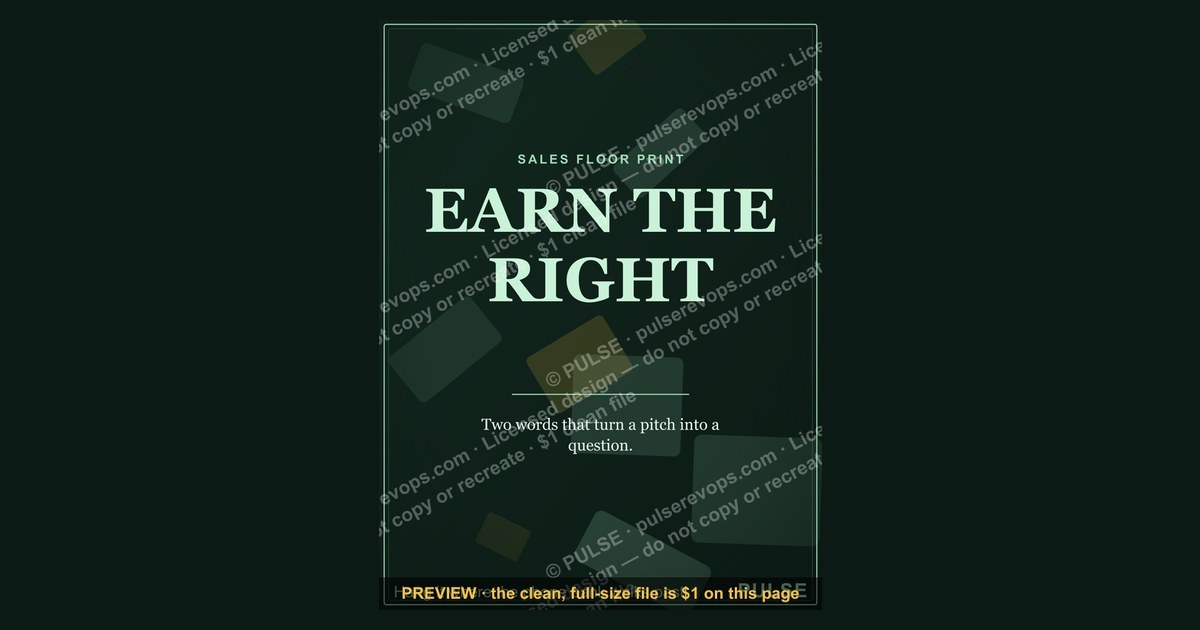
The print itself is deliberately minimal. There is no stock photo of a handshake, no clip-art rocket ship, no list of ten tactics. It is a phrase, a gradient, and a lot of white space. That minimalism is part of why it works as a visual anchor: it is legible from across the room, it does not compete with the screens, and it forces the reader to supply the meaning. A dense infographic would be read once and ignored. A two-word poster gets re-read a hundred times a day, and each re-read is a micro-reminder of the behavior the team is trying to build.
For a RevOps leader, the print is not the intervention — it is the artifact that makes the intervention visible. The real work happens in the huddles, the CRM prompts, the call reviews, and the coaching conversations that the print keeps pointing back to. Treat the poster as the flag, not the army.
How the mechanism actually works
The phrase “Earn the Right” works because it maps to a specific, teachable sequence of sales behaviors. It is not vague encouragement; it is a checklist compressed into two words. When a rep internalizes it, four things change in the way they run a deal.

First, pre-call preparation stops being optional. Before a rep dials, they ask: have I done enough homework to justify this person’s time? In practice that means two to five minutes of research on the account — recent news, a leadership change, a product launch, a funding round, a job posting that signals a pain point. Without that, the first thirty seconds of the call are spent proving you have nothing specific to say.
Second, discovery comes before demonstration. A rep who has not yet earned the right does not open a demo. They ask questions, paraphrase what they hear, and confirm understanding before showing anything. This is the single biggest behavioral shift the print drives, because the default rep instinct under quota pressure is to pitch early and pitch often.
Third, every touch delivers something. A relevant benchmark, a short case study from a similar company, an introduction to a peer, a link to a report — the rep leaves the prospect better off than before the interaction, regardless of whether a next step is booked.

Fourth, the ask becomes earned, not assumed. When the rep finally says “Can we get thirty minutes with your ops lead next week?”, the prospect has already received value, so the ask feels like a natural next step rather than a request for a favor.
The loop matters. A rep who skips the research step and jumps straight to the pitch will feel resistance and may not know why. A rep who runs the loop deliberately will notice that prospects answer more questions, share more context, and agree to next steps more often — not because the rep got luckier, but because the rep stopped asking for something before giving something.
Real numbers, ranges, and benchmarks
Specific numbers turn “earn the right” from a slogan into a measurable operating standard. None of the figures below are universal laws — they vary by industry, deal size, and motion — but they are the ranges most sales organizations converge on when they instrument value-first behavior.

Research time per touch. Two to five minutes of pre-call research is the sweet spot for most inbound and outbound motions. Under two minutes and the personalization is generic. Over ten minutes and the rep is over-investing in a single low-probability touch. For enterprise accounts with six-figure deal sizes, ten to twenty minutes per first touch is reasonable because the expected value is much higher.
Talk-to-listen ratio. Top-performing reps in consultative sales typically talk 40–45% of the time and listen 55–60%. Average reps invert this. If you record calls and measure talk time, a rep who is above 60% is almost always pitching before earning the right.
Discovery-to-demo sequence. In a well-run motion, the first call is discovery-only. The demo happens on call two or later, after the rep can articulate the prospect’s problem back to them in their own words. Reps who demo on call one routinely see lower conversion to next step because they presented a solution to a problem they had not yet confirmed.

Follow-up cadence. A value-first sequence typically runs five to eight touches over two to three weeks, with each touch carrying a distinct piece of value. Generic “just checking in” emails are the opposite of earning the right — they ask for attention without giving anything.
Self-scoring. A simple 1–10 “did I earn the right in this conversation?” score logged after every meaningful call gives managers a leading indicator. Reps who average 7+ on discovery calls tend to convert to next step at meaningfully higher rates than reps averaging below 5. The absolute number matters less than the trend line for each rep.

Print cost and format. The graphic itself is typically free to download as an SVG or PNG. Printing at 18×24 inches on matte poster paper runs roughly $10–$20 at a print shop; a framed 24×36 inch version runs $30–$80 depending on frame quality. For a team of twenty, a bulk print order usually lands under $15 per poster.
Adoption timeline. Expect two to four weeks before the phrase becomes part of the team’s shared vocabulary, and six to eight weeks before you can see it show up in call recordings and CRM notes without prompting. If nothing changes after eight weeks, the print is decoration — the coaching around it is missing.
Trade-offs and alternatives
“Earn the Right” is not the only valid sales floor philosophy, and it is not right for every motion. Understanding the trade-offs helps you decide whether to adopt it, adapt it, or pair it with something else.

Trade-off 1: Depth versus velocity. A strict value-first approach slows the top of the funnel. Reps spend more time researching and less time dialing. In a high-volume, low-ACV motion — say, a $50/month self-serve product with a sales-assist motion — the research overhead can outweigh the benefit. In that case, a lighter version works better: one specific, personalized line per touch rather than a full research pass.
Trade-off 2: Consultative pull versus transactional push. “Earn the Right” is a consultative frame. It assumes the buyer wants a relationship and a considered decision. For commodity purchases where the buyer just wants a price and a delivery date, an over-consultative approach can feel slow and annoying. Match the frame to the buyer.
Trade-off 3: Confidence versus deference. Some reps misread the phrase as “be humble and agreeable.” That is the wrong lesson. Earning the right includes earning the right to challenge a prospect’s assumptions, push back on an unrealistic timeline, or walk away from a bad-fit deal. A rep who never disagrees has not earned anything — they have just avoided friction.

Trade-off 4: Poster versus system. A print on the wall changes nothing on its own. The alternative is to skip the poster and invest entirely in process: CRM prompts, call review rubrics, coaching cadences. The best results usually come from doing both — the poster makes the process visible, and the process gives the poster teeth.
Alternatives worth considering. “Earn Every Yes” emphasizes the cumulative nature of trust. “Right deal, right time” emphasizes qualification and timing over persuasion. “Value before ask” is a more literal, less memorable version of the same idea. Each has a slightly different center of gravity. Pick the one that matches the behavior gap you are actually trying to close.
Common pitfalls and how to avoid them
Even a good concept can go wrong in execution. These are the failure modes that show up most often when teams adopt a value-first print, and the practical fixes for each.

Pitfall 1: Over-engineering the earning. Reps interpret the phrase literally and spend thirty minutes researching a five-minute cold call. Velocity collapses, and prospects get a rep who is over-prepared but under-conversational. Fix: publish a one-page “minimum viable earn” guide that specifies exactly how much prep each interaction type requires — two minutes for a cold call, five for a discovery call, fifteen for an enterprise first touch.
Pitfall 2: Using it as a blame weapon. After a lost deal, a manager asks “Did you earn the right?” in an accusatory tone. Reps learn to hide mistakes and avoid risk. Fix: reframe the question as a learning prompt in post-mortems: “What could we have done earlier to earn the right to move forward?” Celebrate reps who surface their own gaps.
Pitfall 3: Treating it as one-way. Reps assume they must earn the prospect’s trust but never apply the same standard in reverse. They tolerate unprepared prospects, disrespectful behavior, and endless no-decision cycles. Fix: teach the concept as a two-way filter. If a prospect will not engage meaningfully, the rep has not failed — the deal has failed qualification, and walking away is the right call.
Pitfall 4: Confusing earning with sucking up. Reps flatter, agree, and avoid disagreement because they think they have not yet earned the right to challenge. Deals get weak, timelines slip, and customers end up unhappy. Fix: clarify that once you have demonstrated understanding and delivered value, you have earned the right to push back. Role-play respectful disagreement in team meetings.
Pitfall 5: Set-and-forget. The print goes up during onboarding and is never mentioned again. Within three weeks it is wallpaper. Fix: build recurring touchpoints — a monthly thirty-minute workshop where reps share real examples, a Slack channel where wins get posted, a rotating physical location for the print so the brain re-registers it.
Pitfall 6: No measurement. The team adopts the language but never checks whether behavior actually changed. Fix: pick two or three leading indicators — talk-to-listen ratio, discovery-to-demo sequencing, self-scored earn-the-right average — and review them monthly. If the numbers do not move, the print is not the problem; the coaching is.
Related questions
What does “Earn the Right” mean in sales?
It means building credibility, trust, and demonstrated value before asking for a meeting, a demo, or a commitment. Instead of opening with a pitch, the rep leads with preparation, listening, and a relevant insight. The ask becomes a natural next step rather than a request for a favor.
Is the print only for sales teams?
No. Founders, consultants, account managers, customer success teams, and anyone who needs to influence a decision can use it. The principle applies whenever you are asking for someone’s time, budget, or attention. It is a mindset shift from selling to serving.
How is this different from typical sales advice?
Most sales tactics focus on closing fast or overcoming objections. “Earn the Right” inverts that: the prospect’s needs come first, and the close is downstream of trust. It is less about scripts and more about curiosity and value delivery before any ask.
Does it work in cold outreach?
Yes, but it demands more upfront research. In cold email or cold calls, you earn the right by referencing something specific to the person or company — a recent announcement, a role change, a shared connection. Generic blasts do the opposite of earning the right.
Can it backfire if overdone?
Yes. If a rep spends too long “earning” without ever asking, they look hesitant and waste the prospect’s time. The balance is: once you have delivered clear value, transition naturally to the next step. Earning is a means, not an end.
FAQ
Where should I hang the print for best effect? Place it where reps prep for calls or walk between meetings — near the phone bank, opposite a desk, on the wall by the coffee station, or in the team workspace. The goal is frequent, incidental exposure. Rotate the location every few weeks so the brain keeps re-registering it instead of tuning it out.
Is the print free, and what format does it come in? Most versions are free to download as scalable SVG or high-resolution PNG, with no attribution required. SVG scales to any size without quality loss and drops cleanly into PowerPoint, Google Slides, Canva, Figma, or a LinkedIn banner. PNG is ready for any tool that wants a raster image.
What size should I print it? For a single desk, 11×14 or 12×18 inches works well. For a shared wall or team room, 18×24 or 24×36 inches is more legible from across the floor. Matte poster paper reduces glare under office lighting, which matters more than most people expect.
Can I recolor it to match our brand? Yes. Because the graphic is vector-based, the accent gradient and background can be recolored to your team or company palette, including a transparent background. That makes it easy to match existing office branding or a specific campaign.
How do I know if it is actually working? Track two or three leading indicators: talk-to-listen ratio on recorded calls, the percentage of demos that happen on call two or later, and a self-scored “did I earn the right?” average logged after each meaningful conversation. If those numbers trend up over six to eight weeks, the print is doing its job.
Does it work for remote teams? Yes, with adaptation. Use it as a desktop wallpaper, a Slack channel icon, a recurring calendar banner, or a virtual background for team calls. The physical poster is one delivery mechanism; the phrase works anywhere it appears frequently enough to become shared vocabulary.
Sources
- HubSpot Sales Blog — https://blog.hubspot.com/sales
- Harvard Business Review — https://hbr.org
- Salesforce — https://www.salesforce.com
- American Marketing Association — https://www.ama.org
- LinkedIn Sales Solutions — https://business.linkedin.com/sales-solutions
- Gartner Sales Research — https://www.gartner.com/en/sales
- McKinsey Growth, Marketing & Sales — https://www.mckinsey.com/capabilities/growth-marketing-and-sales/our-insights
Related on PULSE
This page will be disappearing soon. Save it to your device for $1 — or read it free while it is here.
@Kory-White- · if Venmo asks, the last 4 of my number are 2012
This page is gone.
This one is off the shelf now. $1 keeps it on your phone for good — the whole page, pictures and diagrams included.
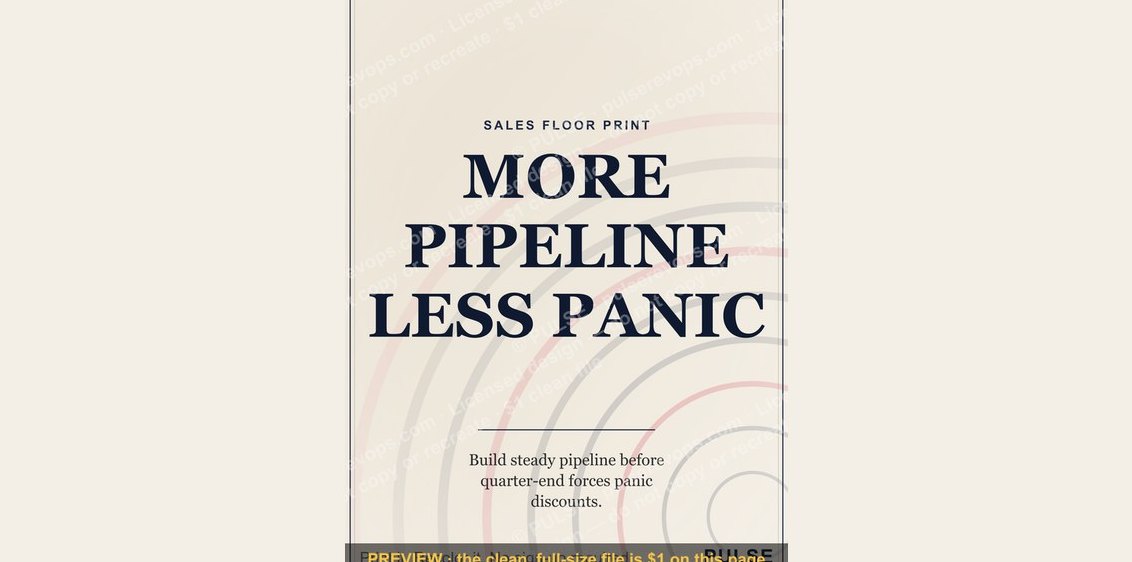 graphic“MORE PIPELINE LESS PANIC” — Sales Floor Print
 graphic“SHOW UP FOLLOW UP CLOSE” — Sales Floor Print
 graphic“BRING THE ENERGY” — Sales Floor Print
 graphic“ONE TEAM ONE NUMBER” — Sales Floor Print
 graphic“SELL THE VALUE” — Sales Floor Print
 graphic“TRUST THE PROCESS” — Sales Floor Print
 graphic“FOLLOW UP AGAIN” — Sales Floor Print
 graphic“CHASE THE NO” — Sales Floor Print
 graphicActivity to Revenue — Motivational Print
 graphic“OWN THE NUMBER” — Sales Floor Print