
“CHASE THE NO” — Sales Floor Print
 Curated byKory White · Fractional CRO · Maryland
 PULSEKNOWLEDGE LIBRARY
Quality
Certified
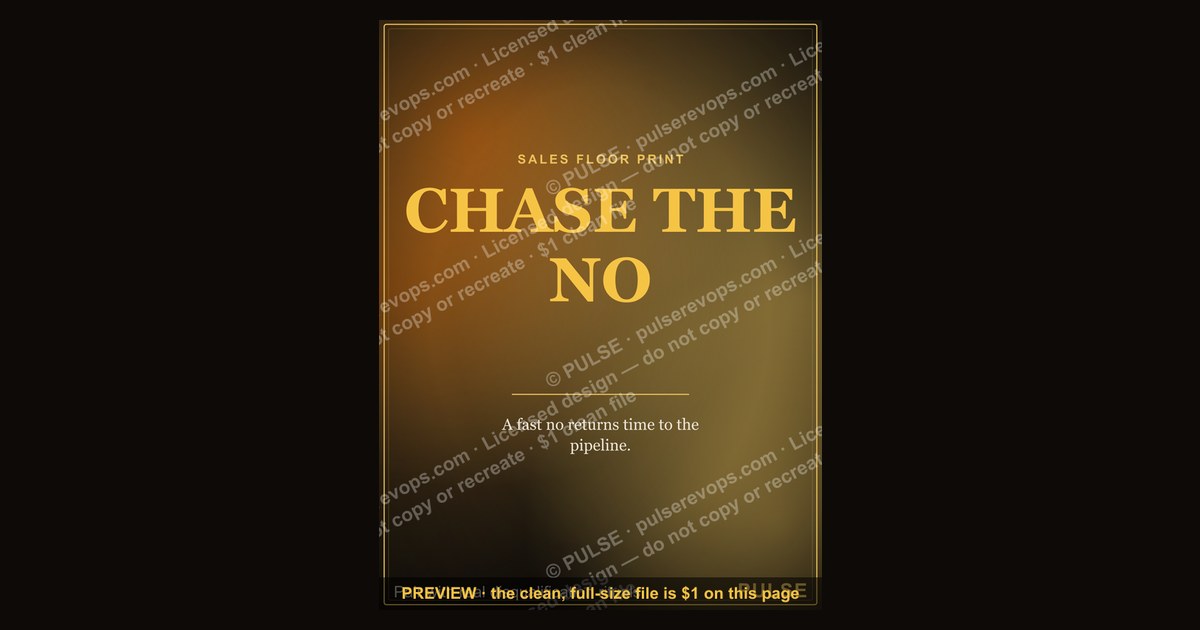
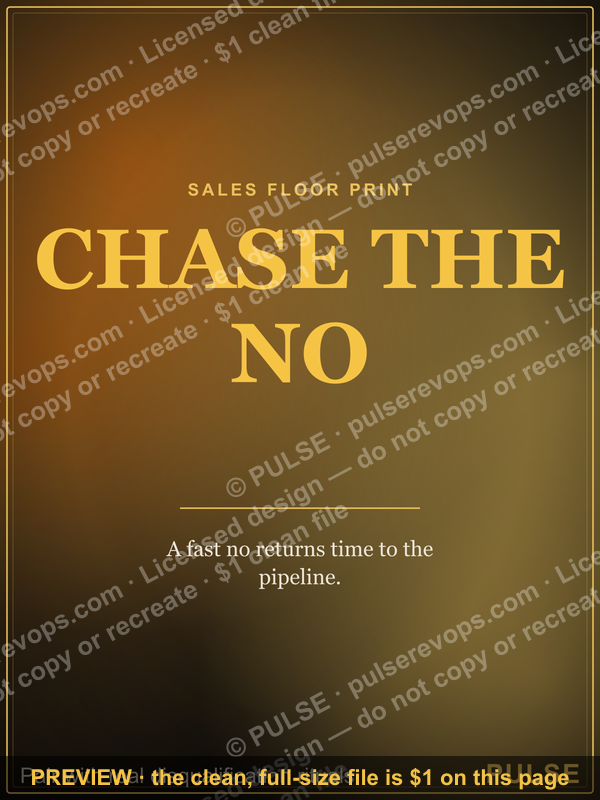
"Chase the No" is a sales floor mantra that tells reps to pursue a clear rejection instead of a comfortable maybe, because a fast no returns time to the pipeline. Sold as a wall print — roughly $15 unframed to $60 framed, or free as a scalable SVG — it works only when paired with real disqualification rituals.
Buying the print versus printing the free SVG
There are two honest ways to get "CHASE THE NO" onto a sales floor wall, and they trade off along different axes than most managers expect.
Option A — buy a finished print. A retail poster or framed art piece arrives ready to hang. Typical retail sizing runs 8×10 inches at the low end up to 24×36 inches for a bullpen-scale statement piece, with unframed prints generally landing near the $15 mark and framed versions climbing toward $60 depending on size, frame material, and seller. Most listings are physical shipped goods; a minority offer a PDF instead, which is why the product page needs to say "physical print" or "digital file" explicitly before you click buy. Return windows vary by seller — 30-day satisfaction guarantees and defect exchanges are common, but confirm the window and the condition requirements before purchase, because a poster that arrives creased in a tube is a different conversation than one you simply disliked.
The advantage is zero effort and a consistent object. Twelve regional offices ordering the same SKU get twelve identical walls. The disadvantage is cost multiplication and color lock-in: you get the seller's palette, not yours, and at $15–$60 a unit, outfitting a 40-person floor across four rooms is a $60–$240 line item that recurs every time you open a new office.
Option B — print the free SVG. The Pulse version of this graphic ships as a scalable vector at 2400×3000 px, free to use with no attribution required, no sign-up, and no watermark. Because it is an SVG, it scales from a 4×6 desk card to a 36×48 wall panel with zero quality loss — there is no resolution ceiling to hit. A color picker lets you recolor the type and swap the background (including transparent) to your team or company colors before export, and you can pull it down as either SVG or PNG. The same file drops straight into PowerPoint, Google Slides, Canva, Figma, or a LinkedIn banner slot, which means the wall art and the QBR deck slide can share one visual identity.

The advantage is cost, brand control, and format reuse. The disadvantage is that you now own the production step: choosing paper stock, finding a print shop or a large-format printer, and handling mounting. A local shop typically charges more per square foot for a one-off 24×36 than a mass-market poster retailer charges for the finished item — the free file does not always mean the cheapest wall.
The real third axis. Neither option addresses the thing that actually determines whether the print earns its wall space: whether the floor has disqualification rituals behind it. A poster with no weekly "no" audit behind it is decoration. A poster with rituals behind it is a daily cue. That distinction matters more than $15 versus $60.
Choosing between the two paths
The decision is not really about money — at these price points the difference across a whole floor is a rounding error against one rep's monthly quota. It is about three questions: how many walls, how much brand control you need, and whether anyone on your team will actually handle production.
Run it in this order:
- Count the walls. One wall in one office → buy the finished print. The convenience is worth $15–$60 and there is no volume to amortize. Four or more walls, or multiple offices → the free SVG wins, because your only marginal cost is print production, and a print shop's per-unit price drops with quantity while a retailer's does not.
- Check the brand constraint. If marketing enforces a palette — and in most companies past Series B they do — the recolor step is not optional. A retail poster in someone else's accent color will get quietly taken down within a quarter. Recolor the SVG to your hex values, and the print reads as an internal artifact rather than a novelty purchase.
- Name the owner. If nobody will spend twenty minutes at a print shop portal, the free file stays a free file forever. Buy the poster. A hung $60 frame beats an unhung $0 SVG every single time.
- Decide the format spread. If you also want the mark on slide masters, Slack channel headers, and a LinkedIn banner, the SVG path is the only one that gets you there — you cannot extract a vector from a shipped poster.

One more filter: if this is a pilot — you are testing whether the mantra lands with a skeptical team — buy one cheap unframed print. Sunk cost is low, and if the floor rolls its eyes at it, you are out fifteen dollars instead of a print-shop minimum order.
The numbers behind each option
Here is what each path actually costs and returns, at a scale a sales manager can sanity-check.
Purchase path, 40-person floor, four rooms. Four 24×36 framed prints at the top of the range runs roughly $240. Four unframed at the low end runs roughly $60. Delivery is days, not weeks, and the effort cost is one purchase order. Add a second office next quarter and you repeat the spend — there is no asset to amortize.
SVG path, same floor. The file costs nothing. Large-format print production is your only line item, and it varies enough by market that the honest planning move is to get two quotes rather than trust a number from a blog post. What is predictable is the reuse: the same recolored file becomes a slide-master graphic, a Slack channel banner, and a LinkedIn header at zero incremental cost. If you open three more offices, the marginal file cost stays zero.

The metrics that decide whether either was worth it. The print is a cue, not a program. Track these:
- Time-to-disqualification. The average days from first contact to a definitive no or not-now. Floors that avoid the hard question typically sit at 45–60 days on deals that eventually die. The target after the mindset lands is 14–21 days. Add a CRM field called "Disqualification Date," have reps stamp it on every clear no, and average it monthly. A healthy floor disqualifies 60–70% of dead deals inside the first 30 days. Deals still dying at day 60+ mean your reps are chasing maybes, and the wall art is not being read.
- Sales cycle compression. Teams that genuinely stop investing in unwinnable deals commonly see cycle length fall 20–40%, because the pipeline stops carrying dead weight through stage reviews.
- Win rate. Scrubbing zombie deals — anything with two clear nos or fourteen days of no movement — typically pulls win rates up 15–25%, since the denominator now contains only deals with a real path to yes.
- Nos-to-yes ratio. In a typical B2B motion you need roughly 5–10 qualified nos to land one yes, varying by ACV and market. Knowing your own number turns rejection from an emotional event into an arithmetic one: a rep who needs 8 nos per close and has collected 3 this week knows exactly what the rest of the week looks like.
- Average deal size. When reps stop spending Tuesdays on a prospect who will never sign, they spend Tuesdays on larger strategic accounts. A 10–20% lift in average deal size inside 3–6 months is a common downstream effect.
- Rep sentiment. Ask quarterly: "On a scale of 1–10, how comfortable are you hearing no from a prospect?" Track it against turnover. Rejection is a leading burnout driver, and a working "chase the no" culture should move that comfort score 15–30% over six months. If it drops instead, the concept has been read as permission to be aggressive — fix that before you print more posters.
The correlation to watch. Plot average nos-per-week per rep on the X axis and win rate on the Y axis. A healthy floor shows a positive slope — the reps collecting the most nos post win rates meaningfully above the rejection-avoidant ones, often 25–40% higher, because their remaining pipeline is better qualified. If your scatter slopes the wrong way, more nos with lower win rates, your reps are disqualifying prematurely or working outside the ICP. That is a coaching finding, not a poster finding.
Putting it on the wall and the rituals behind it
Sequence matters. Hanging the print first and inventing the process later is how a mantra becomes wallpaper. Do it in this order.

Week 0 — decide and produce. Run the decision flow above. If you are on the SVG path, recolor to your brand hex values, set the background (transparent if you are mounting on colored acrylic, solid if you are framing on paper), export at the size your printer wants, and place the order. If you are on the purchase path, order one size larger than feels right — bullpen wall art read from 30 feet needs the 24×36, not the 11×17.
Week 1 — teach the distinction before you hang it. The single largest failure mode is reps hearing "chase the no" as license to be pushy. It is not. The mantra is about being direct and curious, never aggressive. Run a 45-minute session on the exact language difference:
- Aggressive: "Why won't you buy?"
- Correct: "I appreciate the honesty — can I ask what specifically makes this a no right now?"
- Aggressive: "What's it going to take to close this today?"
- Correct: "What would need to change for you to move forward this quarter?"
Role-play both versions. Give the floor a shared correction phrase — when someone opens with "I don't want to push, but…," anyone can point at the wall and say "we're not pushing, we're chasing clarity." If NPS or inbound customer feedback drops after rollout, you crossed the line; walk it back immediately.

Week 1 — hang it, then define the qualifying questions. Two questions do most of the work early in a conversation: "Is this a priority for you in the next 30 days?" and "What would need to change for you to move forward?" Both invite a fast no. Both are respectful. Neither wastes six weeks of follow-up on a prospect who was never going to sign.
Week 2 — build the CRM plumbing. Three fields, no more:
- Disqualification Date — stamped on any definitive no.
- No Type — a picklist separating a *qualified* no (an ICP-fit decision-maker giving a specific reason: "budget is allocated elsewhere," "we just signed a competitor") from an *unqualified* one (a junior admin saying "not interested"). Without this split you will incentivize volume over quality, and someone will win the leaderboard by dialing a hundred wrong numbers.
- Status color — red for disqualified, yellow for needs follow-up, green for active. It makes the chase visible on a dashboard rather than only on a wall.
Week 3 — start the weekly no audit. Fifteen minutes, standing, in front of the print. Each rep brings their top three nos from the week. You are not commiserating; you are pattern-matching. Was it budget timing? Wrong persona? A capability the product genuinely lacks? Write the recurring themes on a whiteboard next to the poster and let them accumulate. Across four to six weeks the same three or four objections will surface repeatedly, and those become concrete work items: a new case study, a pricing tier, a messaging change, or an honest ICP narrowing.
Week 3 — scrub the pipeline on a rule, not a feeling. The rule: two clear nos, or fourteen days of no movement, and the deal gets archived. Zombie deals are the specific thing this print exists to kill. They inflate forecast, they burn rep hours, and they make pipeline coverage ratios lie to the exec team.
Week 4 — gamify carefully. A leaderboard tracking *qualified* nos reached alongside deals closed does flip the fear. A rep who logged 20 qualified nos in a week had 20 meaningful conversations, and that is worth recognizing even if only one closed. Keep the prize small and physical — a rotating trophy or a mug that lives next to the print — and always score against the qualified-no field, never the raw count.

Ongoing — protect the humans. Twenty nos a day is genuinely draining, and the poster does not fix that on its own. Pair it with one-on-ones where reps can vent without it becoming a performance conversation, a channel for sharing the funniest rejections, and periodic resilience coaching on reframing. Some floors run a "no jar" — a coin per clear no, and the pot funds a team outing at month end — which converts the emotional cost into something shared. Watch for the early warning signs: activity dropping, tone turning cynical, absenteeism creeping up. Intervene before the rep does.
Where the print earns its keep beyond the wall
The reason the vector path tends to win over eighteen months is that a wall print is only one surface. The same recolored file, exported at different ratios, covers a surprising amount of internal ground: a slide in the new-hire onboarding deck where the disqualification rules get taught, a Slack channel header for the channel where reps post their nos, a Zoom background for a distributed floor that has no wall to hang anything on, and a LinkedIn banner for reps who want to signal the philosophy publicly.
That last one has a revenue side effect worth naming plainly: reps whose public profile signals a qualification-first approach tend to attract inbound conversations from buyers who are also allergic to being chased. It is a small effect and you should not build a pipeline model on it, but it costs nothing.
For remote and hybrid floors, the print's physical form is the weakest part of the concept — half your team never sees the wall. Ship the file to reps directly and let them print a desk-sized version, or make it a required slide in the weekly pipeline review deck so the cue lands on every screen regardless of geography.
Related questions
Does the poster include a named sales methodology?
No. It is a standalone motivational print with no step-by-step framework attached. That is deliberate — it complements whatever process you already run, whether that is MEDDIC, Challenger, SPIN, or a homegrown stage model, without competing with your existing qualification criteria.
Is it for an individual rep or a whole team?
Both. Individual reps hang the smaller sizes in home offices as a personal cue; managers hang the large format on the bullpen wall to signal that qualification beats hope as a team value. The rituals behind it scale either way, though the weekly no audit needs at least three reps to be useful.
What if my team reads it as permission to be rude?
Retrain the language distinction immediately and watch your customer feedback scores. "Chase the no" means chasing clarity, never pressure. A correctly executed no feels like the natural end of a respectful conversation, not an ultimatum. If NPS dips post-rollout, that is your signal.
How long before I can tell if it worked?
Roughly 60 days for behavior, 3–6 months for outcome metrics. Time-to-disqualification moves first because it is a direct behavior change. Win rate, average deal size, and sentiment scores lag a quarter or more because they depend on full sales cycles completing under the new discipline.
Can I recolor it to my company palette?
Yes, if you use the free SVG version — the color picker changes the type color and the background, including a transparent option, and exports as SVG or PNG with no sign-up and no watermark. A purchased retail print ships in the seller's colors and cannot be changed.
FAQ
What does "Chase the No" actually mean in sales?
It is a mindset that treats a clear rejection as more valuable than an ambiguous maybe. A no returns your calendar time immediately and lets you redeploy it against a better-fit account. A maybe generates weeks of follow-up sequences, forecast noise, and hope — and usually ends in the same place. The mantra pushes reps to ask the disqualifying question early rather than avoiding it.
Is this a digital download or a physical poster?
Both exist. Retail listings are usually physical prints shipped to you, though some sellers offer a PDF instead — the product page should specify, so look for "physical print" or "digital file" before buying. The Pulse version is a free downloadable SVG at 2400×3000 px that you print yourself, with no attribution required.
What sizes are available and is it framed?
Retail sizes commonly run from 8×10 inches up to 24×36 inches depending on the seller. Most versions ship unframed, with framing offered as a paid upgrade. Unframed prints generally start around $15 and framed versions reach roughly $60 at the larger sizes. The SVG has no fixed size — it scales to any dimension without quality loss.
Can I return a print I do not like?
Return policies vary by seller. Many offer a 30-day satisfaction guarantee or exchanges for damaged goods, but the window and the condition requirements differ, so confirm both on the listing before you order. Posters shipped in tubes arrive creased often enough that it is worth checking whether damage claims are handled separately from preference returns.
How many nos should a rep be collecting per week?
There is no universal number — it depends on your ACV, cycle length, and motion. What matters is knowing your own nos-to-yes ratio, which commonly falls between 5 and 10 qualified nos per closed deal in B2B. Measure it for your own team over a quarter, then set weekly activity targets backward from quota rather than importing a benchmark.
Will hanging this print actually change anything?
By itself, no. A print is a cue, not a program. It works when it sits next to a weekly no audit, a CRM field that stamps disqualification dates, a hard scrub rule, and a leaderboard scored on qualified nos. With those rituals, the wall art reinforces a system already running. Without them, it is a poster.
Sources
- https://hbr.org/topic/subject/sales — Harvard Business Review's sales collection, including research on negotiation and buyer psychology
- https://blog.hubspot.com/sales — HubSpot Sales Blog, practical material on objection handling and qualification
- https://www.salesforce.com/resources/ — Salesforce documentation and best-practice guides on pipeline management and sales methodology
- https://www.saleshacker.com/ — Sales Hacker, community-sourced content on modern B2B sales process
- https://www.challengerinc.com/ — Challenger, the organization behind the research-based Challenger Sale framework
- https://www.gartner.com/en/sales — Gartner's sales practice research on buying groups and pipeline discipline
- https://www.ama.org/ — American Marketing Association, industry research on sales and marketing communication
- https://www.pewresearch.org/ — Pew Research Center, for general workforce and burnout survey methodology reference
Related on PULSE
This page will be disappearing soon. Save it to your device for $1 — or read it free while it is here.
@Kory-White- · if Venmo asks, the last 4 of my number are 2012
This page is gone.
This one is off the shelf now. $1 keeps it on your phone for good — the whole page, pictures and diagrams included.
 graphic“TRUST COMPOUNDS” — Sales Floor Print
 graphic“FILL THE FUNNEL” — Sales Floor Print
 graphicActivity to Revenue — Motivational Print
 graphic“PROGRESS EVERY DEAL” — Sales Floor Print
 graphic“KEEP THE CADENCE” — Sales Floor Print
 graphic“EARN EVERY YES” — Sales Floor Print
 graphic“NEXT CALL WINS” — Sales Floor Print
 graphic“DO THE REPS” — Sales Floor Print
 graphic“EARN THE RIGHT” — Sales Floor Print
 graphic“STAY IN THE DEAL” — Sales Floor Print