
“PROGRESS EVERY DEAL” — Sales Floor Print
 Curated byKory White · Fractional CRO · Maryland
 PULSEKNOWLEDGE LIBRARY
Quality
Certified
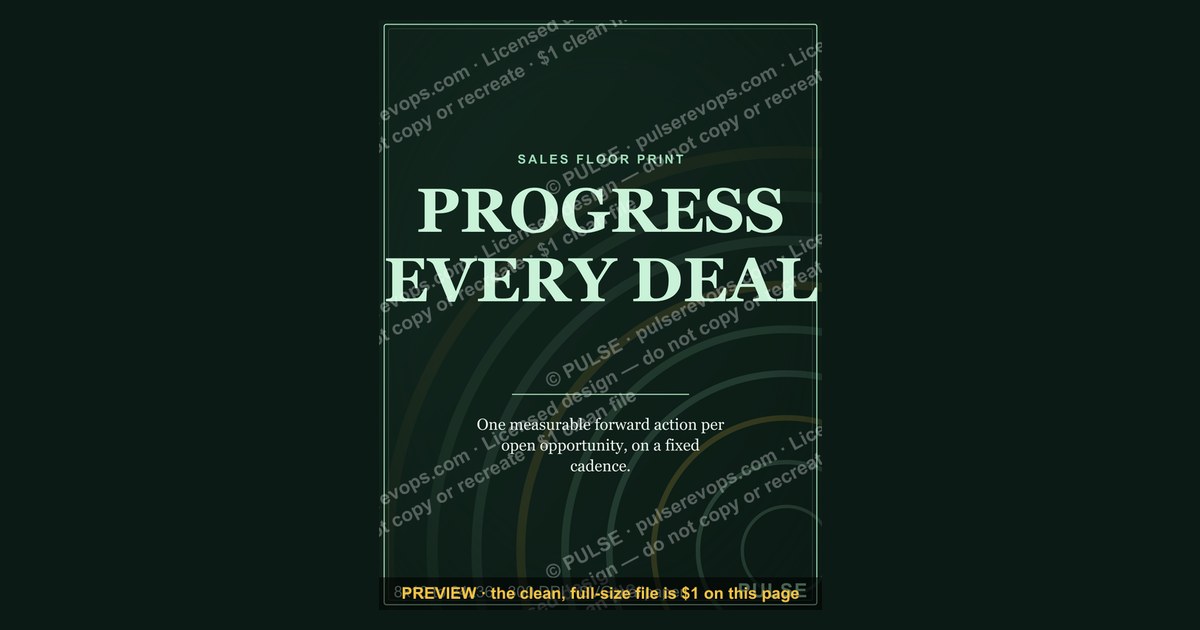
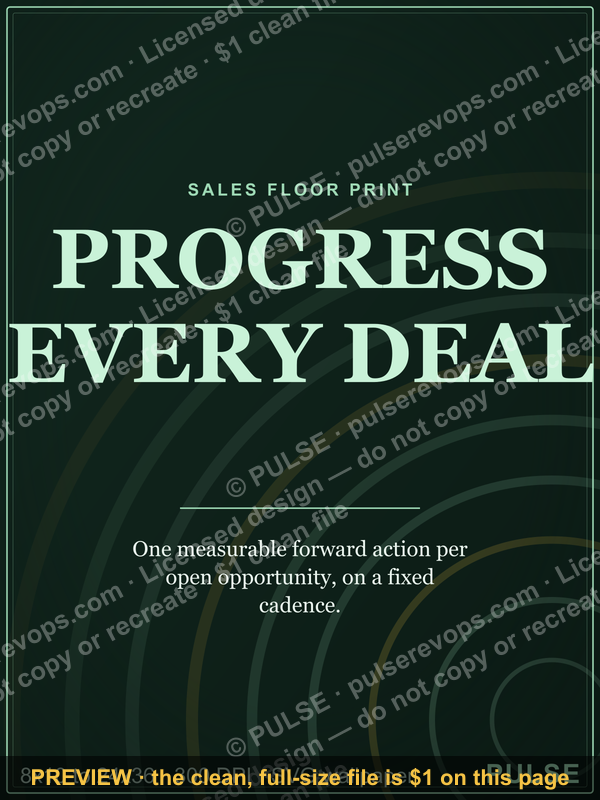
This is a sales-floor print/poster that reads "PROGRESS EVERY DEAL" in bold, high-contrast display type over a stepped-arrow pipeline graphic, delivered as a free 1200×1600 px PNG you can download at the top of this page. It's built to hang where reps see it between calls — the message: every touch on a deal should move it forward, not just log activity.
Wall poster vs. monitor slide: the two ways teams run this
There are really only two delivery mechanisms for a sales-floor print like this one, and most teams end up mixing both rather than picking a single lane. The first is the literal print: the PNG goes to a local print shop or an in-house laser printer, comes back as a physical sheet, and gets mounted on a wall, a cubicle divider, or a foam-core standee near the bullpen. The second is the digital version: the same file gets dropped into a rotation on the office TV or monitor that already cycles through leaderboard numbers, win announcements, and team KPIs.
Physical print wins on permanence. A poster taped above the phone bank or framed next to the door reps walk through every morning doesn't compete for attention with anything else — it's just there, all day, whether or not anyone remembers to advance a slideshow. It also survives outages: if the office TV, the display app, or the Wi-Fi goes down, the poster on the wall is unaffected. The tradeoff is that a physical print is static. Once it's up, changing the wording, swapping a color scheme for a new sales season, or updating it to reference a current contest means reprinting and remounting.

The digital slide flips that tradeoff. It costs nothing to update — drop a new PNG into the folder the display pulls from, and the poster refreshes on the next rotation cycle, often within seconds. It can also travel: a remote or hybrid team with no shared floor can push the same graphic into a Slack channel header, a Teams background, or a CRM dashboard banner, which a printed poster obviously can't do. The cost is competition. A monitor that cycles through eight or ten slides gives this message roughly one-eighth or one-tenth of the room's attention at any given moment, and if the rotation interval is long, reps may go most of a shift without seeing it at all.
The teams that get the most mileage out of a sales-floor print like this one usually run both: a printed, framed copy in a fixed high-traffic spot (so the message is always ambient and unavoidable), plus the same graphic in the digital rotation for remote reps, new hires who haven't learned the floor layout yet, and anyone joining video calls from a home office. That combination costs maybe $30–$60 more than doing just the print, and it closes the visibility gap for anyone not physically walking past the wall version.
Deciding where this poster earns wall space
Not every open floor plan has an obvious spot for a motivational print, and a poster placed badly gets ignored exactly the way a slide buried in a long TV rotation does. The decision comes down to traffic pattern, sightlines, and whether the team is even co-located.
For a co-located floor, the strongest spot is anywhere reps naturally pause — above the row of phones, next to the door into the bullpen, or on the wall a rep faces while on a call. Anywhere a rep has to turn their head deliberately to see it gets ignored within a week; anywhere it's in the default field of view gets absorbed passively, which is the whole point of a print like this over, say, a memo. If the floor doesn't have an obvious bullpen (a lot of modern layouts are individual desks or small pods), the next-best spot is the room where deal reviews or pipeline stand-ups happen — reps are already primed to think about deal progression in that room, so the print reinforces the conversation rather than competing with it.

For fully remote or hybrid teams, skip the physical print entirely unless there's a hub office worth decorating, and put the effort into the digital surfaces reps actually look at: a CRM homepage banner, a pinned Slack message with the image, or a shared virtual-background file for video calls. The message lands the same way — a visual, ambient reminder — it's just delivered through the screen reps already have open instead of a wall they don't walk past.
Whatever the placement, revisit it roughly once a quarter. Reps stop seeing anything that's been in the same spot for months — this is a well-documented perception effect, not unique to sales floors — so moving the print to a new wall, or swapping in a refreshed version with a new secondary line of copy, resets the noticing effect at effectively zero cost.
Sizing, paper stock, and framing costs
The source file for this print is 1200×1600 px, a 3:4 portrait ratio. At a standard 150 dpi print resolution, that maps cleanly to an 8×10.7 inch sheet; scaled down to 100 dpi (still sharp enough for wall viewing from a few feet away), it prints comfortably at 12×16 inches. Most teams size up further than that — sales-floor prints read best at 18×24 inches or larger, since the point is to be legible from across a room, not from a desk. Scaling the 1200×1600 file up to 18×24 or 24×32 inches drops the effective resolution to roughly 65–80 dpi, which is still fine for large-format wall art viewed from six or more feet away; print quality only becomes a visible problem below about 50 dpi at that viewing distance.
On cost: a same-day 18×24 inch poster print on standard matte or semi-gloss stock runs roughly $12–$25 at a typical office-supply or print-shop counter (Staples, Office Depot, FedEx Office, or a local print shop all offer comparable walk-in pricing). Stepping up to 24×36 inches — a size that reads well even in a large open floor — typically runs $25–$45 depending on paper stock and finish. Lamination, which matters if the print is going somewhere reps might touch, tape things near, or that gets direct sunlight, adds roughly $5–$15. Mounting on rigid foam-core board (so it doesn't curl and can be pinned or leaned rather than framed) adds another $8–$20. A basic frame, if the print is going somewhere permanent like a lobby or a deal-review room, runs anywhere from $25 for a simple poster frame to $75–$120 for a nicer wood or metal frame from a standard frame shop.
Total realistic cost for a durable, framed, floor-ready version: somewhere between $40 on the low end (large matte print, foam-core mount, pushpins) and $150 on the high end (large laminated print in a quality frame). For a team testing whether the print actually changes behavior before committing to framing, the cheap version — an unframed 18×24 matte print taped up with removable adhesive — is the right first move; it costs under $20 and can be repositioned or replaced without any sunk cost in framing.
Getting it onto the floor: order, place, refresh, customize
Once the size and placement decision are made, the sequence from download to installed print is short and doesn't require design software.
Start by downloading the PNG from this page — it's the full-resolution 1200×1600 file, ready to hand directly to a print vendor without any conversion. Most walk-in print counters accept a file on a USB drive or emailed directly to the store, and same-day turnaround is standard for poster-size jobs under 36 inches. Decide the size based on the placement chosen above: smaller (18×24) for a pod or hallway where reps pass within a few feet, larger (24×36) for anything viewable from across an open floor. Pick a finish — matte reduces glare under fluorescent office lighting and is the safer default; glossy reads more vibrant but glares badly under overhead lights, which is a common mistake with sales-floor prints specifically, since most floors are lit overhead. Mount or frame based on how permanent the spot is, then install at the height and orientation decided in the placement step — eye level for a standing area, slightly above eye level for a spot reps see while seated.
For customization, the wording and color scheme aren't locked to what ships in the default file. Teams running this on a themed sales floor — team colors, a specific contest name, a manager's preferred phrasing — typically hand the base layout to whoever already does light design work (a marketing team member, an outside contractor, or basic editing in Canva) and swap the headline text, accent color, or the small print at the bottom (a contest deadline, a manager's name, a secondary tagline) while keeping the core layout and typography intact. The one thing worth keeping constant across customized versions is the core message — "progress," not "activity" — since the print's entire job is to reframe what reps optimize for during idle moments between calls: not "did I dial," but "did this specific deal move."
On the "when it backfires" side: a print like this loses its effect fast if it isn't backed by an actual process reps can act on. If there's no clear definition of what "progress" means on a deal — no defined next-step expectation, no CRM field reps are supposed to update, no manager conversation that references it — the poster becomes wallpaper within a couple of weeks, and eventually a bit of an inside joke about a slogan nobody follows up on. It works best paired with something concrete: a daily stand-up question ("what moved yesterday?"), a CRM view that surfaces deals with no activity in N days, or a one-on-one agenda item. The print is a reminder, not a mechanism — it earns its wall space only when there's a real behavior underneath it for reps to be reminded of.
Related questions
How big should a motivational sales-floor poster be?
For a bullpen or open floor, 24×36 inches is the standard size — visible from across the room. For a hallway, pod, or single-desk area, 18×24 inches is plenty and costs less to print and frame.
Does a wall poster actually change rep behavior?
On its own, rarely for long — the effect fades within weeks unless it's tied to an actual process, like a daily check on stalled deals or a manager conversation that references the message directly.
Can I use this print for a remote sales team?
Yes — skip the physical print and use the same PNG as a CRM homepage banner, a pinned Slack header image, or a shared video-call background so remote reps see the same message without a shared wall.
How often should sales-floor signage be refreshed?
Roughly once a quarter. Reps stop consciously noticing anything that's occupied the same spot for months, so rotating placement or refreshing the wording resets attention at no real cost.
What's the cheapest way to test this before framing it permanently?
Print an unframed 18×24 matte copy (under $20 at most office-supply counters) and hang it with removable adhesive for a few weeks before committing to lamination, mounting, or a frame.
FAQ
What size print file does this poster come as? The download is a 1200×1600 px PNG, a 3:4 portrait ratio. It scales cleanly to common poster sizes like 18×24 or 24×36 inches at a print shop without needing any resizing or re-export.
Where's the best spot to hang it on a sales floor? Anywhere reps naturally face during downtime — above a phone bank, near the bullpen entrance, or in a deal-review room — works better than a spot they'd have to turn to see. Out-of-the-way walls get ignored within days.
Can I change the wording or colors on the print? Yes. The layout can be edited by anyone with basic design tools (Canva or similar) to swap the headline, accent color, or footer text for a team's own branding, contest name, or manager signature, while keeping the core layout intact.
Should I laminate the print? Lamination is worth the extra $5–$15 if the print will be near a window, touched often, or taped near other materials. For a framed print in a stable indoor spot, it's optional.
Does a poster like this work as well as a digital display slide? They do different jobs. A physical print is always visible and doesn't depend on tech; a digital slide is easy to update and reaches remote reps, but competes with other slides in a rotation. Most floors benefit from running both.
What happens if the message doesn't change any behavior? That usually means there's no process backing it — no clear definition of "progress," no CRM field or stand-up question tied to it. The print works as a reminder of an existing expectation, not as a substitute for one.
Sources
- https://www.staples.com/services/printing/
- https://www.officedepot.com/a/services/print-and-copy/
- https://www.fedex.com/en-us/office/poster-printing.html
- https://www.canva.com/posters/templates/
- https://www.hubspot.com/sales
- https://www.salesforce.com/resources/articles/sales-pipeline/
- https://www.gartner.com/en/sales
Related on PULSE
- How to run a daily sales floor stand-up that surfaces stalled deals
- What counts as "progress" on a deal — a practical CRM field checklist
- Sales floor leaderboard design: print vs. digital display
- How often should sales motivational signage be refreshed
- Remote sales team engagement without a shared physical floor
- CRM banner and Slack header ideas for reinforcing pipeline habits
This page will be disappearing soon. Save it to your device for $1 — or read it free while it is here.
@Kory-White- · if Venmo asks, the last 4 of my number are 2012
This page is gone.
This one is off the shelf now. $1 keeps it on your phone for good — the whole page, pictures and diagrams included.
 graphic“FILL THE FUNNEL” — Sales Floor Print
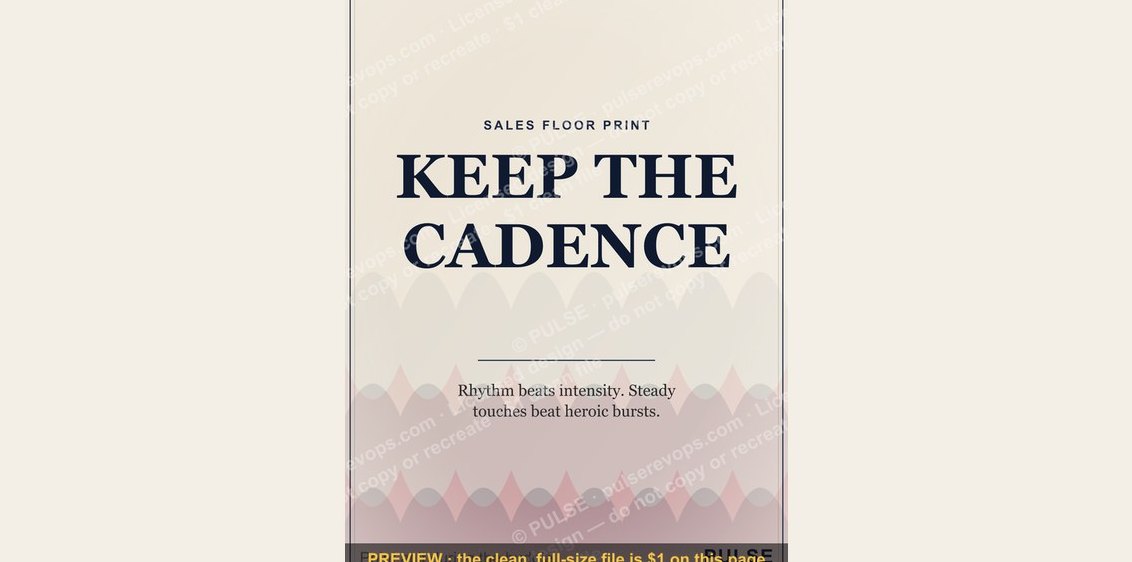 graphic“KEEP THE CADENCE” — Sales Floor Print
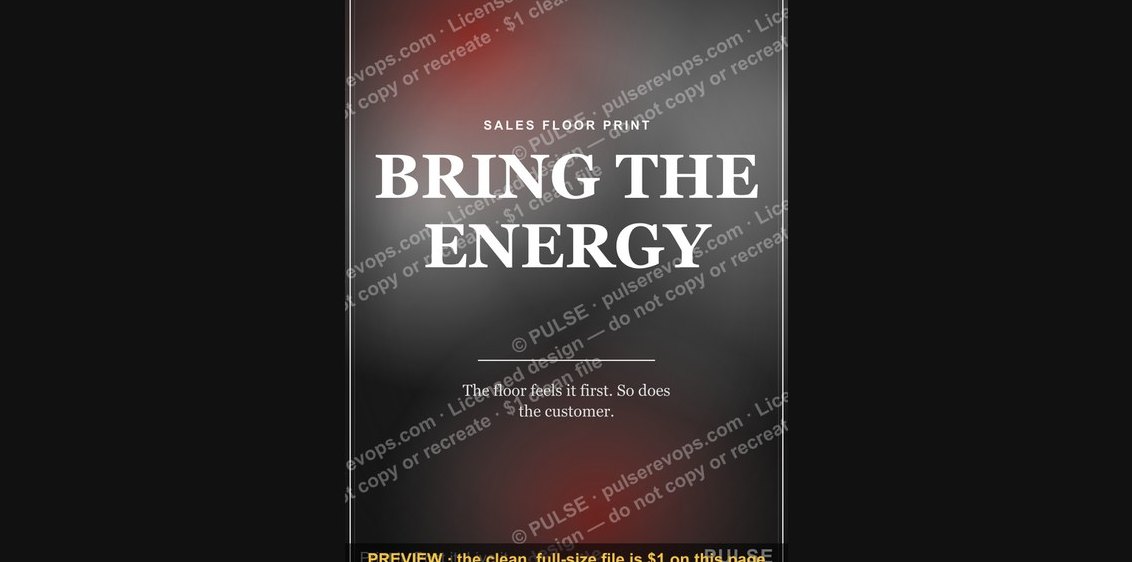 graphic“BRING THE ENERGY” — Sales Floor Print
 graphic“EARN EVERY YES” — Sales Floor Print
 graphicActivity to Revenue — Motivational Print
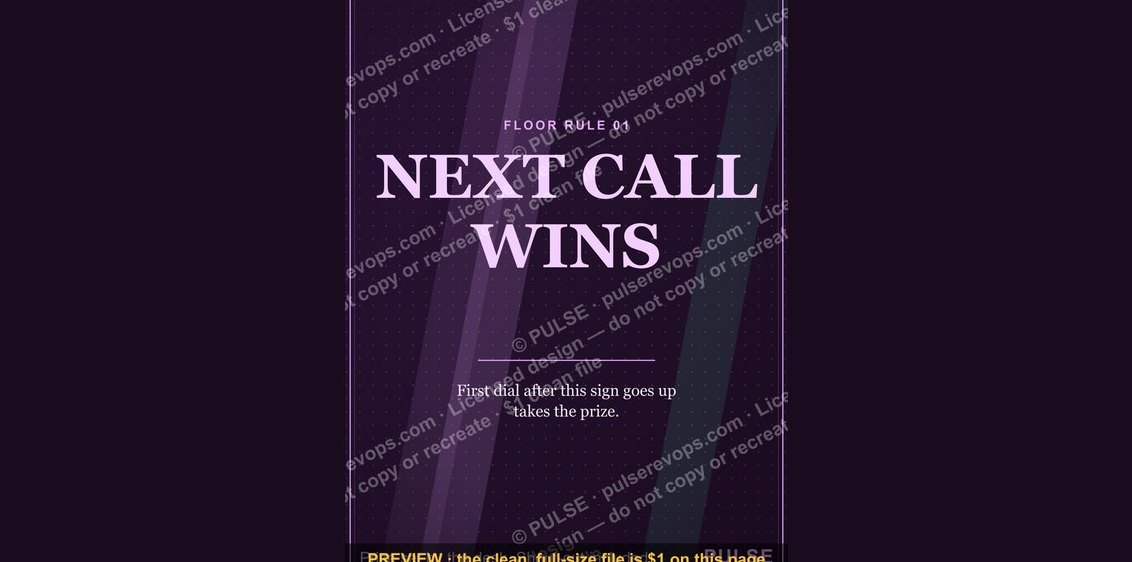 graphic“NEXT CALL WINS” — Sales Floor Print
 graphic“COMMIT MEANS COMMIT” — Sales Floor Print
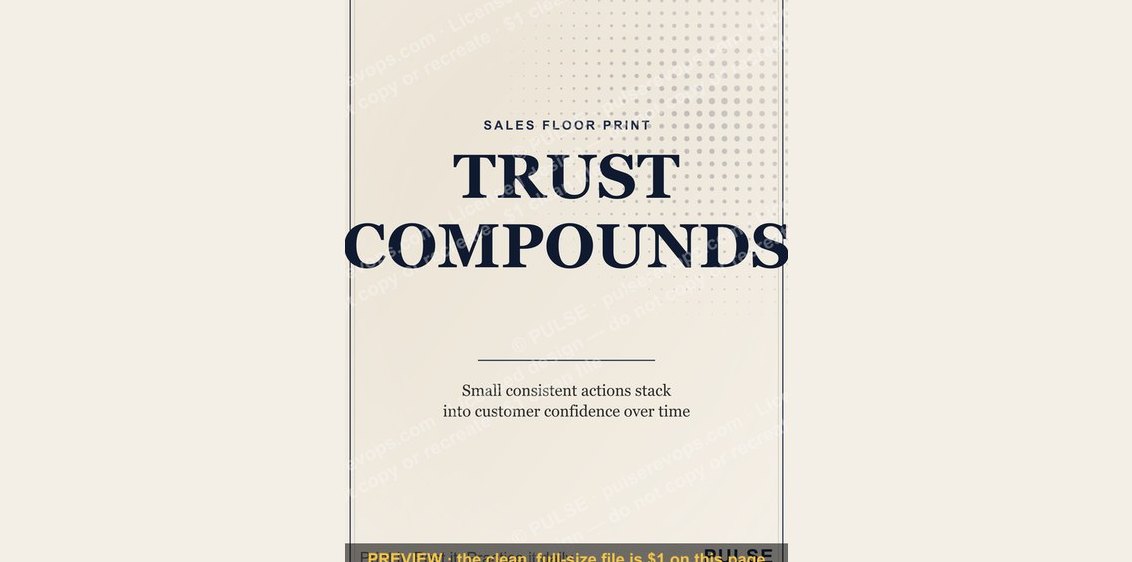 graphic“TRUST COMPOUNDS” — Sales Floor Print
 graphic“EARN THE RIGHT” — Sales Floor Print
 graphic“OWN THE NUMBER” — Sales Floor Print