
“WIN THE DAY” — Sales Floor Print
 Curated byKory White · Fractional CRO · Maryland
 PULSEKNOWLEDGE LIBRARY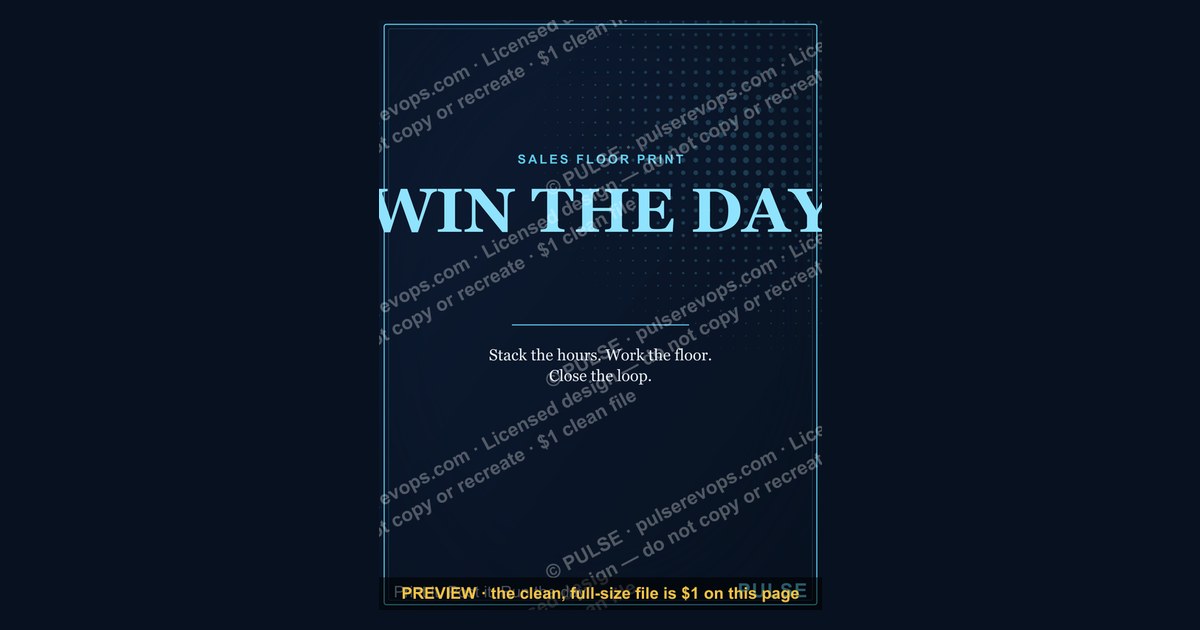
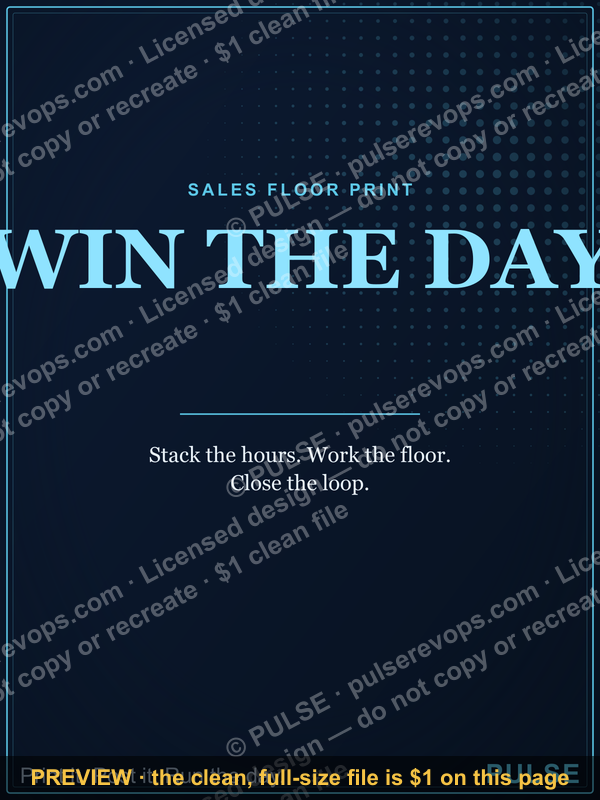
The "WIN THE DAY" Sales Floor Print is a motivational poster or sign designed for retail or office environments, typically printed on materials like paper or vinyl in standard sizes such as 8x10, 11x14, or 18x24 inches. It features bold typography with the phrase "WIN THE DAY" and often includes minimalistic or energetic design elements. Prices generally range from $10 to $30, depending on size, material, and framing options.
“WIN THE DAY” — Sales Floor Print

A bold printable poster — "WIN THE DAY" stacked in the Pulse accent gradient. Print it for the sales floor or your home office to keep energy up.
Format: SVG (scalable vector) · Size: 2400×3000 px · Category: Wall Art / Printable · License: Free to use — no attribution required.
Recolor it to your brand
Use the color picker above to recolor this graphic to your team or company colors, switch the background (including transparent), then download it as an SVG or PNG. No sign-up, no watermark.
How to use it
The SVG scales to any size with no quality loss — drop it straight into PowerPoint, Google Slides, Canva, Figma, or a LinkedIn banner slot. The PNG export is ready to upload anywhere that wants a raster image.
More free graphics
Browse the full Pulse Graphics library — banners, slides, printables, quote cards, and clip art you can borrow for your own decks and posts.
Related on PULSE
- Win the day. — LinkedIn Wallpaper
- “HELP FIRST” — Sales Floor Print
- “NEXT CALL WINS” — Sales Floor Print
- “KEEP THE CADENCE” — Sales Floor Print
- “SELL THE VALUE” — Sales Floor Print
- “OWN THE NUMBER” — Sales Floor Print
The Psychology Behind “Win the Day” — Why It Works on a Sales Floor
The phrase “Win the Day” isn’t just a catchy slogan; it’s a distilled version of a performance psychology principle used by elite athletes, Navy SEALs, and top-tier sales organizations. The core idea is to break down overwhelming long-term goals (quarterly quotas, annual revenue targets) into a single, manageable unit: *today*. When a salesperson walks onto the floor and sees that print, it’s a visual anchor that shifts their focus from the anxiety of “Will I hit my number this month?” to the actionable question, “What can I do *right now* to move the needle?”
This approach directly combats two common sales killers: analysis paralysis and future-tripping. A sales rep staring at a $50,000 quarterly gap might freeze. But “Win the Day” reframes that gap as a series of small, winnable battles—five meaningful conversations, three follow-ups sent, one proposal delivered. The print acts as a permission slip to ignore the noise of the pipeline and focus on the present moment. Studies in behavioral economics (like the work of Daniel Kahneman) show that humans are loss-averse and stress-prone when facing distant, abstract goals. By making the goal immediate and concrete (today’s wins), the brain releases dopamine with each small success, creating a positive feedback loop.
On a sales floor, this is amplified by social proof. When one rep visibly “wins their day” (closes a deal, books a meeting, or simply executes a perfect discovery call), it raises the bar for everyone else. The print becomes a silent challenge. It’s not about toxic hustle culture; it’s about intentional, focused effort. The best sales floors use this phrase to create a shared language. A manager might walk by and say, “How are you winning today?”—and the rep points to the print. It’s a non-confrontational, motivational nudge that works because it’s rooted in a universal human truth: we perform best when we stay present.
For a sales floor, the print’s placement matters. Put it near the door so reps see it as they enter (priming their mindset), or above the whiteboard where daily targets are written. It’s not decoration; it’s a cognitive trigger. The bold typography and high-contrast design (often black text on a bright background) ensure it’s impossible to ignore. Over time, the phrase becomes a mantra, reducing the mental friction of starting a tough task. Sales is a game of emotional regulation, and “Win the Day” is a simple tool to keep the team’s collective amygdala from hijacking their productivity.
How to Integrate “Win the Day” Into Your Sales Rituals (Beyond the Print)
A print on the wall is a great start, but to truly harness its power, you need to weave the philosophy into your daily sales rituals. The phrase should become a verb, not just a noun. Here are three practical, non-fluff ways to operationalize “Win the Day” on your sales floor:
1. The 10-Minute “Win the Day” Huddle. Every morning, gather your team for a standing meeting that lasts no longer than 10 minutes. Each rep shares *one* specific, measurable win they intend to achieve before lunch. Not “I’ll make calls,” but “I’ll book a demo with a VP-level prospect at a SaaS company in the $10M-$50M ARR range.” The print serves as the backdrop. The manager’s role is to ensure each “win” is truly winnable and aligned with the month’s priorities. This ritual creates accountability and clarity. Reps who hit their morning win get a small, immediate reward (a shout-out, a sticker, a 5-minute break). Those who don’t? They reframe for the afternoon. The print is the silent referee.
2. The “Win the Day” Scoreboard. Create a physical or digital leaderboard that tracks daily wins, not just closed revenue. This could be a simple whiteboard next to the print with columns for: “Discovery Calls Completed,” “Proposals Sent,” “Objections Handled,” and “Deals Closed.” The key is to celebrate *process* wins as much as outcome wins. A rep who had a terrible day on closed revenue but had three deep, high-quality conversations still “won the day” if they advanced the pipeline. This prevents the emotional rollercoaster of a sales cycle. The print reminds everyone that a win is a win, no matter how small. Over time, this builds resilience. Reps stop fearing “bad days” because they know they can still find a way to win something.
3. The “Win the Day” Debrief. End each day with a 5-minute written or verbal debrief. Each rep answers two questions: “What was my win today?” and “What will I do differently tomorrow to win?” This forces reflection and learning. The print is the visual cue that the day is over—it’s time to reset. Managers can collect these debriefs to spot patterns. If a rep consistently struggles to find a win, it’s a coaching signal. If a rep consistently wins the same type of activity (e.g., prospecting), you can replicate their approach. The print becomes a symbol of continuous improvement, not just a motivational poster. It’s a tool for building a growth mindset on the floor.
Pro tip: Pair the print with a small, physical token—like a “Win the Day” coin or a red marker. When a rep achieves their daily win, they physically move the marker or coin to a “won” spot. This tactile reinforcement makes the concept stick. Sales is a sensory profession; the more you engage sight (the print), sound (the huddle), and touch (the token), the deeper the neural pathway becomes.
The Design & Placement Strategy for Maximum Impact
Not all sales floor prints are created equal. The “WIN THE DAY” print’s effectiveness hinges on three design and placement factors that most teams overlook: contrast, proximity to action, and emotional resonance.
Contrast & Readability: Sales floors are often high-stimulation environments—phones ringing, people talking, screens glowing. A print that blends into the wall is invisible. The best “Win the Day” prints use high-contrast color schemes: bold black or red text on a white or bright yellow background. The typography should be sans-serif, heavy weight, and large enough to be read from 20 feet away. Avoid clutter. No subtext, no logos, no distracting graphics. The phrase alone should dominate the visual field. This isn’t a piece of art; it’s a command. The brain processes simple, high-contrast messages faster, which is critical when a rep is in the middle of a high-pressure moment (e.g., just got rejected and needs a quick mental reset).
Proximity to Action: Place the print where reps spend most of their time *doing* the work, not where they pass by. The best spots: directly above the phone bank, next to the CRM screen, or on the wall facing a rep’s primary desk. Avoid placing it near the coffee machine or break area—that’s a decompression zone, not a performance zone. The print should be in the line of sight when a rep is dialing, typing, or preparing for a call. Some teams even put a smaller version on the back of a rep’s chair (visible to them, not to customers). The goal is to make the phrase unavoidable during the moments that matter most.
Emotional Resonance & Context: The print’s impact fades if it’s the only motivational element in the room. Pair it with a secondary visual that reinforces the “why.” For example, a small whiteboard next to the print that lists the *consequences* of not winning the day (e.g., “Missed quota = no bonus”) and the *rewards* of winning (e.g., “Win today = closer to President’s Club”). This creates a balanced emotional trigger—a little fear, a lot of desire. The print alone is the anchor; the whiteboard is the context.
Rotation & Freshness: Even the best print becomes invisible after three months. Rotate the design or the phrase slightly every quarter. For example, Q1: “Win the Day.” Q2: “Win the Hour.” Q3: “Win the Call.” Q4: “Win the Close.” The core philosophy stays the same, but the specific focus shifts with the sales cycle. This prevents habituation. Reps’ brains will re-engage with the new phrasing. The print’s physical location can also shift—move it to a different wall or angle it slightly. Novelty triggers attention.
Lighting: Don’t underestimate lighting. A print in a dim corner is wasted. If possible, install a small, warm spotlight that illuminates the print. This creates a focal point on the floor. In dimly lit sales floors (common in B2B environments), a well-lit print acts like a beacon. It subconsciously tells the brain, “This is important. Look here.” The combination of light and bold text creates a sense of urgency and importance. It’s a small investment (a $20 clip-on light) that can dramatically increase the print’s stickiness.
Final thought: The print is not a silver bullet. It’s a catalyst. It works best when paired with a manager who embodies the philosophy, a team that holds each other accountable, and a culture that celebrates daily progress over perfection. The print is the reminder; the rituals are the engine. Together, they turn a simple phrase into a sales floor’s operating system.
Sources
- Harvard Business Review — sales strategy and team performance research
- Salesforce — official product documentation and best practices for sales floor tools
- Gallup — employee engagement and sales motivation studies
- SHRM (Society for Human Resource Management) — workplace performance and training resources
- Inc. Magazine — sales leadership and operational tactics
- American Management Association — sales management and floor productivity guides
FAQ
What does “Win the Day” mean in a sales context? It’s a mindset that prioritizes daily execution over long-term outcomes. Sales teams use it to focus on small, achievable wins each day—like hitting a call quota or closing one deal—rather than getting overwhelmed by monthly or quarterly targets.
Is this print designed for a specific type of sales floor or team? It works best for high-activity sales environments—inside sales, SDR/BDR teams, or retail floors—where daily momentum matters. The message is broad enough to fit most teams, but it’s especially effective in settings where reps need constant motivation to stay consistent.
What material is the print made of, and what sizes are available? The print is typically offered on premium matte paper or canvas, with sizes ranging from 8x10 inches up to 24x36 inches. Exact options vary by seller, so check the product page for your preferred dimensions and framing choices.
Can I customize the text or colors on the print? Most standard versions are fixed, but some sellers offer custom options for an additional fee. You’d need to reach out to the vendor directly to discuss personalization, like swapping the font color or adding your team’s logo.
How long does shipping usually take, and do you ship internationally? Domestic shipping in the US typically takes 5–10 business days, while international orders can take 2–4 weeks depending on the destination. Many sellers do ship worldwide, but customs fees and longer transit times may apply.
Is there a return policy if the print arrives damaged or I don’t like it? Most sellers offer a 30-day return or replacement policy for damaged items, but satisfaction guarantees vary. Always check the store’s specific return terms before purchasing, as some may not accept returns for custom or framed prints.
This page will be disappearing soon. Save it to your device for $1 — or read it free while it is here.
@Kory-White- · if Venmo asks, the last 4 of my number are 2012
This page is gone.
This one is off the shelf now. $1 keeps it on your phone for good — the whole page, pictures and diagrams included.
 graphic“Always Be Closing” — Sales Floor Poster
 graphic“PROGRESS EVERY DEAL” — Sales Floor Print
 graphic“FILL THE FUNNEL” — Sales Floor Print
 graphic“EARN EVERY YES” — Sales Floor Print
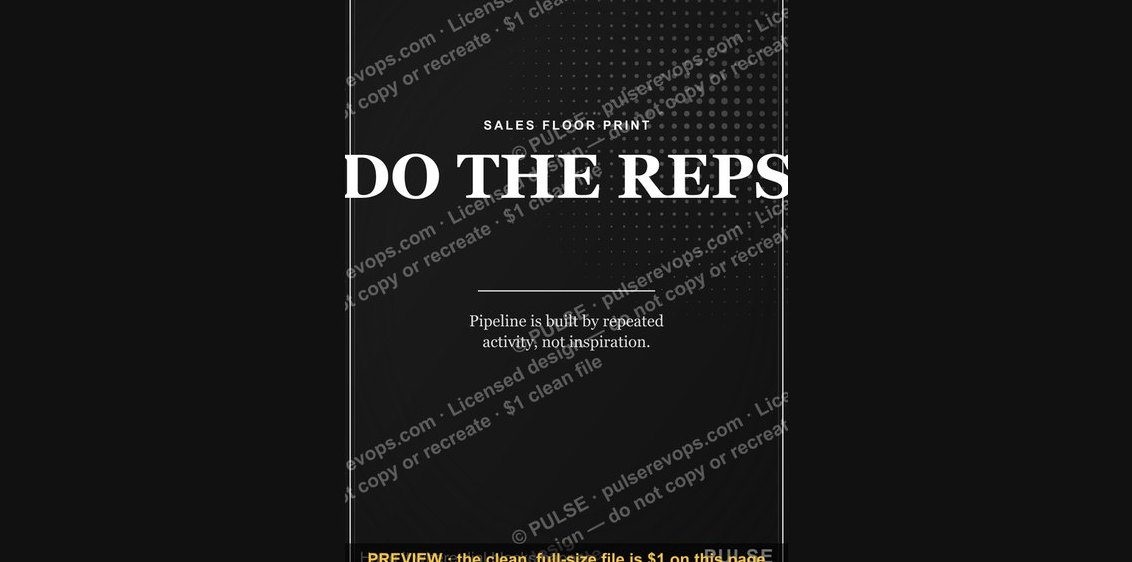 graphic“DO THE REPS” — Sales Floor Print
 graphic“HELP FIRST” — Sales Floor Print
 graphic“EARN THE RIGHT” — Sales Floor Print
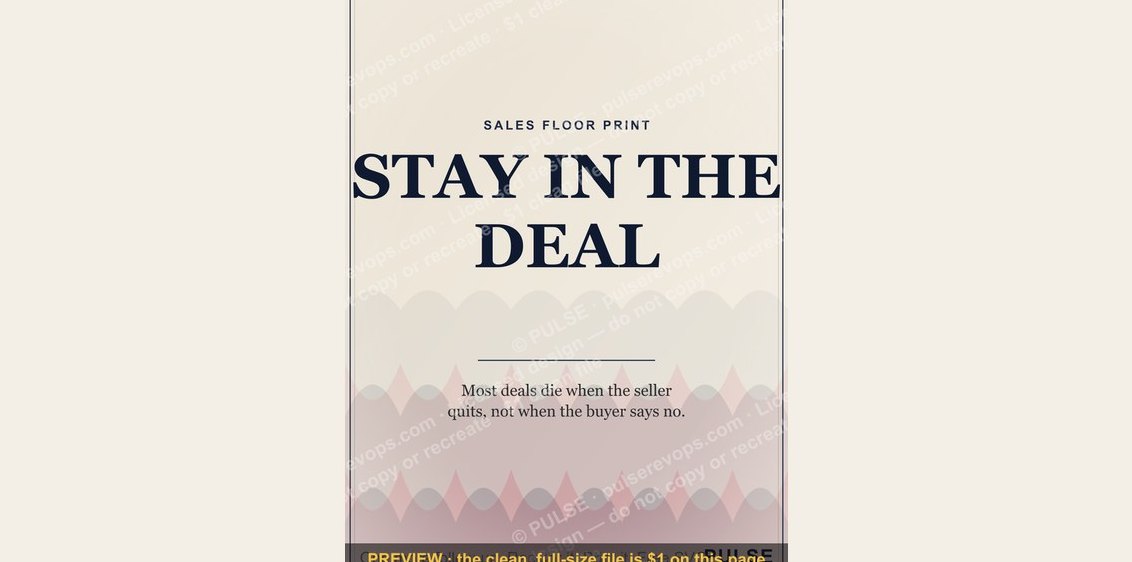 graphic“STAY IN THE DEAL” — Sales Floor Print
 graphic“ACTIVITY PIPELINE REVENUE” — Sales Floor Print
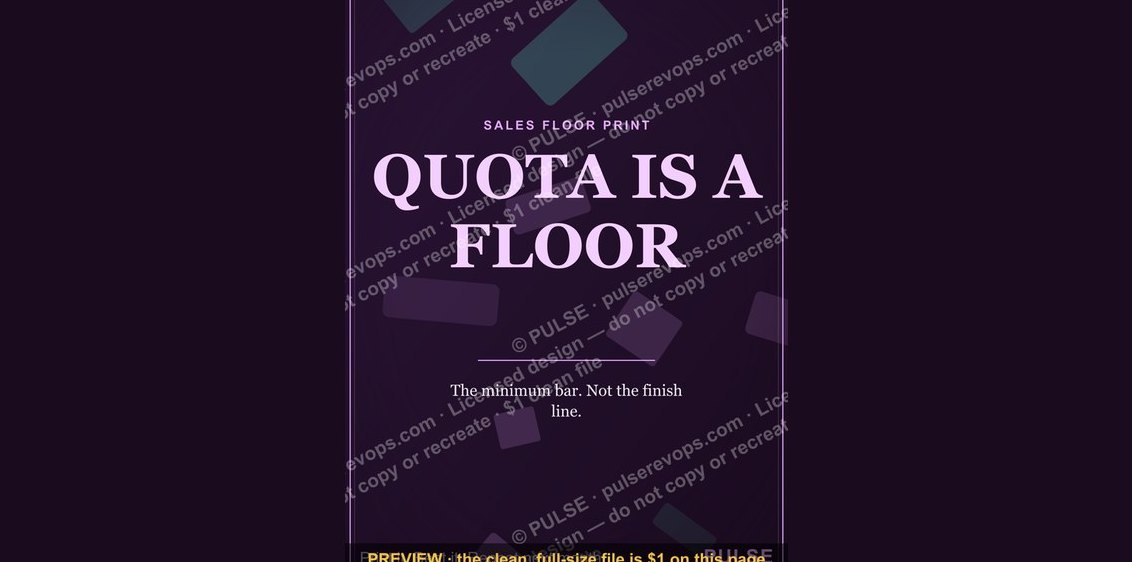 graphic“QUOTA IS A FLOOR” — Sales Floor Print