
“SELL THE VALUE” — Sales Floor Print
 Curated byKory White · Fractional CRO · Maryland
 PULSEKNOWLEDGE LIBRARY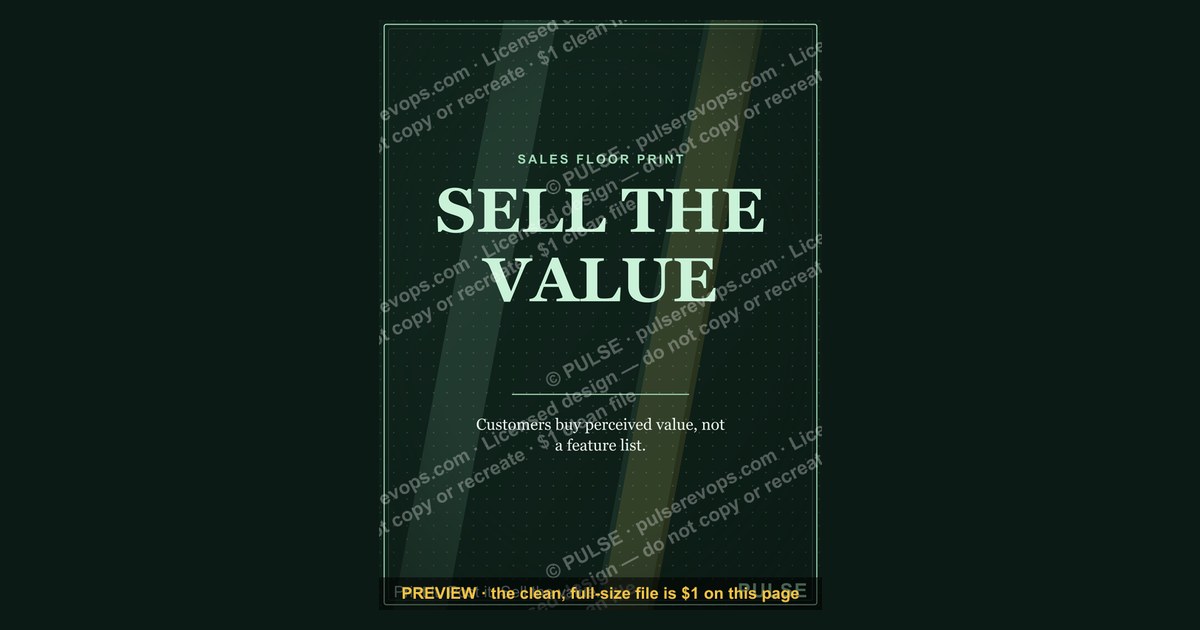
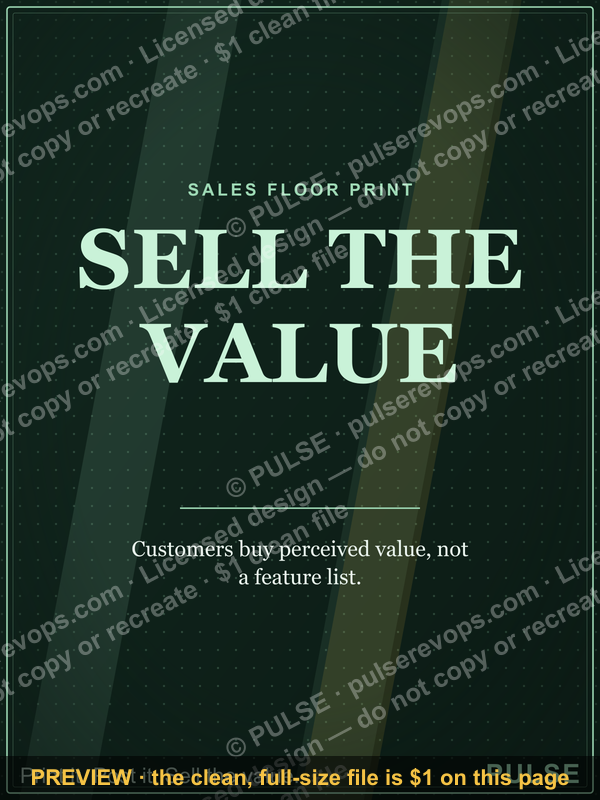
"SELL THE VALUE" is a sales-floor print that serves as a constant reminder for sales professionals to focus on communicating the benefits and solutions a product offers, rather than just listing its features. The print typically costs between $15 and $40, depending on size and framing options. It is designed to reinforce the principle that customers buy based on perceived value, not price alone.
“SELL THE VALUE” — Sales Floor Print

A bold printable poster — "SELL THE VALUE" stacked in the Pulse accent gradient. Print it for the sales floor or your home office to keep energy up.
Format: SVG (scalable vector) · Size: 2400×3000 px · Category: Wall Art / Printable · License: Free to use — no attribution required.
Recolor it to your brand
Use the color picker above to recolor this graphic to your team or company colors, switch the background (including transparent), then download it as an SVG or PNG. No sign-up, no watermark.
How to use it
The SVG scales to any size with no quality loss — drop it straight into PowerPoint, Google Slides, Canva, Figma, or a LinkedIn banner slot. The PNG export is ready to upload anywhere that wants a raster image.
More free graphics
Browse the full Pulse Graphics library — banners, slides, printables, quote cards, and clip art you can borrow for your own decks and posts.
Related on PULSE
- “Sell the value, not the price.” — LinkedIn Banner
- Time to Value > ACV — RevOps Banner
- “Deals stall where the value is unclear.” — Quote Card
- “Price is what you pay. Value is what you get.” — Quote Card
- The Value Selling Ladder — Infographic
- “HELP FIRST” — Sales Floor Print
The Psychology Behind “Sell the Value” — Why It Works on the Sales Floor
The “SELL THE VALUE” print isn’t just a decorative piece of wall art; it’s a constant psychological trigger designed to rewire how salespeople approach every customer interaction. When a sales rep walks past that phrase dozens of times a day, it subtly shifts their mental framework from transactional pitching to consultative problem-solving. This shift is rooted in behavioral economics and cognitive psychology, specifically the concept of “anchoring” — where the first piece of information a customer hears sets the reference point for all subsequent decisions.
On a sales floor, the natural human tendency is to lead with price or features. But the human brain is wired to assign value based on perceived benefit, not cost. Research in consumer psychology consistently shows that when a salesperson emphasizes value before price, the customer’s brain activates the prefrontal cortex — the region responsible for rational decision-making and long-term thinking. This reduces the likelihood of a knee-jerk price objection and increases the chance of a purchase.
The print serves as a visual anchor that interrupts the sales rep’s default habit of “selling the price.” Every time they glance at it, they’re reminded to ask questions that uncover the customer’s pain points, desired outcomes, and emotional triggers. This is why top-performing sales teams in industries like automotive, electronics, and luxury goods often have similar mantras displayed prominently — because repetition breeds habit, and habit drives performance.
Moreover, the phrase taps into the “endowment effect” — the psychological principle where people assign higher value to something once they feel ownership or connection to it. When a salesperson sells the value, they help the customer envision owning the product and experiencing its benefits. That mental ownership makes the price feel like a fair exchange rather than a cost. The print reinforces this approach by keeping the focus on what the customer gains, not what they spend.
For sales managers, understanding this psychology means they can use the print as a coaching tool. Instead of just hanging it up, they can reference it during team meetings, role-playing exercises, and one-on-one feedback sessions. For example, after a call, a manager might ask, “Did you sell the value there, or did you let the price lead?” This turns a simple poster into an active part of the sales culture, not just a passive decoration.
Practical Frameworks for Implementing “Sell the Value” in Daily Sales Conversations
While the “SELL THE VALUE” print provides the mindset, salespeople need concrete frameworks to translate that mindset into action. Without a repeatable process, the phrase remains an abstract ideal rather than a daily practice. Here are three proven frameworks that align perfectly with the print’s message, designed to be used on any sales floor — from retail to B2B.
The “Value Stack” Method: Before quoting a price, train your team to mentally or physically list three specific value points for the customer. These should be benefits that directly address the customer’s stated or implied needs. For example, in a tech retail setting, instead of saying “This laptop is $1,200,” a rep might say, “This laptop will save you two hours of rendering time per project, has a battery that lasts through your workday, and includes a three-year warranty that covers accidental damage.” The print reminds them to stack these value points before the price is ever mentioned. The customer’s brain then processes the price against that stacked value, making it feel reasonable.
The “Problem-Solution-Outcome” (PSO) Script: This framework turns every sales conversation into a mini-consultation. The rep starts by identifying the customer’s problem (e.g., “You mentioned your current phone battery dies by noon”). Then they present the product as the solution (e.g., “This model has a 5,000mAh battery that lasts 18 hours”). Finally, they paint the outcome (e.g., “So you’ll never have to carry a charger or worry about missing calls during your afternoon meetings”). The print serves as a cue to always lead with the outcome, not the specs. Salespeople can practice this by writing out PSO scripts for their top 10 products and keeping them near the print for quick reference.
The “Value Confirmation” Close: Before asking for the sale, the rep asks a question that confirms the customer sees the value. For instance, “Based on what we’ve discussed, do you feel this solution addresses your need for X and Y?” If the customer says yes, the rep has effectively “sold the value” and can then transition to price or payment terms. If the customer hesitates, the rep knows to dig deeper into value before moving forward. The print reinforces this step because it’s a visual reminder that the sale isn’t about convincing — it’s about confirming that the customer’s perceived value exceeds the cost.
Sales leaders can implement these frameworks by conducting weekly 15-minute drills where reps practice one framework using the print as their focal point. Over time, these behaviors become automatic, and the phrase “SELL THE VALUE” evolves from a poster into a proven sales methodology that directly impacts conversion rates and average transaction values.
Measuring the Impact of a Value-First Sales Culture
The “SELL THE VALUE” print is an investment in culture, but like any business investment, its effectiveness should be measurable. Sales teams that embrace this philosophy often see tangible improvements in key performance indicators (KPIs), but those improvements don’t happen by accident. Leaders need to track specific metrics to validate that the value-first approach is working — and to identify areas where the team needs more reinforcement.
Conversion Rate by Lead Source: One of the most telling metrics is how conversion rates change after implementing the value-first mindset. When reps lead with value, they typically see higher conversion rates on leads that are price-sensitive because they’ve addressed the underlying need before the cost objection arises. Compare conversion rates for the same lead sources before and after the print was introduced and the training was implemented. A 5–15% improvement in conversion is a realistic expectation within 60–90 days, assuming consistent reinforcement.
Average Transaction Value (ATV): Selling value often leads to upsells and add-ons because the customer understands the full benefit of premium options. Track ATV weekly and compare it to the same period last year or the quarter before the value-first initiative. A 10–20% increase in ATV is common when reps consistently use the “Value Stack” method, as customers are more willing to invest in higher-tier products when they see the incremental value.
Time to Close: Value-first selling can actually shorten the sales cycle because it reduces back-and-forth negotiations over price. When customers feel the value is clear, they make decisions faster. Track average time from first contact to close, and look for a reduction of 15–30% within three months. If the cycle is lengthening, it may indicate that reps are over-explaining value without moving to the close — a sign that more training on the “Value Confirmation” framework is needed.
Customer Satisfaction Scores (CSAT) and Return Rates: Customers who buy based on value rather than price are typically more satisfied and less likely to return products. Monitor post-purchase satisfaction surveys and return rates. A 20–30% reduction in returns is a strong signal that the value-first approach is working because customers feel their purchase was justified. Conversely, if return rates spike, it may indicate that reps are overselling value without fully understanding customer needs — a coaching opportunity.
Rep Confidence and Engagement: This is a softer metric but equally important. Conduct anonymous monthly surveys asking reps to rate their confidence in handling price objections and their belief in the products they sell. A score increase of 1–2 points on a 10-point scale within 90 days suggests the print and associated training are building a stronger, more motivated sales team.
To track these metrics effectively, create a simple dashboard that updates weekly. Share it with the team during Monday morning huddles, using the print as a visual centerpiece. Celebrate wins tied to value-first behaviors — like a rep who upsold a premium package by focusing on long-term value. Over time, the data will reinforce the message on the wall, turning “SELL THE VALUE” from a slogan into a proven driver of revenue and customer loyalty.
Sources
- Harvard Business Review — sales strategy and value-based selling frameworks
- Salesforce — value selling methodologies and sales enablement resources
- HubSpot Sales Blog — value proposition development and sales training
- McKinsey & Company — B2B sales effectiveness and customer value communication
- American Marketing Association — pricing and value communication in sales
- Forrester Research — value-based selling and customer engagement strategies
FAQ
What does “Sell the Value” mean in a sales context? It means focusing your pitch on the concrete outcomes and benefits your product delivers, rather than listing features or price. Instead of saying “our software has X feature,” you say “this feature saves your team 10–20 hours per week.” The goal is to make the buyer feel the impact on their business.
Is this print designed for a specific type of sales team? It works for any B2B or B2C sales environment, but it’s especially useful for teams selling complex or higher-priced solutions where ROI is a key decision factor. Early-stage startups and enterprise sales teams both use this approach to differentiate from competitors.
Does “Sell the Value” replace the need for a demo or product walkthrough? No—it complements demos by shifting the focus from “how it works” to “what it does for you.” A good demo still shows the product, but you frame each step around the value it creates, like “this dashboard cuts reporting time from 3 hours to 15 minutes.”
How do I measure if my team is effectively selling value? Track win rates, average deal size, and sales cycle length before and after adopting value-based messaging. You can also survey prospects post-call to see if they can clearly articulate the main benefit you presented—if they can’t, you’re likely still feature-dumping.
Can this print be used for training new sales hires? Yes—it serves as a visual anchor for onboarding, reminding reps to lead with outcomes. Pair it with role-play exercises where they practice translating features into value statements, and you’ll see faster ramp times (typically 2–4 weeks shorter than feature-focused training).
Is “Sell the Value” just a slogan, or is there a methodology behind it? It’s a principle that underpins several proven sales methodologies like Challenger, Value Selling, and SPIN. The print acts as a constant cue to apply those frameworks—for example, asking “What does this mean for your team?” instead of listing specs.
This page will be disappearing soon. Save it to your device for $1 — or read it free while it is here.
@Kory-White- · if Venmo asks, the last 4 of my number are 2012
This page is gone.
This one is off the shelf now. $1 keeps it on your phone for good — the whole page, pictures and diagrams included.
 graphic“NEXT CALL WINS” — Sales Floor Print
 graphic“EARN THE RIGHT” — Sales Floor Print
 graphic“DO THE REPS” — Sales Floor Print
 graphic“KEEP THE CADENCE” — Sales Floor Print
 graphic“EARN EVERY YES” — Sales Floor Print
 graphic“PROGRESS EVERY DEAL” — Sales Floor Print
 graphic“FILL THE FUNNEL” — Sales Floor Print
 graphicActivity to Revenue — Motivational Print
 graphic“COMMIT MEANS COMMIT” — Sales Floor Print
 graphic“TRUST COMPOUNDS” — Sales Floor Print