


“Deals stall where the value is unclear.” — Quote Card
Quality
Certified
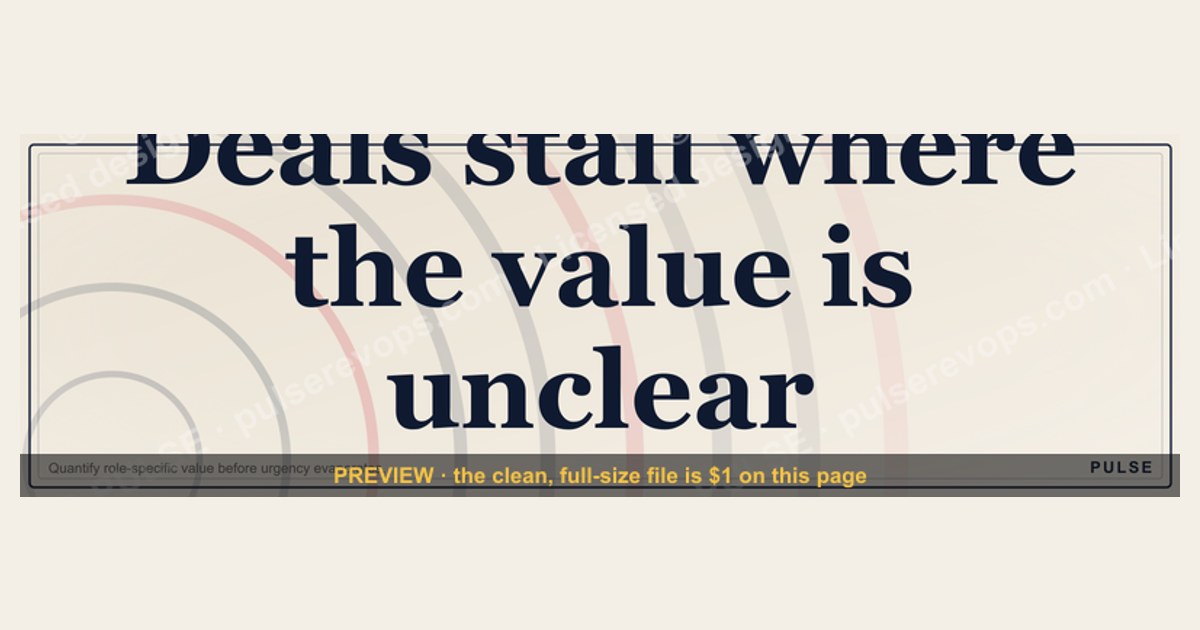

Deals stall where the value is unclear because buyers cannot defend a purchase they cannot quantify. When economic impact stays vague, every stakeholder substitutes a worst-case assumption, urgency evaporates, and the opportunity drifts into no-decision. Role-specific, numeric value restores momentum faster than any discount or pressure tactic.
What the quote claims and why it matters
The line "Deals stall where the value is unclear" is deliberately narrow. It does not blame price, competition, a departed champion, or procurement. It isolates one failure mode — ambiguity about worth — and asserts that this is where forward motion dies. That precision is what makes it a usable quote card rather than a platitude. A poster reading "sell better" changes nothing. A poster naming the exact place deals die gives a rep something to check against on a Tuesday afternoon.
The claim rests on a well-documented asymmetry in how buyers process incomplete information. When a benefit is concrete, the buyer evaluates an opportunity: is this gain worth this cost? When the benefit is vague, there is nothing to weigh, so the buyer falls back on risk evaluation instead: what happens to me if this fails? Those are two different mental questions with two different default answers. Opportunity evaluation defaults to "maybe." Risk evaluation defaults to "not yet." A rep who leaves value unclear has not delivered a neutral message — they have handed the buyer the version of the question that resolves to delay.
This matters most mid-pipeline, not at the top. Early conversations tolerate vagueness because both sides are still exploring. Late-stage conversations do not. By the time a proposal circulates, someone in the buyer's organization must write a sentence beginning "we should do this because…" If the rep never supplied the end of that sentence in the buyer's own units — hours, headcount, dollars, tickets, cycle days — the champion has to invent it. Champions who must invent the business case usually stop trying, and the thread goes quiet. Nobody sends a rejection. The deal simply ages out of the forecast.

The card is also a diagnostic prompt for pipeline reviews. When a manager asks "why is this stuck?" the honest answer is often "I don't know." The quote reframes the question into something answerable: can the buyer state, unprompted, what this is worth to them? If the rep cannot report that sentence back verbatim, the value is unclear, and the stall has a name. Naming it is the whole point of putting the quote where a team sees it daily — it converts a mysterious slowdown into a specific, fixable gap.
One caution about usage. It is a diagnosis, not an accusation. Teams that read it as "the rep failed to explain value" drive reps to over-explain, producing longer decks and more feature talk — the opposite of clarity. The useful reading is structural: value is unclear when the buyer cannot restate it, regardless of how well it was presented. Clarity is measured on the receiving end, not the sending end.
Turning an unclear deal into a quantified one, step by step
The recovery process is mechanical and works whether the deal is three weeks old or three months stalled. It runs in five moves.

Move one — confirm the stall is actually a value stall. Send the champion one short message asking a single question: "If your CFO asked you today why this is worth doing, what would you say?" You are not asking for permission or a meeting. You are testing whether the sentence exists. Three outcomes are possible. They answer with numbers — value is clear, and the stall is something else entirely. They answer with adjectives ("it would really help the team") — value is unclear. They do not answer at all — value is unclear and the champion has disengaged. An adjective-only answer is the most common result on stalled deals, and it is also the most fixable.
Move two — recover the buyer's own baseline numbers. You cannot quantify an outcome without a starting point, and the starting point must come from them, not from your benchmark deck. Ask for three to five metrics they already track and already report upward: hours spent per week on the process, headcount assigned to it, error or rework rate, cycle time in days, cost per unit of whatever they produce. If they do not know a number, ask for a range and use the conservative end. A buyer who says "somewhere between 10 and 20 hours a week" gives you 10, not 15, and certainly not 20. Under-claiming is a credibility asset later.
Move three — build the delta, not the feature list. Take each baseline and state the expected after-state as a range with a time horizon: from 20 hours per week to somewhere in the 4–8 hour band within the first quarter after rollout. Ranges outperform point estimates because they read as honest rather than promotional, and because they survive contact with the buyer's own skepticism. A single precise-sounding number invites the buyer to argue with the number. A range invites them to pick a spot inside it, which is participation rather than opposition.
Move four — translate the same delta into three separate languages. The economic buyer needs the delta as money and payback period. The end user needs it as their own week — what disappears from their Monday. The technical evaluator needs it as risk removed — integration surface, uptime, data handling, compliance obligations. It is one underlying claim rendered three ways, not three different claims. If the three versions contradict each other, the buying committee will find the contradiction before you do.

Move five — verify on the receiving end. Before the proposal circulates, get 15 minutes with the champion and ask them to say the value back. Not "does this look good" — that always gets a yes. Ask "in your words, what changes and by how much?" If they hesitate, stumble, or reach for your deck to read from it, the value is still unclear and the proposal is not ready. This single step is the highest-leverage part of the sequence, because it catches ambiguity while it costs one meeting instead of one quarter.
A worked example. A mid-market logistics buyer has a stalled $85,000 annual deal in proposal stage for 47 days. The champion, asked the CFO question, says "it would make the team's life easier." That is an adjective answer — value unclear. Baseline recovery yields three numbers: 22 hours per week of manual exception handling, 6% invoice error rate, 9-day close cycle. The delta is stated as ranges: exception handling drops to 6–10 hours per week within 90 days, error rate to 2–3%, close cycle to 5–6 days. Translated: roughly $61,000 annualized labor recovery, 14 hours back per week for the operations lead, and a documented audit trail for the technical reviewer. The champion restates all three on the verification call without notes. The deal closes 19 days later at full price.
Costs, timelines, and typical ranges
The expense of an unclear value story is rarely booked anywhere, which is why it persists. It shows up as three separate leaks.

The first is cycle extension. A stall does not usually kill a deal outright; it adds weeks. Every round of "let me take this back to the team" that happens because the business case was thin adds a full internal meeting cycle, which in most mid-market and enterprise organizations means one to three weeks depending on how often the relevant committee meets. Two such rounds on a 90-day cycle push it toward 120 days or beyond. The revenue is not lost — it is deferred into a later quarter, which is a cash flow problem and a forecasting problem even when the deal eventually closes.
The second is forecast corruption. A deal sitting in late stage with an unclear value story looks identical in the CRM to a deal with a fully built business case. Both show the same stage, the same amount, the same close date. Only one is real. When a meaningful share of a late-stage pipeline consists of deals whose champions cannot articulate worth, the forecast is not a forecast — it is a list of hopes with dates attached. The correction usually arrives in the last two weeks of a quarter, exactly when there is no time left to compensate.
The third is opportunity cost inside the rep's own week. Stalled deals do not sit quietly. They consume follow-up cycles, check-in calls, internal escalations, and manager attention. A rep working a stalled late-stage deal is spending time that could have gone into a new opportunity where the value could still be framed correctly from the start. A handful of ambiguous deals can absorb the working hours that would have generated the pipeline needed to cover them.
Timelines for recovery should be set realistically. Re-running discovery on a stalled deal and rebuilding the value story typically costs two to four weeks: one call to recover baselines, a few days to build the delta, one verification call, and then the buyer's own internal cycle before anything moves. Building the quantified story during first discovery costs perhaps an extra 20 minutes of question-asking. Rebuilding it after a stall costs a month. That asymmetry is the entire argument for prevention.

A reasonable internal service level: any deal in the same stage past 30 days gets a mandatory value-clarity check before any discounting is discussed. Discounting a deal whose value is unclear does not fix anything — it lowers the price of something the buyer still cannot justify, reducing revenue without removing the actual blocker. Reps reach for price because price is the one variable they control. The quote card exists partly to interrupt that reflex.
Typical ranges worth carrying in your head. Stalled late-stage deals run 30–90 days past their original close date before anyone formally disqualifies them. Average enterprise buying-committee size sits between six and ten people, which means the value sentence has to survive six to ten separate retellings. Deals with a verified, buyer-stated business case convert at meaningfully higher rates than deals with a vendor-authored ROI model — the exact multiplier varies by segment, so treat any single percentage as suspect and measure your own.
Where teams get it wrong
Feature volume mistaken for clarity. The most common error is responding to a stall by sending more material. Longer decks, additional demo recordings, a second technical session. Volume is not clarity; it is often the opposite, because it increases the work the champion must do to extract the one sentence they need. If a 40-slide deck exists and the champion still cannot state the worth, slide 41 will not help. Cut to a single page.
Vendor benchmarks substituted for buyer baselines. "Companies like yours typically see a 30% improvement" is not a value statement about this buyer. It is a statement about a population the buyer may not believe they belong to, and it invites the response "we're different." Any number that did not come out of the buyer's own mouth or their own reporting is decorative. Use industry figures only to sanity-check a buyer-supplied number, never to replace one.

Building the case only for the economic buyer. Teams that learn "quantify the ROI" often build one CFO-facing model and stop. That leaves the end user and the technical evaluator to construct their own interpretations. The end user, absent a clear statement of what changes in their week, tends to assume more work during rollout with unclear benefit after. The technical evaluator, absent a clear statement of integration and risk posture, tends to assume unknown risk. Neither will block the deal openly. Both will slow it, and the slowdown is indistinguishable from ordinary calendar friction.
Precision that outruns evidence. The overcorrection to vagueness is fake specificity — a number computed to two decimal places from assumptions nobody validated. Sophisticated buyers spot this instantly, and the credibility damage extends past the number to everything else in the proposal. If the underlying inputs are estimates, present the output as a range and say which inputs are estimates. Stated uncertainty reads as honest. Unstated false precision reads as a pitch.
Confusing organizational value with personal value. Sometimes the business case is airtight and the deal still stalls. That is usually because the value to the organization is clear while the value to the individual decision-maker's career is not. Someone is weighing what happens to them if the rollout goes badly. No spreadsheet addresses that. It gets addressed by de-risking: a smaller initial scope, a defined success checkpoint, a reference call with a peer who already took the same bet. Probe for it directly — "beyond the numbers, is there anything about this that feels risky for you personally?" — and treat the answer as legitimate rather than as an objection to overcome.

Treating silence as a value problem when it is a timing problem. Not every stall is a value stall. Budget cycles, hiring freezes, a reorganization, or a competing internal priority can all freeze a deal whose value is perfectly clear. The diagnostic in move one exists precisely to separate these. Running the value-rebuild sequence on a deal that is actually waiting for the next fiscal year wastes weeks and annoys a buyer who has already agreed with you.
Letting the rep narrate instead of the buyer. In deal reviews, reps summarize the value in their own words and managers accept it. That is the rep's sentence, not the buyer's. The only artifact that proves clarity is the champion's own phrasing, quoted. When reviews accept paraphrase, ambiguity survives all the way to the committee.
Decision framework: when to choose what
Not every stalled deal needs the same response, and applying the wrong one costs time. The decision turns on two questions: can the buyer state the value, and does the value they state match what you believe you deliver?
If the buyer can state the value and it matches your understanding, the value is clear and the stall lives elsewhere. Go looking for the structural blocker — budget timing, an unmet security or procurement requirement, an absent stakeholder, a competing initiative. Rebuilding the value story here is wasted motion and signals that you were not listening.
If the buyer can state a value but it is smaller than what you deliver, you have an under-scoped case rather than an unclear one. The fix is additive: find the second and third impact areas that never came up in discovery. A buyer who sees only the time-savings benefit and none of the error-reduction or revenue-recovery benefit is comparing your full price against a fraction of your worth, and the arithmetic will not close.

If the buyer states a value larger than you can defend, that is a different emergency. Expectation inflation produces a deal that closes and then churns, and churn is more expensive than a lost deal. Correct downward before signature, in writing, even at the cost of momentum.
If the buyer cannot state any value, run the full five-move rebuild. And if a rebuild has already been run once and the value is still unclear after a verification call, the honest read is usually that there is no strong fit for this buyer's actual situation. Disqualifying at that point is a legitimate outcome, and it is far better than carrying a phantom deal through two more forecast cycles.
Three operational uses convert the card from wall art into process. Use it as a pipeline review header: put the line at the top of the deal-review agenda and require one artifact per late-stage deal — the champion's own value sentence, quoted. Deals without that sentence get flagged before close dates are debated. Use it as a proposal gate: before any proposal leaves, someone other than the deal owner reads the first page and answers one question — what changes for this buyer, by how much, and by when? If the reviewer cannot answer from the page alone, the proposal goes back. Five minutes per proposal catches most ambiguity before it reaches a committee. Use it in onboarding: the most transferable habit for a new seller is asking for baseline numbers during discovery rather than after a stall. New reps who learn to leave discovery with three buyer-supplied metrics stall less often than those who leave with a list of requirements.
Related questions
How long should a deal sit before I call it a value stall?
Roughly 21–30 days in the same stage with no buyer-initiated activity. Before that, normal internal cycles explain the quiet. After that, run the one-question diagnostic rather than sending another check-in email.
Does discounting ever unstick a value-unclear deal?

Rarely, and it usually makes things worse. Lowering price on something the buyer cannot justify reduces your revenue without removing the blocker, and it signals the original price was arbitrary — undermining the value story you still need to build.
Who should supply the numbers in the business case?
The buyer. Vendor benchmarks are for sanity-checking only. A number the buyer stated themselves survives internal scrutiny; a number you supplied gets challenged by the first skeptic in the room.
What if the champion refuses to share baseline metrics?
Ask for a range instead of a figure, and use the conservative end. If they will not give even a range, that is usually a signal about access or engagement rather than about data — treat it as a qualification question.
Can a deal have clear value and still be a bad deal?
Yes. Clear value that is smaller than your price is a legitimate no. Recognizing that early and disqualifying protects the forecast more than carrying it forward on hope.
FAQ
What does "Deals stall where the value is unclear" actually mean in practice?
It means the buyer cannot construct the internal sentence that justifies the purchase. Not that they disagree with you — that they have nothing concrete to repeat to a colleague. Without that sentence, the deal has no internal advocate, and it decays quietly rather than being formally rejected.
How do I tell a value stall apart from a budget or timing stall?

Ask the champion what they would tell their CFO today if asked why this is worth doing. Numbers back means value is clear and the blocker is elsewhere. Adjectives or silence means value is unclear. The two stalls need completely different responses, so the diagnostic is worth one email.
Should I use ranges or exact figures when quantifying value?
Ranges, with a stated time horizon, unless you have verified inputs for a precise number. Ranges read as honest and invite the buyer to pick a point inside them. False precision invites a challenge to the number itself, and losing that argument costs credibility across the whole proposal.
Can a stalled deal be recovered, or is it effectively lost?
It can be recovered, but budget two to four weeks: one call to recover baselines, a short build, one verification call, then the buyer's own internal cycle. Prevention costs about 20 extra minutes in first discovery, which is why the habit matters more than the rescue technique.
Why do more slides and another demo usually fail to fix this?
Because volume is not clarity. More material increases the work the champion has to do to extract one usable sentence. If 40 slides have not produced it, slide 41 will not. Replace the deck with a single page that states what changes, by how much, and when.
Does this apply to renewals and expansions, or only new business?
It applies equally, and often more sharply. Renewal conversations stall when the customer cannot articulate the value already delivered, which is a measurement failure on the vendor's side. Expansion stalls for the same reason as new business: nobody has quantified the incremental gain in the buyer's own units.
Sources
- https://hbr.org/2015/03/making-the-consensus-sale — Harvard Business Review on consensus buying and stakeholder alignment
- https://hbr.org/2017/03/the-new-sales-imperative — HBR on buying-group complexity and purchase-decision paralysis
- https://www.mckinsey.com/capabilities/growth-marketing-and-sales/our-insights — McKinsey growth, marketing and sales insights
- https://www.gartner.com/en/sales/insights/b2b-buying-journey — Gartner on the B2B buying journey and buying groups
- https://www.investopedia.com/terms/v/valueproposition.asp — Investopedia definition of a value proposition
- https://www.investopedia.com/terms/r/returnoninvestment.asp — Investopedia on return on investment and payback period
- https://www.nobelprize.org/prizes/economic-sciences/2002/kahneman/facts/ — Background on prospect theory and loss aversion
- https://sloanreview.mit.edu/topic/marketing/ — MIT Sloan Management Review marketing and sales research
Related on PULSE
This page will be disappearing soon. Save it to your device for $1 — or read it free while it is here.
@Kory-White- · if Venmo asks, the last 4 of my number are 2012
This page is gone.
This one is off the shelf now. $1 keeps it on your phone for good — the whole page, pictures and diagrams included.
 graphic“Sell like you'd want to be sold to.” — Quote Card
 graphic“A confused buyer never buys.” — Quote Card
 graphic“No decision is your real competitor.” — Quote Card
 graphic“The next call is the most important one.” — Quote Card
 graphic“Process scales. Heroics don't.” — Quote Card
 graphic“Pressure off. Pipeline on.” — Quote Card
 graphic“Trust compounds. So does pipeline.” — Quote Card
 graphic“Listen more. Pitch less.” — Quote Card
 graphic“Pipeline Cures All” — Quote Card
 graphic“Be the signal, not the noise.” — Quote Card