
“KEEP THE CADENCE” — Sales Floor Print
 Curated byKory White · Fractional CRO · Maryland
 PULSEKNOWLEDGE LIBRARY
Quality
Certified
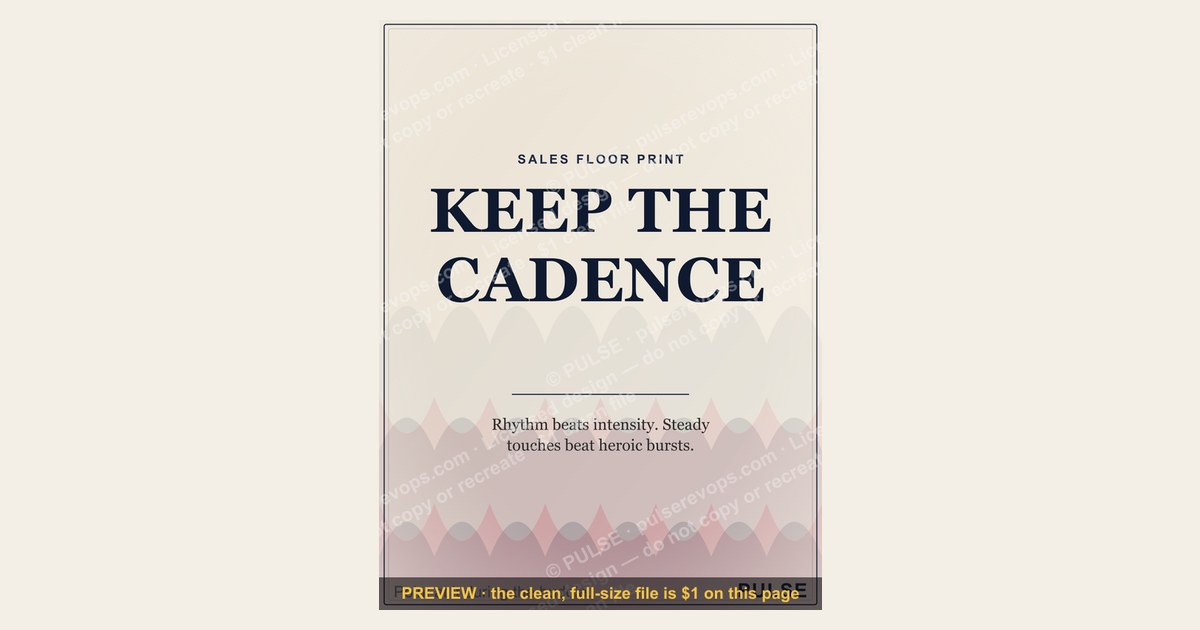
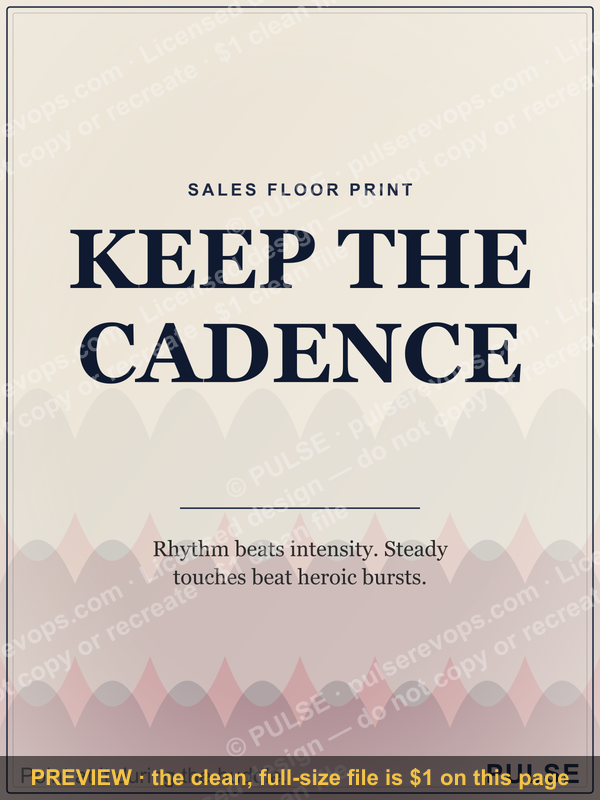
This is a downloadable sales-floor print — a 1200 x 1600 px poster titled "KEEP THE CADENCE" — that you hang where reps actually walk: the Floor, the pod aisle, the wall behind the huddle board. It is a visual commitment device, not a strategy deck. Print it, hang it, and let the phrase do the reminding.
The outcome you should expect
Hang a poster and nothing measurable happens. That is the honest starting point, and it is why so many Sales leaders write off floor Print altogether. A sheet of paper does not change quota attainment, it does not fix a broken pipeline, and it will not rescue a territory that was mis-sized in January. What it can do — reliably, if you place it correctly and tie it to a ritual — is shorten the distance between "we agreed on this" and "we are still doing this in week nine."
The realistic outcome is a reduction in drift. Cadence decays. A team starts a quarter with a Monday pipeline review, a Wednesday deal desk, and a Friday forecast commit. By week six the Monday review has slipped to Tuesday, the deal desk has become an email thread, and the Friday commit is a Slack message at 4:55 pm. Nobody decided to abandon the CADENCE. It eroded, one reasonable exception at a time. A poster on the wall is a low-cost, always-on counterweight to that erosion. It does not enforce anything. It makes the standard visible at the exact moment someone is deciding whether to skip.
Second expected outcome: it gives managers a shared vocabulary that costs nothing to invoke. "Where are we on cadence?" is a softer, faster opening than "you missed the review again." A physical artifact in the room makes the standard feel like the team's property rather than the manager's preference. That shift — from personal rule to shared norm — is where the real behavioral leverage sits, and it is the reason the print is worth the wall space.

Third: it survives turnover. A new hire walking the Floor in their second week absorbs the standard without a meeting. Onboarding decks get skimmed. A poster at eye level gets read forty times.
What you should not expect is attribution. You will never be able to prove the poster moved a number. Treat it as infrastructure, like a whiteboard or a standing desk — cheap, ambient, and useful only in combination with something else.
What drives that outcome
Four levers determine whether the print does anything at all.
Placement. A poster in a conference room nobody uses is decoration. A poster at the threshold of the Sales Floor — where reps physically enter in the morning — gets seen. The highest-performing placement in most offices is directly adjacent to the huddle board or the TV showing the dashboard, because that is where attention already goes. Second best: the wall behind the desks of the SDR pod, since that is where the highest-frequency, lowest-tenure population sits.

Ritual linkage. The print needs a recurring moment attached to it. If the Monday standup happens in front of it, the phrase becomes the frame for the meeting. If the print hangs in a hallway and the standup happens in a different room, the two never connect and the poster fades into the background within three weeks.
Wording specificity. "KEEP THE CADENCE" works because it is imperative and short. Generic posters — "TEAMWORK," "EXCELLENCE," "WIN" — get tuned out because they carry no operational instruction. Cadence is a real thing a Sales team does. The phrase points at a behavior, not a virtue.
Manager modeling. If the manager shows up late to the cadence review, the poster becomes ironic. The artifact amplifies whatever the leadership behavior already is. It cannot manufacture a standard that leadership does not hold.

The diagram is not a guarantee — it is a decision tree. Most failed posters fail at the first or second gate, not the third. Placement and ritual linkage are the two variables you control for free.
Benchmarks and realistic ranges
There is no published study on sales-floor poster efficacy, and anyone quoting a percentage is making it up. What follows are practitioner-observable ranges, offered as sanity checks rather than claims.
Time to invisibility without a ritual: two to four weeks. This is the single most reliable pattern. A poster with no attached meeting or review becomes visual furniture inside a month. Reps stop seeing it. If you want a longer half-life, the ritual is not optional.
Time to invisibility with a ritual: one to two quarters. Even anchored posters lose salience. The standard fix is rotation — swap the print each quarter, or move it to a different wall, or update the sub-line. Novelty resets attention. A poster that has been in the same spot for a year is doing roughly nothing.
Print size for a pod wall: 18 x 24 inches (roughly A2). This is readable from eight to ten feet, which covers the standing distance in most pod aisles. For a larger open floor or a wall you want visible from across the room, go to 24 x 36 inches. Below 11 x 17 inches, the print reads as a personal reminder, not a team standard — which is a different (and legitimate) use case, but not this one.
Viewing distance rule of thumb: one inch of poster height per foot of viewing distance, minimum. A 24-inch-tall poster holds up to roughly 24 feet. Beyond that, the headline stops resolving and the poster becomes a colored rectangle.
Paper and finish. Matte or satin, 200-250 gsm, is the practical default. Gloss reflects overhead lighting and makes the print unreadable from the angles people actually stand at. If the wall gets direct sun, choose a UV-resistant stock or accept that the colors will shift within a year. Foam board or a thin aluminum panel costs more but eliminates the curling that plagues rolled paper in humid offices.
Cost range. A single 18 x 24 print on decent stock runs a few dollars to roughly twenty depending on the print shop and finish. Foam-mounted versions run higher. Lamination adds a few dollars and roughly doubles the lifespan in a high-touch environment. This is not a budget decision — it is a "will you actually print it" decision.
Refresh cadence. Plan to reprint or rotate every quarter. Budget for four prints a year per location if you want sustained attention. That is a trivially small line item compared to almost anything else in a Sales org's tooling spend, which is precisely the argument for doing it.
Where it underperforms. Fully remote teams. A poster has no audience if nobody walks past it. For distributed teams, the digital equivalent — a pinned banner in the team channel, a recurring calendar hold titled with the cadence, a slide in the weekly deck — does the same job with different mechanics. Do not print posters for an office that averages two people a day.
Risks, edge cases, and failure modes
The ironic poster. The most damaging failure mode. A "KEEP THE CADENCE" print hanging above a team whose manager cancels the weekly review is worse than no poster at all. It converts a neutral wall into a daily reminder that the stated standard is not real. Before you print, audit whether the cadence the poster names is actually being held by leadership. If it is not, fix that first. The poster is the last step, not the first.
The virtue-signal wall. If the Floor already has six motivational prints, adding a seventh produces nothing. Attention is a fixed budget. A new poster competes with the existing ones and typically loses. The fix is subtraction: take down two generic prints, put up one specific one. Fewer, sharper artifacts beat a wall of slogans every time.
The jargon trap. "Cadence" is insider vocabulary. It lands with tenured Sales reps and Sales managers. It lands poorly with new hires in week one, with adjacent functions like marketing or customer success who may share the Floor, and with anyone visiting from finance. If your Floor is mixed-population, either add a plain-language sub-line ("the weekly rhythm we run on") or accept that the poster speaks to a subset of the room.
Cultural mismatch. In some Sales cultures an imperative poster reads as motivating. In others it reads as a manager talking down. This is not predictable from the outside — it depends on whether the team already has a self-deprecating, high-trust tone or a tense one. If the team is tense, the poster will be read as pressure. Test with one manager before rolling out floor-wide.
The compliance misread. A poster is not a policy. If you find yourself pointing at it in a performance conversation as evidence of an expectation, you have crossed a line the artifact cannot support. Expectations belong in the written cadence doc, the onboarding plan, and the one-on-one. The poster is ambient reinforcement, and treating it as documentation creates avoidable HR exposure.
The "printed once, never revisited" decay. Posters that stay up for years become part of the architecture. Nobody reads the fire exit signs either. If you are not going to rotate it, do not bother hanging it — the marginal value of the first three months does not justify a permanent wall fixture that has stopped working.
Edge case: shared floors. If two teams share a Floor and only one runs on the cadence the poster names, the poster creates a quiet in-group/out-group signal. This is usually manageable — most shared floors have visible team boundaries — but it is worth a thought before you hang it in a neutral zone.
A practical rollout plan
The rollout is small enough to do in a week. The sequence matters more than the speed.
Step one — confirm the cadence is real. Write down, in one sentence, the recurring rhythm the poster will reference. "Monday pipeline review at 9am, Wednesday deal desk at 2pm, Friday commit by 4pm" is a cadence. "We meet sometimes" is not. If you cannot write the sentence, the poster has nothing to point at and should wait.
Step two — pick the wall. Walk the Floor at 8:45 am and again at 1:30 pm. Note where people actually pass and where they actually stop. The poster goes at the intersection of those two — usually near the huddle board, the coffee point, or the entrance. Not the conference room. Not the hallway to the bathroom.
Step three — decide the size and paper. For a pod wall, 18 x 24 on 200 gsm matte with lamination. For a large open floor, 24 x 36. Order two — one to hang, one spare for when the first gets scuffed or you need to re-hang after an office move.
Step four — anchor a ritual to it. The simplest version: move the Monday standup so it happens in front of the poster. Now the phrase is in the room when the cadence is being discussed. No extra meeting, no extra time, just a location change.
Step five — brief the managers, not the reps. Managers are the ones who will reference the poster in conversation. Give them one sentence: "If the cadence slips, point at the wall, not at the person." That is the whole playbook.
Step six — set a rotation reminder. Ninety days out, calendar a task to reprint with a new sub-line, move it to a different wall, or take it down. The rotation is what keeps it alive.
Step seven — measure nothing, or measure the cadence itself. Do not try to attribute anything to the poster. Instead, track whether the cadence reviews actually happened, on time, at the expected frequency. That is the outcome the poster is nominally supporting, and it is measurable without any poster-specific instrumentation.
The last branch is the one most teams skip. A poster that has stopped working should come down. Leaving it up trains people to ignore the next one.
Related questions
What is on the graphic, element by element?
The print carries a headline reading "KEEP THE CADENCE" in a heavy sans or slab face, sized to dominate the sheet. Beneath it sits a smaller sub-line you can customize — typically the actual rhythm, e.g. "Mon 9am Pipeline · Wed 2pm Deal Desk · Fri 4pm Commit." A footer strip carries the team name or quarter. Colors are high-contrast, two or three at most.
Where should I hang it on the Sales Floor?
At a traffic threshold — the entrance to the pod, the wall beside the huddle board, or the spot where the morning standup already gathers. Not the conference room, not a hallway nobody uses. If reps do not walk past it twice a day, it will not work.
What size and paper should I print it at?
18 x 24 inches on 200-250 gsm matte or satin stock for a pod wall; 24 x 36 inches for a large open floor. Add lamination in high-touch areas. Avoid gloss — overhead lights make it unreadable from standing angles.
When does this poster backfire?
When leadership does not actually hold the cadence it names. The print then becomes a daily reminder that the stated standard is fiction, which is worse than a blank wall. Audit the cadence before you print.
How often should I rotate or reprint it?
Every quarter. Attention resets with novelty. Swap the sub-line, move it to a different wall, or replace it entirely. A poster that has hung unchanged for a year is visual furniture.
FAQ
Does a sales-floor poster actually change rep behavior? Not on its own. It works as ambient reinforcement when three conditions hold: it is placed where reps walk, a recurring meeting happens in front of it, and managers model the cadence it names. Remove any one and the effect drops to roughly zero. Treat it as infrastructure, not a campaign.
Can I use this print for a remote or hybrid team? A physical poster has no audience if nobody walks past it. For distributed teams, use the digital equivalent: a pinned banner in the team channel, a calendar hold literally titled with the cadence, and a recurring slide in the weekly deck. Same function, different medium.
What if my team does not use the word "cadence"? Then either teach the word or change the poster. "Cadence" is insider Sales vocabulary that lands with tenured reps and lands poorly with new hires and cross-functional neighbors. If your Floor is mixed-population, add a plain-language sub-line or pick a different headline.
Is this the same as a quota poster or a leaderboard? No. Quota posters and leaderboards are about outcomes — numbers, rankings, attainment. This print is about process rhythm — the recurring meetings and checkpoints that produce the outcomes. They serve different purposes and can coexist, but they should not be confused.
How do I customize the wording for my team? Keep the headline if it resonates; change the sub-line to your actual rhythm. The sub-line is where specificity lives — name the days, times, and meeting types. If you want role-specific versions, print one per pod with that pod's rhythm. Colors should match your brand or your team's existing visual language.
Will this work in a non-Sales context? The mechanic generalizes — any team with a recurring operating rhythm can use a visible print to reinforce it. Engineering teams with sprint ceremonies, customer success teams with QBR cycles, and support teams with shift handoffs all run cadences. The wording "KEEP THE CADENCE" is Sales-flavored but not Sales-exclusive.
Sources
- Harvard Business Review — The Power of Small Wins
- Harvard Business Review — The Feedback Fallacy
- MIT Sloan Management Review — Why Sales Teams Underperform
- Salesforce — State of Sales Report
- Gartner — Sales Research and Insights
- McKinsey — The B2B Sales Benchmark Research
- Atlassian — Team Rituals and Working Agreements
- Nielsen Norman Group — Visual Design and Signage Legibility
Related on PULSE
- Sales floor huddle board layouts that actually get used
- Designing a weekly pipeline review that reps do not dread
- Onboarding artifacts for new SDRs: what belongs on the wall
- Turning a recurring meeting into a ritual people show up for
- Print vs. digital signage for distributed revenue teams
- Building a manager playbook for cadence enforcement
This page will be disappearing soon. Save it to your device for $1 — or read it free while it is here.
@Kory-White- · if Venmo asks, the last 4 of my number are 2012
This page is gone.
This one is off the shelf now. $1 keeps it on your phone for good — the whole page, pictures and diagrams included.
 graphic“BRING THE ENERGY” — Sales Floor Print
 graphic“FILL THE FUNNEL” — Sales Floor Print
 graphic“Always Be Closing” — Sales Floor Poster
 graphic“QUOTA IS A FLOOR” — Sales Floor Print
 graphic“NEXT CALL WINS” — Sales Floor Print
 graphic“EARN EVERY YES” — Sales Floor Print
 graphicActivity to Revenue — Motivational Print
 graphic“FOLLOW UP AGAIN” — Sales Floor Print
 graphic“CHASE THE NO” — Sales Floor Print
 graphic“OWN THE NUMBER” — Sales Floor Print