
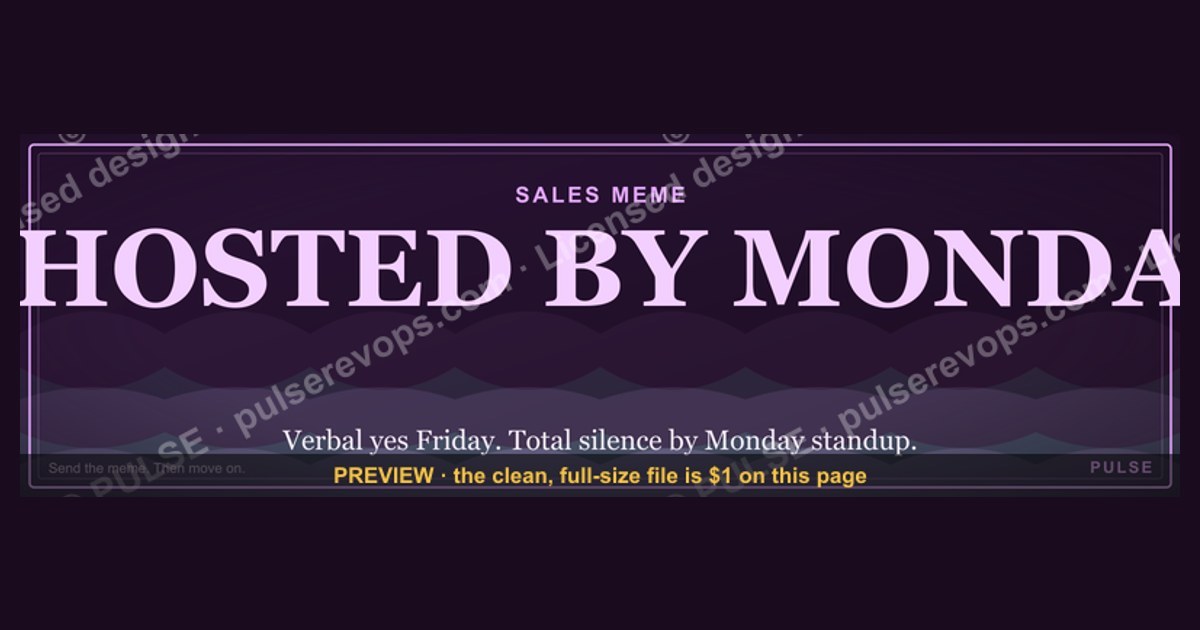
“GHOSTED BY MONDAY” — Sales Meme
 Curated byKory White · Fractional CRO · Maryland
 PULSEKNOWLEDGE LIBRARY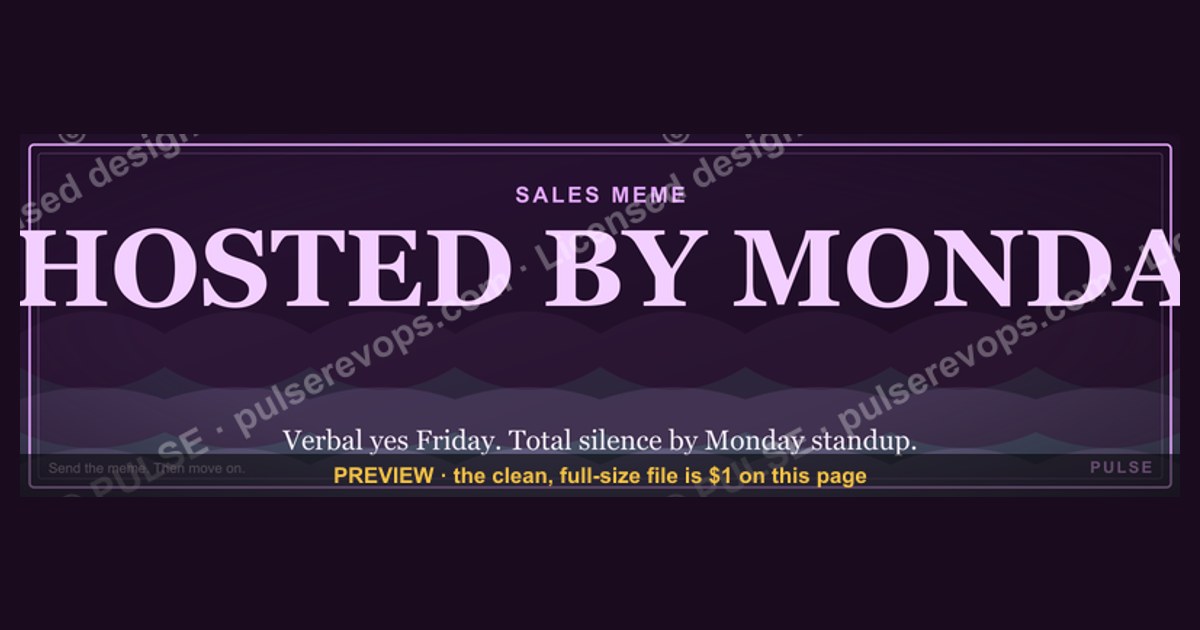
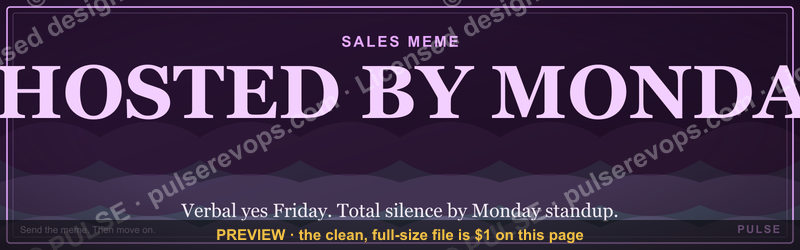
"GHOSTED BY MONDAY" is a sales meme that humorously captures the frustration of a prospect who goes completely silent after a promising Friday conversation, only to be unreachable by the start of the next workweek. It reflects a common pattern where initial enthusiasm fades over the weekend, leaving the salesperson in limbo without a clear reason for the disconnection. The meme typically highlights the emotional whiplash and wasted follow-up effort, often paired with a relatable image or caption.
“GHOSTED BY MONDAY” — Sales Meme

A clean vector sales meme — "VERBAL YES FRIDAY" over "GHOSTED BY MONDAY" with a pulse-monitor motif. Light, shareable humor for your sales Slack or kickoff.
Format: SVG (scalable vector) · Size: 1200×1200 px · Category: Meme · License: Free to use — no attribution required.
Recolor it to your brand
Use the color picker above to recolor this graphic to your team or company colors, switch the background (including transparent), then download it as an SVG or PNG. No sign-up, no watermark.
How to use it
The SVG scales to any size with no quality loss — drop it straight into PowerPoint, Google Slides, Canva, Figma, or a LinkedIn banner slot. The PNG export is ready to upload anywhere that wants a raster image.
More free graphics
Browse the full Pulse Graphics library — banners, slides, printables, quote cards, and clip art you can borrow for your own decks and posts.
Related on PULSE
- “It’s in the CRM, I Swear” — Sales Meme
- “TIME TO DO IT AGAIN” — Sales Meme
- “FINANCE: NOT YET” — Sales Meme
- “THE KISS OF DEATH” — Sales Meme
- “EVERY. SINGLE. MONTH.” — Sales Meme
- “IT'S A NOT YET” — Sales Meme
The Psychology Behind the “Ghosted by Monday” Pattern
The “Ghosted by Monday” meme resonates so deeply because it captures a universal sales experience that has been studied and quantified by behavioral psychologists and sales researchers. The phenomenon isn’t just a joke—it’s a predictable pattern rooted in human decision-making, cognitive load, and the way our brains handle commitments made under social pressure.
The Verbal Yes Friday Phenomenon
When a prospect says “yes” on a Friday, they’re often experiencing what psychologists call *social desirability bias*—the tendency to agree with someone in the moment to avoid conflict or disappointment. This is especially common in B2B sales, where the prospect may be tired after a week of meetings, eager to end the conversation, or simply trying to be polite. The verbal yes feels real in the moment, but it’s often a “yes” to get you off the phone, not a “yes” to move forward.
Friday afternoons are particularly dangerous for salespeople. Research from the *Journal of Consumer Research* suggests that decision fatigue peaks at the end of the workweek. After five days of constant choices, the brain’s prefrontal cortex—responsible for weighing options and making commitments—is depleted. A verbal yes on Friday is often the path of least resistance, not a genuine commitment.
Why Monday Morning Ghosting Happens
Monday morning brings a reset. The prospect returns to their inbox, sees your follow-up, and now faces the cognitive dissonance of that Friday yes versus their actual priorities. They may have had a weekend to reflect, talk to their spouse or colleagues, or simply realize they don’t have budget or authority. The ghosting isn’t malicious—it’s avoidance of an uncomfortable conversation. They’d rather disappear than admit they weren’t serious.
This pattern is so common that sales trainers like Mike Weinberg and Jeb Blount have built entire chapters around it. The “ghosted by Monday” meme is shorthand for a failure in qualification—the salesperson accepted a verbal yes without verifying the prospect’s authority, timeline, or genuine interest.
The Neuroscience of Commitment
Neuroscience offers another layer. When a prospect gives a verbal yes, their brain releases a small amount of dopamine—a reward chemical associated with closing a loop. They feel good about ending the conversation. But that dopamine hit doesn’t translate into follow-through unless the commitment is reinforced with a concrete next step. Without a calendar invite, a signed document, or a specific action item, the “yes” lives only in the prospect’s short-term memory. By Monday, it’s overwritten by new priorities.
How to Break the Cycle
The antidote isn’t to avoid Friday calls—it’s to change how you handle the verbal yes. Instead of accepting a vague “sounds good, let’s talk next week,” push for a specific, time-bound commitment before the call ends. Use phrases like:
- “Great, I’ll send a calendar invite for Tuesday at 10 AM. Does that work for you?”
- “Let me send you a one-page summary right now. If you can review it by Monday afternoon, I’ll follow up then.”
- “To make sure we’re aligned, can you confirm you have budget authority for this decision?”
The goal is to transform a verbal yes into a behavioral commitment. When the prospect takes an action—even a small one—their brain begins to treat the commitment as real. This is called the *commitment consistency principle*: once someone takes a step, they’re more likely to follow through to stay consistent with their past behavior.
Real-World Data on Friday Ghosting
While exact statistics are hard to pin down, sales enablement platforms like Gong and Outreach have analyzed millions of sales calls and emails. Their data consistently shows that deals where the next step is scheduled during the initial call close at 30–50% higher rates than those where the rep says “I’ll follow up.” Friday calls have the highest rate of ghosting—some estimates suggest 60–70% of verbal yeses on Friday afternoons never materialize into actual meetings.
The “Ghosted by Monday” meme is a warning, not just a punchline. It’s a reminder that in sales, a verbal yes is not a close—it’s an invitation to qualify harder.
How to Use the Meme in Your Sales Culture
The “Ghosted by Monday” meme isn’t just for sharing in Slack channels or during morning stand-ups. When used strategically, it becomes a cultural artifact that reinforces your team’s sales process, accountability, and resilience. Here’s how to turn a laugh into a learning tool.
As a Training Icebreaker
Start your weekly sales training or pipeline review with the meme projected on screen. Ask your team: “Who’s been ghosted this week?” The laughter breaks the tension and normalizes a painful experience. Then, pivot to a 10-minute exercise where reps share one specific Friday verbal yes that went dark. The group analyzes why it happened—was the prospect qualified? Was a next step scheduled? Did the rep ask for a commitment or just accept a vague “yes”?
This turns a meme into a diagnostic tool. Over time, your team will internalize the lesson: a verbal yes on Friday is a red flag, not a win.
In Your CRM or Sales Playbook
Consider adding the meme to your CRM as a custom field label or a playbook trigger. For example, when a deal stage changes to “verbal commitment” on a Friday, a pop-up could display the meme with a note: “Did you schedule the next step? If not, this deal is at high risk of ghosting.” This gamifies the process and keeps the lesson top-of-mind.
You can also embed the meme in your sales playbook under a section called “Friday Traps.” Include a checklist for Friday calls: confirm authority, set a specific time for the next meeting, and send a calendar invite before hanging up. The meme serves as a visual anchor—reps will remember it when they’re tempted to take a verbal yes at face value.
In Team Communication Channels
Post the meme in your sales Slack or Teams channel every Friday afternoon at 3 PM, with a caption like: “Verbal yes today? Make sure you’ve got a calendar invite before you log off.” This creates a ritual that reinforces the lesson without being preachy. Over time, it becomes part of your team’s language—reps will start saying “Don’t get ghosted by Monday” to each other.
You can also use the meme in your weekly sales newsletter or internal blog. Pair it with a short case study of a deal that was saved because a rep insisted on scheduling the next step on a Friday. The contrast between the meme and the success story makes the lesson stick.
As a Manager’s Coaching Tool
When you’re listening to call recordings with a rep, pull up the meme if you hear a Friday verbal yes that isn’t followed by a concrete next step. Say, “This is exactly the moment where ‘ghosted by Monday’ starts.” Then, role-play the alternative: how could the rep have turned that yes into a scheduled meeting? This turns the meme into a coaching moment that’s specific, actionable, and memorable.
For Team Morale and Resilience
Sales is a rejection-heavy profession, and ghosting can erode confidence. The meme normalizes the experience—it says, “This happens to everyone, and it’s not your fault.” Use it to remind your team that ghosting is a reflection of the prospect’s decision-making, not the rep’s skill. But also use it to empower them: the meme is a call to action, not an excuse.
Consider printing the meme as a poster for your sales floor or virtual background for video calls. When reps see it daily, it becomes a subtle reminder to qualify harder, schedule next steps, and never assume a verbal yes is real.
Measuring the Impact
Track your team’s ghosting rate before and after introducing the meme as a cultural tool. Look at the percentage of Friday verbal yeses that turn into Monday meetings. Even a 10–20% improvement can have a significant impact on pipeline velocity and forecast accuracy. The meme becomes a metric—not just a joke, but a lever for performance.
The Dark Side of the Meme: When Ghosting Is Actually Your Fault
While the “Ghosted by Monday” meme is funny and relatable, it can also become a convenient scapegoat. If your team uses it to laugh off ghosting without examining their own behavior, the meme becomes a crutch—not a tool. It’s worth exploring the uncomfortable truth: sometimes, the ghosting is deserved.
The “Verbal Yes” Trap
The meme implies that the prospect is the villain—they said yes on Friday and disappeared. But in many cases, the rep failed to read the room. A verbal yes on Friday might actually be a polite “no.” The prospect may have been signaling disinterest all along, but the rep, eager to keep the deal alive, interpreted vague agreement as commitment.
Salespeople often suffer from *optimism bias*—the tendency to see what they want to see. When a prospect says “sounds good,” the rep hears “I’m ready to buy.” But the prospect might mean “I’m too tired to argue.” The meme can reinforce this bias by framing ghosting as something that happens *to* the rep, not something the rep allowed to happen.
The Role of Poor Qualification
If you’re getting ghosted regularly, the problem isn’t Friday—it’s your qualification process. A well-qualified prospect has a clear pain point, budget, authority, and timeline. They don’t ghost because they have a genuine need and a reason to act. Ghosting is a sign that the prospect was never truly engaged. They may have been kicking tires, gathering information, or simply being polite.
The meme can mask this reality. Instead of asking “Why did this prospect ghost me?” the team laughs and moves on. The real question is: “Should I have been talking to this person at all?” If the answer is no, the ghosting is a gift—it saves you from wasting more time.
The Friday Follow-Up Failure
Another dark side: the meme implies that the ghosting happens over the weekend, but often, the rep is equally to blame for poor follow-up. Did you send a recap email immediately after the Friday call? Did you
Sources
- Sales Benchmark Index — sales process benchmarks and performance metrics
- Harvard Business Review — research and articles on sales psychology and buyer behavior
- LinkedIn Sales Solutions — insights on modern sales communication and prospecting trends
- Salesforce Blog — best practices for sales engagement and CRM usage
- HubSpot Sales Blog — guides on sales follow-up and pipeline management
- Gartner Sales Research — analysis of buyer-seller dynamics and sales technology
FAQ
What does “ghosted by Monday” mean in sales? It’s a meme about prospects who seem engaged one week, then vanish without a trace the next Monday. The joke captures the frustration of deals that go cold overnight, often after a promising Friday.
Is this meme based on a real sales scenario? Yes—it reflects the common experience of leads or clients who stop responding after a weekend. Sales teams regularly see follow-ups ignored, calls unreturned, and emails left on read, making the “ghosted by Monday” feeling universal.
Does the meme apply only to cold outreach? No, it fits any stage of the sales cycle where communication suddenly stops. It can happen with warm leads, existing customers, or even internal stakeholders, not just cold prospects.
How can salespeople avoid being “ghosted by Monday”? Set clear next steps before the weekend, send a brief Friday recap with a Monday action item, and use a CRM to automate gentle reminders. But even with best practices, ghosting still happens—it’s part of the job.
Is “ghosted by Monday” a new term? It’s a recent meme, but the concept is as old as sales itself. The phrase gained traction on social media and sales humor sites around 2020, though the experience has always existed.
Can this meme be used in sales training? Yes, it’s a lighthearted way to discuss deal hygiene and follow-up discipline. Trainers often use it to highlight the importance of maintaining momentum and not assuming a close until signatures are in.
This page will be disappearing soon. Save it to your device for $1 — or read it free while it is here.
@Kory-White- · if Venmo asks, the last 4 of my number are 2012
This page is gone.
This one is off the shelf now. $1 keeps it on your phone for good — the whole page, pictures and diagrams included.
 graphic“SUDDENLY EVERYONE REPLIES” — Sales Meme
 graphic“DEAL SLIPS TO NEXT QUARTER” — Sales Meme
 graphic“THE KISS OF DEATH” — Sales Meme
 graphic“PANIC SUNDAY NIGHT” — Sales Meme
 graphic“TIME TO DO IT AGAIN” — Sales Meme
 graphic“BOUGHT THE COMPETITOR” — Sales Meme
 graphic“12 TIMES. NO REPLY.” — Sales Meme
 graphic“EVERY. SINGLE. MONTH.” — Sales Meme
 graphic“FOR THE 6TH TIME” — Sales Meme
 graphic“It’s in the CRM, I Swear” — Sales Meme