
“IT'S A NOT YET” — Sales Meme
 Curated byKory White · Fractional CRO · Maryland
 PULSEKNOWLEDGE LIBRARY
Quality
Certified
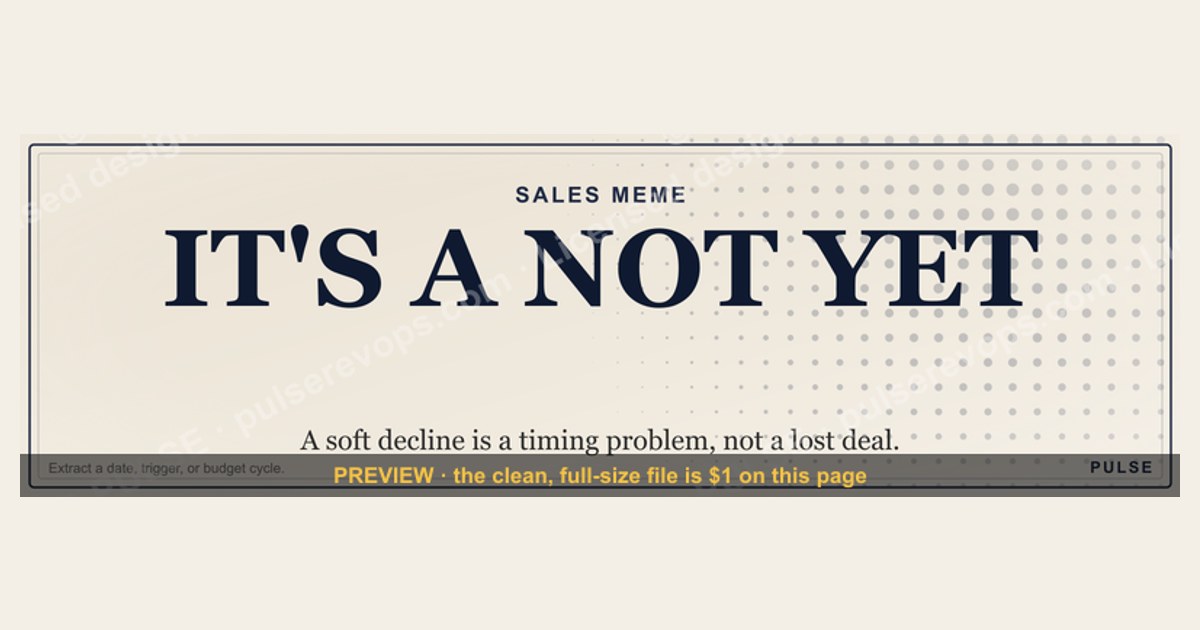
This banner is a 1600×500 pixel graphic that reads "IT'S A NOT YET" in bold display type, designed as a reframing cue for Sales teams who track "not now" prospects as a real pipeline stage instead of a lost deal. It works as a Slack header, CRM stage banner, or team Meme wall image — a visual shorthand that turns a rejection into a follow-up trigger rather than a closed-lost tag.
A scenario where "no" gets recorded as "not yet"
Picture a mid-market account executive closing out a quarter. A prospect who seemed close for six weeks finally replies: budget got frozen, timing is wrong, the champion just took a new role internally. In most CRMs that reply gets logged as Closed Lost, the opportunity disappears from the active pipeline report, and the rep moves on. Three months later a different rep, working the same account cold, reopens the exact conversation from zero — no memory of the earlier interest, no record of what already got discussed, no signal that this was ever warm.
This banner exists for that gap. Teams that print or pin "IT'S A NOT YET" near a rep's desk, in a Slack channel pinned message, or as the header image on a "Nurture" board in the CRM are making a deliberate distinction: a "not yet" is not the same data point as a "never." The graphic's job is to be the thing a rep sees every time they're tempted to write off a stalled conversation, and to prompt one extra action — set a reminder, tag the reason, log the real objection — before the deal gets buried in a Closed Lost report nobody revisits.

The scenario repeats across nearly every B2B sales motion: SaaS renewals pushed to "next fiscal year," enterprise deals stuck behind a reorg, SMB owners who say "check back after the holidays." In each case the underlying interest is real and the timing is the only broken variable. A team that treats every one of those as dead inventory is quietly discarding pipeline it already paid to generate — the prospecting hours, the discovery call, the demo, all sunk into a lead that gets zero further follow-up. The banner is a cheap, visible countermeasure to that specific failure mode: it costs nothing to hang on a wall, but it changes what a rep does in the ten seconds after hearing "not right now."
How the mechanism actually works
The banner is built from three simple visual elements, each carrying specific wording, and each doing a specific job in the reframe.

Element 1 — the headline. The exact text "IT'S A NOT YET" sits center-weighted across the 1600px width, set large enough to read at a glance from across a room or in a shrunk Slack thumbnail. The phrasing deliberately swaps "no" for "not yet" — the grammatical trick is the entire point. It's a rejection stated as a postponed yes.
Element 2 — the color and type treatment. A high-contrast palette (dark background, light bold serif or condensed sans headline) keeps the graphic legible at small sizes, which matters because this asset is meant to survive being resized into a CRM stage icon, a Slack emoji-adjacent header, or a printed desk card, not just viewed full-size once.

Element 3 — the implicit call to action. Unlike a stat-card or chart graphic, this banner carries no data and no bullet list — its entire function is emotional reframing, delivered in one line, meant to be glanced at repeatedly rather than read once and archived.
Mechanically, the value comes from where it's placed and what habit it's tied to, not from the graphic alone:

The loop only works if the "Not Yet" tag connects to an actual CRM field or task, not just a feeling. Teams that hang the banner but never build the corresponding pipeline stage get the emotional lift with none of the pipeline recovery — the graphic becomes decoration instead of a workflow trigger. The teams that get real value wire it to something mechanical: a custom "Not Yet" stage separate from Closed Lost, a required reason code, and an automated reminder task 30, 60, or 90 days out depending on the stated objection.
Numbers, ranges, and realistic benchmarks
There's no single universal statistic for how many "not now" responses eventually convert — it varies enormously by deal size, industry, and sales cycle length — but a few practitioner-level ranges are worth anchoring on when deciding how seriously to treat this bucket.

For a typical B2B sales team, informal pipeline reviews commonly find that a meaningful share of Closed Lost opportunities — often cited anecdotally in the 15-30% range across various sales organizations — were lost specifically to timing or budget rather than to a competitor or a genuine lack of fit. That's the population this banner targets: not the deals that were never a fit, but the ones that were a fit at the wrong moment.
Follow-up cadence matters more than follow-up existence. A single re-touch weeks later rarely reopens a stalled deal; a structured cadence — commonly 3 to 5 touches spread across 30 to 90 days, varying the channel (email, then a short call, then a relevant piece of content) — has a much better shot at catching the prospect when the blocking condition (budget cycle, reorg, competing priority) has actually cleared. Sales teams that build automated "Not Yet" nurture sequences typically set the first re-touch at 30 days for a stated short-term blocker (e.g., "check back next quarter") and stretch to 90 or even 180 days for structural blockers (e.g., "we just signed with someone else for a year," "we're in a hiring freeze").
Team-level adoption also has a rough shape worth knowing before rolling this out: a "Not Yet" stage or tag with no owner and no reporting visibility tends to fill up and never get worked — it becomes a graveyard with better branding. The stage only stays healthy when someone (a rep, a manager, or an SDR doing pipeline hygiene) reviews it on a fixed cadence, commonly weekly for high-velocity SMB pipelines and monthly for longer enterprise cycles, and either advances, re-tags, or genuinely closes each entry.

Trade-offs, alternatives, and where the reframe breaks
The "Not Yet" framing works well when the objection is genuinely about timing — budget cycles, internal reorganizations, seasonal buying patterns, a champion who left and needs replacing. In those cases the deal's fundamentals (fit, need, authority) haven't changed, only the calendar has, and treating it as a live-but-dormant opportunity is accurate.
It backfires when a rep or a manager uses "Not Yet" as a way to avoid saying "this deal is dead." That's the core trade-off: the same reframe that rescues genuinely timing-blocked deals can also inflate a pipeline with zombie opportunities that will never close, making forecast numbers look healthier than reality and wasting future follow-up effort on prospects who used "not now" as a polite way of saying no permanently.

The alternative to this banner's philosophy is a strict two-bucket system: Closed Won or Closed Lost, full stop, with no in-between purgatory stage. That model has real advantages — cleaner forecasting, less rep time spent chasing dead leads, simpler reporting. Teams with very high lead volume and short sales cycles (transactional SMB software, for instance) often prefer the strict model because the cost of re-qualifying a "maybe" lead exceeds the value of occasionally recovering one.
Teams with longer, higher-value sales cycles (enterprise software, capital equipment, multi-year services contracts) tend to benefit more from the "Not Yet" model, because the cost of losing a genuinely-warm six-figure relationship over a bad-timing rejection is much higher than the admin cost of tracking it for another quarter. The right choice depends on deal size and cycle length, not on which framing sounds more optimistic.

A second alternative worth naming: some teams skip the CRM stage entirely and instead route "not yet" responses into a separate lightweight tool — a simple reminder list, a shared spreadsheet, or a marketing nurture list — keeping the core pipeline reporting completely clean while still not losing the lead. This trades some visibility (the deal isn't tracked in the same forecast view) for cleaner sales metrics.
Pitfalls, customization, and specs for using this banner
The most common pitfall is treating the banner as motivation instead of process. Hanging "IT'S A NOT YET" on a wall changes nothing by itself; it only pays off when it's tied to a mandatory CRM action — a required reason code, a scheduled task, an owner. Teams should build the workflow first and use the banner as the reminder of that workflow, not the other way around.

A second pitfall is letting the "Not Yet" bucket become a dumping ground with no expiration. Every entry needs a re-evaluation date; without one, reps stop trusting the stage and start defaulting back to Closed Lost, which defeats the purpose. A simple rule that works for many teams: if a "Not Yet" deal has had no qualifying signal (reply, event, budget change) after two full nurture cycles, it converts automatically to Closed Lost so the pipeline report stays trustworthy.
A third pitfall is applying the Sales Meme literally as customer-facing language. This phrase and graphic are meant for internal team culture and internal pipeline stages — saying "it's a not yet" back to a prospect can read as dismissive or presumptuous. Internally it's a helpful shorthand; externally it needs to be translated into the prospect's own words and specific reason for delay.

Customizing the banner for your own team: the wording, color palette, and even the central phrase are easy to swap. Teams commonly localize it to their own stage names ("This Quarter's Maybe," "Parking Lot," "Warm Bench") while keeping the same 1600×500 landscape ratio so it drops cleanly into the same slots — Slack channel header, CRM custom-field icon, a printed card at a rep's desk. Swapping the headline text only requires re-exporting the same layout with new copy; the supporting color and type treatment can stay identical for visual consistency across a rebrand, or be recolored to match team or company branding.
Specs and download: the banner exports as a 1600×500 pixel PNG, sized for a LinkedIn banner slot, a Slack channel header, or a wide CRM dashboard tile without cropping. At that resolution it also downsizes cleanly to a small icon (roughly 200×63px) for use as a pipeline-stage badge without the headline becoming illegible. To swap it into an existing tool: replace the current header image at the same aspect ratio (3.2:1) to avoid automatic cropping by the host platform, and re-upload; most CRMs and Slack accept direct PNG uploads for these slots with no further conversion needed.
Related questions
Should "not yet" leads count toward quota or pipeline coverage?
Generally no — count them separately from active, quota-bearing pipeline. Mixing them inflates forecast accuracy and hides genuine coverage gaps a manager needs to see clearly each cycle.
How is a "not yet" different from a nurture lead in marketing?
A "not yet" already had a live sales conversation and a specific stated blocker; a marketing nurture lead typically hasn't been sales-qualified yet. The follow-up cadence and messaging should reflect that prior context.
Who should own following up on "not yet" deals — the original rep or someone else?
The original rep, when possible — they carry the relationship context. If territory or role changes intervene, a clean handoff note (objection, timing, next trigger) should travel with the deal.
What's a reasonable time limit before a "not yet" deal should be re-evaluated as lost?
Commonly two full nurture cycles with zero engagement signal, often 60-180 days depending on cycle length, after which it should convert to Closed Lost rather than sit indefinitely.
FAQ
What does "IT'S A NOT YET" mean in a Sales context? It's shorthand for treating a stalled deal as postponed rather than dead — the fit and need are still real, only the timing is wrong, so the deal stays tracked instead of being written off.
Is this banner meant for customers or for the internal team? Internal team culture and internal CRM/Slack use. It's an internal reframing cue, not language meant to be said directly to a prospect.
What size is the downloadable graphic? 1600×500 pixels, a 3.2:1 landscape ratio sized to drop into a LinkedIn banner slot, a Slack channel header, or a wide dashboard tile without cropping.
Can I change the wording or colors? Yes — the layout, palette, and headline text are all easy to customize to your own team's stage names or brand colors while keeping the same aspect ratio.
Does using this framing hurt forecast accuracy? Only if "Not Yet" deals are left untracked with no expiration date. Paired with a required re-evaluation cadence, it improves accuracy by separating true losses from timing delays.
Where should I actually place this graphic for it to matter? Anywhere a rep makes the "log this as lost" decision in real time — a CRM stage icon, a Slack pipeline-review channel header, or a printed card near the desk — not just a general team-culture wall.
Sources
- https://blog.hubspot.com/sales
- https://www.salesforce.com/resources/
- https://hbr.org/topic/subject/sales
- https://www.gong.io/blog/
- https://blog.close.com/
- https://www.gartner.com/en/sales
- https://www.linkedin.com/business/sales/blog
- https://www.rainsalestraining.com/blog
Related on PULSE
- How to build a "Not Yet" pipeline stage in your CRM
- Nurture cadences for stalled enterprise deals
- Closed Lost reason codes worth tracking
- Slack channel setups for sales team culture
- When to walk away from a stalled deal for good
This page will be disappearing soon. Save it to your device for $1 — or read it free while it is here.
@Kory-White- · if Venmo asks, the last 4 of my number are 2012
This page is gone.
This one is off the shelf now. $1 keeps it on your phone for good — the whole page, pictures and diagrams included.
 graphic“FREE CONSULTING SESSION” — Sales Meme
 graphic“SHOULD DO IT” — Sales Meme
 graphic“...AFTER THE DEAL CLOSES” — Sales Meme
 graphic“12 TIMES. NO REPLY.” — Sales Meme
 graphic“TIME TO DO IT AGAIN” — Sales Meme
 graphic“PANIC SUNDAY NIGHT” — Sales Meme
 graphic“FOR THE 6TH TIME” — Sales Meme
 graphic“THE KISS OF DEATH” — Sales Meme
 graphic“SUDDENLY EVERYONE REPLIES” — Sales Meme
 graphic“EVERY. SINGLE. MONTH.” — Sales Meme