
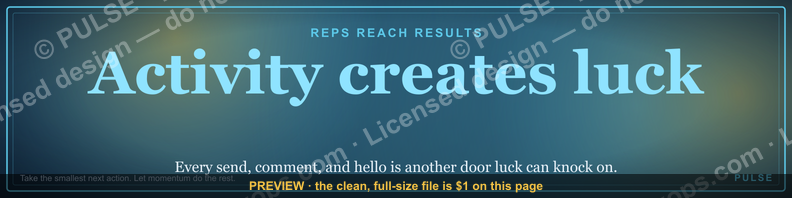
“Activity creates luck.” — LinkedIn Banner
 Curated byKory White · Fractional CRO · Maryland
 PULSEKNOWLEDGE LIBRARY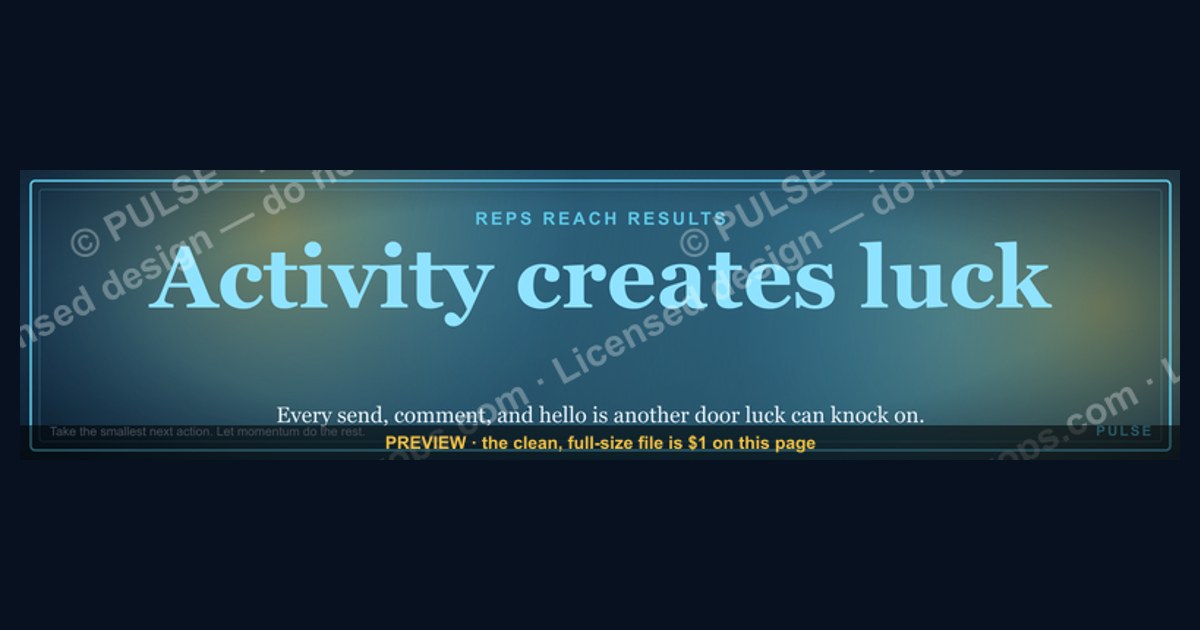
"Activity creates luck" means that fortunate outcomes are far more likely to find people who are consistently in motion than people who are waiting for the right moment. The logic is straightforward: every email you send, post you comment on, application you submit, or conversation you start is one more point of contact with the outside world—and opportunity can only reach you through those contacts. You can't control whether any single action pays off, but you can control how many chances you create. Used most often in sales, job searching, and business development, the phrase reframes luck as a numbers-and-exposure problem you can actually influence, rather than a force you have to hope for. The practical instruction it carries is simple: when you're stuck, don't wait to feel ready—take the smallest next action and let momentum do the rest.
“Activity creates luck.” — LinkedIn Banner

A dark, on-brand LinkedIn banner — "Activity creates luck." over a "Reps Reach Results" line with a pulse motif. Put it on your profile to signal exactly what you do.
Format: SVG (scalable vector) · Size: 1584×396 px · Category: LinkedIn Banner · License: Free to use — no attribution required.
Recolor it to your brand
Use the color picker above to recolor this banner to your team or company colors, switch the background (including transparent), then download it as an SVG or PNG. No sign-up, no watermark.

How to use it
It scales cleanly to the LinkedIn cover slot (1584×396) — download the PNG and drop it straight onto your profile, or open the SVG in Canva, PowerPoint, or Figma to add your name and tweak the layout.
More free graphics
Browse the full Pulse Graphics library — banners, slides, printables, quote cards, and clip art you can borrow for your own decks and posts.

Related on PULSE
- “Activity creates luck.” — Quote Card
- "Activity creates luck." — LinkedIn Banner
- Motion creates momentum. — LinkedIn Wallpaper
- “Motion creates momentum.” — LinkedIn Banner
- Activity to Revenue — Motivational Print
- “ACTIVITY PIPELINE REVENUE” — Sales Floor Print
Why Action Comes Before Motivation
There's a common assumption that you need to feel motivated, inspired, or "ready" before you act. In practice, the order is usually reversed: action tends to produce motivation, not the other way around. Behavioral psychologists describe this as a feedback loop—completing even a small task gives you a sense of progress, and that sense of progress makes the next step feel easier. Waiting for the perfect moment keeps you in planning mode, where ideas multiply but nothing gets the reinforcement that only comes from doing.
This is why getting started matters more than getting it perfect. When you're idle, opportunities stay invisible because you're not in any position to notice or receive them. When you're in motion, you start spotting patterns, openings, and follow-ups you'd otherwise miss—a salesperson who makes one extra call a day gets faster at reading buying signals; a writer who drafts 200 words a day generates ideas more fluidly. The "luck" isn't random. It's the predictable result of staying engaged long enough to be in the room when something happens.
The practical takeaway is simple: if you're stuck, don't try to think your way out—move. Send the email. Make the introduction. Write the first sentence. Motivation will catch up. The most consistent performers often describe their routines as boring precisely because they've stopped waiting for lightning to strike and started treating action like a muscle that gets stronger with every rep.
The Serendipity Engine: How Small Actions Compound
"Activity creates luck" is sometimes misread as a call to hustle blindly. It's better understood as a description of how serendipity actually works—as the predictable intersection of preparation, visibility, and randomness. Activity is what drives all three.
Consider the idea of "weak ties," from sociologist Mark Granovetter's 1973 paper *The Strength of Weak Ties*. Granovetter found that most new job opportunities come not from close friends and family, but from acquaintances—people you know only casually. The reason is structural: your inner circle tends to share the same information and the same opportunities you already have. Weak ties connect you to different industries, circles, and perspectives. Every conference you attend, post you comment on, or message you send adds weak ties to your network, and each one is a potential bridge to information you couldn't have reached on your own.
It's not only about quantity—it's about exposure. Developer and writer Jason Roberts captured this with the phrase "luck surface area": the more projects you start, articles you publish, and conversations you initiate, the larger the surface you present for chance to land on. Most of those contacts lead nowhere. A small fraction lead somewhere you never could have planned: a referral, a collaboration, a piece of advice that changes your direction.
The power is in the compounding, and a simple thought experiment shows why. Imagine each action carries a roughly 1% chance of producing a meaningful opportunity. At 10 actions a week, you'd expect about one opportunity every ten weeks. Raise that to 50 actions a week and you'd expect one every two weeks—roughly 26 a year instead of 5. The exact percentages are illustrative, not measured, but the shape is real: more activity means more chances for serendipity, which is why high-output people so often look "lucky" from the outside.
You can see the pattern in everyday stories. Someone leaves a thoughtful two-sentence comment on a LinkedIn post about CRM integration—thirty seconds of effort. A reader notices, sends a DM, books a call, and months later that thread has become a signed contract. A designer shares a free template they made in their spare time; a brand manager spots it and reaches out about ongoing work. Neither outcome was planned, and neither was magic. They were the natural result of being visible and in motion. The takeaway is to stop treating activity purely as a means to a specific end and start treating it as a way to widen your surface area—each action a low-cost bet with asymmetric upside.
The Practical Playbook: Building Your Personal Luck System
Understanding the principle is one thing; running it as a system is another. Here's a three-part playbook you can adapt to almost any goal.
Part 1: The Minimum Viable Action (MVA)
The biggest barrier to activity is inertia. To beat it, define your minimum viable action—the smallest step toward your goal that requires almost no willpower. For a salesperson, that might be one follow-up email. For a writer, one sentence. For a job seeker, one application. The MVA should be easy enough to do on your worst day. Its job isn't to produce a result; it's to break the seal of inaction. Borrowing the idea of "activation energy" from chemistry, the first action is the hardest—once it's done, the next one takes far less effort.
Part 2: The 3-3-3 Rule for Consistent Output
To sustain activity over time, try a simple daily structure: three actions tied directly to your primary goal, three that expand your network or knowledge, and three that are purely experimental. The direct actions are your MVAs—the things that move the needle. The network actions widen your surface area: comment on a post, message a stranger thoughtfully, join a virtual meetup. The experimental actions invite serendipity: try a new tool, write about something outside your lane, reach out to someone in a different industry. That last category matters most, because it deliberately injects randomness—and you can't predict where luck will come from, so you cast a wide net.
Part 3: The Weekly Luck Audit
Activity without reflection is just noise. Once a week, spend fifteen minutes reviewing what you did and what came of it. Which actions led to unexpected openings? Which felt like dead ends? Are there patterns in the good outcomes? This serves two purposes. First, it sharpens your strategy—if commenting on posts keeps starting conversations, you double down. Second, it trains you to recognize luck when it shows up. People too often dismiss serendipitous moments as random. Writing down the chain—comment led to DM, DM led to call, call led to deal—makes the cause visible and the behavior repeatable.
One caution: don't over-optimize. The goal isn't to eliminate randomness; it's to work with it. Treat your activity system like a garden. You can't force a plant to grow, but you can prepare the soil, water it regularly, and pull the weeds. The unexpected bloom comes in its own time. The job is to keep tending the garden even when nothing seems to be happening—and to measure success by inputs (actions taken) rather than outcomes (deals closed), since inputs are the only part you fully control while results catch up.
Sources
- Mark Granovetter, "The Strength of Weak Ties," *American Journal of Sociology*, Vol. 78, No. 6 (1973) — foundational research showing that most new opportunities arrive through acquaintances rather than close contacts.
- Richard Wiseman, *The Luck Factor* (Miramax, 2003) — a psychologist's multi-year study finding that people who consider themselves "lucky" are more open to chance and act on more opportunities.
- Jason Roberts, "How to Increase Your Luck Surface Area" (jasonroberts.net, 2010) — the essay that coined the "luck surface area" framing used above.
- James Clear, *Atomic Habits* (Avery, 2018) — on activation energy and how small, repeatable actions compound over time.
- BJ Fogg, *Tiny Habits* (Houghton Mifflin Harcourt, 2019) — the Stanford behavior researcher's case for starting with the smallest possible action.
- Harvard Business Review — ongoing coverage of networking, career development, and how professionals create their own opportunities.
FAQ
What does “Activity creates luck” mean? It means consistent, intentional effort raises the odds of good things happening. Luck here isn't random fortune—it's the byproduct of staying visible, taking action, and being in enough conversations that opportunity can find you.
How can I apply this to my career? Take one small, real action every day—send a thoughtful message, share an insight, start a project, or follow up on a lead. None of these guarantees a result, but over weeks and months they compound into openings that look, from the outside, like luck.
Does this apply to job searching? Yes, and it's one of the clearest examples. Instead of waiting for the perfect role to appear, apply to a realistic range of positions, reconnect with old colleagues, and follow up. Research on weak ties shows acquaintances—not close friends—surface most new roles, so widening your circle of contacts directly widens your options.
Is this just about working harder? No. It's about working consistently and a little more broadly than feels comfortable. Activity includes learning, experimenting, and reflecting—not just grinding out volume. Ten focused, varied actions beat a hundred identical ones, because variety is what exposes you to chances you couldn't have predicted.
How long until I see results? It varies—some people see shifts in weeks, others in months—because you're playing a probability game, not following a schedule. The point is to keep adjusting based on what's actually working rather than expecting a payoff from any single action.
Can this backfire if I'm too active? It can, if "active" turns into spamming people or chasing every direction at once. Quality and genuine intent matter more than raw volume—targeted, thoughtful activity builds a reputation, while scattered busywork burns it. Pair steady action with focus and patience.
This page will be disappearing soon. Save it to your device for $1 — or read it free while it is here.
@Kory-White- · if Venmo asks, the last 4 of my number are 2012
This page is gone.
This one is off the shelf now. $1 keeps it on your phone for good — the whole page, pictures and diagrams included.
 graphicMake it predictable. — LinkedIn Wallpaper
 graphic“Great reps are coached, not born.” — LinkedIn Banner
 graphic“Stay in the deal.” — LinkedIn Banner
 graphicField Sales Rep — LinkedIn Banner
 graphicHow do you build a Champions sell motion from scratch in 2027?
 graphicInspect. Qualify. Commit. — LinkedIn Wallpaper
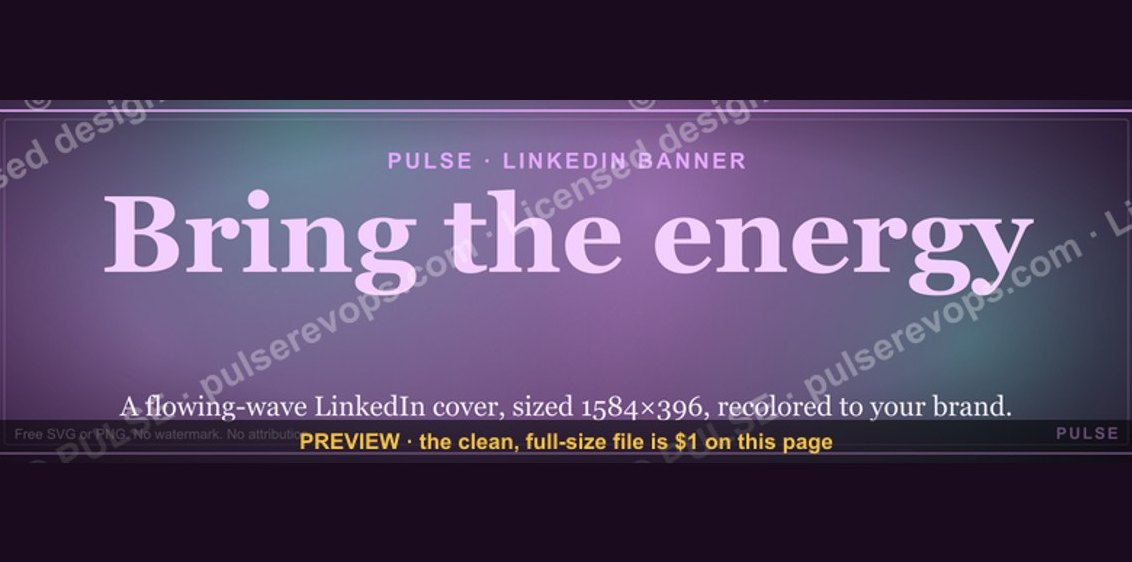 graphicBring the energy. — LinkedIn Wallpaper
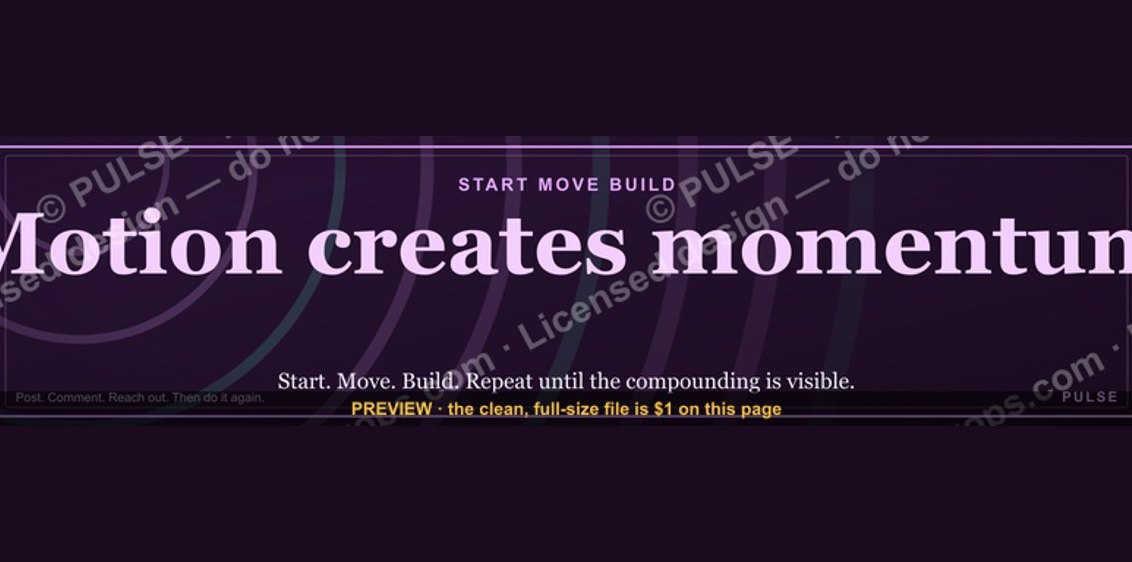 graphic“Motion creates momentum.” — LinkedIn Banner
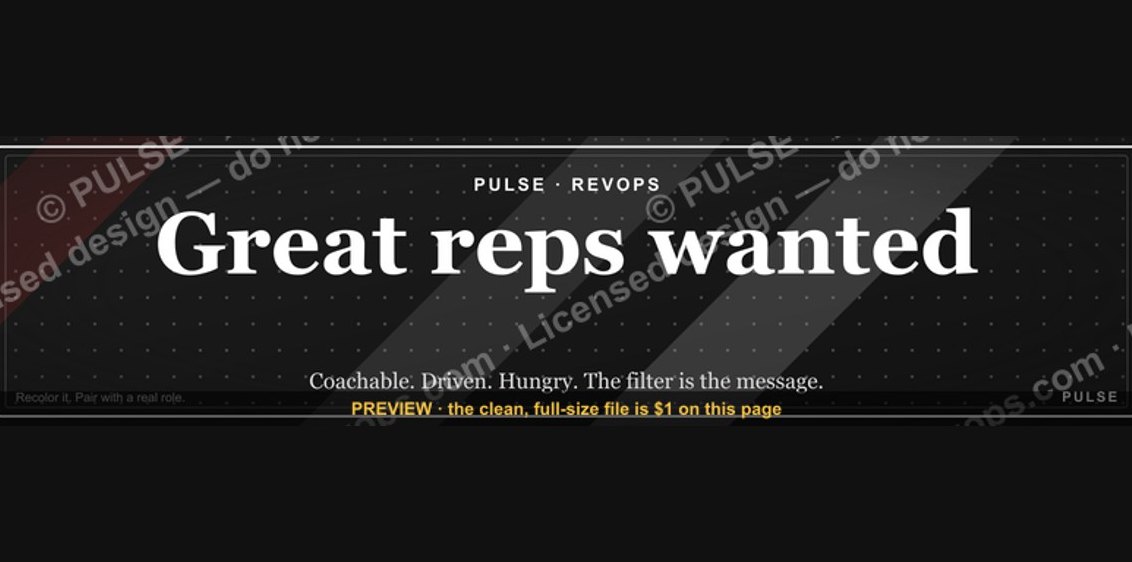 graphic“Great reps wanted.” — LinkedIn Banner
 graphic“Bring the energy every call.” — LinkedIn Banner