 Pulse Reviews and Analysis
Sales-assisted PLG for mid-market in 2027
 Curated by Kory White · Fractional CRO, CRO Syndicate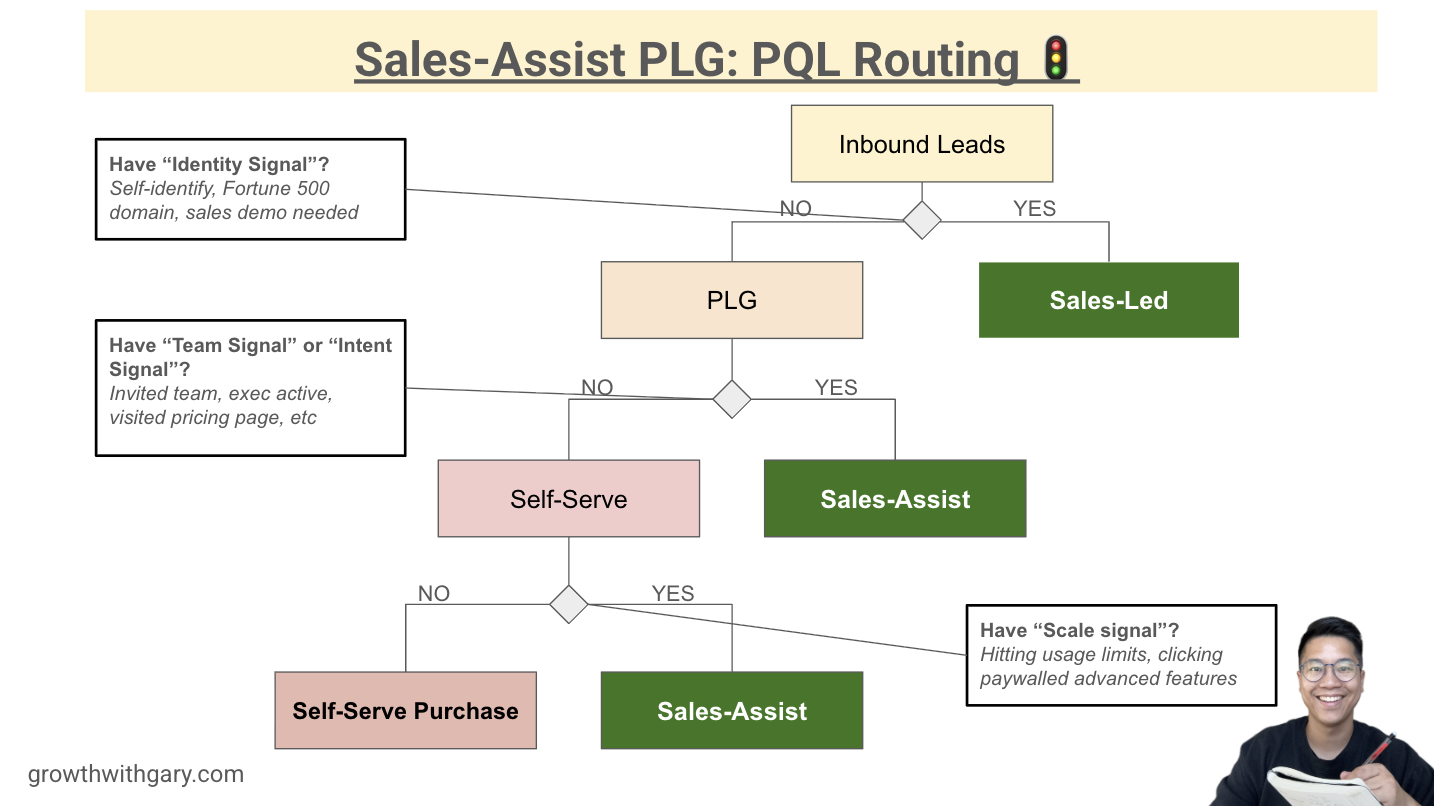
Direct Answer
A sales-assisted PLG motion for mid-market combines product-led growth with a light sales layer aimed at the mid-market segment — companies large enough to warrant human attention but too numerous and fast-moving for a heavy enterprise sales process. Users discover and adopt the product through self-serve (free trial, freemium, or low-friction signup), and sales steps in selectively when a usage or account signal indicates an opportunity to expand, convert a team, or close a larger deal.
The product does the initial selling; sales accelerates and enlarges deals the product surfaces. In 2027 it is operationalized with product analytics like Amplitude and Mixpanel, product-qualified-lead scoring via Pocus or Endgame, and CRM workflows in HubSpot or Salesforce.
Success is measured by PQL-to-paid conversion, expansion revenue, sales efficiency, and net revenue retention in the mid-market band.
Why Mid-Market Needs a Hybrid Motion
Pure self-serve leaves money on the table in mid-market: these accounts will pay more and adopt more broadly with a little human guidance, but they do not justify the cost or the months-long cycle of full enterprise sales. Pure enterprise sales, conversely, is too expensive and slow for the volume of mid-market accounts.
The hybrid motion threads the needle: let the product acquire and activate cheaply, then apply sales surgically where data shows it will pay off. The product de-risks and pre-qualifies; sales converts intent into larger commitments.
The art is timing and selectivity — engaging the right accounts at the right moment, not blasting every signup or ignoring high-intent usage.
Define the Product-Qualified Lead (PQL)
The motion lives or dies on a sharp definition of a product-qualified lead — a user or account whose in-product behavior signals readiness to buy or expand. Build the PQL from signals such as:
- Activation depth — reaching key value milestones in the product.
- Usage intensity — frequency and breadth of use.
- Team spread — multiple users from the same company adopting.
- Firmographic fit — the account matches the mid-market ICP.
- Approaching limits — hitting plan caps that imply a need to upgrade.
A user who merely signed up is not a PQL; a user whose team is actively hitting value and bumping limits is. Sharp PQL criteria keep sales focused on accounts likely to convert.
Instrument Signals and Route to Sales
You cannot run sales-assisted PLG without product instrumentation. Required pieces:
- Product analytics — Amplitude or Mixpanel to capture activation and usage events.
- PQL scoring — Pocus or Endgame to combine product signals with firmographic data and score accounts.
- CRM integration — push qualified accounts and their usage context into HubSpot or Salesforce so reps act with full visibility.
The handoff must carry context: the rep should see what the account has done in the product so the first conversation is relevant, not a cold pitch. A blind handoff wastes the product's pre-qualification.

👉 Book a 20-minute call with Kory White, Fractional CRO · Connect on LinkedIn · CRO Syndicate
Right-Size the Sales Engagement
Mid-market reps in this motion are not enterprise AEs running six-month cycles. They are efficient, high-velocity sellers who:
- Engage warm — accounts already using and valuing the product.
- Expand and upgrade — convert individuals to teams, move accounts to paid or higher tiers, sell annual commitments.
- Move fast — short cycles measured in days or weeks, not quarters.
- Stay lean — one rep handles many accounts, leaning on product-led activation for the early work.
Compensation and quotas should reward expansion and conversion of product-sourced accounts, reinforcing the motion rather than driving reps to chase cold outbound.
Blend Automation With Human Touch
Not every account warrants a rep. Below the PQL threshold, automation does the work: in-product prompts, lifecycle email, and self-serve upgrade paths nurture users toward value and conversion. Sales focuses on the high-value, high-intent slice.
This blend keeps customer-acquisition cost low while capturing the upside that only human selling unlocks in mid-market deals.
Customer success then sustains the relationship, driving the expansion and retention that make the economics work over time.
Metrics for the Motion
Grade sales-assisted PLG on:
- PQL-to-paid conversion — how well product signals predict closed revenue.
- Expansion / upsell revenue — growth within product-sourced accounts.
- Sales efficiency — revenue per rep and CAC payback, which should beat pure enterprise sales.
- Net revenue retention — durable mid-market expansion.
- Time from PQL to close — velocity of the assisted motion.
FAQ
What is sales-assisted PLG? A hybrid motion where users adopt a product self-serve and sales engages selectively when usage or account signals show an opportunity to expand or close a larger deal, letting the product do the initial selling and sales accelerate it.
Why is it well-suited to mid-market? Mid-market accounts will pay more with light human guidance but do not justify a full enterprise sales cycle, so combining cheap product-led acquisition with surgical sales engagement captures upside efficiently.
What is a product-qualified lead? A user or account whose in-product behavior — activation depth, usage intensity, team adoption, fit, and hitting limits — signals readiness to buy or expand, making it worth a salesperson's time, unlike a plain signup.
What tools power the motion? Product analytics like Amplitude or Mixpanel to capture usage, PQL scoring tools like Pocus or Endgame to identify ready accounts, and CRM such as HubSpot or Salesforce to route accounts with full context to reps.
How should the sales handoff work? Sales should receive the account's full product context so the first conversation is relevant and warm; a blind handoff wastes the qualification the product already performed and lowers conversion.
Related on PULSE
- PLG-to-sales-assist handoff playbook in 2027
- Usage-based pricing GTM motion in 2027
- Land-and-expand net revenue retention motion in 2027